
Report Feature
Speech Pathology Service Market Trends and Forecast
The future of the global speech pathology service market looks promising with opportunities in the hospitals, specialty clinics, rehabilitation centers, and speech therapy centers markets. The global speech pathology service market is expected to grow with a CAGR of 4.3% from 2025 to 2031. The major drivers for this market are increasing incidence of speech and language disorders, advancements in speech pathology technologies, and rising incidence of neurological disorders and stroke. Lucintel forecasts that, within the type category, speech disorders will remain the largest segment over the forecast period due to speech disorders include issues with articulation, fluency, and voice disorders. Within the application category, hospitals will remain the largest segment due to hospitals provide comprehensive care for patients with a wide range of speech. In terms of region, North America will remain the largest region over the forecast period due to presence of a large number of speech therapists and well-funded healthcare systems. Gain valuable insights for your business decisions with our comprehensive 150+ page report. Sample figures with some insights are shown below.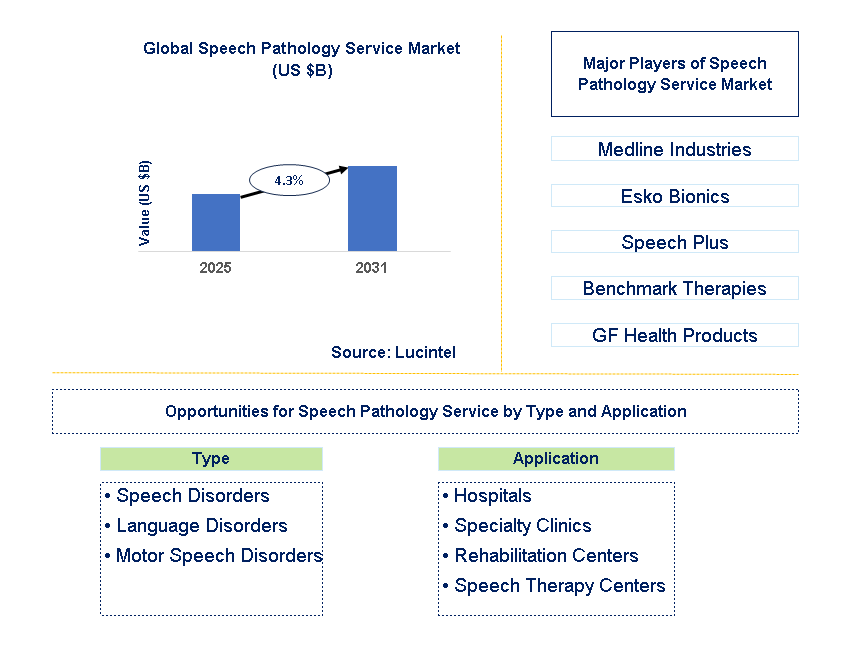
Speech Pathology Service Market by Segment
• AI and Machine Learning Integration: Artificial intelligence (AI) and machine learning are revolutionizing speech pathology services by enabling more precise diagnostics and personalized therapy. AI-powered software is used to analyze speech patterns, detect disorders, and track improvements over time. These tools help clinicians create tailored therapy plans and provide real-time feedback to patients. The integration of AI into speech therapy practices is expected to increase treatment efficacy and reduce the time needed to achieve therapeutic goals, improving outcomes for patients with complex conditions.
• Pediatric Speech Therapy Demand: With an increasing awareness of developmental speech and language disorders in children, pediatric speech therapy is emerging as a key growth area. Early diagnosis and intervention are being emphasized, leading to an increase in demand for specialized pediatric speech pathologists. Disorders such as autism spectrum disorder (ASD), speech delays, and language impairments are being diagnosed at younger ages, prompting parents to seek professional care early on. This trend is driving an increase in pediatric-focused speech therapy services and the development of specialized tools for young children.
• Aging Population and Geriatric Speech Therapy: The aging population is significantly contributing to the demand for speech pathology services, particularly in addressing conditions related to aging such as dysphagia, aphasia, and voice disorders. With an increasing number of elderly people, especially in developed nations like Japan, the need for geriatric speech therapy is on the rise. Speech therapists are playing a crucial role in improving the quality of life for elderly patients by helping them recover or manage speech and swallowing difficulties, which are common in neurodegenerative diseases like Parkinson’s disease and stroke recovery.
• Integration of Multidisciplinary Care: Speech pathology services are increasingly being integrated into multidisciplinary healthcare teams. This approach enables speech therapists to work closely with other healthcare providers, including physicians, occupational therapists, and psychologists, to deliver holistic care. By collaborating with other professionals, speech pathologists can address complex cases, such as neurological disorders and developmental delays, in a more comprehensive manner. The integration of services is also helping improve patient outcomes by ensuring that all aspects of a patient’s health are considered during treatment. The speech pathology services market is being reshaped by several key trends, including the rise of teletherapy, AI integration, and a greater emphasis on pediatric and geriatric speech therapy. As technology continues to advance, the accessibility and effectiveness of speech therapy will improve, enabling more personalized care. Additionally, the growing recognition of the importance of early intervention and multidisciplinary approaches is pushing speech pathologists to work more collaboratively. These trends are not only expanding the market but also enhancing the quality of care for individuals with speech and language disorders." src="Emerging Trends in the Speech Pathology Service Market" style="height: auto;width: auto;" title="The speech pathology service market is influenced by several emerging trends that are reshaping the way speech therapy is delivered and experienced. Technological innovations such as AI, teletherapy, and digital diagnostics are driving significant changes in service delivery. Additionally, there is an increased focus on early diagnosis and intervention, the aging population’s needs, and integrated multidisciplinary care. Below are five key trends that are significantly impacting the market.
• Teletherapy and Virtual Speech Therapy: Teletherapy is one of the most transformative trends in the speech pathology services market. Enabled by digital platforms and video conferencing tools, teletherapy allows patients to receive speech therapy remotely, breaking down geographic barriers and increasing access to care. This trend has particularly flourished post-COVID-19, with patients in rural and underserved areas now able to access high-quality therapy. For speech therapists, teletherapy platforms also offer the benefit of scheduling flexibility and ease of integration with other healthcare services.
• AI and Machine Learning Integration: Artificial intelligence (AI) and machine learning are revolutionizing speech pathology services by enabling more precise diagnostics and personalized therapy. AI-powered software is used to analyze speech patterns, detect disorders, and track improvements over time. These tools help clinicians create tailored therapy plans and provide real-time feedback to patients. The integration of AI into speech therapy practices is expected to increase treatment efficacy and reduce the time needed to achieve therapeutic goals, improving outcomes for patients with complex conditions.
• Pediatric Speech Therapy Demand: With an increasing awareness of developmental speech and language disorders in children, pediatric speech therapy is emerging as a key growth area. Early diagnosis and intervention are being emphasized, leading to an increase in demand for specialized pediatric speech pathologists. Disorders such as autism spectrum disorder (ASD), speech delays, and language impairments are being diagnosed at younger ages, prompting parents to seek professional care early on. This trend is driving an increase in pediatric-focused speech therapy services and the development of specialized tools for young children.
• Aging Population and Geriatric Speech Therapy: The aging population is significantly contributing to the demand for speech pathology services, particularly in addressing conditions related to aging such as dysphagia, aphasia, and voice disorders. With an increasing number of elderly people, especially in developed nations like Japan, the need for geriatric speech therapy is on the rise. Speech therapists are playing a crucial role in improving the quality of life for elderly patients by helping them recover or manage speech and swallowing difficulties, which are common in neurodegenerative diseases like Parkinson’s disease and stroke recovery.
• Integration of Multidisciplinary Care: Speech pathology services are increasingly being integrated into multidisciplinary healthcare teams. This approach enables speech therapists to work closely with other healthcare providers, including physicians, occupational therapists, and psychologists, to deliver holistic care. By collaborating with other professionals, speech pathologists can address complex cases, such as neurological disorders and developmental delays, in a more comprehensive manner. The integration of services is also helping improve patient outcomes by ensuring that all aspects of a patient’s health are considered during treatment. The speech pathology services market is being reshaped by several key trends, including the rise of teletherapy, AI integration, and a greater emphasis on pediatric and geriatric speech therapy. As technology continues to advance, the accessibility and effectiveness of speech therapy will improve, enabling more personalized care. Additionally, the growing recognition of the importance of early intervention and multidisciplinary approaches is pushing speech pathologists to work more collaboratively. These trends are not only expanding the market but also enhancing the quality of care for individuals with speech and language disorders." />
Emerging Trends in the Speech Pathology Service Market
Recent Development in the Speech Pathology Service Market
Recent developments in the speech pathology service market highlight the increasing demand for speech therapy and the role of technological innovation in improving service delivery. Advancements in digital platforms, AI-based diagnostic tools, and teletherapy services are reshaping how patients access and receive care. As healthcare systems focus on improving service accessibility and quality, these developments offer significant growth opportunities. Below are five key developments that are currently shaping the market.• Telehealth and Virtual Speech Therapy Expansion: Telehealth has become one of the most significant developments in the speech pathology service market. The COVID-19 pandemic accelerated the adoption of virtual speech therapy, and many healthcare providers have continued to expand these services even post-pandemic. Virtual therapy not only increases access for patients in remote areas but also reduces the need for physical visits, making therapy more convenient and cost-effective. This trend is expected to continue, with more telehealth platforms being integrated into healthcare systems, especially in rural or underserved areas.
• AI and Speech Recognition Software in Diagnostics: The integration of AI and speech recognition software into speech pathology is revolutionizing diagnosis and treatment. These technologies can help speech pathologists identify patterns in speech data, detect disorders like stuttering, dysphasia, or aphasia, and track patients’ progress. AI-powered diagnostic tools also enable real-time analysis, improving the speed and accuracy of assessments. This development enhances the ability of clinicians to provide personalized treatment plans and improves patient outcomes by allowing for quicker intervention.
• Increasing Integration with Multidisciplinary Teams: Speech pathology services are increasingly becoming part of integrated multidisciplinary care teams, particularly for patients with complex conditions. For example, in stroke rehabilitation, speech therapists are working alongside neurologists, physical therapists, and occupational therapists to provide comprehensive care. This integrated approach ensures that all aspects of a patient’s health are addressed and improves outcomes by offering a holistic view of patient needs. The move toward multidisciplinary care is expanding the role of speech pathologists and creating new collaboration opportunities.
• Growth in Pediatric Speech Pathology Services: The rising awareness of speech and language disorders in children is driving the growth of pediatric speech pathology services. Early intervention is critical in addressing speech delays, developmental disabilities, and language impairments. With increased access to pediatric therapy services, parents are becoming more proactive in seeking help for their children. Additionally, new technologies tailored to young patients, such as apps and interactive digital tools, are being introduced, improving engagement and therapy outcomes.
• Focus on Geriatric Speech Therapy: An aging population, particularly in developed countries, is driving the demand for geriatric speech pathology services. Conditions such as dysphagia, aphasia, and speech-related issues caused by neurological diseases (e.g., Alzheimer’s and Parkinson’s disease) are becoming more common. Speech therapists are playing a vital role in helping elderly patients maintain their quality of life by offering therapies that focus on improving speech, swallowing, and cognitive functions. This focus is leading to increased investment in geriatric speech therapy services. The speech pathology service market is undergoing a major transformation, with advancements in telehealth, AI integration, and a growing focus on pediatric and geriatric care. These developments are improving access, efficiency, and effectiveness of therapy services across various patient groups. As these trends continue, the market will see sustained growth, enhanced patient outcomes, and the evolution of speech pathology services to meet the demands of a rapidly changing healthcare landscape.
Strategic Growth Opportunities in the Speech Pathology Service Market
The speech pathology services market is poised for significant growth as the demand for speech and language therapy continues to rise, driven by an aging population, increasing awareness of speech disorders, and advances in technology. As healthcare systems evolve and new therapeutic approaches emerge, there are multiple growth opportunities across key applications. These opportunities are expanding access to speech pathology services, improving treatment outcomes, and enhancing patient engagement. Below are five key growth opportunities in the speech pathology service market, each highlighting the potential impact in different segments of the industry.• Expansion of Teletherapy Services: Teletherapy represents one of the largest growth opportunities in the speech pathology services market. With the rise of telehealth platforms, speech pathologists can deliver services remotely, allowing for greater access to therapy, especially in rural and underserved areas. Teletherapy also increases convenience for patients, reducing barriers like transportation or time constraints. During the COVID-19 pandemic, teletherapy services grew exponentially, and now many healthcare providers are making these services permanent. This growth opportunity is expected to continue, as virtual therapy can provide personalized care, meet patient preferences, and improve therapy compliance.
• Early Intervention Programs for Pediatric Speech Disorders: Early intervention is critical for addressing pediatric speech and language disorders, which is driving a significant growth opportunity in this segment. Awareness around the importance of early speech therapy is increasing among parents and educators. Conditions such as speech delays, stuttering, and developmental speech disorders are being diagnosed at younger ages, prompting a surge in demand for specialized pediatric speech therapists. Early intervention not only improves speech development but can also prevent more severe long-term effects, positioning this market as a key area for investment. Advances in technology, including apps and interactive digital tools, are further enhancing engagement and outcomes.
• Aging Population and Geriatric Speech Therapy: The global aging population presents another major growth opportunity for speech pathology services, particularly for elderly patients with age-related speech disorders. Conditions such as aphasia, dysphagia (swallowing disorders), and voice disorders are common in the elderly, especially those recovering from strokes, neurological diseases, or dementia. As the number of older adults increases, demand for geriatric speech pathology services is rising. This growth opportunity is further fueled by healthcare initiatives focused on improving the quality of life for older patients. Speech pathologists are playing an increasingly important role in supporting elderly patients through rehabilitation and speech recovery.
• Integration of Artificial Intelligence and Digital Tools: Artificial intelligence (AI) and digital tools are transforming the speech pathology service market by enhancing diagnostics, treatment plans, and patient monitoring. AI-powered speech recognition software and machine learning algorithms are being integrated into clinical practices, allowing for more accurate and timely diagnosis of speech disorders. Additionally, digital tools like speech therapy apps and virtual training programs are expanding access to therapy, especially for homebound patients. The integration of AI and digital tools is expected to reduce costs, improve treatment efficacy, and streamline operations for speech therapists, driving growth in this segment.
• Multidisciplinary Approaches in Stroke and Neurological Rehabilitation: The integration of speech pathology services into multidisciplinary teams is opening new growth opportunities in neurological rehabilitation, particularly for stroke patients. Speech therapists are working alongside other specialists such as neurologists, physiotherapists, and occupational therapists to provide a holistic approach to rehabilitation. In stroke recovery, speech pathologists help patients regain speech, language, and swallowing functions, which are often impacted. As the emphasis on integrated care grows in healthcare systems worldwide, this collaborative approach is driving demand for speech therapy services. This opportunity extends to other neurological conditions like Parkinson’s disease and brain injuries. The speech pathology service market is expanding rapidly across several key applications. Teletherapy, early intervention for pediatric speech disorders, geriatric speech therapy, AI integration, and multidisciplinary care are shaping the future of this market. These opportunities are improving accessibility, efficiency, and effectiveness of therapy services. As the demand for specialized care increases and technological innovations continue to evolve, speech pathology services are becoming an integral part of healthcare systems globally. Providers who can adapt to these growth opportunities will be well-positioned to capitalize on the market’s ongoing expansion.
Speech Pathology Service Market Driver and Challenges
The speech pathology services market is influenced by various technological, economic, and regulatory factors. Technological advancements, the growing awareness of speech disorders, and healthcare policy reforms are all contributing to the expansion of the market. However, challenges such as regulatory hurdles, economic constraints, and workforce shortages continue to impact service delivery and growth. Below are five key drivers and three challenges that are currently shaping the speech pathology services market. The factors responsible for driving the Speech Pathology Service market include: 1. Technological Advancements: Technological advancements, particularly in teletherapy and AI, are one of the biggest drivers of growth in the speech pathology services market. AI-powered diagnostic tools, speech recognition software, and virtual platforms are improving diagnostic accuracy, treatment personalization, and patient engagement. Teletherapy, which became more prevalent during the COVID-19 pandemic, has become a permanent fixture in the market, allowing for increased access to care. As these technologies continue to evolve, they will likely drive further innovation and efficiency in service delivery, making therapy more effective and accessible. 2. Aging Population: The aging global population is a major driver for the speech pathology services market. Age-related speech disorders such as aphasia, dysphagia, and cognitive-communication disorders are increasingly common among elderly individuals. The demand for speech therapy services is growing as the number of elderly patients needing rehabilitation and speech recovery continues to rise. This demographic shift is putting pressure on healthcare systems to expand services for the elderly, especially for conditions related to neurological disorders and strokes, creating significant growth potential for speech pathology. 3. Growing Awareness of Speech and Language Disorders: Increasing awareness of speech and language disorders is driving demand for speech pathology services. As awareness rises among parents, educators, and healthcare professionals, more individuals are seeking diagnosis and treatment for speech disorders at an earlier stage. This early intervention is crucial for children with speech delays, language impairments, or developmental disorders. Public health campaigns and educational initiatives are further raising awareness, which is resulting in a higher rate of diagnoses and subsequently increasing demand for qualified speech pathologists. 4. Government and Healthcare System Support: Government initiatives and healthcare system reforms are also contributing to the growth of speech pathology services. In many countries, healthcare policies now support greater access to speech therapy, especially in underserved or rural regions. Telemedicine regulations have been relaxed in several regions, making it easier for patients to access speech therapy remotely. In addition, more insurance companies are covering speech therapy services, increasing affordability for patients and expanding the market. These supportive measures help ensure the accessibility and affordability of speech pathology services. 5. Increased Focus on Preventive Healthcare: As healthcare systems move toward preventive care models, the focus on early diagnosis and intervention for speech disorders is expanding. Speech pathology is increasingly being integrated into preventive healthcare programs, especially for children and at-risk populations. Early diagnosis of speech and language disorders can reduce the long-term impact of these conditions, promoting better educational outcomes and quality of life. Preventive healthcare policies are encouraging the inclusion of speech pathology services in broader health plans, fostering market growth in this area. Challenges in the Speech Pathology Service market are: 1. Workforce Shortage: One of the major challenges facing the speech pathology services market is the shortage of qualified professionals. There is a growing demand for speech pathologists, but the supply of trained professionals is not keeping up. This shortage is particularly evident in rural or underserved regions where access to speech therapy services is limited. Training programs are struggling to meet the increasing demand, and high turnover rates in the field further exacerbate this issue. The shortage of qualified professionals is limiting the ability of healthcare systems to meet the rising demand for speech therapy services. 2. Regulatory and Reimbursement Challenges: Regulatory barriers and reimbursement policies pose challenges for speech pathology services. In some regions, the lack of clear telehealth regulations has created uncertainties for service providers, particularly for cross-border teletherapy. Furthermore, insurance coverage for speech therapy services varies by region and policy, making it difficult for some patients to afford care. Inconsistent reimbursement rates and restrictions on the types of services covered can also limit the growth potential of speech pathology services, especially for private providers. 3. Economic Constraints: Economic factors also present a challenge for the growth of speech pathology services. While awareness and demand for speech therapy are rising, the cost of therapy can be a barrier for some patients, particularly those without insurance coverage or in lower-income groups. Additionally, healthcare budgets in many regions are constrained, which can lead to limited access to services, particularly for underserved populations. Economic constraints can also affect investment in new technologies and innovations within the speech pathology services sector, potentially limiting advancements in care delivery. The speech pathology services market is experiencing growth driven by technological advancements, an aging population, increased awareness, government support, and a greater focus on preventive healthcare. However, challenges such as workforce shortages, regulatory uncertainties, and economic constraints are hindering the sector’s ability to meet the growing demand for services. Addressing these challenges, through better workforce training, clearer regulations, and improved funding mechanisms, will be crucial to sustaining the market’s growth and ensuring that speech pathology services are accessible and effective for all patients.List of Speech Pathology Service Companies
Companies in the market compete on the basis of product quality offered. Major players in this market focus on expanding their manufacturing facilities, R&D investments, infrastructural development, and leverage integration opportunities across the value chain. With these strategies speech pathology service companies cater increasing demand, ensure competitive effectiveness, develop innovative products & technologies, reduce production costs, and expand their customer base. Some of the speech pathology service companies profiled in this report include-• Medline Industries
• Esko Bionics
• Speech Plus
• Benchmark Therapies
• GF Health Products
Speech Pathology Service Market by Segment
The study includes a forecast for the global speech pathology service market by type, application, and region.Speech Pathology Service Market by Type [Value from 2019 to 2031]:
• Speech Disorders
• Language Disorders
• Motor Speech Disorders
Speech Pathology Service Market by Application [Value from 2019 to 2031]:
• Hospitals
• Specialty Clinics
• Rehabilitation Centers
• Speech Therapy Centers
Speech Pathology Service Market by Region [Value from 2019 to 2031]:
• North America
• Europe
• Asia Pacific
• The Rest of the World
Country Wise Outlook for the Speech Pathology Service Market
The speech pathology service market is undergoing significant transformation, driven by advancements in healthcare technology, increased awareness of speech-related disorders, and evolving patient needs across various regions. In developed markets like the U.S. and Germany, teletherapy and AI-driven diagnostic tools are becoming more prevalent, while emerging markets like China and India are witnessing rapid growth due to expanding healthcare access and awareness. As the demand for speech therapy services rises, each country is adapting to address unique challenges and opportunities. Below, we explore key developments in the speech pathology service market across the U.S., China, Germany, India, and Japan.• United States: In the U.S., the speech pathology services market is evolving rapidly, with teletherapy becoming a major trend, especially after the COVID-19 pandemic. Healthcare providers are increasingly leveraging digital platforms to offer remote services, improving access to therapy for patients in rural or underserved areas. Additionally, advancements in artificial intelligence (AI) and machine learning are enhancing diagnostic accuracy and personalized therapy plans. With a growing elderly population and increased recognition of speech disorders such as aphasia and dysphagia, the demand for speech pathologists continues to grow. U.S. healthcare policy reforms are also supporting telemedicine and home-based speech therapy services, further driving market expansion.
• China: China’s speech pathology services market is witnessing rapid growth, driven by a rising awareness of speech and language disorders, especially among children. The government’s focus on improving healthcare accessibility and education has led to an increased demand for speech therapists across the country. Telemedicine has also started to gain traction, allowing for more widespread access to speech therapy services in rural areas. In addition, as China continues to modernize its healthcare system, there has been a growing emphasis on early intervention and therapy for speech-related conditions in both children and adults, contributing to market growth.
• Germany: Germany has seen a steady increase in the demand for speech pathology services, with the aging population driving growth in speech therapy for age-related conditions like dysphagia and aphasia. Technological integration, such as AI-based speech recognition software, is helping to improve therapeutic outcomes by offering real-time feedback. Moreover, Germany’s healthcare system is highly advanced, allowing for better insurance coverage for speech therapy services, which has increased patient access to these services. The growing recognition of speech therapy’s role in improving quality of life for individuals with neurological conditions is another factor supporting market growth.
• India: In India, the speech pathology services market is expanding rapidly, driven by increasing awareness of speech and language disorders and improvements in healthcare access. The rise in pediatric speech disorders, coupled with a growing middle-class population, has significantly increased demand for speech therapy services. While speech pathology services in urban areas are thriving, rural regions are gradually catching up due to the government’s focus on improving healthcare infrastructure. Furthermore, telehealth services are gaining popularity, allowing patients in remote areas to access speech therapy without needing to travel long distances.
• Japan: Japan’s speech pathology services market is growing due to the country’s aging population and increasing need for elderly care, particularly in addressing age-related speech issues like aphasia and voice disorders. Japan’s healthcare system is embracing the integration of digital tools, including telemedicine and AI-powered speech therapy applications, to meet growing demand. The government’s focus on healthcare reforms and increasing recognition of speech therapy’s importance in improving elderly patients’ quality of life has also led to an expanded market. As awareness of speech disorders in children increases, there is also a rise in demand for pediatric speech therapy services.

Features of the Global Speech Pathology Service Market
Market Size Estimates: Speech pathology service market size estimation in terms of value ($B). Trend and Forecast Analysis: Market trends (2019 to 2024) and forecast (2025 to 2031) by various segments and regions. Segmentation Analysis: Speech pathology service market size by type, application, and region in terms of value ($B). Regional Analysis: Speech pathology service market breakdown by North America, Europe, Asia Pacific, and Rest of the World. Growth Opportunities: Analysis of growth opportunities in different type, application, and regions for the speech pathology service market. Strategic Analysis: This includes M&A, new product development, and competitive landscape of the speech pathology service market. Analysis of competitive intensity of the industry based on Porter’s Five Forces model.
FAQ
Q1. What is the growth forecast for speech pathology service market? Answer: The global speech pathology service market is expected to grow with a CAGR of 4.3% from 2025 to 2031. Q2. What are the major drivers influencing the growth of the speech pathology service market? Answer: The major drivers for this market are increasing incidence of speech and language disorders, advancements in speech pathology technologies, and rising incidence of neurological disorders and stroke. Q3. What are the major segments for speech pathology service market? Answer: The future of the speech pathology service market looks promising with opportunities in the hospitals, specialty clinics, rehabilitation centers, and speech therapy centers markets. Q4. Who are the key speech pathology service market companies? Answer: Some of the key speech pathology service companies are as follows:• Medline Industries
• Esko Bionics
• Speech Plus
• Benchmark Therapies
• GF Health Products Q5. Which speech pathology service market segment will be the largest in future? Answer: Lucintel forecasts that speech disorders will remain the largest segment over the forecast period due to speech disorders include issues with articulation, fluency, and voice disorders. Q6. In speech pathology service market, which region is expected to be the largest in next 5 years? Answer: North America will remain the largest region over the forecast period due to presence of a large number of speech therapists and well-funded healthcare systems. Q7. Do we receive customization in this report? Answer: Yes, Lucintel provides 10% customization without any additional cost.
Table of Contents
Methodology
- In-depth interviews of the major players in this market
- Detailed secondary research from competitors’ financial statements and published data
- Extensive searches of published works, market, and database information pertaining to industry news, company press releases, and customer intentions
- A compilation of the experiences, judgments, and insights of Lucintel’s professionals, who have analyzed and tracked this market over the years.


Buy Now
Choose a license that fits your team. Instant PDF delivery.
Prices exclude taxes. Instant delivery. Custom licensing available on request.
Key Questions
- • What are some of the most promising, high-growth opportunities for the speech pathology service market by type (speech disorders, language disorders, and motor speech disorders), application (hospitals, specialty clinics, rehabilitation centers, and speech therapy centers), and region (North America, Europe, Asia Pacific, and the Rest of the World)?
- • Which segments will grow at a faster pace and why?
- • Which region will grow at a faster pace and why?
- • What are the key factors affecting market dynamics? What are the key challenges and business risks in this market?
- • What are the business risks and competitive threats in this market?
- • What are the emerging trends in this market and the reasons behind them?
- • What are some of the changing demands of customers in the market?
- • What are the new developments in the market? Which companies are leading these developments?
- • Who are the major players in this market? What strategic initiatives are key players pursuing for business growth?
- • What are some of the competing products in this market and how big of a threat do they pose for loss of market share by material or product substitution?
- • What M&A activity has occurred in the last 5 years and what has its impact been on the industry? For any questions related to Speech Pathology Service Market, Speech Pathology Service Market Size, Speech Pathology Service Market Growth, Speech Pathology Service Market Analysis, Speech Pathology Service Market Report, Speech Pathology Service Market Share, Speech Pathology Service Market Trends, Speech Pathology Service Market Forecast, Speech Pathology Service Companies, write Lucintel analyst at email: helpdesk@lucintel.com. We will be glad to get back to you soon.


