
Market Report · July 31, 2026

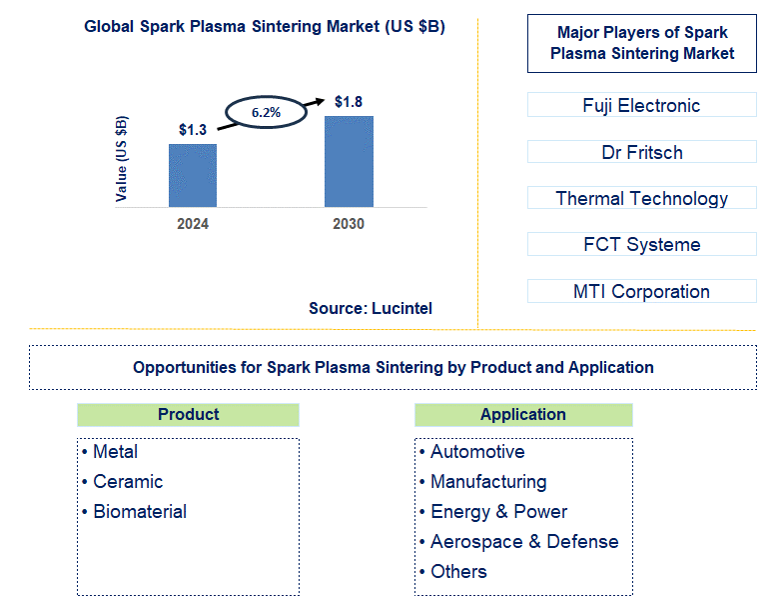
Key data points: The market size in 2030 = $1.83 billion, growth forecast = 6.2% annually for the next 6 years. Scroll below to get more insights. This market report covers trends, opportunities, and forecasts in the global spark plasma sintering market to 2030 by product (metal, ceramic, and biomaterial), application (automotive, manufacturing, energy & power, aerospace & defense, and others), and region (North America, Europe, Asia Pacific, and the Rest of the World)
We'll send your sample report shortly.
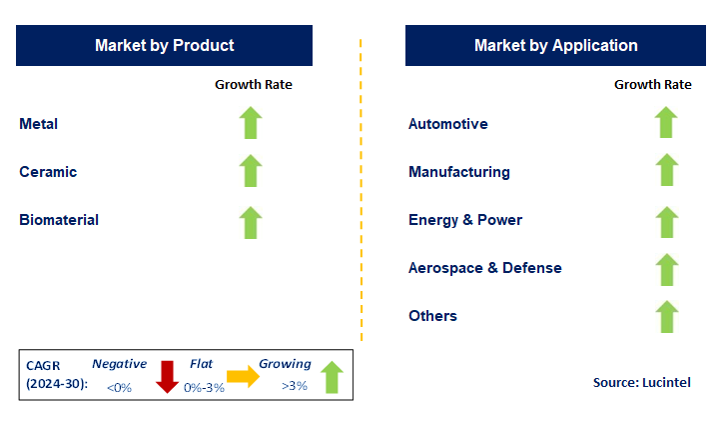
• Lucintel forecasts that, within the product category, metal is expected to witness the highest growth over the forecast period.
• Within the application category, automotive will remain the largest segment.
• In terms of regions, APAC is expected to witness the highest growth over the forecast period. Gain valuable insights for your business decisions with our comprehensive 150+ page report.
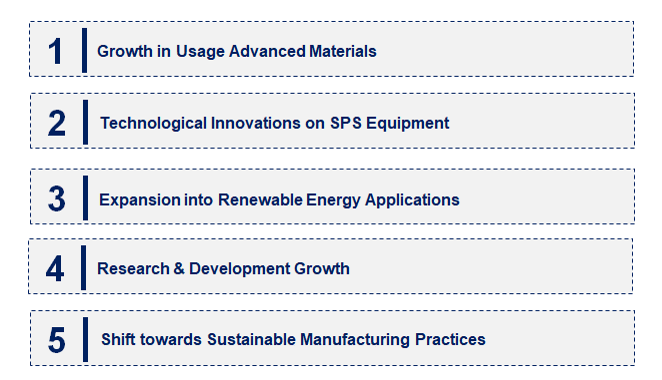
• Growth in Usage Advanced Materials: Automotive and aerospace industries are now demanding advanced materials such as magnesium matrix composites and ceramics. For instance, these materials offer lightweightness together with high strength aspects compared to other materials used in automotive industry or aerospace engineering. It can be produced through the adoption of SPS since its density can be increased up to the level required for performance in harsh environments.
• Technological Innovations on SPS Equipment: Recent technological innovations in spark plasma sintering equipment have enhanced the efficiency and capabilities of the sintering process. These include control system upgrades, hybrid heating mechanisms as well as real-time integration into monitoring devices. As a result, manufacturers will be able to optimize their parameters for sintering hence reducing cycle times and leading to improved material properties thus making SPS more competitive vis-à-vis other forms of sintering.
• Expansion into Renewable Energy Applications: SPS is increasingly being applied within the renewable energy sector, particularly in the fabrication of energy storage/conversion materials. Via creating electrodes that are capable of performing at extremely high levels coupled with components applicable while producing battery systems or fuel cells respectively, SPS has made itself indispensable when it comes to adopting sustainable energy solutions. It also corresponds to the need for green approaches during manufacturing processes.
• Research & Development Growth: There has been a significant increase in research and development activities around SPS technology driven by both educational institutions and industry players. The objective of this study is to explore new materials and applications, improve process understanding, as well as develop new SPS systems. This emphasis on patents and scientific papers that relate to the field represents its importance in the progress of material science as an engineering discipline.
• Shift towards Sustainable Manufacturing Practices: Spark plasma sintering technique fits well within the global shift towards sustainability in manufacturing. In comparison to traditional methods, SPS has reduced waste generation processes thus energy efficient making it attractive for companies that are conscious about the environment. Thus, this new trend shifts the market focus from industries whose priority is sustainable practices hence increasing its attractiveness for manufacturers and growth prospects. Emerging trends in the spark plasma sintering market are reshaping technological advancements, expanding applications, and aligning with sustainability goals which make them important components for this analysis. For instance, the adoption of SPS will grow with more industries appreciating its benefits leading to innovations that will improve material properties and production efficiency. All these trends will make SPS one of the most critical technologies for advanced materials manufacturing going forward.
• Advanced Materials: For instance, scientists are now able to use SPS for manufacturing advanced materials such as nanocomposites, nanostructured ceramics, and functional materials. This opens up other possibilities for research and development in areas like electronics, energy storage systems as well as biomedical applications.
• Process Optimization: The researchers and engineers have therefore concentrated on optimizing several parameters of the SPS process including temperature, pressure, pulse duration, etc. so that they achieve the desired material features. Thus this has improved control over microstructure; besides it increased density and mechanical performance.
• Scalability: Some efforts have been directed towards making the scaling-up of SPS technologies possible in industrial production enabling not only larger component fabrication but also higher material volumes production. As a result of this efficiency which is cost-effective, the manufacturers prefer using SPS technology more than ever before.
• Integration with Other Techniques: What is more exciting about this approach is that it can be combined with other processes such as additive manufacturing or infiltration to generate complex multifunctional materials. Consequently, this brings various uses of sintering into operation by enhancing its versatility.
• Environmental Sustainability: In addition to the provided environmental benefits like lower emissions and reduced energy consumption compared with conventional sintering techniques. Hence industries seeking to minimize their impacts on the environment may consider opting for this method of sintering because it will be effective for them at long last. Thus these advancements work together to propel growth in the spark plasma sintering market globally. With an ability to produce advanced materials having specific properties along with enhanced process effectiveness and scalability levels ‘SPS’ now represents an essential tool for researchers, engineers, and manufacturers. Consequently, SPS technology is likely to become a critical component in the future of materials science and engineering as it continues to evolve.
• Precision Manufacturing for Advanced Ceramics: SPS is an important process in manufacturing advanced ceramics with better mechanical properties. The ability to control temperature and pressure at high precision makes it possible to produce highly dense ceramics with the smallest grain sizes needed for electronics and cutting tools. This has a great impact on industries as far as improving product performance and prolonging the life cycle of ceramic parts is concerned.
• Battery Materials with High Performance: In the energy storage industry, SPS technology supports the production of battery materials with enhanced performance characteristics like high energy density properties. As a result of improving electrical conductivity and enhancing such features as the capacity of storing charge, SPS remains a key link in developing the next generations of batteries. In this way, advancement changes battery efficiency within renewable energy sources alongside electric cars ensuring their general viability regarding storage.
• Customizable Implants & Prosthetics in Biomaterials: Within medical practice, there are numerous chances for growth provided by SPS in the production of biomaterials employed for creating implants together with prosthetic devices. It helps generate dense biocompatible substances having customized properties that make personalized medication apparatuses designed. At the same time, it addresses implant functionality and durability concerns facing the health sector while promoting positive outcomes among patients thereby increasing the adoption rate of biomaterials made using SPS.
• Exceptional Nanomaterials Properties: SPS represents an indispensable method when it comes to the fabrication of nanomaterials exhibiting unusual qualities such as increased strength, hardness, or even enhanced thermal stability. The possibility of preservation of the nanoscale structures during the sintering process opens up new perspectives for electronics, coatings, and catalyst applications. This opportunity enables the production of materials with improved performance thus encouraging innovations and enlarging nanotechnology possibilities in different industries.
• Light Weight and High-Strength Alloys for Aerospace Components: The aerospace field takes advantage of SPS to produce strong lightweight alloys. SPS can be used to control microstructures in a precise manner that yields materials matching the stringent requirements for aerospace applications like turbine blades or structural elements. Through this, the weight is reduced in the aerospace industry as a way of increasing fuel economy and enhancing aircraft performance and safety aspects. These strategic growth opportunities demonstrate how SPS is transforming industries by enabling the production of advanced materials with superior properties. The impact that SPS has on various sectors including advanced ceramics, energy storage, biomaterials, nanomaterials, and aerospace components is profound since it drives innovation as well as improves product performance across various market niches.
• Fuji Electronic
• Dr Fritsch
• Thermal Technology
• FCT Systeme
• MTI Corporation
• Shanghai Haoyue
• Elenix
• Toshniwal Instruments Madras
• Sinter
• Metal
• Ceramic
• Biomaterial
• Automotive
• Manufacturing
• Energy & Power
• Aerospace & Defense
• Others
• North America
• Europe
• Asia Pacific
• The Rest of the World
• United States: The US has invested much in the SPS process using AI that incorporates machine learning to optimize material properties as well as cut down production duration. Recent partnerships between research institutions and businesses have focused on commercializing new materials produced through SPS. The DOE has also funded several projects which aim at the large-scale implementation of SPS industrial processes mainly in the automotive industry and aerospace.
• China: The country has invested heavily in SPS technology because it requires high-performance materials used for defense purposes and electronics. A lot of Chinese government funds have been directed towards various research undertakings oriented at improving capabilities inherent in SPS technology including high-temperature ceramics design. In addition, Chinese manufacturers team up with their overseas counterparts to upgrade SPS equipment and expand their markets globally, particularly within the Asia-Pacific region.
• Germany: Energy-efficient methods of sintering cheaply that do not pollute the environment are being developed in Germany. The German researchers are following green manufacturing guidelines whereby they have devised ways to make carbon-free spark plasma sintering systems by harnessing renewable energy resources and reusing heat from waste products. Examples include some current projects aiming at lightweight but strong structures; hence contributing to the development of automotive as well aerospace industries which drive this type of technology most in Germany. Availability of funding support from the German government hence propels innovations in advanced manufacturing within the country further fueling advancement related to SPS processes.
• India: This developing country’s academic institutions have increasingly adopted SPS technology for purposes of coming up with such modern materials required in electronics and defense. To this end, the Indian government has initiated some programs that would assist them develop local producers of SPS equipment to reduce over-dependence on foreign ones. Having stated that there are joint ventures between academicians and industry players who aim at making SPS technology efficient and scalable hence India is seen as a new entrant into the global market of Spark Plasma Sintering.
• Japan: Japan is a leader in using SPS, paying much attention to accuracy and novelty. The Japanese scientists are now looking into the new scopes where spark plasma sintering can be utilized particularly in the medical sector or semi-conductor industry for instance; being able to create extremely fine-grained materials possessing better mechanical properties. As a result, Japan continues to be recognized as one of the world’s major frontiers of this method with the emphasis being on sustainable high-performance substances and a strong industrial base along with consistent investments into R&D.


• Fuji Electronic
• Dr Fritsch
• Thermal Technology
• FCT Systeme
• MTI Corporation
• Shanghai HaoYue
• Elenix
• Toshniwal Instruments Madras
• Sinter Q6. Which spark plasma sintering market segment will be the largest in future? Answer: Lucintel forecast that metal is expected to witness the highest growth over the forecast period. Q7. In spark plasma sintering market, which region is expected to be the largest in next 5 years? Answer: APAC is expected to witness the highest growth over the forecast period. Q.8 Do we receive customization in this report? Answer: Yes, Lucintel provides 10% customization without any additional cost.


Choose a license that fits your team. Instant PDF delivery.
Prices exclude taxes. Instant delivery. Custom licensing available on request.
Market Report · July 31, 2026
Market Report · July 22, 2026
Market Report · July 20, 2026
Trusted partner for strategic intelligence and business growth


Receive a complimentary market analysis tailored to your industry. Our analysts will identify key growth opportunities and competitive dynamics specific to your business.

Market size, growth rate, and key trend analysis for your specific sector.

Top competitor positioning and market share analysis.

Strategic recommendations backed by data-driven insights.
Get curated market intelligence and competitive moves straight to your inbox.
By subscribing, you agree to receive our monthly insights. Unsubscribe anytime.
Receive a complimentary market analysis tailored to your industry. Our analysts will identify key growth opportunities and competitive dynamics specific to your business.
Market size, growth rate, and key trend analysis for your specific sector.
Top competitor positioning and market share analysis.
Strategic recommendations backed by data-driven insights.
Get curated market intelligence, emerging trends, and competitive moves straight to your inbox each month.
By subscribing, you agree to receive our monthly insights. Unsubscribe anytime.
We'll send your sample report shortly.