
Report Feature
Space Robotic Market Trends and Forecast
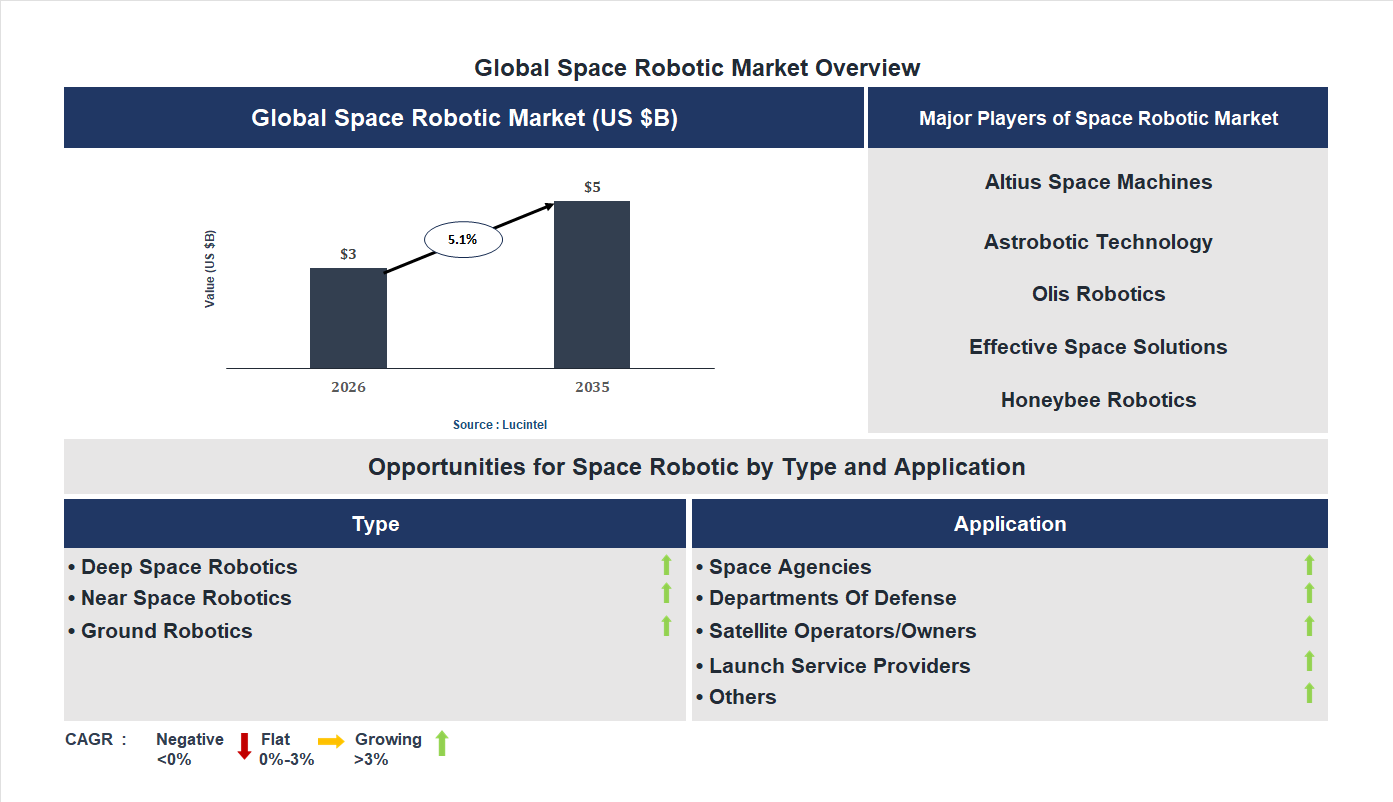
The future of the global space robotic market looks promising with opportunities in the space agency, department of defense, satellite operators/owner, and launch service provider markets. The global space robotic market is expected to reach an estimated $5 billion by 2035 with a CAGR of 5.1% from 2026 to 2035. The major drivers for this market are the increasing investments in space exploration missions, the rising demand for satellite servicing robotics, and the growing adoption of autonomous space technologies.• Lucintel forecasts that, within the type category, deep space robotic is expected to witness the highest growth over the forecast period.
• Within the application category, space agency is expected to witness the highest growth.
• In terms of region, APAC is expected to witness the highest growth over the forecast period. Gain valuable insights for your business decisions with our comprehensive 150+ page report. Sample figures with some insights are shown below.
Emerging Trends in the Space Robotic Market
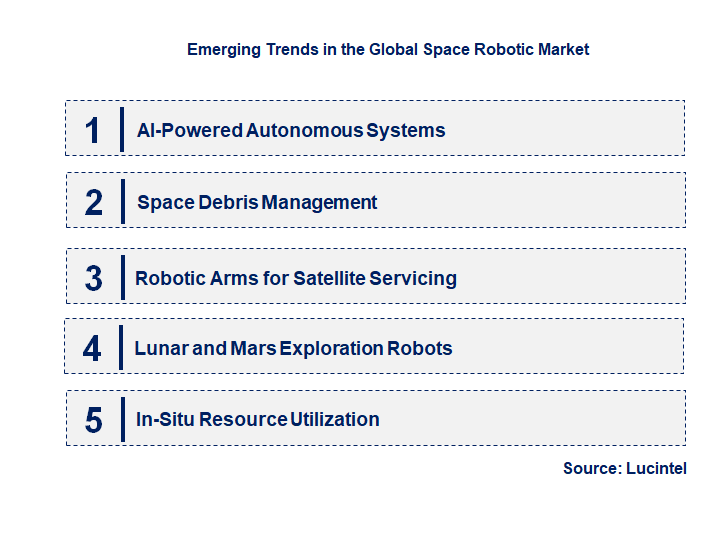
The space robotic market is driven by innovations in autonomous systems, AI, and multi-functional robotic technologies that reduce the need for human intervention in space operations. These trends are enhancing space exploration, satellite servicing, and space station management.• AI-Powered Autonomous Systems: AI is enabling space robots to operate autonomously, navigate harsh environments, and make decisions without direct human intervention. This is improving efficiency in space missions, especially for long-duration exploration like Mars and deep-space probes.
• Space Debris Management: Robotics are playing a crucial role in managing space debris. Autonomous robots are being developed to capture and remove defunct satellites and other debris in Earths orbit, mitigating collision risks. These robots improve space traffic management and the safety of space operations.
• Robotic Arms for Satellite Servicing: Robotic arms equipped with AI and precise control systems are becoming essential for satellite maintenance and repair. These robots can extend satellite lifespans by repairing or upgrading them while in orbit, reducing costs for satellite operators.
• Lunar and Mars Exploration Robots: Robotic systems are being designed to conduct exploration on the Moon and Mars. These autonomous robots will gather data, perform experiments, and prepare for human habitation. They’re also crucial for testing new technologies in extreme environments.
• In-Situ Resource Utilization (ISRU): Robotics are increasingly being used for resource extraction on celestial bodies, such as the Moon and Mars. These systems will help harvest materials for future space missions, potentially reducing the need to transport resources from Earth. These trends are reshaping how space exploration and operations are conducted, making missions more efficient and less reliant on human intervention.
Recent Developments in the Space Robotic Market
Recent advancements in space robotic market are largely driven by the growing demand for more sophisticated and autonomous systems for space exploration, maintenance, and infrastructure. Here are the key developments reshaping the market.• Advanced Robotic Systems for Lunar Exploration: Robotic systems capable of operating on the Moon are under development, with a focus on autonomous rovers and robots that will explore lunar terrain, perform geological analysis, and assist in the construction of infrastructure.
• AI and Machine Learning Integration: The integration of AI and machine learning algorithms in space robots is helping improve autonomous decision-making capabilities. These systems can make real-time decisions during exploration, maintenance, and other critical tasks, making operations more efficient.
• Commercial Space Robotics: Private companies are contributing significantly to space robotics, with firms like SpaceX and Blue Origin working on developing robotic technologies for satellite servicing, cargo transport, and other commercial space operations. This collaboration is accelerating innovation in the field.
• Multi-Function Robotic Arms: Robotic arms are evolving from single-use tools to multi-functional devices. They can now perform tasks like spacecraft assembly, satellite repairs, and even assisting astronauts. This versatility is enhancing the scope of space missions.
• Autonomous Satellites and Spacecraft: Autonomous robots are now being designed for spacecraft and satellite maintenance. These robots can adjust orbits, monitor spacecraft conditions, and perform repairs without human intervention, reducing mission costs and increasing satellite lifespan. These developments are advancing space exploration capabilities, reducing reliance on human intervention, and enabling more cost-effective missions.
Strategic Growth Opportunities in the Space Robotic Market
The space robotic market offers substantial growth opportunities across various applications, particularly in exploration, satellite servicing, and resource management. These opportunities are aligned with the increasing commercial and government investments in space infrastructure.• Lunar Exploration: Space robots designed for lunar exploration are in high demand. These robots will carry out geological surveys, sample collection, and assist in infrastructure development for future manned missions to the Moon.
• Satellite Servicing and Repair: With the increasing reliance on satellites for communication, navigation, and weather monitoring, robotic systems are being developed to service and repair satellites. This will extend the lifespan of satellites, reducing the cost of replacement and improving operational continuity.
• Deep-Space Missions: Robotic systems designed for deep-space exploration are rapidly advancing. These robots will conduct missions to distant planets, asteroids, and comets. With advancements in AI and autonomous navigation, deep-space exploration is becoming increasingly feasible.
• Space Debris Removal: As the amount of space debris increases, robotic technologies for debris removal are becoming more critical. Autonomous robots that can capture and deorbit defunct satellites and debris are expected to become essential for space traffic management.
• In-Situ Resource Utilization (ISRU): Robots capable of extracting resources from celestial bodies like the Moon and Mars present a significant growth opportunity. These systems will harvest materials to support future space missions, reducing the need for Earth-based resources. These growth opportunities reflect the expanding role of robots in enabling sustainable and cost-effective space exploration and infrastructure development.
Space Robotic Market Driver and Challenges
The space robotic market is influenced by various drivers such as technological advancements, increasing space exploration initiatives, and growing space industry investment. However, the market also faces several challenges including high development costs and regulatory hurdles. The factors responsible for driving the space robotic market include:• Technological Innovation: Advances in AI, robotics, and autonomous systems are driving the growth of space robotics, making missions more cost-effective and efficient.
• Rising Investment in Space Exploration: Increased government and private sector investments in space exploration and infrastructure are creating a strong demand for robotic systems.
• Space Industry Expansion: The rapid expansion of the space industry, including satellite services, space tourism, and lunar exploration, is pushing the need for advanced robotics.
• Commercial Space Initiatives: Private companies’ investments in space robotics, such as SpaceX’s reusable spacecraft, are accelerating the growth of robotic applications.
• International Collaboration: The collaboration between countries and agencies like NASA, ESA, and private firms is driving shared innovations in space robotics. The challenges facing the space robotic market include:
• High Development Costs: The high costs associated with the design, manufacturing, and testing of space robots are a major barrier for smaller companies and governments.
• Technical Limitations: Developing robots that can withstand the harsh conditions of space, including extreme temperatures and radiation, remains a challenge.
• Regulatory and Ethical Concerns: Regulatory frameworks and ethical issues surrounding the use of autonomous robots in space exploration are a hurdle to widespread adoption. The space robotic market is poised for significant growth driven by technological innovations and increasing space exploration, though challenges like high development costs and regulatory obstacles must be overcome for broader adoption.
List of Space Robotic Companies
Companies in the market compete on the basis of product quality offered. Major players in this market focus on expanding their manufacturing facilities, R&D investments, infrastructural development, and leverage integration opportunities across the value chain. With these strategies space robotic companies cater increasing demand, ensure competitive effectiveness, develop innovative products & technologies, reduce production costs, and expand their customer base. Some of the space robotic companies profiled in this report include-• Altius Space Machines
• Astrobotic Technology
• Olis Robotics
• Effective Space Solutions
• Honeybee Robotics
• iSpace
• Made in Space
• Maxar Technologies
• Metecs
• Northrop Grumman
Space Robotic Market by Segment
The study includes a forecast for the global space robotic market by type, application, and region.Space Robotic Market by Type [Value from 2019 to 2035]:
• Deep Space Robotics
• Near Space Robotics
• Ground Robotics
Space Robotic Market by Application [Value from 2019 to 2035]:
• Space Agencies
• Departments Of Defense
• Satellite Operators/Owners
• Launch Service Providers
• Others
Space Robotic Market by Region [Value from 2019 to 2035]:
• North America
• Europe
• Asia Pacific
• The Rest of the World
Country Wise Outlook for the Space Robotic Market
The space robotic market is experiencing rapid growth, driven by advancements in autonomous systems, AI, and satellite servicing technologies. Countries like the United States, China, Germany, India, and Japan are leading the charge in developing robotics for space exploration, satellite maintenance, and debris removal. These innovations are transforming the role of robots in space, with each nation focusing on specific aspects of space robotics to enhance their space programs.• United States: The United States is driving space robotics advancements through NASA’s Artemis program, focusing on autonomous rovers, robotic arms, and systems for lunar exploration and satellite servicing. With AI integration, these robots will assist in constructing lunar bases and conducting long-term missions on the moon and Mars.
• China: China is advancing its space robotics through the Yutu rover series, which has been crucial for moon exploration. The country is developing autonomous systems for resource extraction and scientific research, positioning itself as a key player in deep space exploration with future lunar base construction in focus.
• Germany: Germany is working on robotic arms and satellite servicing systems in collaboration with the European Space Agency (ESA). Their focus on energy efficiency and integration with European space initiatives is strengthening the market, enhancing robot interoperability for satellite repairs and in-orbit assembly.
• India: India’s ISRO is focused on cost-effective space robotics solutions for lunar exploration, including the Chandrayaan rover. These robots are crucial for exploring the moon’s surface and assisting in satellite servicing, helping India make significant strides in space robotics at a fraction of the cost of traditional missions.
• Japan: Japan’s JAXA is leading innovation in robotic arms and autonomous systems for lunar exploration and satellite servicing. Their emphasis on precision robotics and miniaturization is improving robot efficiency and reliability, enabling smoother operations in space exploration and debris removal.

Features of the Global Space Robotic Market
Market Size Estimates: Space robotic market size estimation in terms of value ($B). Trend and Forecast Analysis: Market trends (2019 to 2025) and forecast (2026 to 2035) by various segments and regions. Segmentation Analysis: Space robotic market size by type, application, and region in terms of value ($B). Regional Analysis: Space robotic market breakdown by North America, Europe, Asia Pacific, and Rest of the World. Growth Opportunities: Analysis of growth opportunities in different types, applications, and regions for the space robotic market. Strategic Analysis: This includes M&A, new product development, and competitive landscape of the space robotic market. Analysis of competitive intensity of the industry based on Porter’s Five Forces model.
FAQ
Q1. What is the space robotic market size? Answer: The global space robotic market is expected to reach an estimated $5 billion by 2035. Q2. What is the growth forecast for space robotic market? Answer: The global space robotic market is expected to grow with a CAGR of 5.1% from 2026 to 2035. Q3. What are the major drivers influencing the growth of the space robotic market? Answer: The major drivers for this market are the increasing investments in space exploration missions, the rising demand for satellite servicing robotics, and the growing adoption of autonomous space technologies. Q4. What are the major segments for space robotic market? Answer: The future of the space robotic market looks promising with opportunities in the space agency, department of defense, satellite operators/owner, and launch service provider markets. Q5. Who are the key space robotic market companies? Answer: Some of the key space robotic companies are as follows:• Altius Space Machines
• Astrobotic Technology
• Olis Robotics
• Effective Space Solutions
• Honeybee Robotics
• iSpace
• Made in Space
• Maxar Technologies
• Metecs
• Northrop Grumman Q6. Which space robotic market segment will be the largest in future? Answer: Lucintel forecasts that, within the type category, deep space robotic is expected to witness the highest growth over the forecast period. Q7. In space robotic market, which region is expected to be the largest in next 8 years? Answer: In terms of region, APAC is expected to witness the highest growth over the forecast period. Q8. Do we receive customization in this report? Answer: Yes, Lucintel provides 10% customization without any additional cost.
Table of Contents
List of Figures
List of Tables
Methodology
- In-depth interviews of the major players in this market
- Detailed secondary research from competitors’ financial statements and published data
- Extensive searches of published works, market, and database information pertaining to industry news, company press releases, and customer intentions
- A compilation of the experiences, judgments, and insights of Lucintel’s professionals, who have analyzed and tracked this market over the years.


Buy Now
Choose a license that fits your team. Instant PDF delivery.
Prices exclude taxes. Instant delivery. Custom licensing available on request.
Key Questions
- • What are some of the most promising, high-growth opportunities for the space robotic market by type (deep space robotics, near space robotics, and ground robotics), application (space agencies, departments of defense, satellite operators/owners, launch service providers, and others), and region (North America, Europe, Asia Pacific, and the Rest of the World)?
- • Which segments will grow at a faster pace and why?
- • Which region will grow at a faster pace and why?
- • What are the key factors affecting market dynamics? What are the key challenges and business risks in this market?
- • What are the business risks and competitive threats in this market?
- • What are the emerging trends in this market and the reasons behind them?
- • What are some of the changing demands of customers in the market?
- • What are the new developments in the market? Which companies are leading these developments?
- • Who are the major players in this market? What strategic initiatives are key players pursuing for business growth?
- • What are some of the competing products in this market and how big of a threat do they pose for loss of market share by material or product substitution?
- • What M&A activity has occurred in the last 5 years and what has its impact been on the industry? For any questions related to Space Robotic Market, Space Robotic Market Size, Space Robotic Market Growth, Space Robotic Market Analysis, Space Robotic Market Report, Space Robotic Market Share, Space Robotic Market Trends, Space Robotic Market Forecast, Space Robotic Companies, write Lucintel analyst at email: helpdesk@lucintel.com. We will be glad to get back to you soon.


