
Market Report · July 22, 2026

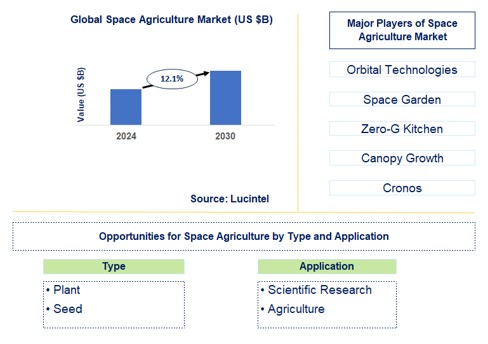
Key data points: The growth forecast = 12.1% annually next 6 years. Scroll below to get more insights. This market report covers trends, opportunities, and forecast in the global space agriculture market to 2030 by type (plant and seed), application (scientific research and agriculture), and region (North America, Europe, Asia Pacific, and the Rest of the World)
We'll send your sample report shortly.
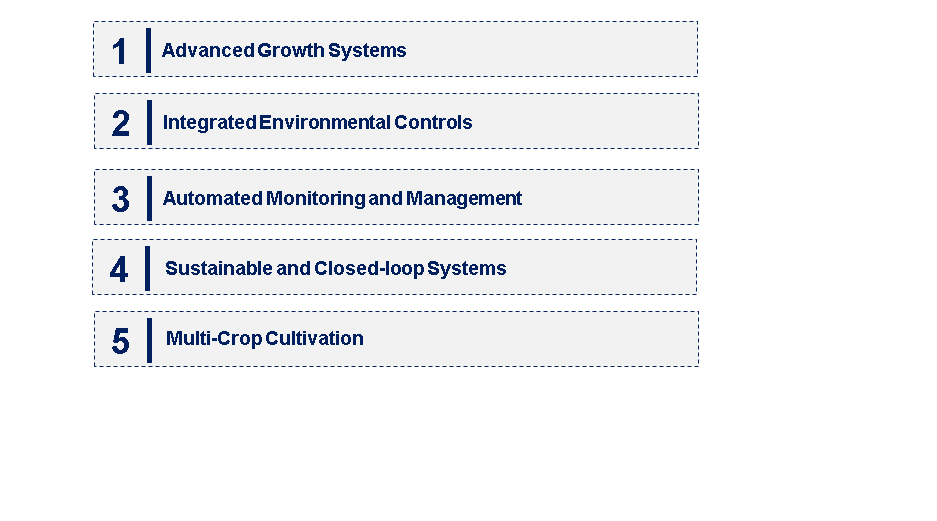
• Advanced Growth Systems: Sophisticated means hydrogenation like aeroponics are becoming more common place within this field which is in turn bringing change. These are nutrient efficient which besides, optimize growth condition and are crucial for long space missions.
• Integrated Environmental Controls: Presently, the field of space agriculture has moved into more sophisticated environmental controls that see to temperature, humidity and CO2 levels. This integrated system ensures maximum plant growth even under harsh space conditions.
• Automated Monitoring and Management: Monitoring and managing individual plants automatically are becoming rather common these days. Robotics and Artificial Intelligence help in assessing plant conditions on real-time basis thus enhancing productivity with minimum human labor input.
• Sustainable and Closed-loop Systems: The development of closed-loop systems that recycle water and nutrients is ongoing. This will ensure resource-use efficiency as well as waste reduction hence making it possible for agro-space to be sustainable.
• Multi-Crop Cultivation: Nowadays most of our attention is drawn towards cultivating multiple crop varieties at once. This move seeks to broaden the base of foodstuffs available while addressing nutritional concerns during long-term space trips. Thus, these trends are shifting the Space Agriculture market by increasing its efficiency, sustainability, flexibility thereby making space farming viable for extended travels beyond earth or colonization in other planets.
• Veggie Plant Growth System (NASA): Recently, the veggie system of NASA has undergone a few changes that are meant to improve plant growth in ISS. Some of these improvements include; better LED lights and nutrient management leading to increased crop yields in low gravity.
• Tiangong Space Station (China): China’s Tiangong space station has now been fitted with advanced plant growth facilities. This seems promising for long-term space missions as demonstrated by recent experiments on rice and wheat.
• DLR Research Initiatives (Germany): Germany’s DLR has brought new media into play and introduced automated systems for growing plants in the ISS. These were aimed at improving plant health monitoring and optimizing growth conditions.
• ISRO Hydroponics Research (India): Over time, the focus of ISRO method was directed towards hydroponic systems which have greatly enabled plants grow in spaces. The idea behind developing advanced growth chambers is to provide support for deep-space missions ahead.
• JAXA’s Kibo Laboratory (Japan): JAXA’s Kibo laboratory has made it possible to grow different crops on the ISS including some recent projects designed to refine space farming techniques supporting moon and mars mission. Therefore, these developments show a lot of progress towards space agriculture which makes it more feasible growing food in space while supporting long term human space exploration.
• In-Situ Resource Utilization (ISRU): Making use of available resources in space such as lunar soil or Martian regolith for cultivation is a great opportunity. This reduces resupply missions needs and supports sustainability in terms of habitation at other locations within the solar system.
• Advanced Growth Chambers: Advanced growth chambers with precise environmental control enable the growing of different varieties of crops. These chambers are important in supporting long-term missions and colonizing other planets.
• Automated Cultivation Systems: Ploughing, monitoring and harvesting through automated systems can enhance efficiency and reduce labour needs. It is these systems that guarantee continuous crop production in space.
• Research in Crop Varieties: Therefore, developing new crop varieties thriving under those conditions should be a priority. Consequently, this research will lead to production of more nutritious and adaptable plants to cater for various dietary preferences.
• Closed-Loop Nutrient Systems: Implementing nutrient cycling within closed loop water recycling system is one way to achieve sustainable space agriculture practice. This minimizes waste and ensures effective use of resources for further space mission planning purposes. All these growth opportunities drive innovations in the field of space agriculture making it more sustainable, efficient and resilient leading to successful long-term space exploration as well as habitation.
• Orbital Technologies Corporation
• Space Garden
• Zero-G Kitchen
• Canopy Growth Corporation
• Cronos
• SpaceX
• AeroFarms
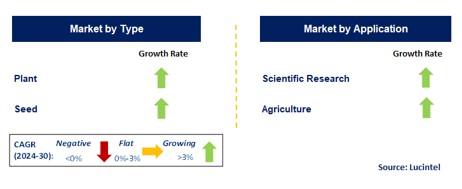
• Plant
• Seed
• Scientific Research
• Agriculture
• North America
• Europe
• Asia Pacific
• The Rest of the World
• USA: NASA has pioneered in this area with the Veggie plant growth system on board the International Space Station (ISS). Recently, there have been improvements in LED lighting and nutrient delivery systems that facilitate plant growth and productivity under microgravity conditions.
• China: China made notable progress through its Tianwen missions and space stations. There are advanced facilities at Tiangong space station to grow crops like rice and wheat. The latest focus is on optimizing growth conditions and expanding the set of plants available to support long-duration manned missions.
• Germany: Germany’s DLR has been doing research on cultivating plants inside ISS. Recent developments include testing of new growth substrates and automated monitoring systems for plant health. All these attempts aim at improving sustainability of space agriculture and contribute to ESA projects.
• India: ISRO’s Indian Space Program has recently concentrated on technology development for growing plants in space. Their studies involve use of hydroponic systems plus advanced growth chambers. The objective is to provide future deep-space explorations with necessary foods while establishing protocols for farming in outer space.
• Japan: JAXA, Japan's space agency is actively involved in Kibo laboratory inside ISS where it does experiments related to Agriculture in Space. They have been part of various projects including cultivation of diverse crops; as well as developing methods that could be used during mars mission or lunar gateway stations.
• Orbital Technologies Corporation
• Space Garden
• Zero-G Kitchen
• Canopy Growth Corporation
• Cronos
• SpaceX
• AeroFarms Q5. Which space agriculture market segment will be the largest in future? Answer: Lucintel forecasts that seed will remain the larger segment over the forecast period due to the growing necessity to tailor crops to the distinctive challenges presented by space environment. Q6. In space agriculture market, which region is expected to be the largest in next 5 years? Answer: North America will remain the largest region over the forecast period due to the presence of a strong ecosystem comprising space agencies, private space companies, and research institutions, fostering innovation and expertise in controlled environment agriculture technologies. Q7. Do we receive customization in this report? Answer: Yes, Lucintel provides 10% customization without any additional cost.


Choose a license that fits your team. Instant PDF delivery.
Prices exclude taxes. Instant delivery. Custom licensing available on request.
Market Report · July 22, 2026
Market Report · July 22, 2026
Market Report · July 22, 2026
Trusted partner for strategic intelligence and business growth


Receive a complimentary market analysis tailored to your industry. Our analysts will identify key growth opportunities and competitive dynamics specific to your business.

Market size, growth rate, and key trend analysis for your specific sector.

Top competitor positioning and market share analysis.

Strategic recommendations backed by data-driven insights.
Get curated market intelligence and competitive moves straight to your inbox.
By subscribing, you agree to receive our monthly insights. Unsubscribe anytime.
Receive a complimentary market analysis tailored to your industry. Our analysts will identify key growth opportunities and competitive dynamics specific to your business.
Market size, growth rate, and key trend analysis for your specific sector.
Top competitor positioning and market share analysis.
Strategic recommendations backed by data-driven insights.
Get curated market intelligence, emerging trends, and competitive moves straight to your inbox each month.
By subscribing, you agree to receive our monthly insights. Unsubscribe anytime.
We'll send your sample report shortly.