
Market Report · July 22, 2026

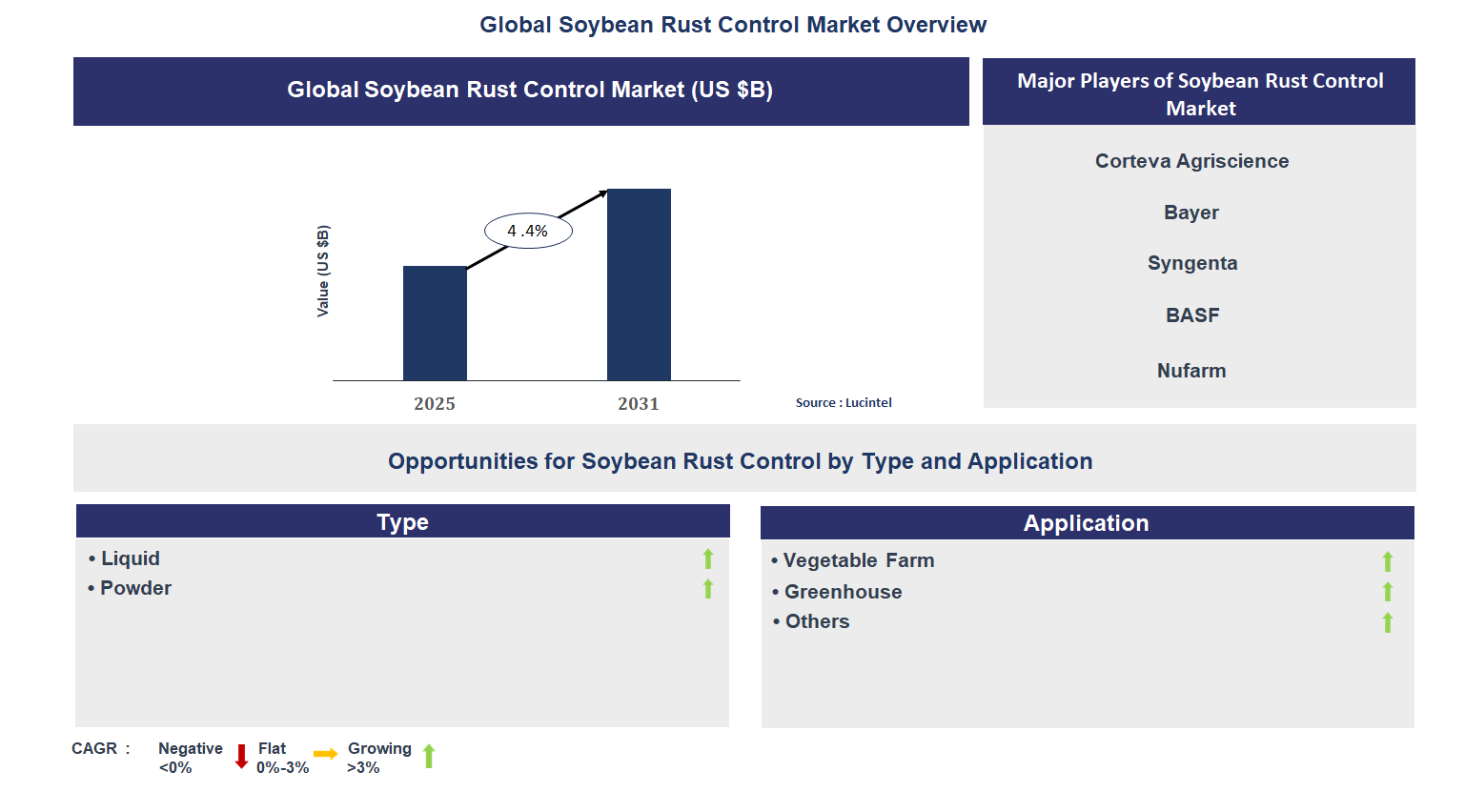
Key data points: The growth forecast = 4.4% annually for the next 7 years. Scroll below to get more insights. This market report covers trends, opportunities and forecasts in soybean rust control market to 2031 by type (liquid and powder), application (vegetable farm, greenhouse, and others), and region (North America, Europe, Asia Pacific, and the Rest of the World)
We'll send your sample report shortly.
• Lucintel forecasts that, within the type category, liquid is expected to witness higher growth over the forecast period.
• Within the application category, greenhouse is expected to witness higher growth.
• In terms of region, APAC is expected to witness the highest growth over the forecast period. Gain valuable insights for your business decisions with our comprehensive 150+ page report. Sample figures with some insights are shown below.
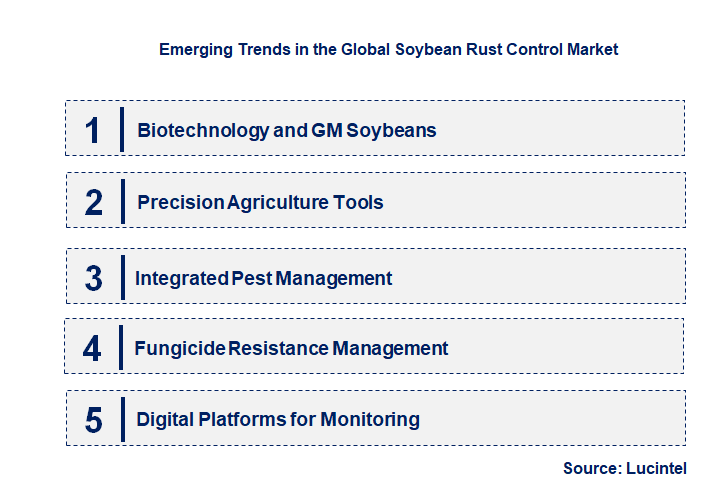
• Biotechnology and GM Soybeans: Genetically modified soybeans with enhanced resistance to rust are increasingly being developed and adopted. These innovations are aimed at reducing the need for fungicides and improving yields, offering a long-term solution to soybean rust.
• Precision Agriculture Tools: The use of precision agriculture technologies, such as drones, GPS, and weather-based models, is gaining traction. These tools help farmers detect early rust outbreaks and apply fungicides more accurately, improving control and minimizing chemical use.
• Integrated Pest Management: The adoption of IPM strategies, combining biological control, resistant varieties, and targeted chemical applications, is growing globally. IPM helps reduce reliance on chemical fungicides and promotes a more sustainable approach to rust management.
• Fungicide Resistance Management: As fungicide resistance becomes a concern in some regions, the focus is shifting toward fungicide resistance management strategies. These include rotating fungicide classes and combining chemical treatments with biological controls to reduce resistance buildup.
• Digital Platforms for Monitoring: The integration of digital platforms and mobile apps for monitoring and forecasting rust outbreaks is revolutionizing soybean rust management. These platforms provide farmers with real-time data, enhancing decision-making and the timing of rust control measures. These emerging trends are transforming the soybean rust control market by making disease management more efficient, sustainable, and data-driven. Innovations in biotechnology, precision agriculture, and integrated pest management are improving the resilience of soybean crops and reducing the reliance on chemical treatments, leading to more sustainable farming practices globally.
• Development of Resistant Soybean Varieties: Significant progress is being made in developing soybean varieties resistant to rust. These varieties reduce the need for chemical interventions and offer a long-term solution to the problem, increasing yield stability and reducing production costs.
• Advanced Fungicide Formulations: New fungicides with enhanced systemic properties are being developed. These formulations provide better protection against soybean rust and are more effective in controlling the disease, even in cases of fungicide resistance.
• Improved Early Detection Systems: Advances in remote sensing, weather forecasting, and digital platforms are enabling early detection of soybean rust outbreaks. Farmers can now detect infections earlier, leading to more targeted treatments and improved management of the disease.
• Shift Towards Sustainable Practices: There is a growing shift towards sustainable soybean rust control practices, including the adoption of IPM, biological controls, and organic fungicides. These methods aim to reduce the environmental impact of traditional chemical treatments while maintaining high crop yields.
• Global Collaboration and Research: Collaborative efforts between governments, academic institutions, and the private sector are driving research on soybean rust control. These collaborations are leading to the development of more effective control strategies and the sharing of knowledge across regions. These developments are enhancing the ability of farmers to manage soybean rust more efficiently and sustainably. Through improved fungicides, resistant varieties, and early detection systems, farmers can protect their crops with greater precision. Moreover, the focus on sustainable practices is reducing environmental impact while maintaining high agricultural productivity.
• Biotechnology and GM Crop Adoption: The adoption of genetically modified soybean varieties resistant to rust presents a major growth opportunity. As biotech crops become more accepted, this technology can help reduce dependency on chemical fungicides while providing long-term disease management solutions.
• Precision Agriculture Expansion: The rise of precision farming technologies such as drones, GPS, and soil sensors presents an opportunity to enhance rust control efforts. These technologies enable better monitoring, early detection, and targeted application of fungicides, leading to improved yields and sustainability.
• IPM Solutions in Emerging Markets: In emerging markets like India and parts of Africa, there is an opportunity to introduce integrated pest management solutions. Educating farmers about the benefits of IPM, including crop rotation and resistant varieties, can help reduce the use of chemical fungicides.
• Fungicide Resistance Management Programs: As fungicide resistance grows, there is an opportunity to develop resistance management programs. These programs could focus on rotating fungicide classes, combining chemicals with biological controls, and promoting sustainable farming practices to prevent resistance build-up.
• Smart Monitoring Platforms: The development of digital monitoring platforms and mobile applications offers significant growth potential. These tools can provide real-time data on rust outbreaks, weather conditions, and fungicide application, helping farmers optimize their control strategies and improve efficiency. These growth opportunities are driving innovation in soybean rust control by focusing on biotechnology, precision farming, and sustainable practices. Expanding IPM solutions and enhancing digital platforms will increase the markets ability to manage soybean rust more efficiently, fostering better crop yields and reducing environmental impacts in key agricultural regions.
• Corteva Agriscience
• Bayer
• Syngenta
• BASF
• Nufarm
• UPL
• FMC Corporation
• Adama Agricultural
• Ourofino Agrociência
• Sumitomo Chemical
• Liquid
• Powder
• Vegetable Farm
• Greenhouse
• Others
• North America
• Europe
• Asia Pacific
• The Rest of the World
• United States: In the U.S., the soybean rust control market is focused on the development and application of fungicides. New fungicide formulations, including systemic treatments, are being increasingly used to manage rust outbreaks. Additionally, precision agriculture tools are helping farmers detect early signs of infection, allowing for more targeted and effective treatments, enhancing overall crop protection and yield.
• China: China is making strides in soybean rust control by incorporating both biotechnology and advanced monitoring systems. Research into genetically modified (GM) soybean varieties with rust resistance is progressing. Meanwhile, the use of digital platforms and weather monitoring tools to predict rust outbreaks is improving the efficiency of fungicide applications, supporting more sustainable soybean farming practices.
• Germany: Germanys approach to soybean rust control emphasizes integrated pest management (IPM). The focus is on combining biological controls, resistant soybean varieties, and the judicious use of fungicides. Additionally, Germany is investing in research to improve early detection systems and forecasting models, helping farmers optimize their rust control strategies and reduce reliance on chemical treatments.
• India: India faces challenges with soybean rust due to the development of fungicide resistance in some regions. To counter this, there is a push toward educating farmers on crop rotation, resistant varieties, and the use of fungicides in integrated pest management (IPM) systems. Furthermore, India is focusing on improving the accessibility of rust control solutions through better distribution networks.
• Japan: In Japan, soybean rust control is being enhanced through the use of precision farming technologies and biotechnological advancements. Farmers are increasingly adopting GPS-based systems for precise fungicide application, reducing waste and improving control efficacy. Additionally, research into GM soybeans resistant to rust is gaining momentum, providing long-term solutions to the disease’s impact on yield and quality.


• Corteva Agriscience
• Bayer
• Syngenta
• BASF
• Nufarm
• UPL
• FMC Corporation
• Adama Agricultural
• Ourofino Agrociência
• Sumitomo Chemical Q5. Which soybean rust control market segment will be the largest in future? Answer: Lucintel forecasts that, within the type category, liquid is expected to witness higher growth over the forecast period. Q6. In soybean rust control market, which region is expected to be the largest in next 5 years? Answer: In terms of region, APAC is expected to witness the highest growth over the forecast period. Q7. Do we receive customization in this report? Answer: Yes, Lucintel provides 10% customization without any additional cost.


Choose a license that fits your team. Instant PDF delivery.
Prices exclude taxes. Instant delivery. Custom licensing available on request.
Market Report · July 22, 2026
Market Report · July 20, 2026
Market Report · July 20, 2026
Trusted partner for strategic intelligence and business growth


Receive a complimentary market analysis tailored to your industry. Our analysts will identify key growth opportunities and competitive dynamics specific to your business.

Market size, growth rate, and key trend analysis for your specific sector.

Top competitor positioning and market share analysis.

Strategic recommendations backed by data-driven insights.
Get curated market intelligence and competitive moves straight to your inbox.
By subscribing, you agree to receive our monthly insights. Unsubscribe anytime.
Receive a complimentary market analysis tailored to your industry. Our analysts will identify key growth opportunities and competitive dynamics specific to your business.
Market size, growth rate, and key trend analysis for your specific sector.
Top competitor positioning and market share analysis.
Strategic recommendations backed by data-driven insights.
Get curated market intelligence, emerging trends, and competitive moves straight to your inbox each month.
By subscribing, you agree to receive our monthly insights. Unsubscribe anytime.
We'll send your sample report shortly.