
Market Report · July 13, 2026

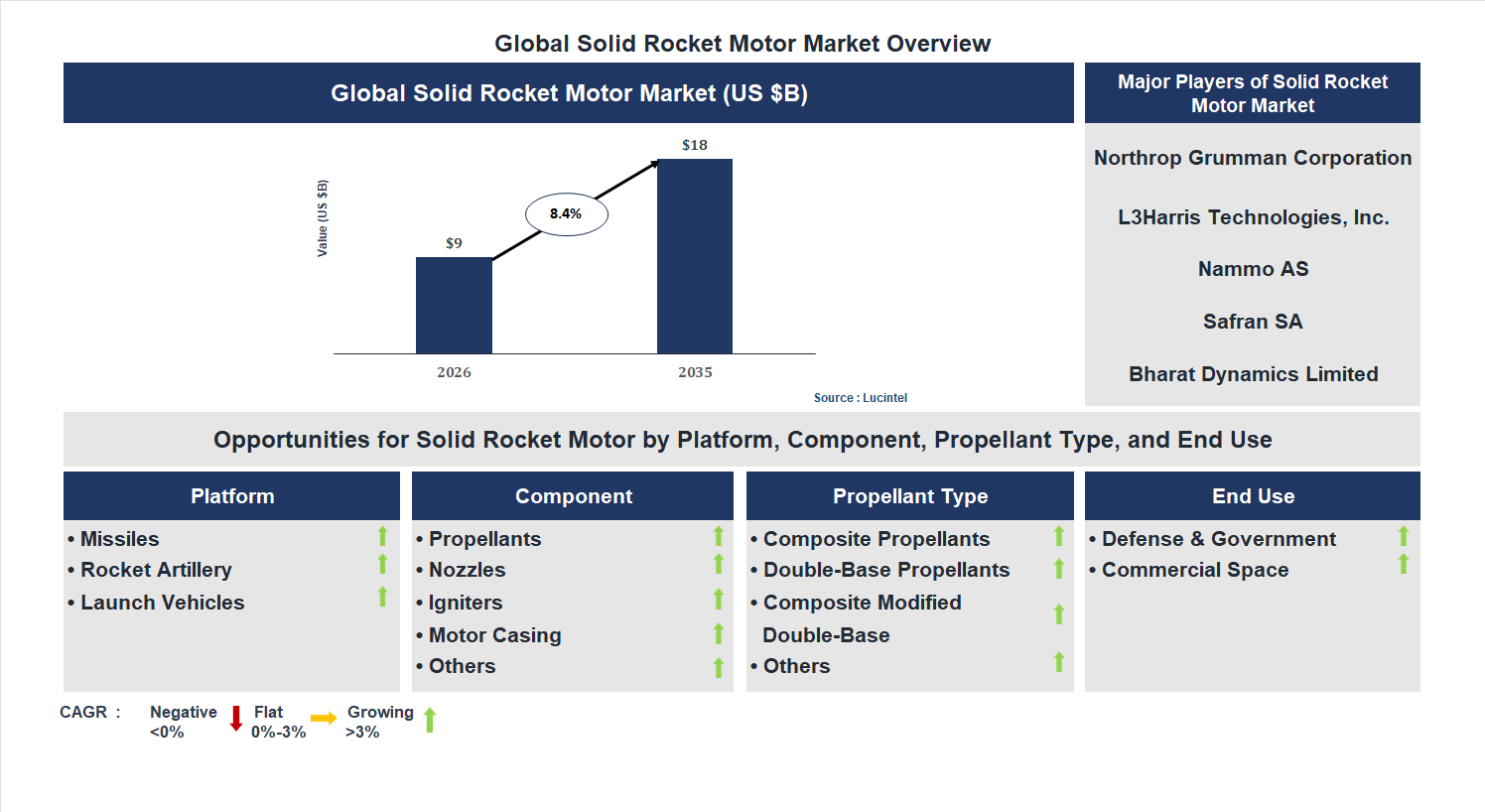
Key data points: The market size in 2035 = $18 billion, growth forecast = 8.4% annually for the next 8 years. Scroll below to get more insights. This market report covers trends, opportunities and forecasts in solid rocket motor market to 2035 by platform (missiles, rocket artillery, and launch vehicles), component (propellants, nozzles, igniters, motor casing, and others), propellant type (composite propellants, double-base propellants, composite modified double-base, and others), end use (defense & government and commercial space), and region (North America, Europe, Asia Pacific, and the Rest of the World)
We'll send your sample report shortly.
• Lucintel forecasts that, within the platform category, missile is expected to witness the highest growth over the forecast period.
• Within the end use category, defense & government is expected to witness higher growth.
• In terms of region, APAC is expected to witness the highest growth over the forecast period. Gain valuable insights for your business decisions with our comprehensive 150+ page report. Sample figures with some insights are shown below.
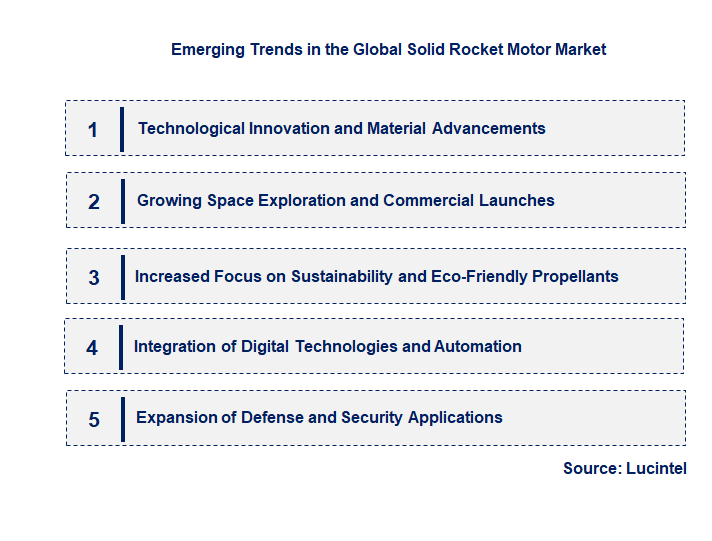
• Technological Innovation and Material Advancements: The industry is witnessing significant progress in materials used for solid rocket motors, such as high-energy composites and advanced propellants. These innovations improve thrust, efficiency, and safety while reducing weight and manufacturing costs. The development of environmentally friendly propellants also addresses regulatory concerns and sustainability goals. Enhanced manufacturing techniques, including additive manufacturing, enable complex designs and rapid prototyping, accelerating development cycles. These technological advancements are crucial for meeting the increasing performance demands of space and defense applications, making solid rocket motors more reliable and cost-effective.
• Growing Space Exploration and Commercial Launches: The surge in space exploration initiatives by government agencies and private companies is a major driver. Companies like SpaceX, Blue Origin, and others are investing heavily in reusable and high-performance solid rocket motors for satellite deployment, lunar missions, and interplanetary exploration. The demand for reliable, high-thrust motors that can operate in diverse environments is increasing. This trend is expanding the market beyond traditional defense applications, opening new revenue streams and fostering innovation in motor design and manufacturing. It also encourages partnerships between aerospace firms and government agencies to develop next-generation propulsion systems.
• Increased Focus on Sustainability and Eco-Friendly Propellants: Environmental concerns are prompting the industry to develop greener propellants that produce fewer toxic byproducts and reduce environmental impact. Innovations include the use of composite propellants and alternative chemical formulations that are less harmful. This shift aligns with global sustainability initiatives and regulatory pressures, encouraging manufacturers to adopt eco-friendly practices. The move towards sustainable propellants not only benefits the environment but also enhances safety and handling procedures, reducing risks associated with toxic chemicals. This trend is expected to shape future product development and market standards.
• Integration of Digital Technologies and Automation: The adoption of digital tools such as simulation software, data analytics, and automation is transforming manufacturing and testing processes. Digital twins and predictive analytics enable real-time monitoring and optimization of motor performance, reducing development time and costs. Automation in assembly lines enhances precision and consistency, ensuring higher quality standards. These technologies facilitate rapid prototyping and iterative testing, accelerating time-to-market for new products. The integration of digital solutions is also improving safety protocols and operational efficiency, making the industry more agile and responsive to market demands.
• Expansion of Defense and Security Applications: The increasing need for missile defense systems, tactical missiles, and strategic deterrence is fueling demand for advanced solid rocket motors. Countries are investing in modernizing their military arsenals, which requires high-performance, reliable propulsion systems. The development of hypersonic missiles and long-range ballistic missiles further boosts the market. These applications demand motors with enhanced thrust, durability, and safety features. The expansion into defense sectors is also driving innovation in motor design, with a focus on miniaturization, stealth capabilities, and integration with advanced guidance systems, thereby broadening the market scope. These emerging trends are collectively reshaping the Solid Rocket Motor Market by fostering innovation, enhancing performance, and expanding application horizons. Technological advancements and material innovations are making motors more efficient and environmentally friendly. The rise of space exploration and commercial launches is opening new markets, while digital integration improves manufacturing and operational efficiency. Additionally, increased defense spending and modernization efforts are driving demand for sophisticated propulsion systems. Together, these trends are creating a dynamic, competitive landscape that is poised to support the future of space exploration, defense, and commercial applications, ensuring sustained growth and technological leadership in the industry.
• Technological Innovations in Propellant Formulations: This development involves the creation of more efficient, stable, and environmentally friendly propellants. Advances in composite materials and nanotechnology have led to higher performance and safer solid rocket motors. These innovations reduce costs, improve reliability, and enable longer mission durations. The impact is substantial, as it allows for more complex space missions and military applications, expanding market reach and competitiveness.
• Increased Defense Spending and Military Applications: Governments worldwide are boosting defense budgets, focusing on missile defense systems and strategic deterrence. This surge in spending drives demand for advanced solid rocket motors capable of delivering higher payloads with greater accuracy. The growth enhances national security and fosters innovation in missile technology. Consequently, the market benefits from sustained demand, encouraging R&D investments and fostering competitive advancements among key players.
• Growing Space Exploration and Commercial Launch Services: The rise of private space companies and government space agencies investing in exploration missions has created a significant market opportunity. Solid rocket motors are essential for launch vehicles, satellite deployment, and deep-space missions. This trend accelerates market growth, promotes technological development, and opens new revenue streams. The impact includes increased collaboration, reduced launch costs, and expanded access to space for commercial and scientific purposes.
• Environmental Regulations and Sustainable Propellant Development: Stricter environmental standards are pushing manufacturers to develop eco-friendly propellants that produce fewer toxic emissions. Innovations include green propellants with lower environmental impact and improved safety profiles. This shift influences market dynamics by encouraging sustainable practices, reducing regulatory hurdles, and appealing to environmentally conscious clients. The result is a more sustainable industry with broader acceptance and compliance with global environmental standards.
• Integration of Digital Technologies and Automation: The adoption of digital design, simulation, and manufacturing processes enhances efficiency and precision in solid rocket motor production. Automation reduces lead times, minimizes errors, and lowers costs. Digital twin technology and AI-driven analytics optimize performance and maintenance. This integration boosts competitiveness, accelerates product development cycles, and ensures higher quality standards, ultimately transforming manufacturing practices and enabling rapid response to market demands. The overall impact of these developments is a dynamic, innovative market characterized by increased efficiency, sustainability, and technological prowess. These trends are fostering growth opportunities, expanding applications, and strengthening the global position of the solid rocket motor industry. As a result, the market is poised for sustained expansion, driven by technological progress and strategic investments.
• Growing Defense Budget and Missile Programs: Increased defense spending worldwide is boosting demand for solid rocket motors used in missile systems. Countries are investing in advanced missile technology for strategic and tactical purposes, leading to higher procurement of reliable propulsion solutions. The development of hypersonic missiles and long-range ballistic systems further amplifies this growth, with key segments including tactical missiles, strategic missile systems, and defense applications.
• Expansion in Space Launch Services and Satellite Deployment: The rise in satellite launches and space exploration initiatives is creating a substantial market for solid rocket motors. These motors are preferred for their reliability, cost-effectiveness, and quick deployment capabilities. Sub-segments such as small satellite launchers, CubeSats, and deep-space missions are experiencing increased demand, driven by government agencies and private companies aiming to expand global connectivity, Earth observation, and scientific research.
• Technological Innovations in Propellant Materials: Advances in composite propellants and high-energy materials are improving performance, safety, and environmental impact of solid rocket motors. Innovations include burn rate control, reduced toxicity, and enhanced storage stability. These developments enable more efficient, longer-lasting, and environmentally friendly propulsion systems, opening opportunities for new applications in commercial space, defense, and emergency response sectors.
• Rising Adoption of Modular and Customizable Rocket Motors: The trend toward modular design and customization allows manufacturers to tailor solid rocket motors for specific applications, reducing development time and costs. This flexibility benefits small satellite launches, tactical missile systems, and experimental missions. The ability to quickly adapt to evolving requirements enhances market competitiveness and attracts new entrants, fostering innovation and expanding the overall market scope.
• Increasing Focus on Safety and Reliability Standards: Stringent safety regulations and reliability standards are driving innovation in manufacturing processes and quality control. Enhanced testing, certification, and monitoring ensure performance consistency and safety in critical applications. This focus reduces risks associated with launch failures and missile malfunctions, boosting customer confidence and expanding market acceptance across defense, space, and commercial sectors. The overall impact of these growth opportunities is a dynamic and expanding solid rocket motor market, driven by technological advancements, increased defense and space exploration activities, and evolving customer needs. These factors collectively foster innovation, improve safety standards, and open new revenue streams, ensuring sustained growth and competitiveness in the global market.
• Technological Innovation: The continuous development of advanced materials and propulsion techniques enhances motor performance, reliability, and safety. Innovations such as composite propellants and 3D printing are reducing manufacturing times and costs, enabling more efficient and powerful solid rocket motors. These technological improvements are critical for military, space, and commercial applications, fostering market expansion and competitiveness.
• Growing Space Exploration and Satellite Launches: Increased investments by government agencies and private companies in space exploration and satellite deployment are fueling demand for reliable solid rocket motors. These motors are preferred for their simplicity, storability, and high thrust capabilities, making them ideal for launching satellites and deep-space missions. The surge in space activities directly correlates with market growth.
• Defense and Military Applications: Rising defense budgets worldwide and the need for advanced missile systems are significant drivers. Solid rocket motors are integral to missile technology due to their quick ignition and high thrust. The modernization of military arsenals and the development of strategic missile systems are expected to sustain demand, especially in regions like North America, Europe, and Asia-Pacific.
• Regulatory and Safety Standards: Stringent safety and environmental regulations are pushing manufacturers to innovate and improve the safety profiles of solid rocket motors. Compliance with international standards ensures market access and reduces risks associated with accidents. These regulations also drive the adoption of environmentally friendly propellants, influencing market dynamics positively. The challenges in the solid rocket motor market are:
• High Manufacturing Costs: The production of solid rocket motors involves complex processes, specialized materials, and rigorous testing, leading to high costs. These expenses can limit market entry for smaller players and restrict overall growth, especially in emerging markets. Cost pressures also impact pricing strategies and profit margins for manufacturers.
• Stringent Safety and Environmental Regulations: While regulations ensure safety and environmental protection, they also impose significant compliance costs and operational constraints. Meeting these standards requires substantial investment in R&D and quality control, which can delay product launches and increase overall project costs.
• Environmental Concerns: The environmental impact of solid rocket motors, particularly related to emissions and hazardous materials, poses a challenge. Growing environmental awareness and regulations aimed at reducing pollution are compelling manufacturers to develop greener propellants and sustainable technologies, which can be costly and technically challenging. The solid rocket motor market is driven by technological advancements, increased space and defense activities, and regulatory support. However, high costs, safety, and environmental concerns present notable challenges. The markets future growth hinges on balancing innovation with regulatory compliance and sustainability efforts, ensuring long-term viability and competitiveness in a rapidly evolving landscape.
• Northrop Grumman Corporation
• L3Harris Technologies, Inc.
• Nammo AS
• Safran SA
• Bharat Dynamics Limited
• Avio S.p.A.
• China Aerospace Science and Technology Corporation
• Rafael Advanced Defense Systems Ltd.
• Anduril Industries, Inc.
• Ursa Major Technologies, Inc.
• Missiles
• Rocket Artillery
• Launch Vehicles
• Propellants
• Nozzles
• Igniters
• Motor Casing
• Others
• Composite Propellants
• Double-Base Propellants
• Composite Modified Double-Base
• Others
• Defense & Government
• Commercial Space
• North America
• Europe
• Asia Pacific
• The Rest of the World
• United States: The US market has seen substantial innovation with the development of high-performance solid rocket motors for military and space applications. Leading companies like Aerojet Rocketdyne and Northrop Grumman are advancing propulsion technologies, focusing on increased thrust and reliability. The US government has increased funding for space exploration programs, including NASAs Artemis missions, boosting demand for advanced solid rocket motors. Additionally, efforts are underway to improve sustainability by developing environmentally friendly propellants, reducing toxic emissions during manufacturing and operation.
• China: China has rapidly expanded its solid rocket motor capabilities, primarily driven by military modernization and space ambitions. The China Academy of Launch Vehicle Technology (CALT) has developed new solid rocket motors for its Long March series, enhancing payload capacity and reliability. The country is also investing in indigenous technology to reduce dependency on foreign suppliers. Recent advancements include the development of solid rocket motors for satellite launches and missile systems, with a focus on cost efficiency and performance. China’s growing space program and military modernization efforts continue to propel market growth.
• Germany: Germanys solid rocket motor market is characterized by innovation in propulsion technology and a focus on sustainability. German aerospace firms are developing environmentally friendly solid rocket motors with reduced toxic emissions, aligning with European Union regulations. The country is also involved in collaborative projects within the European Space Agency (ESA), contributing to the development of advanced propulsion systems for space missions. Germany emphasizes high-precision manufacturing and safety standards, ensuring the reliability of solid rocket motors for both military and civilian applications. The market is also seeing increased investment in research and development to improve performance and environmental compliance.
• India: India has made significant strides in solid rocket motor technology, driven by its space agency ISRO and defense sector. Recent developments include the successful testing of solid rocket motors for the Gaganyaan human spaceflight program and satellite launches. India is focusing on indigenous development to reduce reliance on foreign technology, with advancements in propellant formulations and manufacturing processes. The country is also working on cost-effective solutions to support its expanding space and defense needs. The launch of the Polar Satellite Launch Vehicle (PSLV) and other missions demonstrate India’s growing capabilities in solid rocket motor technology, positioning it as a key player in the global market.
• Japan: Japan’s solid rocket motor industry is characterized by technological innovation and a focus on space exploration. The Japan Aerospace Exploration Agency (JAXA) has developed advanced solid rocket motors for its Epsilon launch vehicle, emphasizing reliability and cost efficiency. Japan is also investing in environmentally friendly propellants and manufacturing processes to meet strict safety and environmental standards. The country’s market growth is supported by collaborations with international partners and a focus on small satellite launches. Japan continues to enhance its propulsion technology to support both civilian space missions and defense applications, maintaining its position as a significant player in the global market.


• Northrop Grumman Corporation
• L3Harris Technologies, Inc.
• Nammo AS
• Safran SA
• Bharat Dynamics Limited
• Avio S.p.A.
• China Aerospace Science and Technology Corporation
• Rafael Advanced Defense Systems Ltd.
• Anduril Industries, Inc.
• Ursa Major Technologies, Inc. Q6. Which solid rocket motor market segment will be the largest in future? Answer: Lucintel forecasts that, within the platform category, missile is expected to witness the highest growth over the forecast period. Q7. In solid rocket motor market, which region is expected to be the largest in next 8 years? Answer: In terms of region, APAC is expected to witness the highest growth over the forecast period. Q8. Do we receive customization in this report? Answer: Yes, Lucintel provides 10% customization without any additional cost.


Choose a license that fits your team. Instant PDF delivery.
Prices exclude taxes. Instant delivery. Custom licensing available on request.
Market Report · July 13, 2026
Market Report · July 10, 2026
Market Report · July 9, 2026
Trusted partner for strategic intelligence and business growth


Receive a complimentary market analysis tailored to your industry. Our analysts will identify key growth opportunities and competitive dynamics specific to your business.

Market size, growth rate, and key trend analysis for your specific sector.

Top competitor positioning and market share analysis.

Strategic recommendations backed by data-driven insights.
Get curated market intelligence and competitive moves straight to your inbox.
By subscribing, you agree to receive our monthly insights. Unsubscribe anytime.
Receive a complimentary market analysis tailored to your industry. Our analysts will identify key growth opportunities and competitive dynamics specific to your business.
Market size, growth rate, and key trend analysis for your specific sector.
Top competitor positioning and market share analysis.
Strategic recommendations backed by data-driven insights.
Get curated market intelligence, emerging trends, and competitive moves straight to your inbox each month.
By subscribing, you agree to receive our monthly insights. Unsubscribe anytime.
We'll send your sample report shortly.