
Solar Photovoltaic Panel Manufacturing Market Report: Trends, Forecast and Competitive Analysis to 2035

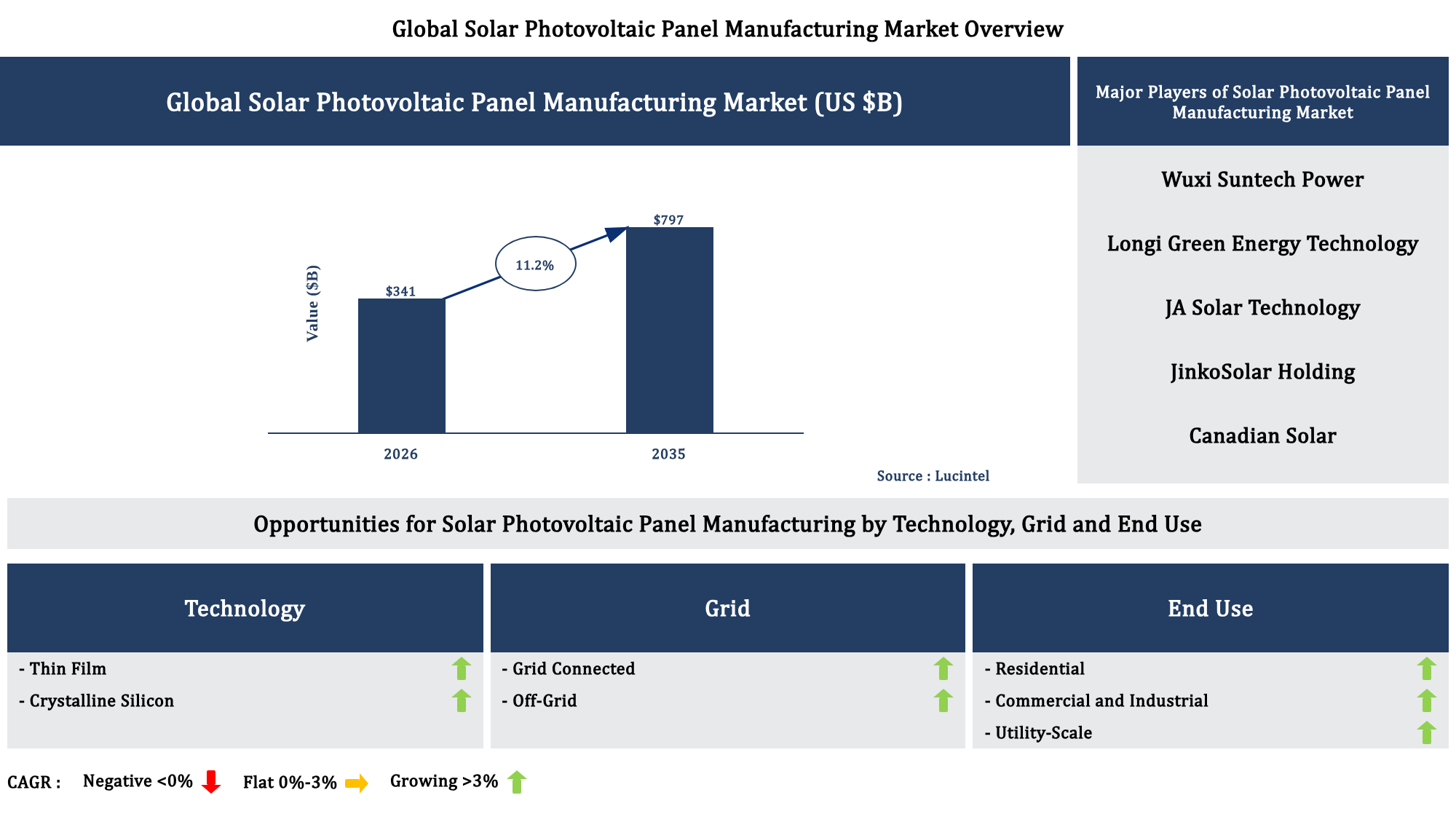
Key data points: The market size in 2035 = $797 billion, growth forecast = 11.2% annually for the next 8 years. Scroll below to get more insights. This market report covers trends, opportunities and forecasts in solar photovoltaic panel manufacturing market to 2035 by technology (thin film and crystalline silicon), grid (grid connected and off-grid), end use (residential, commercial and industrial, and utility-scale), and region (North America, Europe, Asia Pacific, and the Rest of the World)

Publisher: Lucintel Last Updated: August 2026
See Pricing

Download Sample Report

| ✨ New Download Sample report — Get instant insights! | ✨ New Download Sample report — Get instant insights!

Solar Photovoltaic Panel Manufacturing Market Report: Trends, Forecast and Competitive Analysis to 2035

Solar Photovoltaic Panel Manufacturing Market

The future of the global solar photovoltaic panel manufacturing market looks promising with opportunities in the residential, commercial and industrial, and utility-scale markets. The global solar photovoltaic panel manufacturing market is expected to reach an estimated $797 billion by 2035 with a CAGR of 11.2% from 2027 to 2035. The major drivers for this market are growing demand for renewable energy sources, increasing government incentives and subsidies, and rising adoption of solar energy to reduce carbon emissions.

  • Lucintel forecasts that, within the technology category, crystalline silicon will remain a larger segment over the forecast period due to rising demand for cost-effective solar cells.
  • Within the end use category, utility-scale will remain the largest segment due to growing large-scale solar farm investments.
  • In terms of regions, APAC will remain the largest region over the forecast period due to rising manufacturing capacity.

Gain valuable insights for your business decisions with our comprehensive 150+ page report. Sample figures with some insights are shown below.
Solar Photovoltaic Panel Manufacturing Market

Emerging Trends in the Solar Photovoltaic Panel Manufacturing Market

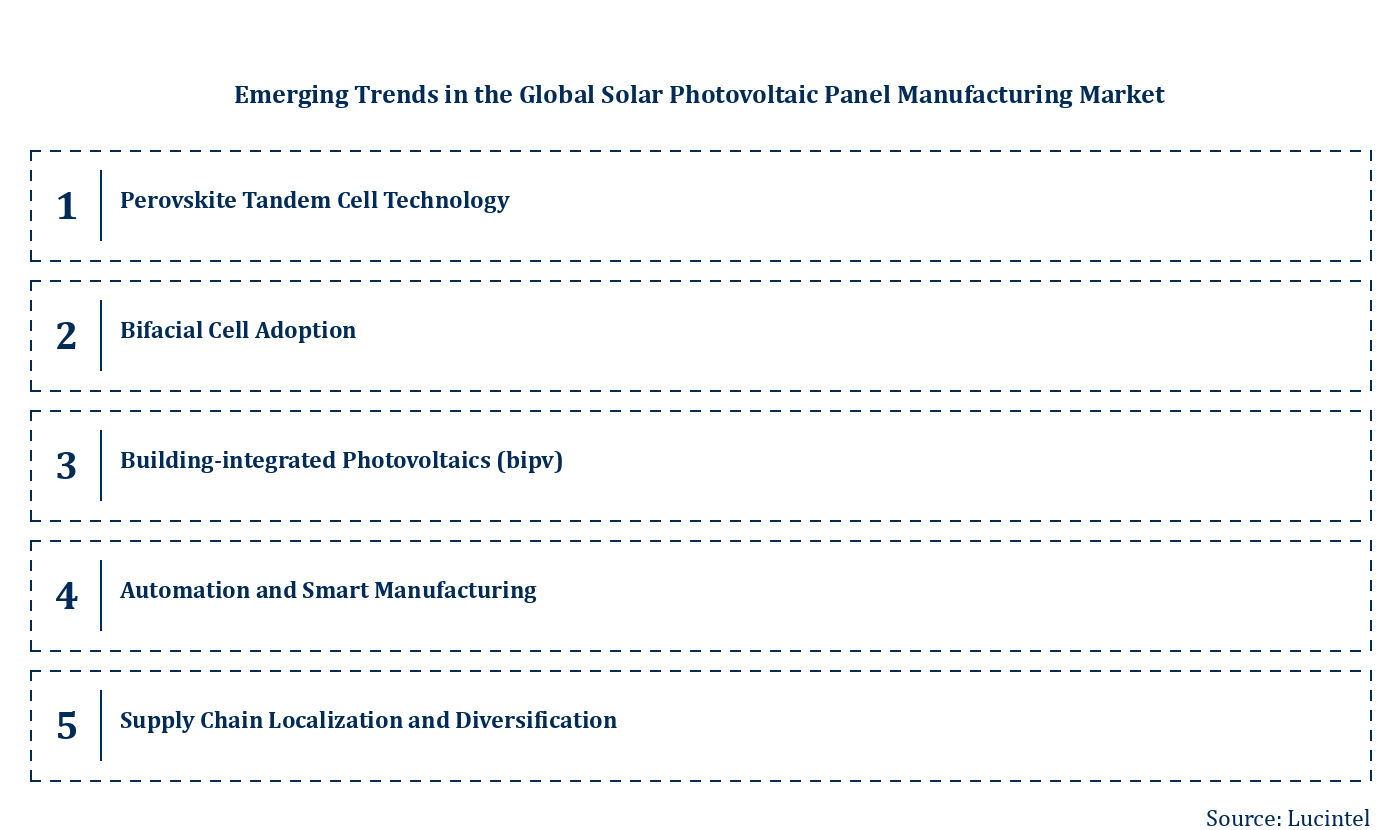
The solar photovoltaic panel manufacturing market is currently experiencing rapid changes in both technology and industry structure as manufacturers seek to minimize production costs and maximize efficiency and adaptability. Progress in cell architecture and materials science, coupled with advancements in automation, means panels can be designed to be more efficiently manufactured and deployed across the residential, commercial, and utility markets. Manufacturers and governments are placing great value on next-generation technologies in an effort to achieve breakthroughs in efficiency beyond today’s limits of silicon-based PVs and also to better manage supply chain disruptions. These efforts incrementally change the competitive landscape of the market. These are the five key trends impacting the solar PV panel manufacturing market.

  • Perovskite Tandem Cell Technology: With the silicon and perovskite cell layers, perovskite-silicon tandem cells are able to break the efficiency barriers. The first applications of perovskite-silicon tandem cells for commercialization are already being built. These cells use a low-cost solution-based manufacturing method. There will be extensive commercialization by 2027, at which time it is expected that efficiency of perovskite-silicon tandem cell modules will be improved, cost of production will decrease, and module manufacturing companies that have the most advanced production technologies will take the lead in cell production.
  • Bifacial Cell Adoption: Both sides of bifacial solar panels are now used to capture the energy from the sun, resulting in a 15% improvement in energy production in modules, making these modules appropriate for high-albedo environments. Additionally, bifacial modules are now constructible using improved cell design and two layers of glass. These modules have the advantage of ground-mounted utility installations. The more bifacial modules that are installed, the greater the yield, which strengthens the return on investment for developers and incentives manufacturers to produce bifacial modules for all sizes of applications.
  • Building-integrated Photovoltaics (BIPV): Embedding solar technology in construction materials is a rapidly advancing technology that involves the integration of solar cells into roof tiles, building façade panels, and windows. There is no need to use additional mounting structures. Aesthetically the technology fits with the needs for net-zero buildings. Electronic components for integrated photovoltaics in building substructures are being developed with a large surface area pervoshkite cell for building integration. The Japanese Ministry of Economy, Trade and Industry are sponsoring perovskite cell building integrated photovoltaic systems for window applications.
  • Automation and Smart Manufacturing: Use of automated construction methods and Artificial Intelligence (AI) is becoming commonplace in manufacturing. Improved cell stringing methods and automation have improved manufacturing efficiency and lowered the levelized cost of energy by 15 percent. Smart systems for monitoring and predictive maintenance have become ubiquitous. The use of AI for quality control has become commonplace in manufacturing. These improvements are enabling manufacturers to operate more efficiently, improve product quality, control operational costs, maintain consistency, and respond to global competition and changing demand.
  • Supply Chain Localization and Diversification: By investing in manufacturing within their respective countries, countries are intent on breaking monopolies in the supply of goods. Manufacturing incentives, local content laws, and tariffs are incentivizing manufacturing vertical integration in the production of polysilicon, wafers, cells, and modules. These efforts can especially be seen in the U.S., India, and Europe, where manufacturing capacities are being rebuilt. Geopolitical diversification is strengthening supply chains and rebalancing global trade.

These five trends can be seen as thereat boiling the photovoltaic module manufacturing market away from the low-cost, competitive marketplace. Now, the market can be shaped more by innovation. Manufacturing companies can introduce new features, new designs, and more efficient modules. An example of that would be the building integration of photovoltaic modules, where solar energy can be utilized almost everywhere. An emphasis on production module automation in connection with supply chain localization, shifts the power away from traditional manufacturing hubs. Innovative solar module design and manufacturing in different geographic regions of the world can increase the competitiveness, and resiliency of the global solar manufacturing ecosystem.
Solar Photovoltaic Panel Manufacturing Market by country

Recent Developments in the Solar Photovoltaic Panel Manufacturing Market

The solar photovoltaic panel manufacturing market is changing quickly. Innovations and changes in policy and trade will do this. Nations have begun improving their domestic manufacturing while dealing with overcapacity, the increases in tariffs and the changes in the supply chain. Policy makers deal with these problems by offering incentives and imposing quality requirements to promote local manufacturing. At the same time, manufacturers are investing in the technologies of the next generation of solar cells. All of this is occurring at the same time and the manufacturing of solar technology is adjusting the local and global competition for the manufacturing of solar technology.

  • Expanding Manufacturing Capabilities in The US: Manufacturing of solar technology in the US is experiencing its largest growth ever. Manufacturing of solar technology in the US is over 60 GW, which is enough to supply the entire country for one year. Qcells and Corning are building manufacturing of Ingots, Wafers and Solar cells. This increased manufacturing provides supply chain benefits and improved visibility in the manufacturing supply chain. This also creates the potential for more tax credits. Manufacturing of solar technology in the US is plagued with uncertainty due to the slow regulatory processes and the inability to get permits. This greatly affects the manufacturing of solar technology in the US.
  • China Manufacturing Consolidation: China is moving away from rapid capacity expansion and toward strategic consolidation. To address ongoing oversupply issues, the Chinese government has closed low-efficiency production lines. Manufacturers are incentivized to focus on quality improvements as the government has ended export tax rebates on photovoltaic products. While domestic installations are slowing, exports are increasing, especially to Indonesia and India. This consolidation demonstrates China's confidence managing overcapacity while offering the entire world supply, maintaining its dominant position.
  • India Policy-driven Localization: India is rapidly growing its domestic solar manufacturing, primarily through the Production Linked Incentive (PLI) scheme and Approved List of Models and Manufacturers (ALMM). Valid until June 2026, the ALMM has significantly increased domestic module manufacturing to 121 gigawatts, and the new cell manufacturing mandates will accelerate growth further. This improves India's manufacturing capabilities and independence, but the growth of solar manufacturing may lead to an even increased overcapacity as the domestic demand for solar installations will not keep pace, inducing harmful competition among manufacturers.
  • Perovskite and Tandem Cell Commercialization: Manufacturers are prioritizing the research and development of perovskite and tandem cells to overcome the efficiency limits of traditional silicon cells. Japan has undertaken major investments to target the commercial production of perovskite cells by 2027. Other markets have also undertaken investments to reach similar breakthroughs. These cells, with their improved manufacturing methods, have the potential to further disrupt the market with lower production costs and enhance the light absorption of traditional photovoltaic modules.
  • Rising Trade Barriers and Tariffs: There have been notable changes in the global trade environment. Countries have started to introduce tariffs and import bans and require certification for quality to allow certain goods to be imported. The U.S., Europe, and India have implemented changes to supply chain and sustainability regulations concerning polysilicon, as well as to the laws and regulations concerning the safety of modules, which will help reduce reliance on supply chains and stimulate local supply. Increasing trade barriers and the resulting pressure on pricing will force trade partners to reassess which markets they will be able to access and which markets they will be able to source from.

These changes will result in greater regional trade, increased domestic sourcing, and greater reliance on advanced technologies in the solar photovoltaic panel manufacturing industry. Increased manufacturing capacity combined with trade-related policies will cause regional manufacturing systems to be under greater pressure due to the risk of overcapacity. Manufacturing trade barriers will result in greater uncertainty in the marketplace. Manufacturing technologies such as perovskites and tandem will likely result in trade-related market pressures, and advanced solar cell manufacturing systems, combined with international trade pressures, will contribute to greater system flexibility in the international solar cell manufacturing trade. The advanced technologies that are being developed will promote greater regional trade in an advanced technologies manufacturing system.

Strategic Growth Opportunities in the Solar Photovoltaic Panel Manufacturing Market

The manufacturing market of solar photovoltaic panels holds immense potential for growth spanning various segments including residential, commercial, industrial and utility. The combined force of growing energy demand globally, governmental support and reduction in technology costs have created an opportunity for manufacturers to enter the global market and target wider segments, geographies and technologies. The continued innovations in the industry, storage integration and specialty applications will enable manufacturers to grow and respond to the demands of various markets including residential, commercial, industrial and utility.

  • Utility-scale Solar Farms: The significant investment being focused on large scale solar energy projects provides manufacturers particular opportunities with regard to advanced, high-efficiency and bifacial modules. The incorporation of advanced tracking technology and agrivoltaics systems, which enables a solar energy generation farm to be mixed with agriculture, provides an additional advantage to the segments due to economies of scale and governmental support to achieve set renewable energy targets. Manufacturers that focus on utility-scale supply chains will meet significant demands as countries rapidly implement grid connected solar energy in pursuit of their clean energy and decarbonization goals.
  • Residential Rooftop Solar: Continued interest and growth in residential adoption of rooftop solar technology provides manufacturers the potential for the development of compact and aesthetically integrated solar panels. Increased electricity prices and the interest by homeowners in solar energy and battery storage systems will also drive the growth of rooftop solar installations. New technologies and the development of innovativebuilding integrated solar photovoltaics offer the potential for light weight and flexible systems to be employed in residences.
  • Commercial/Industrial Rooftop Deployment: Solar projects for cost control and ESG goals is a quickly growing segment. The deployment of panels on commercial and industrial rooftops is a huge untapped opportunity. Corporate renewable energy goals and favorable economics help this segment. With decreasing costs on modules, increasing maturity in commercial level financing with PPAs, the demand will only increase. The commercial sector will become more energy efficient and take steps to reduce their environmental impact. Manufacturers that make strong, high-quality, efficient panels will see the demand increase quickly.
  • Emerging Market Geographic Expansion: With the increasing demand for electricity and the pro-solar policies, the developing nations in the Asia-Pacific Region, Africa, and Latin America provide huge opportunities for growth. Manufacturers that build local solar manufacturing and/or distribution partnerships will be first to market and gain the most market potential. Diversifying into these new growth markets will help reduce the reliance on developed market saturation and add new profitable revenue streams.
  • Advanced Technology Integration Opportunities: Although the investment/ROI and growth in the solar market will continue, there are still differentiating technologies that will provide added market value potential. Manufacturing Tesla Roof Tiles, 2-sided Bifacial Panels, or Perovskite Tandem cells, all have use cases in sectors outside of solar and offer the ability to charge a premium on manufacturing costs.

Combined, the growth opportunities outlined below indicate sustained market growth for the solar photovoltaic panel manufacturing market. The segmentation of the market of greatest volume focus remains the utility and residential segments, with the commercial segment representing the fastest growth segment and the last of the major markets to be served. New technologies are enabling manufacturers to differentiate themselves and secure competitive advantage. The growth opportunities outlined are creating opportunities to enlarge market share, create new revenue sources, and strengthen competitive positions for market players in the global solar energy market.

Solar Photovoltaic Panel Manufacturing Market Drivers and Challenges

The manufacturing market for solar photovoltaic panels has a remarkable ability to adapt and change. On the positive end, as new, more efficient, cells are produced, the economies of scale lead to lower prices and more favorable policies from governments, allowing bigger market expansion. However, this is balanced by overcapacity, trade restrictions, and low prices. Finding the correct balance between competing cost pressures and innovation is difficult. This is compounded by the changes to the supply chain, tensions between nations, changing demands for renewable energy at different scales, and advanced technology. While the world is pushing for commitments of sustainability and decarbonization, far more stringent regulations for Renewable Energy Targets are established. For all of these reasons, solar photovoltaic panel manufacturing continues to thrive and gain market share quickly.

The factors responsible for driving the solar photovoltaic panel manufacturing market include:

  • Supportive Government Policies and Incentives: Production-linked Incentives, subsidies, and tax breaks from different governments in major markets help set up solar manufacturing facilities in those markets. Vertically-integrated manufacturing companies have started investing in these facilities because of the Production Linked Incentives in India and tax credit frameworks in the US. These policies utilize import substitution and strengthen local manufacturing while creating jobs. Protective lists of approved manufacturers along with local content requirements ensure progress for domestic producers. These manufacturers invest to improve capacity and compete with foreign producers. Because of these policies, capital investment increases, the industry is able to provide employment, and can achieve its goal of improving energy security in a nation. Industry growth causes the manufacturing sector to innovate and improve technologies, creating a positive trend in the industry.
  • Declining Production Costs and Technological Advancement: Manufacturing is becoming more automated, leading to assembly line production of solar panels and lowering production costs. Newer cell technology allows for stringing of cells in a manner that increases production. The advancements in solar technology combined with production at an economies of scale level enable an even greater reduction in the levelized cost of energy. Manufacturing of solar panels is further becoming more cost effective with new technologies such as perovskite cells. Solar power is becoming a cheaper alternative to a traditional source of power. Because of this, manufacturers can sell their products at prices that allow the growth of the market. Demand is generated also in formerly cost-constrained markets, particularly developing economies.
  • Corporate Sustainability Targets and Energy Security Concerns: Corporate efforts to reduce carbon emissions by going carbon neutral with the concurrent proliferation of renewable energy are leading to greater demand for the installation of solar photovoltaic systems in the commercial and industrial sectors. Companies are entering power purchase agreements and investing directly in solar infrastructure to help them accomplish their environmental, social, and governance goals. At the same time, the focus on secure energy sources, stemming from geopolitical turbulence and the volatility of fossil fuel prices, is prompting countries and companies to rely more on solar energy. The concurrent commitment to corporate sustainability goals and national energy independence goals is creating a surge in demand for solar panels, particularly in manufacturing where there are multiple commercial and industrial applications across the globe.

The challenges facing the market include:

  • Manufacturer Pricing Pressure and Financial Viability: Solar photovoltaic panel manufacturing is an industry where there might be too many organizations competing against each other. This is especially true in China where there is a lot of manufacturing capacity, and not enough demand for solar panel installation everywhere in the world. This has resulted in many companies competing against one another to see who can offer the lowest price possible, and it is affecting all companies throughout that supply chain including the suppliers of polysilicon, wafers, cells, and modules. Smaller companies are financially at risk due to longer payment cycles. This is especially true in India, where once again, manufacturing capacity for solar modules is greater than the demand for solar panel installations. Manufacturing companies must focus on quality of products and innovations in order to justify selling more panels at higher price.
  • Rising Trade Barriers and Geopolitical Tensions: The combination of rising trade barriers and geopolitical tensions creates an increasingly difficult environment for solar panel manufacturers. The US and India are coming down harder on polysilicon supply chains, module safety, and domestic content. All of these things create local industry protection, but they also negatively impact global trade. Tensions over supply chain reliance on China increase the uncertainty within the industry. Companies will be forced to look at their supply chains and manufacturing locations. The diversification of these things will add costs to the manufacturers. Currently, the fragmented laws and regulations increase operational costs and the costs associated with manufacturing. Manufacturing companies will be dissuaded from long term planning and capacity investments.
  • Regulatory Uncertainty and Permitting Delays: The inconsistent laws and the permitting processes in most countries increase the uncertainty facing manufacturers. The solar photovoltaic industries in the US and Germany are prototypical examples where manufacturers have become discouraged. There is no way to know if there will be any profit from manufacturing operations in the future. Companies will be forced to focus on stopping long term growth in order to save on the costs associated with changing compliance requirements. This will slow down growth in the solar manufacturing industries.

The Solar Photovoltaic (PV) Panel Manufacturing Market has a unique paradox in its market dynamics, which includes strong growth and new market potential amid existing structural challenges. The adoption of renewable energy, subsidies from governments, a decrease in cost of production, increased corporate sustainability goals, and an expanding array of applications of solar energy panel manufacturing have driven growth in the market. The challenges of market overcapacity, increased trade barriers, and uncertainty in regulations have resulted in a lack of sustained profitability and growth. In the coming years, successful manufacturers will have to have strategies to innovate and diversify their businesses, as well as provide flexibility in their supply chains. These manufacturers will be the ones that will have the best opportunities to grow and succeed in the international solar manufacturing market.

List of Solar Photovoltaic Panel Manufacturing Market Companies

Companies in the market compete on the basis of product quality offered. Major players in this market focus on expanding their manufacturing facilities, R&D investments, infrastructural development, and leverage integration opportunities across the value chain. Through these strategies solar photovoltaic panel manufacturing market companies cater increasing demand, ensure competitive effectiveness, develop innovative products & technologies, reduce production costs, and expand their customer base. Some of the solar photovoltaic panel manufacturing market companies profiled in this report include-

  • Wuxi Suntech Power
  • Longi Green Energy Technology
  • JA Solar Technology
  • JinkoSolar Holding
  • Canadian Solar
  • First Solar
  • Aiko Solar
  • Trinasolar
  • Tata Power Solar Systems
  • Yingli Solar

Solar Photovoltaic Panel Manufacturing Market by Segment

The study includes a forecast for the global solar photovoltaic panel manufacturing market by technology, grid, end use, and region.

  • Solar Photovoltaic Panel Manufacturing Market by Technology [Value from 2019 to 2035]:
    • Thin Film
    • Crystalline Silicon
  • Solar Photovoltaic Panel Manufacturing Market by Grid [Value from 2019 to 2035]:
    • Grid Connected
    • Off-Grid
  • Solar Photovoltaic Panel Manufacturing Market by End Use [Value from 2019 to 2035]:
    • Residential
    • Commercial and Industrial
    • Utility-Scale
  • Solar Photovoltaic Panel Manufacturing Market by Region [Value ($B) from 2019 to 2035]:
    • North America
    • Europe
    • Asia Pacific
    • The Rest of the World

Country Wise Outlook for the Solar Photovoltaic Panel Manufacturing Market

The global solar photovoltaic panel manufacturing market is transforming as countries focus on energy security, technological leadership, and supply chain independence. The leading countries are the U.S., China, Germany, India, and Japan. China is the most dominant in the market due to its scale and cost, but other countries are focusing on manufacturing, localizing through policy, and working on advanced technologies, such as perovskite. Increased tariffs and trade barriers, along with new regulations on quality, are affecting trade around the world. Manufacturers are focusing more on integration along the supply chain and improving efficiency more than ever, due to concern over excess capacity and changing government incentives in the major world economies.

  • United States: The United States is becoming a solar manufacturing hub with both thin film and crystalline silicon production. Qcells is building the first integrated ingot, wafer, and cell manufacturing facility in Georgia, and Corning is producing wafers in Michigan. Though First Solar maintains a thin film manufacturing leadership position, it is not without challenges from regulations and time delays in permitting. For the first time, the country’s manufacturing capacity can meet the internal demand with a manufacturing capacity of 60 gigawatts. Companies are building capacity vertically as a shift toward manufacturing self sufficiency occurs.
  • China: While China is still the leader in global solar manufacturing, growth is slowing with an oversupply on the market. From January to June 2026, China manufactured 538,000 metric tons of polysilicon, and 293, 260.7, and 201.3 gigawatts of wafers, solar cells, and modules, respectively. The country is consolidating manufacturing capacity by shutting down older production lines and is focusing on the quality and technology of production with upgrades, in part, to AI. Exports are increasing with cells and wafers being sent to Indonesia and India, among other countries, while domestic manufacturing slows, in part, due to policy changes and increasing competition in the industry.
  • Germany: Germany is experiencing an increase in solar installations, and a decrease in solar manufacturing. By the end of 2026, Germany had approximately 117 gigawatts of solar capacity, with a sharp decrease in solar module manufacturing. Approximately 88% of photovoltaic systems in Germany are sourced from China.
  • Even with challenges, developments like Solar Fabriks' Höbach facility prioritize flexible and scalable production. High labor and energy costs still impact manufacturers, but Germany continues its commitment to renewable energy and will increase solar energy projects.
  • India: India is quickly advancing solar production with new policies. In August 2026, India hit over 100 GW of solar production with 121.7 GW, thanks to new production incentives. With the introduction of ALMM List-II in June 2026, cell production will grow as well. Currently, the country is working towards optimizing production as the demand for solar modules decreases, and pressure is mounting to enhance domestic production networks.
  • Japan: Japan is working to regain its previous standing in solar production, but will focus on the new technologies similar to perovskite cells. Japan has a large focus on production of new perovskite solar cells, and they expect to have the first commercial production in 2027. They have the ambition of creating a solar cell production block to create 20 GW of production. This is similar to Japan producing 20 nuclear reactors worth of production. They have a large focus of investment to create new solar technologies, as well as perovskite solar cells and building integrated photovoltaics.

Features of the Solar Photovoltaic Panel Manufacturing Market

  • Market Size Estimates: Solar photovoltaic panel manufacturing market size estimation in terms of value ($B).
  • Trend and Forecast Analysis: Market trends (2019 to 2026) and forecast (2027 to 2035) by various segments and regions.
  • Segmentation Analysis: Solar photovoltaic panel manufacturing market size by technology, grid, end use, and region in terms of value ($B).
  • Regional Analysis: Solar photovoltaic panel manufacturing market breakdown by North America, Europe, Asia Pacific, and Rest of the World.
  • Growth Opportunities: Analysis of growth opportunities in different technology, grid, end use, and regions for the solar photovoltaic panel manufacturing market.
  • Strategic Analysis: This includes M&A, new product development, and competitive landscape of the solar photovoltaic panel manufacturing market.
  • Analysis of competitive intensity of the industry based on Porter’s Five Forces model.

Top 5 Companies

  • Wuxi Suntech Power
  • Longi Green Energy Technology
  • JA Solar Technology
  • JinkoSolar Holding
  • Canadian Solar

Table of Contents

1. Executive Summary
14.1 Competitive Analysis Overview

List of Figures

List of Tables

Methodology

Lucintel has been in the business of market research and management consulting since 2000 and has published over 1000 market intelligence reports in various markets / applications and served over 1,000 clients worldwide. This study is a culmination of four months of full-time effort performed by Lucintel's analyst team. The analysts used the following sources for the creation and completion of this valuable report:

  • In-depth interviews of the major players in this market
  • Detailed secondary research from competitors' financial statements and published data
  • Extensive searches of published works, market, and database information pertaining to industry news, company press releases, and customer intentions
  • A compilation of the experiences, judgments, and insights of Lucintel's professionals, who have analyzed and tracked this market over the years.

Extensive research and interviews are conducted across the supply chain of this market to estimate market share, market size, trends, drivers, challenges, and forecasts. Below is a brief summary of the primary interviews that were conducted by job function for this report.

Lucintel's methodology for market research

Thus, Lucintel compiles vast amounts of data from numerous sources, validates the integrity of that data, and performs a comprehensive analysis. Lucintel then organizes the data, its findings, and insights into a concise report designed to support the strategic decision-making process. The figure below is a graphical representation of Lucintel's research process.

Primary interviews by job function

Buy Now

Choose a license that fits your team. Instant PDF delivery.

Market Report

1 User PDF

$4,850
Buy Now

Market Report

2-5 Users PDF

$6,700
Buy Now

Market Report

Corporate PDF

$8,850
Buy Now

Market Report

Global PDF

$10,000
Buy Now

Prices exclude taxes. Instant delivery. Custom licensing available on request.

Frequently Asked Questions

What is the solar photovoltaic panel manufacturing market size?
The global solar photovoltaic panel manufacturing market is expected to reach an estimated $797 billion by 2035.
What is the growth forecast for solar photovoltaic panel manufacturing market?
The global solar photovoltaic panel manufacturing market is expected to grow with a CAGR of 11.2% from 2027 to 2035.
What are the major drivers influencing the growth of the solar photovoltaic panel manufacturing market?
The major drivers for this market are growing demand for renewable energy sources, increasing government incentives and subsidies, and rising adoption of solar energy to reduce carbon emissions.
What are the major segments for solar photovoltaic panel manufacturing market?
The future of the solar photovoltaic panel manufacturing market looks promising with opportunities in the residential, commercial and industrial, and utility-scale markets.
Who are the key solar photovoltaic panel manufacturing market companies?

Some of the key solar photovoltaic panel manufacturing companies are as follows:

  • Wuxi Suntech Power
  • Longi Green Energy Technology
  • JA Solar Technology
  • JinkoSolar Holding
  • Canadian Solar
  • First Solar
  • Aiko Solar
  • Trinasolar
  • Tata Power Solar Systems
  • Yingli Solar
Which solar photovoltaic panel manufacturing market segment will be the largest in future?
Lucintel forecasts that, within the technology category, crystalline silicon will remain a larger segment over the forecast period due to rising demand for cost-effective solar cells.
In solar photovoltaic panel manufacturing market, which region is expected to be the largest in next 8 years?
In terms of regions, APAC will remain the largest region over the forecast period due to rising manufacturing capacity.
Do we receive customization in this report?
Yes, Lucintel provides 10% customization without any additional cost.

Key Questions

  • What are some of the most promising, high-growth opportunities for the solar photovoltaic panel manufacturing market by technology (thin film and crystalline silicon), grid (grid connected and off-grid), end use (residential, commercial and industrial, and utility-scale), and region (North America, Europe, Asia Pacific, and the Rest of the World)?
  • Which segments will grow at a faster pace and why?
  • Which region will grow at a faster pace and why?
  • What are the key factors affecting market dynamics? What are the key challenges and business risks in this market?
  • What are the business risks and competitive threats in this market?
  • What are the emerging trends in this market and the reasons behind them?
  • What are some of the changing demands of customers in the market?
  • What are the new developments in the market? Which companies are leading these developments?
  • Who are the major players in this market? What strategic initiatives are key players pursuing for business growth?
  • What are some of the competing products in this market and how big of a threat do they pose for loss of market share by material or product substitution?
  • What M&A activity has occurred in the last 5 years and what has its impact been on the industry?
Why Choose Us

The Lucintel Advantage

Trusted partner for strategic intelligence and business growth

25+ Years Excellence

25+ Years Excellence

Quarter century of proven expertise in management consulting and market research across global markets.
Game-Changer Ideas

Game-Changer Ideas

Innovative strategies and actionable insights that help clients become the smartest in their industry.
Global Reach

Global Reach

Extensive coverage across 50+ industries and markets worldwide with localized expertise.
Start Your Growth Journey

Get Your Free
Market Intelligence
Briefing

Receive a complimentary market analysis tailored to your industry. Our analysts will identify key growth opportunities and competitive dynamics specific to your business.

Custom Market Snapshot

Market size, growth rate, and key trend analysis for your specific sector.

Competitive Landscape Overview

Top competitor positioning and market share analysis.

Growth Opportunity Identification

Strategic recommendations backed by data-driven insights.

Subscribe

Subscribe to our Newsletter

Get curated market intelligence and competitive moves straight to your inbox.

By subscribing, you agree to receive our monthly insights. Unsubscribe anytime.

Industry Trends Market Signals Opportunities Competitor Moves