
Market Report · July 20, 2026

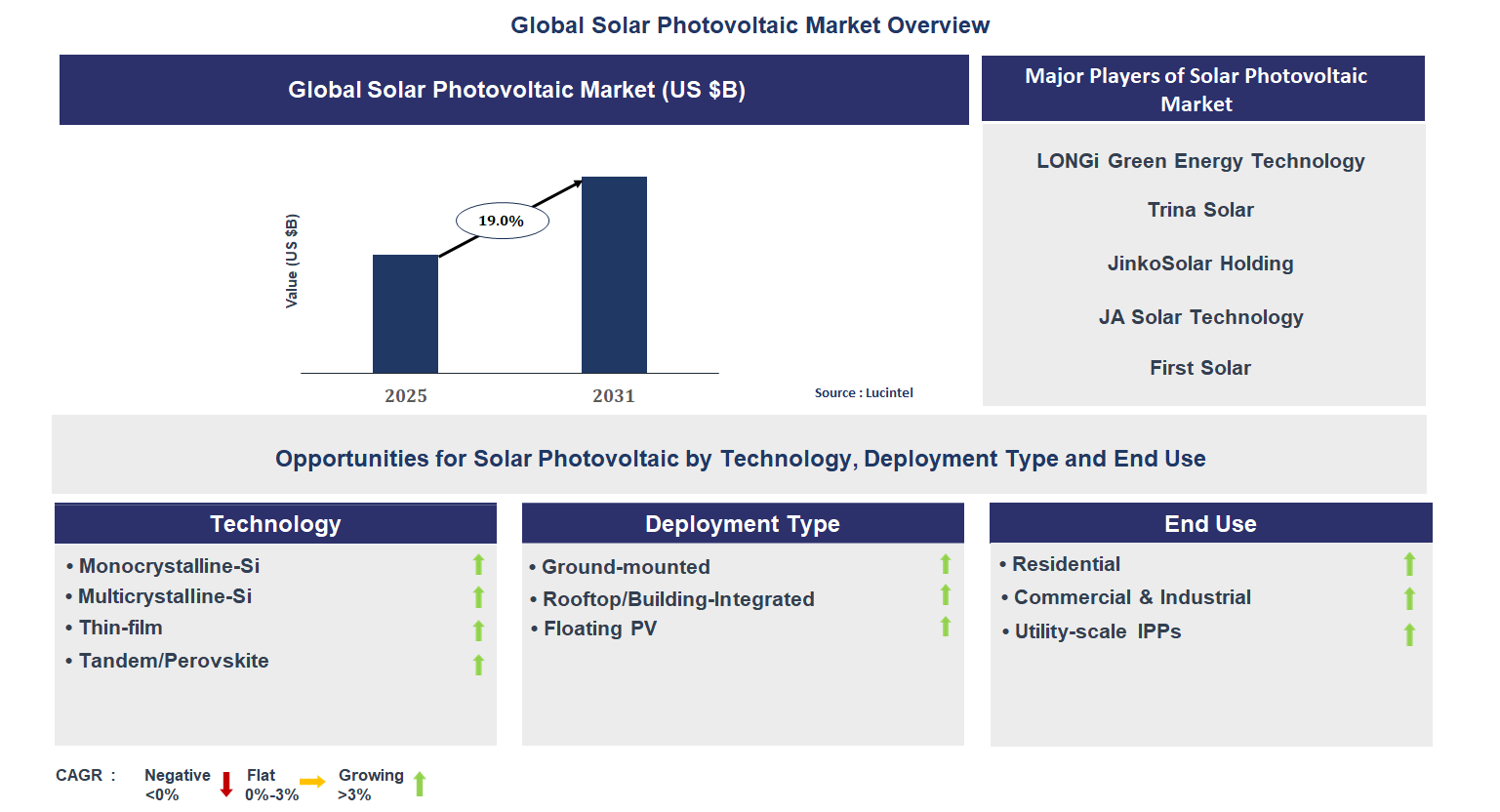
Key data points: The growth forecast = 19.0% annually for the next 7 years. Scroll below to get more insights. This market report covers trends, opportunities and forecasts in solar photovoltaic market to 2031 by technology (monocrystalline-Si, multicrystalline-Si, thin-film, and tandem/perovskite), deployment type (ground-mounted, rooftop/building-integrated, and floating PV), end use (residential, commercial & industrial, and utility-scale IPPs), and region (North America, Europe, Asia Pacific, and the Rest of the World)
We'll send your sample report shortly.
• Lucintel forecasts that, within the technology category, tandem/perovskite is expected to witness the highest growth over the forecast period.
• Within the end use category, utility-scale ipp is expected to witness the highest growth.
• In terms of region, APAC is expected to witness the highest growth over the forecast period. Gain valuable insights for your business decisions with our comprehensive 150+ page report. Sample figures with some insights are shown below.
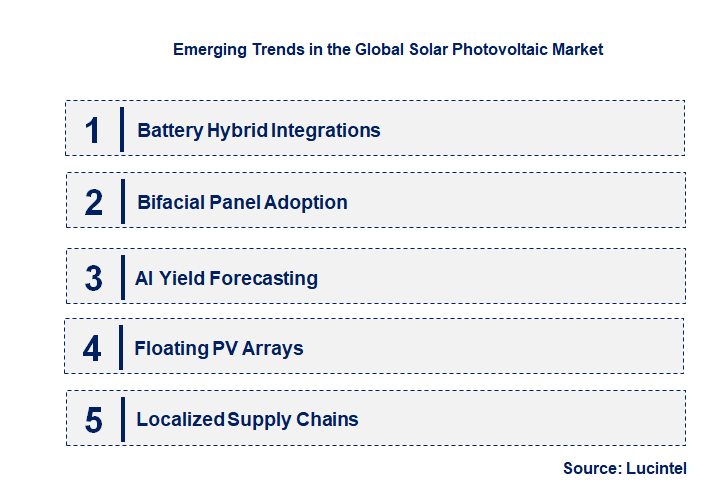
• Battery Hybrid Integrations: PV farms pair with storage for dispatchable power, curbing variability. This stabilizes grids, enables peak services, and reduces wastes, boosting developer revenues in high-demand markets.
• Bifacial Panel Adoption: Dual-sided modules capture reflected light for higher yields. Impacts elevate outputs in open terrains, improve project economics, and support agrivoltaics for multifunctional land use.
• AI Yield Forecasting: Intelligent tools predict performance and automate maintenance. They minimize downtime, optimize sites, and enhance returns, attracting investments in large-scale operations.
• Floating PV Arrays: Water-based systems utilize reservoirs for cooling benefits. This expands sites, lowers evaporation, and synergizes with hydro, scaling without land competition.
• Localized Supply Chains: Regional production mitigates import risks for steady builds. It shortens timelines, cuts emissions, and creates jobs, aiding policy-driven growth. These trends are reshaping the solar photovoltaic market by infusing flexibility and intelligence. They overcome constraints, diversify revenues, and embed sustainability, positioning PV as essential in energy transitions.
• Global Installation Escalations: Worldwide PV additions surge, dominated by key regions. This diversifies sources, lessens fossil ties, and grows manufacturing for clean access.
• Domestic Manufacturing Ramps: Nations localize production for supply security. Enhancements lower costs, reduce footprints, and build workforces in emerging hubs.
• Incentive Policy Refinements: Updated supports speed project flows. They unify standards, fill funding gaps, and include varied participants in progress.
• Module Efficiency Gains: New designs achieve higher conversions. Advances shorten paybacks, widen hybrids and remotes.
• Interconnection Pilot Successes: Stable large links demonstrate scalability. Effects cut curtailments, refine forecasts, blend renewables smoothly. These developments are impacting the solar photovoltaic market by bolstering adaptability and scale. They remove hurdles, spark partnerships, and deepen green integrations for interconnected futures.
• Utility Grid Supplies: Megafarms provide bulk for baseloads. They reshape transmissions, steady prices, offset carbons in operations.
• Residential Rooftops: Home systems enable independence via metering. Bill cuts, property boosts, microgrid scalings resiliently.
• Commercial Facades: Integrated panels merge generation in buildings. Cost savings, pledge fulfillments, credits for electrified uses.
• Agrivoltaic Hybrids: Dual lands optimize energy-crops. Income varieties, resource savings, rural booms without trades.
• Off-Grid Kits: Portable PV lights isolates. Developments, digital enablings, micros via reliable upkeep-light. These opportunities are impacting the solar photovoltaic market by varying arenas and streams. They fuse applications, engage stakeholders, reinforce centrality in evolutions.
• LONGi Green Energy Technology
• Trina Solar
• JinkoSolar Holding
• JA Solar Technology
• First Solar
• Canadian Solar
• Hanwha Q Cells
• SunPower Corporation
• Risen Energy
• Sharp Corporation
• Monocrystalline-Si
• Multicrystalline-Si
• Thin-film
• Tandem/Perovskite
• Ground-mounted
• Rooftop/Building-Integrated
• Floating PV
• Residential
• Commercial & Industrial
• Utility-scale IPPs
• North America
• Europe
• Asia Pacific
• The Rest of the World
• United States: The United States is accelerating large solar farms with battery hybrids, driven by data center demands and domestic incentives. Community models and supply chain shifts bolster resilience, adapting to market fluctuations while advancing clean power in utilities and industries.
• China: China leads with vast PV installations in high-altitude zones and module export surges, leveraging advanced cells for emission cuts. Industrial synergies and policy supports solidify global leadership, enabling scalable renewables in urban and rural applications.
• Germany: Germany advances ground-mount megaprojects and rooftop systems, mitigating grid strains via smart interconnections. European policies drive commercial expansions, fostering autonomy and sustainability in manufacturing economies.
• India: India rapidly builds PV infrastructure through auctions and local content rules, targeting utilities and off-grid areas. These initiatives promote self-reliance, bridging energy gaps and spurring growth in developing regions.
• Japan: Japan pioneers perovskite enhancements and urban PV with storage, optimizing limited spaces. Corporate ties and mandates enhance resilience, integrating solar into electronics and transport for secure supplies.


• LONGi Green Energy Technology
• Trina Solar
• JinkoSolar Holding
• JA Solar Technology
• First Solar
• Canadian Solar
• Hanwha Q Cells
• SunPower Corporation
• Risen Energy
• Sharp Corporation Q5. Which solar photovoltaic market segment will be the largest in future? Answer: Lucintel forecasts that, within the technology category, tandem/perovskite is expected to witness the highest growth over the forecast period. Q6. In solar photovoltaic market, which region is expected to be the largest in next 5 years? Answer: In terms of region, APAC is expected to witness the highest growth over the forecast period. Q7. Do we receive customization in this report? Answer: Yes, Lucintel provides 10% customization without any additional cost.


Choose a license that fits your team. Instant PDF delivery.
Prices exclude taxes. Instant delivery. Custom licensing available on request.
Market Report · July 20, 2026
Market Report · July 20, 2026
Market Report · July 20, 2026
Trusted partner for strategic intelligence and business growth


Receive a complimentary market analysis tailored to your industry. Our analysts will identify key growth opportunities and competitive dynamics specific to your business.

Market size, growth rate, and key trend analysis for your specific sector.

Top competitor positioning and market share analysis.

Strategic recommendations backed by data-driven insights.
Get curated market intelligence and competitive moves straight to your inbox.
By subscribing, you agree to receive our monthly insights. Unsubscribe anytime.
Receive a complimentary market analysis tailored to your industry. Our analysts will identify key growth opportunities and competitive dynamics specific to your business.
Market size, growth rate, and key trend analysis for your specific sector.
Top competitor positioning and market share analysis.
Strategic recommendations backed by data-driven insights.
Get curated market intelligence, emerging trends, and competitive moves straight to your inbox each month.
By subscribing, you agree to receive our monthly insights. Unsubscribe anytime.
We'll send your sample report shortly.