
Report Feature
Solar Nickel Cadmium Battery Market Trends and Forecast
In solar nickel cadmium battery technology, changes have witnessed in recent years. More specifically, this shift focuses on advancing the nickel-cadmium (Ni-Cd) battery system into one of nickel-metal hydride (NiMH) and even to lithium-ion (Li-ion) more advanced options. The above transition was because newer technologies offered superior energy efficiency, increased storages, and lower harmful effects. In general, both newer systems fit well into the storage application that solar energy presents but solve any problems faced with the more traditional older Ni-Cd-based systems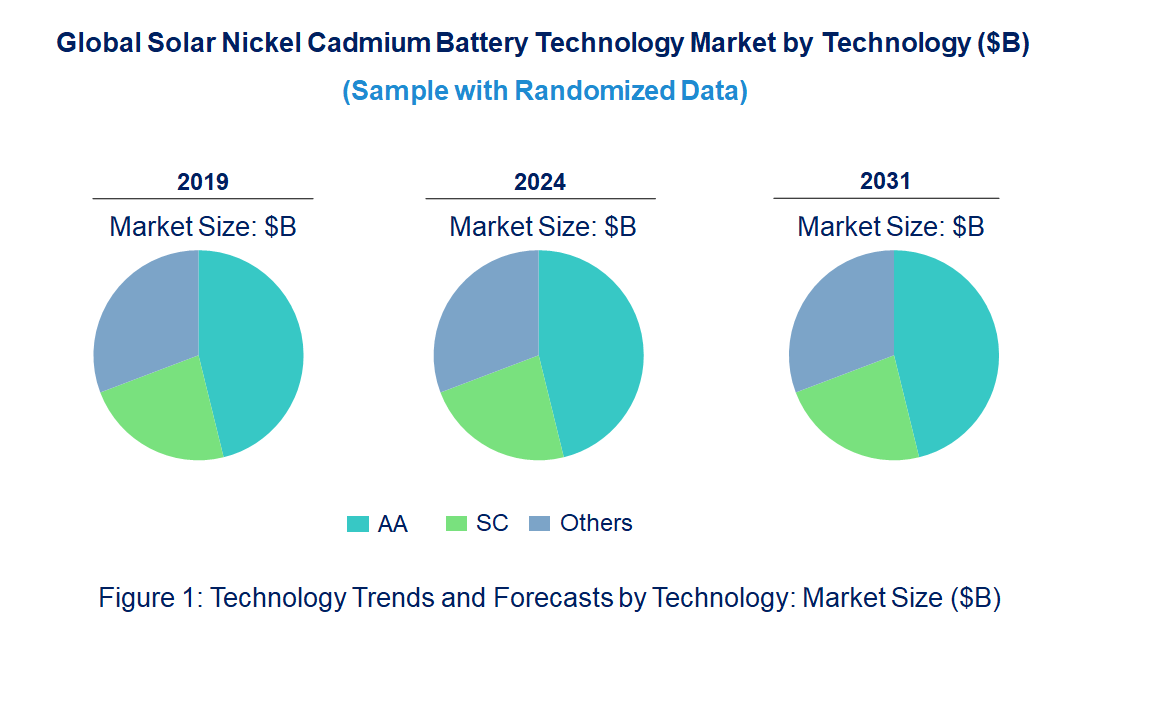
Emerging Trends in the Solar Nickel Cadmium Battery Market
The solar nickel-cadmium (Ni-Cd) battery technology has played a central role in facilitating the storage of renewable energy in recent years due to its reliability and durability. Evolving energy demands, changes, and technological development still require innovation in these lines. Here are five trends that characterize solar ni-cd battery future:• Transition to Hybrid Systems: Solar Ni-Cd batteries are being increasingly integrated into hybrid energy storage systems that combine multiple chemistries, such as Ni-Cd with lithium-ion (Li-ion). This approach optimizes performance, cost, and efficiency, enabling better energy management for solar installations.
• Advancements in Electrolyte Composition: Innovations in electrolyte materials improve the energy density as well as the cycle life of Ni-Cd. The reductions in maintenance, along with the extension of operational life, improve their competitiveness for remote and off-grid applications in solar.
• Recyclability and Sustainability End: With stricter environmental regulations, there is an increased focus on recycling and environmentally friendly disposal of Ni-Cd batteries. Advanced recycling technologies are recovering valuable materials like nickel and cadmium, which in turn reduce environmental impact and the cost of production.
• Miniaturization for Niche Applications: Compact and lightweight Ni-Cd batteries open up niche applications where ruggedness and reliability are the most important factors, such as portable solar-powered devices and specialized industrial systems.
• Improved Temperature Tolerance: Improved designs are allowing Ni-Cd batteries to operate effectively in a wider temperature range. This makes them suitable for solar installations in extreme climatic conditions, such as in deserts or arctic regions, where other battery technologies will fail. These emerging trends of solar nickel cadmium battery technology redefine its role in the renewable energy ecosystem. Thus, by addressing challenges concerning sustainability, efficiency, and adaptability, these innovations ensure that the Ni-Cd technology will stay a valuable component in this worldwide transition to clean energy solutions.
Solar Nickel Cadmium Battery Market : Industry Potential, Technological Development, and Compliance Considerations
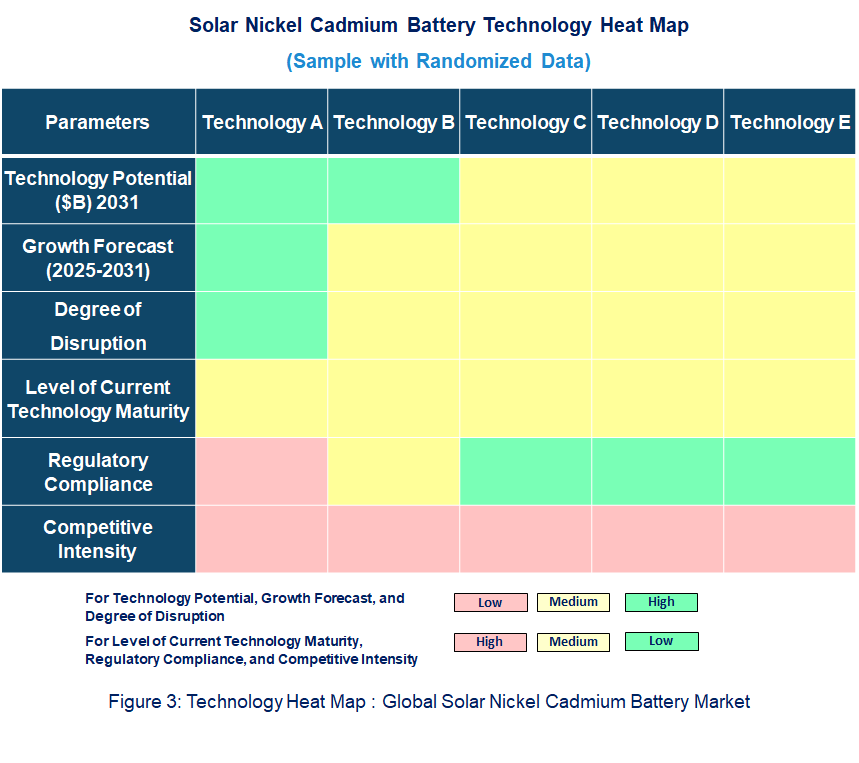
Nickel cadmium (Ni-Cd) battery technology has been cherished as a reliable and robust technology for storage applications in renewable energy. Despite its deep cycling and harsh environmental capability, Ni-Cd technology has remained an important player for specific solar energy use cases.• Technology Potential: Ni-Cd batteries are very rugged, allowing them to operate under extreme temperature conditions and severe cycling, providing consistent performance. These batteries are more effective for off-grid solar systems, telecommunication, and remote industrial applications where reliability and minimal maintenance are critical.
• Degree of Disruption: Though newer technologies such as lithium-ion (Li-ion) and sodium-ion batteries are gaining prominence, Ni-Cd remains a niche player. It is still useful in hybrid systems where modern chemistries augment Ni-Cd to optimize energy management. However, it's been phased out in some regions, partly because of environmental concerns about cadmium.
• Current Technology Maturity: The technology is mature with well-established processes and proven records of manufacturing Ni-Cd batteries. Advances in electrolyte formulations and recycling techniques further improve its efficiency and sustainability.
• Regulatory Compliance: Regulatory frameworks call for strict adherence to recycling and proper disposal because cadmium is toxic. Ni-Cd technology must meet environmental standards while competing with greener alternatives to remain relevant.
Recent Technological development in Solar Nickel Cadmium Battery Market by Key Players
Major key manufacturers of solar nickel-cadmium (Ni-Cd) battery technology continue developing technology improvements in performance, sustainability, and adaptability to various storage applications for renewable energy sources. With growing demands for dependable energy storage solutions within the off-grid and industrial industries, companies are continually finding improvements in cycle life, low environmental impact, and technological compatibility. Here's a recent overview of some key manufacturers' developments in the industry. Key Developments• Alcad: Alcad offers the market advanced Ni-Cd battery solutions that deliver increased energy efficiency and longer cycle life. Their industrial and renewable energy application ensures reliable performance under extreme temperature environments.
• Alcapower: Alcapower is offering a more compact and lightweight design of Ni-Cd battery packs for portable and off-grid solar applications. EverExceed Industrial has a focus on increasing energy density and achieving environmental compliance. EverExceed Industrial develops hybrid battery solutions wherein they combine the Ni-Cd technology with lithium-ion, known as Li-ion. Their breakthrough in hybrid battery solutions efficiently provides energy management and operational conditions to commercial and industrial solar-based facilities.
• Henan Hengming Fengyun Power Source: Henan Hengming enhanced the high temperature stability and lifespan for its Ni-Cd batteries through improved performance even at vast variations of temperatures. This significantly pertains to remote usage as it offers a vast span of temperatures that can provide considerable variations. Panasonic has included environment-friendly manufacturing processes in its Ni-Cd battery production. It uses advanced recycling technologies to recover valuable cadmium and nickel materials efficiently.
• SAFT: SAFT is refining Ni-Cd battery technologies, with a focus on high-performance applications in telecom and energy storage systems. Their solutions emphasize long cycle life and minimal maintenance requirements.
• SICHUAN CHANGHONG BATTERY: Sichuan Changhong has developed cost-effective Ni-Cd battery packs optimized for large-scale solar installations. Scalability and energy efficiency are key to these solutions.
• Interberg Batteries: Interberg Batteries offers robust Ni-Cd battery solutions tailored for industrial and grid storage applications, ensuring durability and long operational life with low environmental impact.
• Avatec Power: Avatec Power has introduced customized solar Ni-Cd systems that integrate well with hybrid energy settings that combine Ni-Cd and other technologies for better performance and cost efficiency. The recent developments in the solar nickel cadmium battery technology by these key players focus on enhancing sustainability, efficiency, and adaptability. With innovations in hybrid integration, environmental compliance, and temperature resilience, Ni-Cd batteries remain critical components of solar energy storage solutions even as newer alternatives emerge.
Solar Nickel Cadmium Battery Market Driver and Challenges
Solar nickel-cadmium (Ni-Cd) battery technology remains an essential solution in the area of energy storage for off-grid, industrial, and remote applications. Even though more modern technologies, such as lithium-ion (Li-ion), are becoming widely adopted, the need for a robust technology with longevity and resistance to harsh environmental conditions remains valid for the use of Ni-Cd. But, as with any technology, environmental factors, technological advancements, and economic situations determine the trends. The factors responsible for driving the solar nickel cadmium battery market include:• Long Cycle Life and Robustness: Ni-Cd batteries ensure excellent durability and cyclic operation, making them perfect for projects that demand continuous operation without frequent replacements. This reduces the long-term expenses of industrial and commercial solar plants.
• Energy Storage for Remote and Off-Grid Applications: Due to the endurance of Ni-Cd in terms of extreme temperature fluctuations, this battery type is preferred over the others for remote and off-grid solar applications where most technologies fail to maintain operation levels.
• Hybrid Application with Lithium-ion Technologies: Hybrid technologies that integrate both Ni-Cd and Li-ion batteries allow optimal performance and minimum cost and overcome the major challenges imposed by energy density and cycle life restrictions.
• Ecological and Cost-Saving Recycling: Improvement in recycling technologies allows for recovering nickel and cadmium materials; thus, a decreased environmental impact coupled with cheaper production.
• Industrial Implementation: Ni-Cd Solar is finding increasing applications in industrial settings and telecom networks where the requirements are of utmost reliability with minimal maintenance. Challenges
• Energy Storage for Solar Applications: Solar nickel cadmium (NiCd) batteries are widely used in energy storage systems for solar power applications due to their robustness and reliability. These batteries are capable of storing energy generated from solar panels during daylight hours and discharging it when there is no sunlight, making them ideal for off-grid or hybrid solar energy systems.
• Long-Term Performance and Durability: One of the key advantages of solar nickel-cadmium batteries is their long-term performance and durability. Unlike other battery technologies, NiCd batteries can withstand thousands of charge and discharge cycles without significant degradation, ensuring a longer lifespan. These opportunities point to the continued relevance of solar nickel cadmium battery technology in critical markets. Technological improvements, hybrid integrations, and sustainability initiatives are driving growth while addressing environmental and economic challenges, ensuring Ni-Cd remains a reliable choice in specialized solar energy storage applications.
List of Solar Nickel Cadmium Battery Companies
Companies in the market compete based on product quality offered. Major players in this market focus on expanding their manufacturing facilities, R&D investments, infrastructural development, and leverage integration opportunities across the value chain. With these strategies solar nickel cadmium battery companies cater to increasing demand, ensure competitive effectiveness, develop innovative products & technologies, reduce production costs, and expand their customer base. Some of the solar nickel cadmium battery companies profiled in this report include.• Alcad
• Alcapower
• Everexceed Industrial
• Henan Hengming Fengyun Power Source
• Panasonic
• SAFT
Solar Nickel Cadmium Battery Market by Technology
• Technology Readiness by Technology Type and Key Applications (AA, SC, Others): AA battery technology is mature and widely used in consumer electronics, toys, and small devices because of its cost efficiency and availability. SC technology is rapidly advancing, especially in automotive and renewable energy applications requiring quick charge-discharge cycles. Other technologies, such as lithium-ion and rechargeable alkaline cells, are gaining ground in consumer electronics, EVs, and industrial applications. Applications for SC include energy regeneration systems and backup power sources. Alternative forms are now targeted at the sustainability markets of consumers. Each has responded to specific needs: affordable AA, high power-density SC, and others targeting energy capacity and lifecycle performance, thus ensuring versatility for applications.
• Competitive intensity and regulatory compliance AA, SC, others: The competitive landscape in solar nickel cadmium battery for AA, SC, and other energy technologies is highly intense, as manufacturers are competing to reduce cost and improve performance. The AA technologies are under pressure from rechargeable batteries and newer chemistries that can provide higher energy efficiency. Supercapacitors (SC) are gaining traction in high-speed applications, challenging conventional battery systems. Regulatory compliance across these technologies focuses on safety, environmental impact, and disposal. AA technology should satisfy environmental requirements on alkaline disposal, while SC technologies are concerned with heat dissipation and lifespan constraints. Other technologies follow very tight recycling and sustainability standards in line with global energy and environmental regulations.
• Disruption Potential of Different Technologies (AA, SC, Others): Energy storage and applications are highly disruptive in nature, with technologies such as AA (Alkaline), SC (Super Capacitors), and others. Although the AA battery is very established, it is highly disrupted by more energy-efficient technologies. SC offers rapid charge and discharge capabilities, which highly disrupt applications requiring high power density. Other technologies, like lithium-based cells, continue to advance in terms of energy density and lifespan, thus displacing traditional AA and SC technologies. Emission-free rechargeable AA variants and new advanced chemistries are promising sustainable options; the integration of supercapacitors in hybrid systems helps to support battery performance and power storage efficiency, contributing to a change in efficiency and sustainability, along with a reduction in the costs of the lifecycle.
Solar Nickel Cadmium Battery Market Trend and Forecast by Technology [Value from 2019 to 2031]:
• AA
• SC
• Others
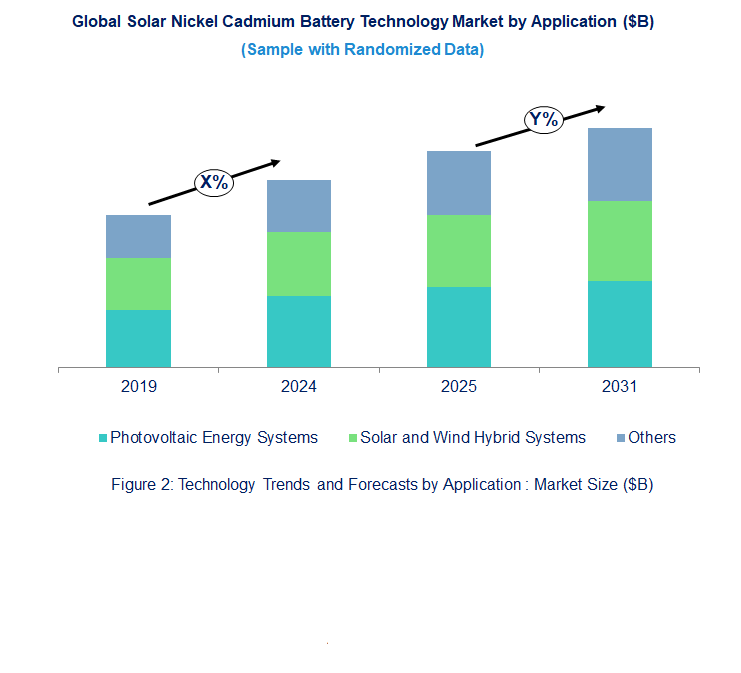
Solar Nickel Cadmium Battery Market Trend and Forecast by Application [Value from 2019 to 2031]:
• Photovoltaic Energy Systems
• Solar and Wind Hybrid Systems
• Others
Solar Nickel Cadmium Battery Market by Region [Value from 2019 to 2031]:
• North America
• Europe
• Asia Pacific
• The Rest of the World
• Latest Developments and Innovations in the Solar Nickel Cadmium Battery Technologies
• Companies / Ecosystems
• Strategic Opportunities by Technology Type
Features of the Global Solar Nickel Cadmium Battery Market
Market Size Estimates: Solar nickel cadmium battery market size estimation in terms of ($B). Trend and Forecast Analysis: Market trends (2019 to 2024) and forecast (2025 to 2031) by various segments and regions. Segmentation Analysis: Technology trends in the global solar nickel cadmium battery market size by various segments, such as application and technology in terms of value and volume shipments. Regional Analysis: Technology trends in the global solar nickel cadmium battery market breakdown by North America, Europe, Asia Pacific, and the Rest of the World. Growth Opportunities: Analysis of growth opportunities in different application, technologies, and regions for technology trends in the global solar nickel cadmium battery market. Strategic Analysis: This includes M&A, new product development, and competitive landscape for technology trends in the global solar nickel cadmium battery market. Analysis of competitive intensity of the industry based on Porter’s Five Forces model.Table of Contents
Methodology
- In-depth interviews of the major players in this market
- Detailed secondary research from competitors’ financial statements and published data
- Extensive searches of published works, market, and database information pertaining to industry news, company press releases, and customer intentions
- A compilation of the experiences, judgments, and insights of Lucintel’s professionals, who have analyzed and tracked this market over the years.


Buy Now
Choose a license that fits your team. Instant PDF delivery.
Prices exclude taxes. Instant delivery. Custom licensing available on request.
Key Questions
- • What are some of the most promising potential, high-growth opportunities for the technology trends in the global solar nickel cadmium battery market by technology (aa, sc, and others), application (photovoltaic energy systems, solar and wind hybrid systems, and others), and region (North America, Europe, Asia Pacific, and the Rest of the World)?
- • Which technology segments will grow at a faster pace and why?
- • Which regions will grow at a faster pace and why?
- • What are the key factors affecting dynamics of different technology? What are the drivers and challenges of these technologies in the global solar nickel cadmium battery market?
- • What are the business risks and threats to the technology trends in the global solar nickel cadmium battery market?
- • What are the emerging trends in these technologies in the global solar nickel cadmium battery market and the reasons behind them?
- • Which technologies have potential of disruption in this market?
- • What are the new developments in the technology trends in the global solar nickel cadmium battery market? Which companies are leading these developments?
- • Who are the major players in technology trends in the global solar nickel cadmium battery market? What strategic initiatives are being implemented by key players for business growth?
- • What are strategic growth opportunities in this solar nickel cadmium battery technology space?
- • What M & A activities did take place in the last five years in technology trends in the global solar nickel cadmium battery market?


