
Report Feature
Solar Electric System Market Trends and Forecast
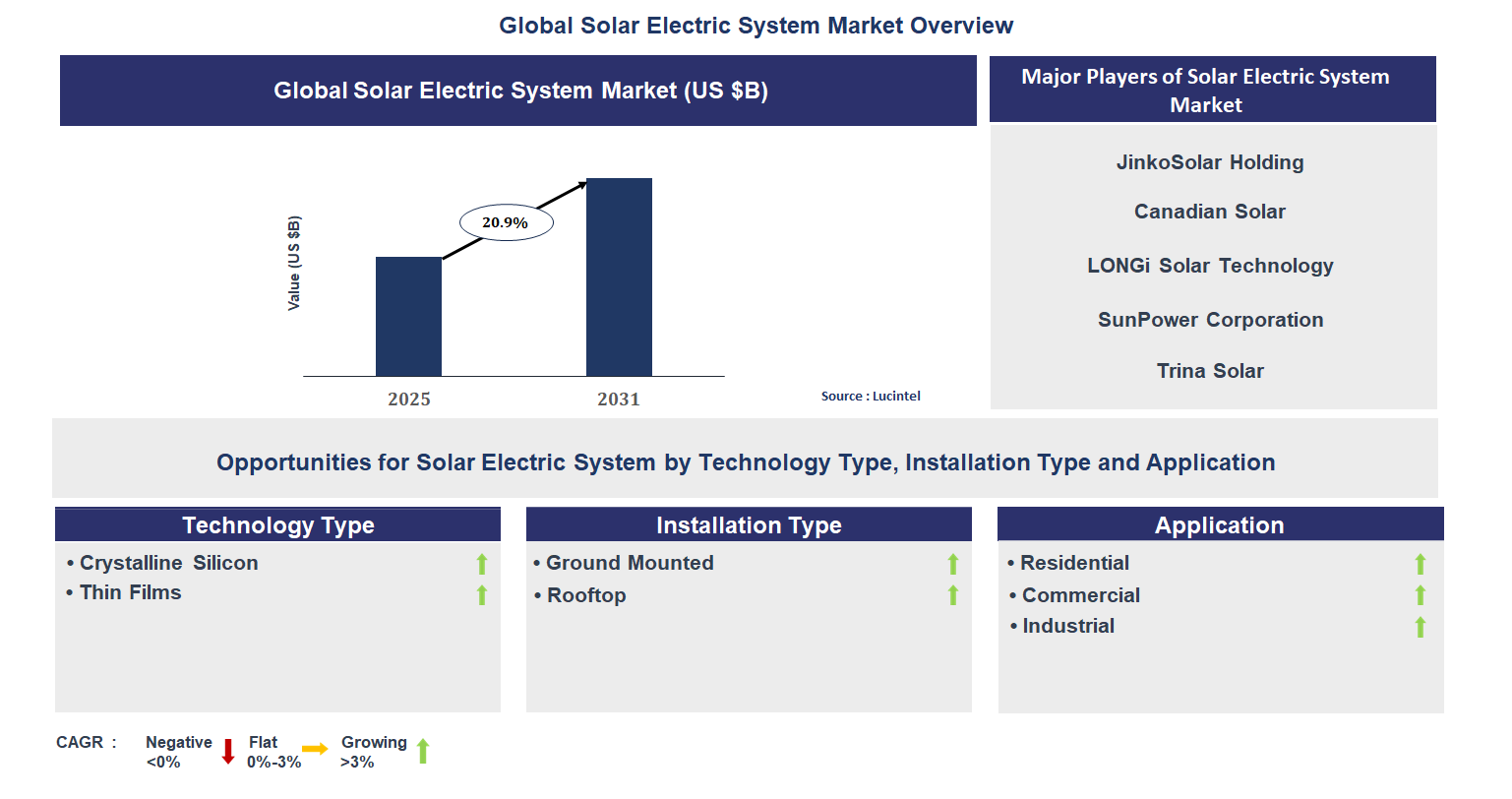
The future of the global solar electric system market looks promising with opportunities in the residential, commercial, and industrial markets. The global solar electric system market is expected to grow with a CAGR of 20.9% from 2025 to 2031. The major drivers for this market are the increasing investments in renewable energy infrastructure, the rising demand for sustainable power solutions, and the growing government incentives for solar adoption.• Lucintel forecasts that, within the technology type category, crystalline silicon is expected to witness higher growth over the forecast period.
• Within the application category, residential is expected to witness the highest growth.
• In terms of region, APAC is expected to witness the highest growth over the forecast period. Gain valuable insights for your business decisions with our comprehensive 150+ page report. Sample figures with some insights are shown below.
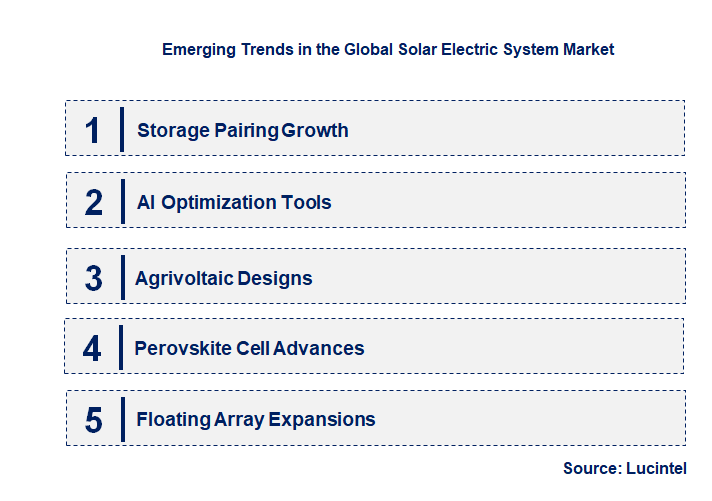
Emerging Trends in the Solar Electric System Market
Emerging trends in the solar electric system market highlight hybrid integrations and efficiency leaps amid electrification surges. These evolutions optimize intermittency and expand applications, aligning with sustainability imperatives across global grids.• Storage Pairing Growth: Solar-battery hybrids enable dispatchable power, addressing variability for reliable supply. This trend stabilizes grids, unlocks ancillary revenues, and reduces fossil backups, accelerating residential and utility adoptions in high-demand regions.
• AI Optimization Tools: Intelligent platforms forecast yields and automate maintenance for precision operations. Impacts include minimized losses, enhanced site designs, and investor confidence, driving scalable deployments in commercial landscapes.
• Agrivoltaic Designs: Dual-use panels over crops balance energy-agriculture, conserving resources via shading. This fosters diversified incomes, expands rural viability, and mitigates land conflicts for sustainable expansions.
• Perovskite Cell Advances: Tandem perovskites achieve superior efficiencies in flexible forms. They slash weights, enable BIPV, and broaden portable uses, transforming urban and off-grid integrations cost-effectively.
• Floating Array Expansions: Reservoir-based systems leverage water cooling for boosted performance. This unlocks non-arable sites, synergizes with hydro, and scales without land pressures in water-abundant areas. These trends are reshaping the solar electric system market by embedding intelligence and multifunctionality. They bridge intermittency gaps, diversify revenues, and promote inclusivity, positioning solar as foundational in resilient energy transitions.
Recent Development in the Solar Electric System Market
Recent developments in the solar electric system market emphasize capacity booms and policy pivots amid innovation waves. These strides are vital for yield enhancements and integrations, underpinning scalable renewables globally.• Global Capacity Milestones: Worldwide additions escalated, led by dominant regions in distributed and utility segments. This diversifies mixes, curbs fossil reliance, and stimulates manufacturing for broader clean access.
• Domestic Manufacturing Ramps: Nations localized production via incentives for supply security. Enhancements lower costs, trim footprints, and build workforces in emerging hubs.
• Policy Incentive Refinements: Updated subsidies accelerated project pipelines amid reforms. They unify standards, bridge funding voids, and empower stakeholders in advancements.
• Efficiency Breakthrough Achievements: Novel cell designs attained superior conversions. Advances shorten paybacks, widen hybrids and remotes.
• Grid Integration Pilots: Stable large-array links demonstrated scalability. Effects cut curtailments, refine forecasts, blend renewables smoothly. These developments are impacting the solar electric system market by amplifying robustness and interoperability. They dissolve rollout obstacles, kindle partnerships, and deepen sustainability, guiding toward equitable energy futures.
Strategic Growth Opportunities in the Solar Electric System Market
Strategic growth opportunities in the solar electric system market derive from sectoral demands, as clean power intensifies. Tailored systems unlock efficiencies in high-potential areas, capitalizing on policies for inclusive scaling.• Utility Grid Feed-Ins: Megascale arrays deliver bulk for baseloads. They transform transmissions, steady prices, mitigate carbons in operations.
• Residential Rooftops: Compact modules enable independence via metering. Bill cuts, property boosts, microgrid scalings resiliently.
• Commercial Building Integrations: Facades blend generation in facilities. Cost trims, fulfillments, credits energize electrified amenities.
• Agrivoltaic Crop Hybrids: Dual structures optimize farmlands energy-agriculture. Diversifications preserve resources, boom rural renewables.
• Off-Grid Remote Solutions: Portable kits illuminate isolates. Developments spark, digital enablings, micros via dependable provisions. These opportunities are impacting the solar electric system market by broadening arenas and streams. They ignite fusions, engagements, reinforce centrality in evolutions.
Solar Electric System Market Driver and Challenges
The solar electric system market is influenced by technological integrations, economic flexibilities, and regulatory mandates prioritizing clean transitions. These elements are crucial for adoption, efficiency, and alignment with electrification surges. The factors responsible for driving the solar electric system market include: 1. Policy Incentive Frameworks: Subsidies and mandates fuel regional accelerations. Catalyzing inflows, uniformities, embeddings for equitable disseminations. 2. Cost Reduction Gains: Declining module prices broaden accessibility. Democratizes installations, hastens ROIs, stimulates demands in infrastructures. 3. Electrification Demand Rises: Transport and digital surges necessitate renewables. Spurring hybrids, equilibrations versus instabilities. 4. Efficiency Tech Boosts: Material refinements yield higher outputs. Minimizations, enhancements, unlocks climates. 5. Supply Chain Diversifications: Hubs buffer disruptions for provisions. Nurturings, trims, norm alignments. Challenges in the solar electric system market are: 1. Upfront Investment Burdens: High capitals strain smaller adopters. Constrains scalability, urges financing for inclusivity. 2. Grid Stability Issues: Influxes overload networks, risking discards. Upgrades delay incorporations, inflate utilities. 3. Supply Volatility Exposures: Concentrated origins invite frictions. Diversifications hike outlays, tangle timelines. Drivers and challenges interplay in the solar electric system market, yielding net positives via mitigations. This equilibrium nurtures robust trajectories, embedding resilience and equity for enduring energy paradigms.List of Solar Electric System Companies
Companies in the market compete on the basis of product quality offered. Major players in this market focus on expanding their manufacturing facilities, R&D investments, infrastructural development, and leverage integration opportunities across the value chain. With these strategies solar electric system companies cater increasing demand, ensure competitive effectiveness, develop innovative products & technologies, reduce production costs, and expand their customer base. Some of the solar electric system companies profiled in this report include-• JinkoSolar Holding
• Canadian Solar
• LONGi Solar Technology
• SunPower Corporation
• Trina Solar
Solar Electric System Market by Segment
The study includes a forecast for the global solar electric system market by technology type, installation type, application, and region.Solar Electric System Market by Technology Type [Value from 2019 to 2031]:
• Crystalline Silicon
• Thin Films
Solar Electric System Market by Installation Type [Value from 2019 to 2031]:
• Ground Mounted
• Rooftop
Solar Electric System Market by Application [Value from 2019 to 2031]:
• Residential
• Commercial
• Industrial
Solar Electric System Market by Region [Value from 2019 to 2031]:
• North America
• Europe
• Asia Pacific
• The Rest of the World
Country Wise Outlook for the Solar Electric System Market
The solar electric system market is accelerating worldwide, propelled by policy incentives, technological efficiencies, and rising energy demands amid decarbonization goals. Key nations are expanding utility-scale farms, rooftop installations, and storage integrations, enhancing grid stability and affordability across residential, commercial, and industrial applications.• United States: The United States added substantial solar capacity in the first half, driven by utility-scale projects and data center demands despite policy shifts. Hybrid storage pairings and domestic manufacturing boosts are fortifying supply chains, supporting energy independence and resilience in diverse sectors.
• China: China achieved unprecedented solar additions, surpassing terawatt milestones with distributed and utility-scale expansions. Policy reforms and market trading mechanisms are optimizing deployments, reducing emissions and solidifying global manufacturing leadership for urban and rural electrification.
• Germany: Germany advanced rooftop and ground-mount systems, with plug-in balcony solutions and agrivoltaics gaining traction amid grid upgrades. Legislative reforms and EU funding promote self-consumption, enhancing urban autonomy and sustainability in manufacturing regions.
• India: India ramped module production and tender awards, targeting utility and rooftop segments via incentives. Domestic mandates and green hydrogen integrations bridge rural gaps, fostering self-reliance and economic growth in clean power applications.
• Japan: Japan pioneered flexible perovskite cells and rooftop mandates for new buildings, emphasizing lightweight urban solutions. Subsidies and hybrid EV integrations optimize limited spaces, bolstering disaster resilience and tech-driven renewables.

Features of the Global Solar Electric System Market
Market Size Estimates: Solar electric system market size estimation in terms of value ($B). Trend and Forecast Analysis: Market trends (2019 to 2024) and forecast (2025 to 2031) by various segments and regions. Segmentation Analysis: Solar electric system market size by technology type, installation type, application, and region in terms of value ($B). Regional Analysis: Solar electric system market breakdown by North America, Europe, Asia Pacific, and Rest of the World. Growth Opportunities: Analysis of growth opportunities in different technology types, installation types, applications, and regions for the solar electric system market. Strategic Analysis: This includes M&A, new product development, and competitive landscape of the solar electric system market. Analysis of competitive intensity of the industry based on Porter’s Five Forces model.
FAQ
Q1. What is the growth forecast for solar electric system market? Answer: The global solar electric system market is expected to grow with a CAGR of 20.9% from 2025 to 2031. Q2. What are the major drivers influencing the growth of the solar electric system market? Answer: The major drivers for this market are the increasing investments in renewable energy infrastructure, the rising demand for sustainable power solutions, and the growing government incentives for solar adoption. Q3. What are the major segments for solar electric system market? Answer: The future of the solar electric system market looks promising with opportunities in the residential, commercial, and industrial markets. Q4. Who are the key solar electric system market companies? Answer: Some of the key solar electric system companies are as follows:• JinkoSolar Holding
• Canadian Solar
• LONGi Solar Technology
• SunPower Corporation
• Trina Solar Q5. Which solar electric system market segment will be the largest in future? Answer: Lucintel forecasts that, within the technology type category, crystalline silicon is expected to witness higher growth over the forecast period. Q6. In solar electric system market, which region is expected to be the largest in next 5 years? Answer: In terms of region, APAC is expected to witness the highest growth over the forecast period. Q7. Do we receive customization in this report? Answer: Yes, Lucintel provides 10% customization without any additional cost.
Table of Contents
List of Figures
List of Tables
Methodology
- In-depth interviews of the major players in this market
- Detailed secondary research from competitors’ financial statements and published data
- Extensive searches of published works, market, and database information pertaining to industry news, company press releases, and customer intentions
- A compilation of the experiences, judgments, and insights of Lucintel’s professionals, who have analyzed and tracked this market over the years.


Buy Now
Choose a license that fits your team. Instant PDF delivery.
Prices exclude taxes. Instant delivery. Custom licensing available on request.
Key Questions
- • What are some of the most promising, high-growth opportunities for the solar electric system market by technology type (crystalline silicon and thin films), installation type (ground mounted and rooftop), application (residential, commercial, and industrial), and region (North America, Europe, Asia Pacific, and the Rest of the World)?
- • Which segments will grow at a faster pace and why?
- • Which region will grow at a faster pace and why?
- • What are the key factors affecting market dynamics? What are the key challenges and business risks in this market?
- • What are the business risks and competitive threats in this market?
- • What are the emerging trends in this market and the reasons behind them?
- • What are some of the changing demands of customers in the market?
- • What are the new developments in the market? Which companies are leading these developments?
- • Who are the major players in this market? What strategic initiatives are key players pursuing for business growth?
- • What are some of the competing products in this market and how big of a threat do they pose for loss of market share by material or product substitution?
- • What M&A activity has occurred in the last 5 years and what has its impact been on the industry? For any questions related to Solar Electric System Market, Solar Electric System Market Size, Solar Electric System Market Growth, Solar Electric System Market Analysis, Solar Electric System Market Report, Solar Electric System Market Share, Solar Electric System Market Trends, Solar Electric System Market Forecast, Solar Electric System Companies, write Lucintel analyst at email: helpdesk@lucintel.com. We will be glad to get back to you soon.


