
Market Report · July 15, 2026

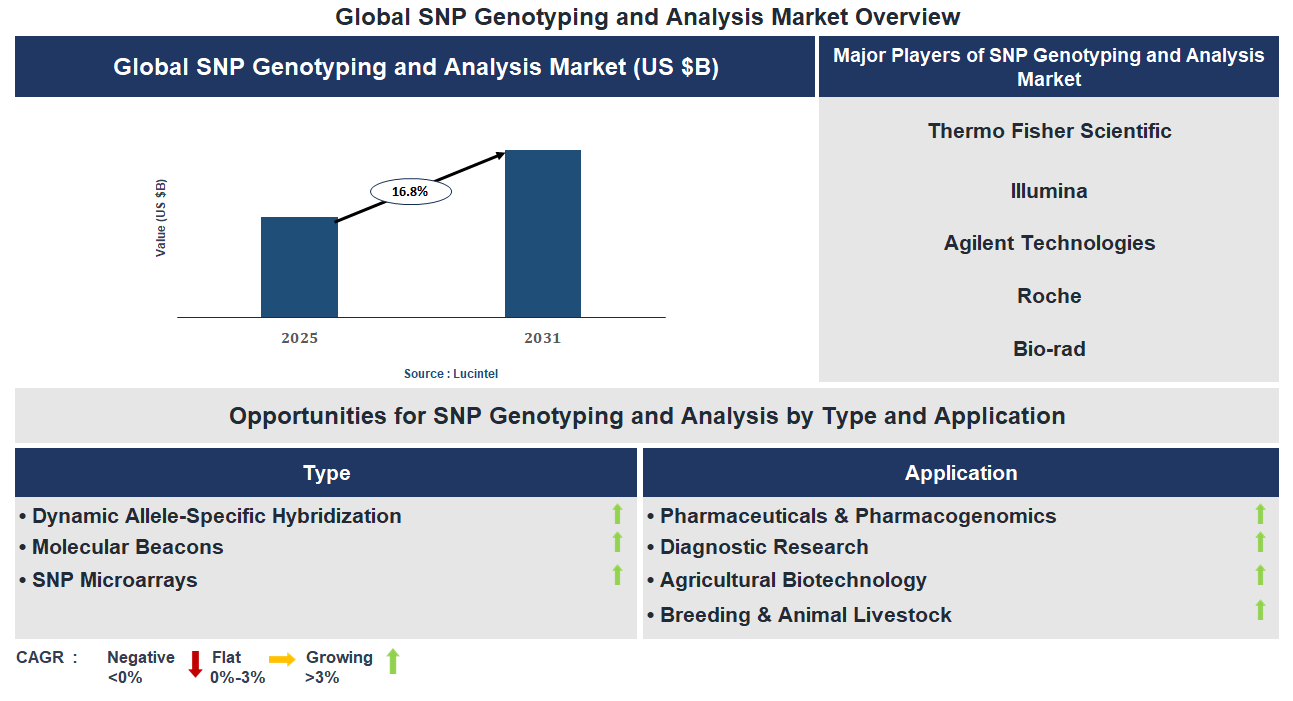
Key data points: The growth forecast = 16.8% annually for the next 7 years. Scroll below to get more insights. This market report covers trends, opportunities and forecasts in SNP genotyping and analysis market to 2031 by type (dynamic allele-specific hybridization, molecular beacons, and SNP microarrays), application (pharmaceuticals & pharmacogenomics, diagnostic research, agricultural biotechnology, and breeding & animal livestock), and region (North America, Europe, Asia Pacific, and the Rest of the World)
We'll send your sample report shortly.
• Lucintel forecasts that, within the type category, molecular beacon is expected to witness the highest growth over the forecast period.
• Within the application category, pharmaceutical & pharmacogenomic is expected to witness the highest growth.
• In terms of region, APAC is expected to witness the highest growth over the forecast period. Gain valuable insights for your business decisions with our comprehensive 150+ page report. Sample figures with some insights are shown below.
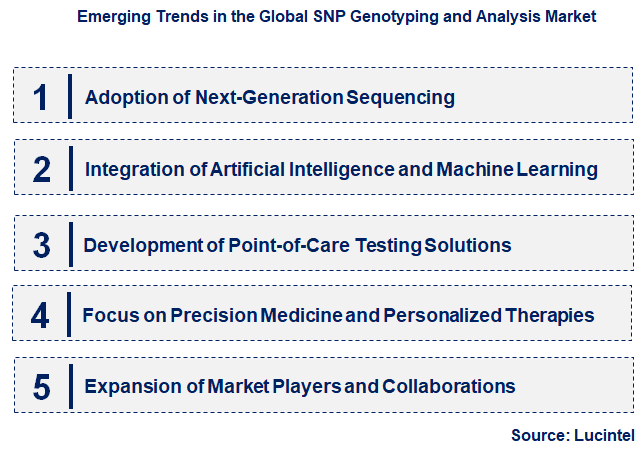
• Adoption of Next-Generation Sequencing: NGS technology is revolutionizing SNP genotyping by enabling high-throughput, cost-effective, and detailed genetic analysis. Its ability to process large volumes of data rapidly allows for comprehensive detection of genetic variations, improving accuracy and reducing turnaround times. This trend is expanding the scope of research and clinical applications, making genetic testing more accessible and reliable. As NGS becomes more affordable and user-friendly, it is expected to dominate the SNP analysis landscape, fostering personalized medicine and large-scale genetic studies.
• Integration of Artificial Intelligence and Machine Learning: AI and machine learning algorithms are increasingly being integrated into SNP analysis to enhance data interpretation and predictive accuracy. These technologies facilitate the identification of complex genetic patterns and associations that traditional methods might miss. AI-driven tools improve diagnostic precision, enable early disease detection, and support drug development by analyzing vast datasets efficiently. This trend is transforming SNP analysis from a purely laboratory-based activity into a sophisticated, data-driven process, ultimately accelerating research and clinical decision-making.
• Development of Point-of-Care Testing Solutions: The market is witnessing a rise in portable, easy-to-use SNP genotyping devices designed for point-of-care testing. These solutions enable rapid genetic analysis outside traditional laboratory settings, making genetic testing more accessible in remote or resource-limited areas. They are particularly valuable for personalized treatment plans, infectious disease management, and rapid diagnostics. The trend toward decentralization of testing is expected to improve healthcare delivery, reduce costs, and facilitate real-time decision-making, broadening the reach of genetic analysis technologies.
• Focus on Precision Medicine and Personalized Therapies: The increasing emphasis on personalized medicine is driving demand for detailed SNP analysis to tailor treatments to individual genetic profiles. This trend is particularly prominent in oncology, pharmacogenomics, and rare disease management. Accurate SNP data helps identify patient-specific drug responses and disease risks, leading to more effective and targeted therapies. As healthcare shifts toward individualized treatment approaches, the SNP genotyping market is expanding, supporting better patient outcomes and more efficient healthcare systems.
• Expansion of Market Players and Collaborations: The competitive landscape is becoming more dynamic with new entrants, collaborations, and strategic partnerships. Established biotech firms are partnering with tech companies to develop innovative genotyping platforms, while startups introduce disruptive solutions. These collaborations accelerate product development, expand market reach, and foster innovation. Increased competition and partnerships are driving down costs, improving product offerings, and broadening access to SNP analysis technologies, ultimately fueling market growth and technological progress. In summary, these emerging trends are fundamentally reshaping the SNP genotyping and analysis market by making genetic testing more precise, accessible, and integrated with advanced technologies. They are fostering a shift toward personalized healthcare, expanding research capabilities, and driving innovation across clinical and research settings. As these trends continue to evolve, the market is poised for significant growth, with broader applications and improved outcomes for patients and researchers alike.
• Technological Advancements in Sequencing: The introduction of next-generation sequencing (NGS) platforms has revolutionized SNP genotyping by enabling faster, more accurate, and cost-efficient analysis. These innovations have increased throughput and reduced turnaround times, making large-scale genetic studies feasible. As a result, researchers can now identify genetic variations with higher precision, accelerating discoveries in disease association and personalized medicine. This technological leap has expanded the market by attracting more healthcare providers and research institutions to adopt SNP analysis tools.
• Expansion of Clinical Applications: SNP genotyping is increasingly integrated into clinical diagnostics for disease risk assessment, pharmacogenomics, and personalized treatment plans. The development of targeted panels for specific conditions such as cancer, cardiovascular diseases, and rare genetic disorders has enhanced diagnostic accuracy. This expansion into clinical settings has driven market growth by creating new revenue streams and encouraging healthcare providers to incorporate genetic testing into routine care, ultimately improving patient outcomes.
• Strategic Collaborations and Partnerships: Major biotech firms, research institutions, and healthcare companies are forming strategic alliances to develop innovative SNP analysis solutions. These collaborations facilitate technology sharing, joint research, and commercialization efforts, accelerating product development. Such partnerships have expanded market reach, enhanced technological capabilities, and fostered the adoption of SNP genotyping in emerging markets, thereby broadening the overall market scope.
• Adoption of Cloud-Based Data Management: The integration of cloud computing with SNP genotyping platforms has streamlined data storage, analysis, and sharing. Cloud-based solutions offer scalable, secure, and cost-effective options for managing large genetic datasets. This development has improved data accessibility and collaboration among researchers and clinicians, leading to faster insights and decision-making. The increased adoption of cloud technology is thus fueling market expansion by supporting large-scale genetic studies and personalized medicine initiatives.
• Growing Use in Agriculture and Livestock: SNP genotyping is increasingly utilized in agriculture for crop improvement and livestock breeding. It helps identify desirable traits, enhance yield, and develop disease-resistant varieties. This application diversification has opened new revenue streams for market players and expanded the market beyond healthcare. The integration of SNP analysis in agriculture is contributing to food security and sustainable farming practices, further propelling market growth. In summary, these developments are significantly impacting the SNP genotyping and analysis market by enhancing technological capabilities, broadening application areas, and fostering collaborations. The market is becoming more integrated into clinical, research, and agricultural sectors, leading to increased adoption, improved accuracy, and cost efficiencies. These trends are poised to drive sustained growth and innovation in the coming years.
• Healthcare Diagnostics: Enhanced disease detection and personalized treatment options. SNP genotyping allows for precise identification of genetic predispositions, enabling early diagnosis and tailored therapies, which improve patient outcomes and reduce healthcare costs.
• Pharmacogenomics: Optimized drug development and personalized medicine. By understanding genetic variations, pharmaceutical companies can develop targeted drugs, minimize adverse effects, and increase treatment efficacy, transforming patient care.
• Agriculture and Crop Improvement: Development of genetically superior crops. SNP analysis helps identify desirable traits, leading to the creation of high-yield, pest-resistant, and climate-resilient crops, thereby boosting agricultural productivity.
• Research and Development: Accelerated genetic research and discovery. SNP genotyping facilitates understanding of genetic diversity and disease mechanisms, driving innovation in biomedical research and enabling new therapeutic targets.
• Forensic and Identity Testing: Improved accuracy in forensic investigations. SNP markers provide reliable genetic identification, enhancing the precision of criminal investigations, paternity testing, and ancestry analysis. In summary, these growth opportunities are significantly impacting the SNP genotyping and analysis market by expanding its applications and improving the accuracy, efficiency, and scope of genetic analysis. This evolution is fostering innovation across healthcare, agriculture, and research sectors, ultimately driving market growth and creating new revenue streams for industry stakeholders.
• Technological Advancements: The continuous development of high-throughput sequencing technologies and automation tools has significantly improved the speed, accuracy, and cost-effectiveness of SNP genotyping. These innovations enable large-scale genetic analysis, making it feasible for research institutions and healthcare providers to implement personalized medicine approaches. As technology evolves, new platforms and methods emerge, expanding the scope of SNP analysis and attracting investments. This ongoing innovation fosters a competitive environment, accelerates research, and broadens application areas, ultimately driving market growth.
• Rising Prevalence of Genetic Disorders: The increasing incidence of genetic disorders such as cancer, cardiovascular diseases, and rare inherited conditions has heightened the demand for precise genetic testing. SNP genotyping plays a crucial role in early diagnosis, risk assessment, and personalized treatment planning. As awareness about genetic factors in disease progression grows among healthcare providers and patients, the adoption of SNP analysis is expected to rise. This trend supports the expansion of the market, especially in regions with improving healthcare infrastructure and genetic testing capabilities.
• Growing Adoption of Personalized Medicine: The shift towards personalized medicine, which tailors treatment based on individual genetic profiles, is a major driver for SNP genotyping. This approach enhances treatment efficacy and reduces adverse effects, making it highly desirable in clinical settings. Governments and healthcare organizations are investing in genomic research and infrastructure to facilitate personalized therapies. The integration of SNP analysis into routine diagnostics and treatment planning is expected to accelerate, further propelling market growth and expanding the application landscape.
• Increasing Research and Development Activities: Investment in genomic research by pharmaceutical companies, academic institutions, and biotech firms is fueling innovation in SNP analysis technologies. R&D efforts aim to discover new genetic markers, develop targeted therapies, and improve diagnostic tools. This increased focus on genetic research enhances the understanding of complex diseases and supports the development of novel products and services. Consequently, the market benefits from a steady pipeline of innovative solutions, attracting funding and expanding its scope across various sectors.
• Expansion of Genomic Data Repositories: The accumulation of large-scale genomic databases facilitates more comprehensive SNP analysis and interpretation. These repositories enable researchers to identify genetic variations associated with diseases more efficiently and accurately. The availability of extensive genetic data accelerates discovery and validation processes, leading to improved diagnostic and therapeutic options. As data sharing and collaboration increase globally, the market benefits from enhanced insights, driving further innovation and adoption of SNP genotyping technologies. The challenges facing this SNP genotyping and analysis market include:
• Data Privacy and Ethical Concerns: The collection and analysis of genetic data raise significant privacy issues and ethical dilemmas. Patients and regulatory bodies are increasingly concerned about data security, consent, and potential misuse of genetic information. Stringent regulations and ethical guidelines can slow down research activities and limit data sharing, hindering market growth. Companies must invest in secure data management systems and transparent policies to build trust and comply with legal standards, which can be resource-intensive and complex.
• High Cost of Advanced Technologies: Despite technological improvements, the cost of sophisticated SNP genotyping platforms and associated analysis remains high, especially for small and medium-sized laboratories. This financial barrier limits access to cutting-edge tools in developing regions and constrains widespread adoption. Additionally, ongoing expenses related to data storage, analysis, and personnel training add to the overall cost burden. Reducing costs through technological innovation and economies of scale is essential to expand market reach and ensure broader accessibility.
• Technical Complexity and Data Management Challenges: SNP genotyping involves complex laboratory procedures and sophisticated data analysis, requiring specialized expertise and infrastructure. Managing vast amounts of genetic data poses significant challenges related to storage, processing, and interpretation. Variability in data quality and standardization issues can affect the reliability of results. Overcoming these technical hurdles necessitates continuous training, robust bioinformatics tools, and standardized protocols, which can be resource-intensive and slow down market growth. In summary, the SNP genotyping and analysis market is driven by rapid technological innovations, increasing disease prevalence, and a shift towards personalized medicine. However, challenges such as data privacy concerns, high costs, and technical complexities pose significant hurdles. The interplay of these factors will shape the market’s evolution, requiring stakeholders to innovate and adapt to sustain growth. Overall, the market holds substantial potential for advancing healthcare and research, provided these drivers and challenges are effectively managed.
• Thermo Fisher Scientific
• Illumina
• Agilent Technologies
• Roche
• Bio-rad
• LGC
• Sequenom
• Beckman Coulter
• QIAGEN
• Fluidigm
• Dynamic Allele-Specific Hybridization
• Molecular Beacons
• SNP Microarrays
• Pharmaceuticals & Pharmacogenomics
• Diagnostic Research
• Agricultural Biotechnology
• Breeding & Animal Livestock
• North America
• Europe
• Asia Pacific
• The Rest of the World
• United States: The US continues to lead in SNP genotyping innovation, with major investments in personalized medicine and biotech startups. Advances include the integration of AI-driven data analysis tools and increased adoption of next-generation sequencing (NGS) platforms. Federal agencies like NIH are funding large-scale genomic projects, fostering collaborations between academia and industry. The US also sees growing use of SNP analysis in cancer research, pharmacogenomics, and rare disease diagnostics, boosting market growth and technological advancements.
• China: China has rapidly expanded its SNP genotyping capabilities, driven by government initiatives to become a global biotech leader. The country has seen increased manufacturing of affordable genotyping kits and equipment, alongside investments in domestic research institutions. Chinese companies are focusing on large-scale population studies and precision medicine projects. The government’s support for biotech innovation and collaborations with international firms are accelerating the development and adoption of SNP analysis technologies across healthcare and agriculture sectors.
• Germany: Germany emphasizes high-quality, reliable SNP genotyping solutions, with a focus on clinical diagnostics and research. The country’s strong pharmaceutical and biotech industries are adopting advanced genotyping tools for drug development and personalized therapies. Germany is also investing in automation and data security to meet stringent regulatory standards. Collaborations between research institutes and industry are fostering innovations in genomic analysis, with a particular emphasis on ethical considerations and data privacy.
• India: India is witnessing rapid growth in SNP genotyping, driven by increasing healthcare awareness and government initiatives like the National Genomic Research Institute. The market is characterized by the proliferation of cost-effective genotyping services and local biotech startups. Focus areas include disease susceptibility studies, pharmacogenomics, and agricultural genomics. The government’s push for affordable healthcare and genomic research is fostering innovation, with collaborations between academia and industry enhancing technological capabilities.
• Japan: Japan maintains a strong position in SNP genotyping through its advanced biotech infrastructure and research expertise. The country is investing in precision medicine, especially in oncology and rare diseases, utilizing high-throughput genotyping platforms. Japanese firms are developing integrated solutions combining genotyping with data analytics and AI. The government supports genomic research through funding and regulatory frameworks, promoting innovation in personalized healthcare and bioinformatics, ensuring Japan remains a key player in the global SNP analysis market.


• Thermo Fisher Scientific
• Illumina
• Agilent Technologies
• Roche
• Bio-rad
• LGC
• Sequenom
• Beckman Coulter
• QIAGEN
• Fluidigm Q5. Which SNP genotyping and analysis market segment will be the largest in future? Answer: Lucintel forecasts that, within the type category, molecular beacon is expected to witness the highest growth over the forecast period. Q6. In SNP genotyping and analysis market, which region is expected to be the largest in next 5 years? Answer: In terms of region, APAC is expected to witness the highest growth over the forecast period. Q7. Do we receive customization in this report? Answer: Yes, Lucintel provides 10% customization without any additional cost.


Choose a license that fits your team. Instant PDF delivery.
Prices exclude taxes. Instant delivery. Custom licensing available on request.
Market Report · July 15, 2026
Market Report · May 18, 2026
Market Report · May 18, 2026
Trusted partner for strategic intelligence and business growth


Receive a complimentary market analysis tailored to your industry. Our analysts will identify key growth opportunities and competitive dynamics specific to your business.

Market size, growth rate, and key trend analysis for your specific sector.

Top competitor positioning and market share analysis.

Strategic recommendations backed by data-driven insights.
Get curated market intelligence and competitive moves straight to your inbox.
By subscribing, you agree to receive our monthly insights. Unsubscribe anytime.
Receive a complimentary market analysis tailored to your industry. Our analysts will identify key growth opportunities and competitive dynamics specific to your business.
Market size, growth rate, and key trend analysis for your specific sector.
Top competitor positioning and market share analysis.
Strategic recommendations backed by data-driven insights.
Get curated market intelligence, emerging trends, and competitive moves straight to your inbox each month.
By subscribing, you agree to receive our monthly insights. Unsubscribe anytime.
We'll send your sample report shortly.