
Report Feature
Sniper Rifle Market Trends and Forecast
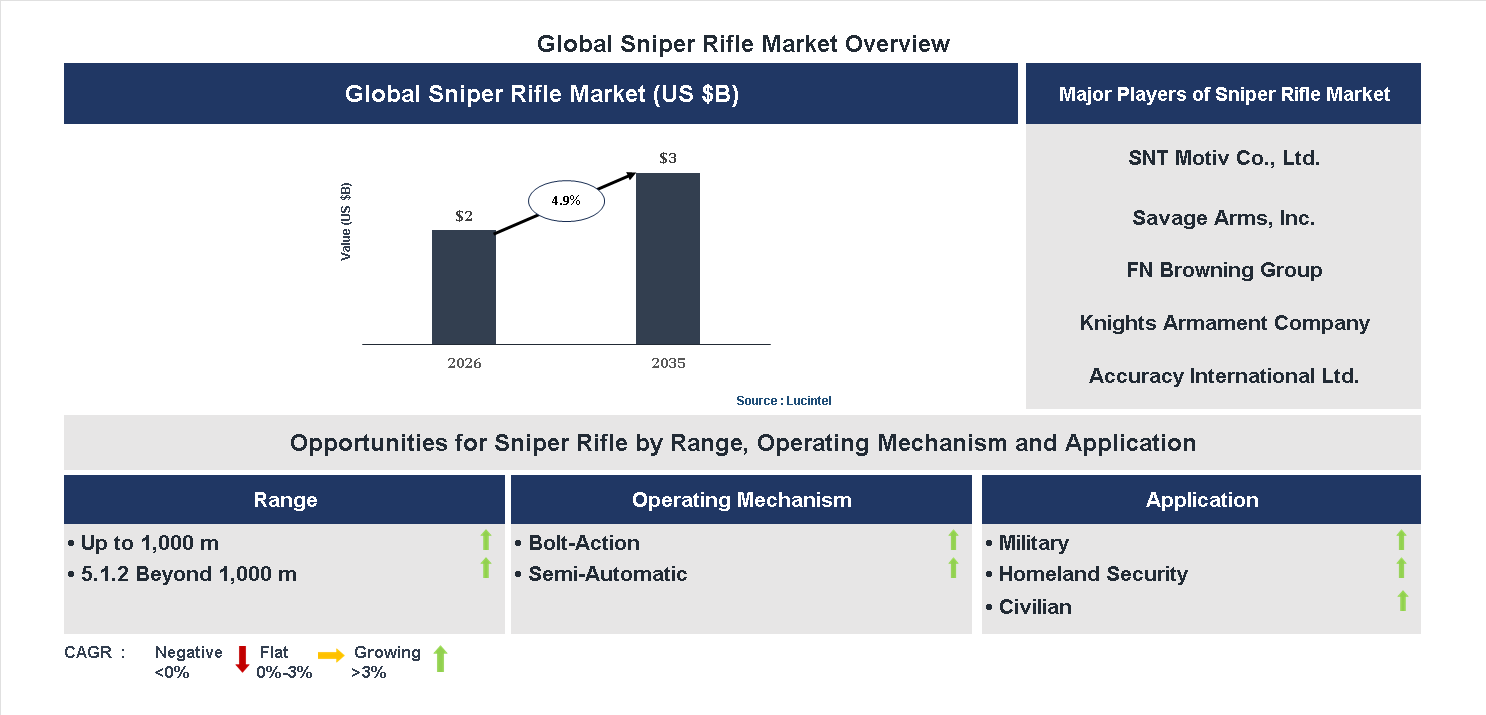
The future of the global sniper rifle market looks promising with opportunities in the military, homeland security, and civilian markets. The global sniper rifle market is expected to reach an estimated $3 billion by 2035 with a CAGR of 4.9% from 2026 to 2035. The major drivers for this market are the increasing demand for long range precision weapons, the rising focus on military modernization programs, and the growing adoption of advanced targeting technologies.• Lucintel forecasts that, within the operating mechanism category, bolt-action is expected to witness higher growth over the forecast period.
• Within the application category, military is expected to witness the highest growth.
• In terms of region, APAC is expected to witness the highest growth over the forecast period. Gain valuable insights for your business decisions with our comprehensive 150+ page report. Sample figures with some insights are shown below.
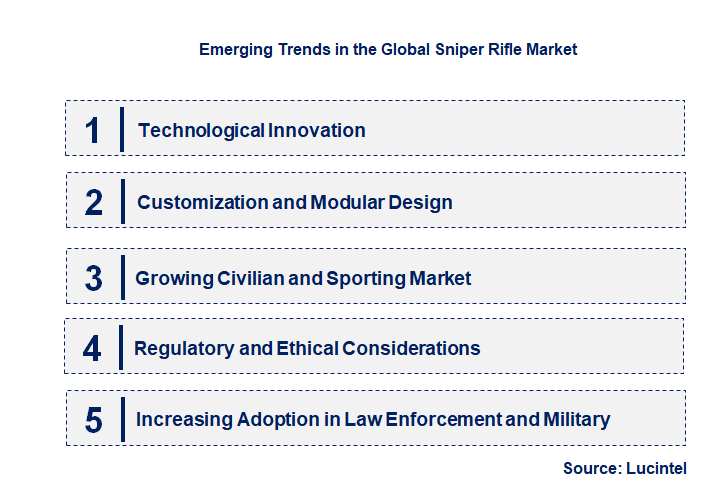
Emerging Trends in the Sniper Rifle Market
The sniper rifle market is experiencing rapid evolution driven by technological advancements, changing security needs, and increasing demand across military, law enforcement, and civilian sectors. As global security concerns grow and technological innovations become more accessible, the market is witnessing significant shifts in product development, customization, and application. These emerging trends are shaping the future landscape of sniper rifles, influencing manufacturers, consumers, and regulatory bodies alike. Understanding these key developments is essential for stakeholders aiming to stay competitive and adapt to the dynamic environment of this specialized market.• Technological Innovation : Integration of advanced optics, thermal imaging, and smart targeting systems is transforming sniper rifles. These innovations enhance accuracy, range, and situational awareness, providing users with a tactical advantage. Manufacturers are investing in developing lightweight materials and modular designs to improve portability and customization. The adoption of digital interfaces and data-sharing capabilities is also increasing, enabling real-time communication and coordination. This trend is expanding the capabilities of sniper rifles beyond traditional roles, making them more effective in complex operational environments.
• Customization and Modular Design : Increasing demand for tailored solutions is driving the shift toward modular sniper rifles. Users seek rifles that can be easily adapted for different missions, calibers, and environments. Manufacturers are offering customizable components such as barrels, stocks, and optics, allowing end-users to optimize performance. This flexibility enhances operational efficiency and user satisfaction. The trend is particularly prominent in military and law enforcement sectors, where specific mission requirements demand adaptable equipment. Modular designs also facilitate easier maintenance and upgrades, extending the lifespan of the rifles.
• Growing Civilian and Sporting Market : The civilian segment of the sniper rifle market is expanding due to rising interest in long-range shooting sports, hunting, and personal defense. This growth is fueled by increased accessibility, affordability, and awareness of legal regulations. Manufacturers are developing precision rifles with user-friendly features suitable for enthusiasts and professionals alike. The civilian markets expansion is also encouraging innovation in lightweight, ergonomic, and aesthetically appealing designs. As a result, the market is diversifying, with a broader range of products catering to different skill levels and preferences, thereby increasing overall market size.
• Regulatory and Ethical Considerations : Stricter regulations and ethical debates surrounding firearm ownership and usage are influencing market dynamics. Governments are implementing tighter controls on the sale, import, and export of sniper rifles, impacting supply chains and pricing. Ethical concerns about civilian access to high-precision weapons are prompting discussions on licensing and usage restrictions. Manufacturers are responding by emphasizing compliance, safety features, and transparency. This trend may lead to market consolidation and innovation in non-lethal or less regulated alternatives, shaping future product development and market strategies.
• Increasing Adoption in Law Enforcement and Military : The demand for advanced sniper rifles is rising among law enforcement and military agencies worldwide. These organizations seek high-precision, reliable, and durable weapons for tactical operations, counter-terrorism, and border security. The focus is on integrating cutting-edge technology, such as suppressors, advanced optics, and ballistic calculators. The trend is driven by geopolitical tensions and the need for specialized equipment to address asymmetric threats. As a result, the market is witnessing increased procurement, R&D investments, and strategic partnerships, which are propelling innovation and expanding the markets scope. These trends are collectively reshaping the sniper rifle market by fostering technological advancements, promoting customization, expanding civilian applications, navigating regulatory landscapes, and meeting the evolving needs of security forces. This dynamic environment is likely to lead to more sophisticated, versatile, and accessible sniper rifle solutions in the coming years.
Recent Development in the Sniper Rifle Market
The sniper rifle market is experiencing rapid growth driven by technological advancements, increasing demand from military and law enforcement agencies, and expanding civilian applications. Innovations in precision, scope technology, and lightweight materials are transforming the industry. Governments worldwide are investing heavily in advanced weaponry, while civilian markets are expanding with sporting and hunting needs. This dynamic environment presents significant opportunities for manufacturers to develop cutting-edge products, meet evolving customer demands, and capture new market segments.• Technological Innovations: Enhanced Precision and Scope Technology Drive Growth: The development of advanced optics, thermal imaging, and ballistic calculators is improving sniper rifle accuracy and reliability. These innovations are crucial for military and law enforcement operations, leading to increased adoption. Civilian markets benefit from improved hunting and sporting rifles. The integration of smart technology and modular designs further boosts market appeal, enabling customization and real-time data access. Overall, technological progress is expanding the market’s scope and capabilities.
• Military and Law Enforcement Demand: Increasing Investment in Advanced Weaponry: Governments worldwide are prioritizing the procurement of high-precision sniper rifles to strengthen defense capabilities. Modern conflicts and border security concerns necessitate reliable, long-range weapons. Law enforcement agencies also seek sniper rifles for tactical operations and hostage rescue missions. This sustained demand is driving manufacturers to innovate and produce specialized, durable, and adaptable rifles. The growth in military and law enforcement procurement significantly contributes to the expanding market size and technological evolution.
• Expansion of Civilian and Sporting Markets: Growing Popularity of Hunting and Shooting Sports: The civilian segment is witnessing rapid growth due to rising interest in hunting, shooting sports, and recreational marksmanship. Manufacturers are offering a variety of models tailored for different skill levels and preferences. Customization options, ergonomic designs, and affordability are attracting a broader consumer base. Additionally, the rise of competitive shooting events and hunting tourism fuels demand. This diversification of applications is broadening the market beyond traditional military and law enforcement sectors.
• Material and Design Innovations: Lighter, Stronger, and More Durable Rifles: Advances in materials such as carbon fiber and composites are enabling the production of lightweight yet durable sniper rifles. These innovations improve portability and ease of use, especially for field operations. Modular designs allow for easy upgrades and customization. Enhanced manufacturing techniques increase precision and longevity. These material and design improvements are critical for meeting the diverse needs of military, law enforcement, and civilian users, thereby expanding market potential and product offerings.
• Regulatory and Geopolitical Factors: Impact on Market Dynamics and Growth: Changes in firearm regulations and export policies influence market accessibility and growth prospects. Geopolitical tensions and conflicts increase demand for advanced sniper rifles globally. Conversely, stricter regulations can pose barriers to market entry and distribution. Manufacturers must navigate complex legal landscapes and adapt to regional policies. These factors significantly shape market strategies, influence supply chains, and determine the pace of technological adoption, ultimately impacting overall market growth and competitiveness. The recent developments in technology, increased military and civilian demand, material innovations, and regulatory factors are collectively transforming the sniper rifle market. These opportunities are driving innovation, expanding market segments, and increasing global competitiveness. As a result, the industry is poised for sustained growth, with manufacturers focusing on advanced, lightweight, and customizable products to meet diverse needs. Overall, these developments are creating a dynamic, competitive environment that is shaping the future of the sniper rifle market.
Strategic Growth Opportunities in the Sniper Rifle Market
The sniper rifle market is experiencing significant growth driven by advancements in technology, increasing demand from military and law enforcement agencies, and expanding applications in sports shooting and hunting. Innovations in precision, scope technology, and lightweight materials are enhancing product offerings. Additionally, geopolitical tensions and security concerns are fueling procurement activities worldwide. Market players are focusing on product diversification, strategic partnerships, and regional expansion to capitalize on emerging opportunities. This dynamic environment presents numerous avenues for growth, innovation, and competitive advantage across various segments and applications.• Military and Law Enforcement Applications: Expanding procurement of advanced sniper rifles for tactical operations, border security, and counter-terrorism efforts is a key growth driver. Governments are investing in precision weapons with enhanced range, accuracy, and durability. The demand for specialized variants such as anti-materiel rifles and lightweight models is increasing, driven by evolving operational needs. Strategic partnerships with defense contractors and technological innovations are further boosting market expansion in this segment.
• Hunting and Sporting Shooters: The rising popularity of long-range shooting sports and hunting activities is creating substantial opportunities. Consumers seek high-precision, customizable sniper rifles with ergonomic designs and advanced optics. The development of sub-segments like tactical hunting and competitive shooting is expanding the customer base. Manufacturers are focusing on product innovation, including modular systems and lightweight materials, to meet the preferences of enthusiasts and professional shooters.
• Technological Innovations in Scope and Ammunition: Advancements in scope technology, such as thermal imaging, night vision, and ballistic calculators, are significantly enhancing sniper rifle capabilities. Innovations in ammunition, including high-precision, low-recoil, and specialized calibers, are improving accuracy and operational efficiency. These technological improvements are enabling better performance in diverse environments, thus opening new market opportunities. Companies investing in R&D are gaining competitive advantages through cutting-edge product offerings.
• Regional Market Expansion and Government Contracts: Growing defense budgets in regions like Asia-Pacific, Middle East, and Africa are fueling sniper rifle procurement. Governments are prioritizing modernization programs, leading to increased tendering and contract awards. Regional manufacturing hubs and strategic alliances are facilitating faster delivery and customization. Market players are expanding their presence through regional offices and partnerships to tap into emerging markets and meet local regulatory requirements.
• Customization and Modular Design Trends: Increasing demand for personalized and adaptable sniper rifles is driving innovation in modular systems. Customers seek rifles that can be tailored for specific missions, calibers, and ergonomic preferences. Modular designs allow easy upgrades and maintenance, appealing to military, law enforcement, and civilian users. This trend enhances product versatility, reduces costs, and accelerates deployment, thereby expanding market share for manufacturers offering customizable solutions. The overall market outlook indicates robust growth driven by technological advancements, expanding applications, and regional opportunities. Companies that innovate and adapt to evolving customer needs will strengthen their market positions. Strategic investments in R&D, regional expansion, and product customization are essential for capturing emerging opportunities. As demand continues to rise across sectors, the sniper rifle market is poised for sustained growth and increased competitiveness in the coming years.
Sniper Rifle Market Driver and Challenges
The sniper rifle market is influenced by a complex interplay of technological advancements, economic factors, and regulatory frameworks. Innovations in firearm technology, such as precision targeting systems and lightweight materials, drive market growth by enhancing performance and user experience. Economic considerations, including defense budgets and military spending, significantly impact demand across regions. Regulatory policies concerning firearm control and export restrictions also shape market dynamics, influencing accessibility and international trade. Additionally, geopolitical tensions and security concerns further propel the need for advanced sniper rifles. Understanding these multifaceted drivers and challenges is essential for stakeholders aiming to navigate and capitalize on the evolving landscape of the sniper rifle industry. The factors responsible for driving the sniper rifle market include:• Technological Innovation: The development of advanced targeting systems, lightweight materials, and modular designs enhances sniper rifle performance. These innovations improve accuracy, durability, and ease of use, making sniper rifles more effective for military, law enforcement, and civilian applications. As technology continues to evolve, manufacturers are investing heavily in R&D to stay competitive, which fuels market growth. The integration of smart scopes and night vision capabilities further broadens the application scope, attracting a wider customer base and increasing demand globally.
• Military and Defense Spending: Increasing defense budgets across various countries are a primary driver. Governments are investing in modernizing their armed forces, which includes procuring high-precision sniper rifles for tactical operations. The rising threat of terrorism and regional conflicts necessitate advanced weaponry, boosting demand. Countries like the US, China, and Russia are significant contributors, with military procurement policies directly influencing market expansion. This sustained spending ensures a steady growth trajectory for the sniper rifle industry, especially in regions with ongoing security concerns.
• Regulatory Environment: Stringent firearm regulations and export controls impact the market significantly. Countries impose restrictions on civilian ownership and international trade of sniper rifles, which can limit market accessibility. Conversely, relaxed regulations in certain regions facilitate growth by enabling easier procurement and export. Compliance with international standards, such as ITAR in the US, influences manufacturing and distribution strategies. Navigating these regulatory landscapes is crucial for market players to expand their reach and maintain legal operations, affecting overall market dynamics.
• Growing Civilian and Law Enforcement Demand: The civilian market is expanding due to increased interest in shooting sports, hunting, and personal security. Law enforcement agencies are also adopting sniper rifles for tactical operations, crowd control, and hostage situations. This diversification of demand from non-military sectors opens new revenue streams for manufacturers. The rising popularity of precision shooting sports and hunting in North America and Europe further propels market growth, encouraging innovation and product development tailored to civilian needs.
• Strategic Partnerships and Mergers: Collaborations between firearm manufacturers, technology firms, and defense contractors are fostering innovation and expanding market reach. Mergers and acquisitions enable companies to access new markets, share R&D costs, and develop cutting-edge products. These strategic alliances often lead to the introduction of advanced sniper systems, boosting competitiveness. Such partnerships also facilitate compliance with regulatory standards and enhance distribution networks, thereby accelerating market growth and consolidating industry players positions globally. The challenges facing the sniper rifle market are:
• Regulatory Restrictions: Strict firearm laws and export controls pose significant barriers. Many countries enforce comprehensive regulations that restrict civilian ownership and limit international trade, reducing market size. These policies can delay product launches and increase compliance costs for manufacturers. Additionally, changing regulations require continuous adaptation, which can hinder rapid innovation and market expansion. Non-compliance risks legal penalties and reputational damage, making regulatory navigation a critical challenge for industry players.
• High Manufacturing Costs: Developing advanced sniper rifles involves substantial investment in R&D, quality materials, and precision manufacturing processes. These costs translate into higher retail prices, potentially limiting consumer and institutional adoption. Small and medium-sized manufacturers may struggle to compete with larger firms that benefit from economies of scale. Fluctuations in raw material prices, such as specialized alloys and optics components, further impact profitability. Managing production costs while maintaining high standards remains a persistent challenge in sustaining competitive advantage.
• Geopolitical and Security Concerns: Political instability and regional conflicts influence market stability. While increased security threats can boost demand, they also introduce uncertainties related to procurement policies and international trade restrictions. Export bans and sanctions can disrupt supply chains and limit access to key markets. Moreover, ethical concerns and public opinion about firearm proliferation can lead to stricter regulations, affecting market growth. Navigating geopolitical risks requires strategic planning and adaptability from manufacturers and stakeholders. The sniper rifle market is shaped by rapid technological advancements, substantial defense investments, and evolving regulatory landscapes. While these drivers foster growth by expanding applications and improving product offerings, challenges such as regulatory restrictions, high manufacturing costs, and geopolitical uncertainties pose hurdles. The interplay of these factors determines the markets trajectory, requiring industry players to innovate, adapt, and collaborate strategically. Overall, the markets future hinges on balancing technological progress with regulatory compliance and geopolitical stability to sustain growth and meet diverse demand segments.
List of Sniper Rifle Companies
Companies in the market compete on the basis of product quality offered. Major players in this market focus on expanding their manufacturing facilities, R&D investments, infrastructural development, and leverage integration opportunities across the value chain. With these strategies sniper rifle companies cater increasing demand, ensure competitive effectiveness, develop innovative products & technologies, reduce production costs, and expand their customer base. Some of the sniper rifle companies profiled in this report include-• SNT Motiv Co., Ltd.
• Savage Arms, Inc.
• FN Browning Group
• Knights Armament Company
• Accuracy International Ltd.
• Strategic Armory Corps, LLC
• Zastava Arms USA
• B&T AG
• PGM Précision
• Heckler & Koch GmbH
Sniper Rifle Market by Segment
The study includes a forecast for the global sniper rifle market by range, operating mechanism, application, and region.Sniper Rifle Market by Range [Value from 2019 to 2035]:
• Up to 1,000 m
• 5.1.2 Beyond 1,000 m
Sniper Rifle Market by Operating Mechanism [Value from 2019 to 2035]:
• Bolt-Action
• Semi-Automatic
Sniper Rifle Market by Application [Value from 2019 to 2035]:
• Military
• Homeland Security
• Civilian
Sniper Rifle Market by Region [Value from 2019 to 2035]:
• North America
• Europe
• Asia Pacific
• The Rest of the World
Country Wise Outlook for the Sniper Rifle Market
The sniper rifle market has experienced significant growth and innovation driven by technological advancements, increasing demand for military and law enforcement applications, and evolving regulations. Countries are investing in research to enhance precision, range, and durability of sniper rifles. The market is also influenced by geopolitical tensions and the need for advanced tactical equipment. As a result, manufacturers are focusing on developing lightweight, customizable, and high-performance models to meet diverse operational needs. These developments reflect a broader trend toward integrating modern technology into traditional firearm designs, shaping the future landscape of the sniper rifle industry globally.• United States: The US market has seen substantial growth with a focus on high-precision, modular sniper systems. Innovations include integration of advanced optics, thermal imaging, and lightweight materials. Military and law enforcement agencies are investing heavily in next-generation sniper rifles, emphasizing accuracy and adaptability. The rise of civilian tactical shooting sports has also contributed to increased demand for premium models. Regulatory changes and import restrictions are shaping market dynamics, encouraging domestic manufacturing and innovation. Overall, the US remains a leader in sniper rifle technology, with ongoing developments aimed at enhancing operational effectiveness.
• China: China’s sniper rifle market is rapidly expanding, driven by increased military modernization and domestic production capabilities. The country is focusing on developing cost-effective, durable, and reliable rifles suitable for various terrains. Recent advancements include integration of electronic targeting systems and improved ergonomics. Government investments in defense technology have spurred local innovation, reducing reliance on foreign imports. The market also sees a growing civilian segment, especially in tactical sports and hunting. As China continues to modernize its armed forces, the demand for advanced sniper rifles is expected to grow, fostering further technological development and domestic manufacturing.
• Germany: Germany’s sniper rifle market is characterized by high-quality, precision-engineered firearms primarily used by military and law enforcement. The focus is on enhancing accuracy, stability, and customization options. Recent developments include the adoption of modular systems that allow for easy upgrades and integration with advanced optics and targeting systems. German manufacturers emphasize durability and compliance with strict European safety standards. The market also benefits from a strong export sector, with German rifles being highly regarded worldwide. Innovations are centered around lightweight materials and improved ballistic performance, ensuring Germany remains a key player in the global sniper rifle industry.
• India: India’s sniper rifle market is witnessing rapid growth due to modernization efforts within its armed forces. The government is prioritizing indigenous development and procurement of advanced sniper systems. Recent advancements include the integration of night vision, laser rangefinders, and ergonomic designs tailored for diverse operational environments. Domestic manufacturers are collaborating with international firms to enhance technology transfer and production capabilities. The civilian segment is also expanding, driven by increased interest in tactical sports and hunting. As India continues to modernize its military, the demand for sophisticated sniper rifles is expected to rise, fostering innovation and local manufacturing.
• Japan: Japan’s sniper rifle market is focused on high-precision, lightweight firearms suitable for military and law enforcement use. Recent developments include the adoption of advanced materials such as carbon fiber to reduce weight and improve portability. Japan emphasizes technological integration, including electronic targeting and stabilization systems. The market is driven by a need for reliable, durable rifles capable of operating in diverse environments. Japanese manufacturers prioritize quality and compliance with strict safety standards, maintaining a competitive edge globally. Ongoing innovations aim to enhance accuracy, ease of use, and adaptability, ensuring Japan remains a significant player in the global sniper rifle industry.

Features of the Global Sniper Rifle Market
Market Size Estimates: Sniper rifle market size estimation in terms of value ($B). Trend and Forecast Analysis: Market trends (2019 to 2025) and forecast (2026 to 2035) by various segments and regions. Segmentation Analysis: Sniper rifle market size by range, operating mechanism, application, and region in terms of value ($B). Regional Analysis: Sniper rifle market breakdown by North America, Europe, Asia Pacific, and Rest of the World. Growth Opportunities: Analysis of growth opportunities in different range, operating mechanisms, applications, and regions for the sniper rifle market. Strategic Analysis: This includes M&A, new product development, and competitive landscape of the sniper rifle market. Analysis of competitive intensity of the industry based on Porter’s Five Forces model.
FAQ
Q1. What is the sniper rifle market size? Answer: The global sniper rifle market is expected to reach an estimated $3 billion by 2035. Q2. What is the growth forecast for sniper rifle market? Answer: The global sniper rifle market is expected to grow with a CAGR of 4.9% from 2026 to 2035. Q3. What are the major drivers influencing the growth of the sniper rifle market? Answer: The major drivers for this market are the increasing demand for long range precision weapons, the rising focus on military modernization programs, and the growing adoption of advanced targeting technologies. Q4. What are the major segments for sniper rifle market? Answer: The future of the sniper rifle market looks promising with opportunities in the military, homeland security, and civilian markets. Q5. Who are the key sniper rifle market companies? Answer: Some of the key sniper rifle companies are as follows:• SNT Motiv Co., Ltd.
• Savage Arms, Inc.
• FN Browning Group
• Knights Armament Company
• Accuracy International Ltd.
• Strategic Armory Corps, LLC
• Zastava Arms USA
• B&T AG
• PGM Précision
• Heckler & Koch GmbH Q6. Which sniper rifle market segment will be the largest in future? Answer: Lucintel forecasts that, within the operating mechanism category, bolt-action is expected to witness higher growth over the forecast period. Q7. In sniper rifle market, which region is expected to be the largest in next 8 years? Answer: In terms of region, APAC is expected to witness the highest growth over the forecast period. Q8. Do we receive customization in this report? Answer: Yes, Lucintel provides 10% customization without any additional cost.
Table of Contents
List of Figures
List of Tables
Methodology
- In-depth interviews of the major players in this market
- Detailed secondary research from competitors’ financial statements and published data
- Extensive searches of published works, market, and database information pertaining to industry news, company press releases, and customer intentions
- A compilation of the experiences, judgments, and insights of Lucintel’s professionals, who have analyzed and tracked this market over the years.


Buy Now
Choose a license that fits your team. Instant PDF delivery.
Prices exclude taxes. Instant delivery. Custom licensing available on request.
Key Questions
- • What are some of the most promising, high-growth opportunities for the sniper rifle market by range (up to 1,000 m and 5.1.2 beyond 1,000 m), operating mechanism (bolt-action and semi-automatic), application (military, homeland security, and civilian), and region (North America, Europe, Asia Pacific, and the Rest of the World)?
- • Which segments will grow at a faster pace and why?
- • Which region will grow at a faster pace and why?
- • What are the key factors affecting market dynamics? What are the key challenges and business risks in this market?
- • What are the business risks and competitive threats in this market?
- • What are the emerging trends in this market and the reasons behind them?
- • What are some of the changing demands of customers in the market?
- • What are the new developments in the market? Which companies are leading these developments?
- • Who are the major players in this market? What strategic initiatives are key players pursuing for business growth?
- • What are some of the competing products in this market and how big of a threat do they pose for loss of market share by material or product substitution?
- • What M&A activity has occurred in the last 5 years and what has its impact been on the industry? For any questions related to Sniper Rifle Market, Sniper Rifle Market Size, Sniper Rifle Market Growth, Sniper Rifle Market Analysis, Sniper Rifle Market Report, Sniper Rifle Market Share, Sniper Rifle Market Trends, Sniper Rifle Market Forecast, Sniper Rifle Companies, write Lucintel analyst at email: helpdesk@lucintel.com. We will be glad to get back to you soon.


