
Report Feature
Smoke Ventilation System Market Trends and Forecast
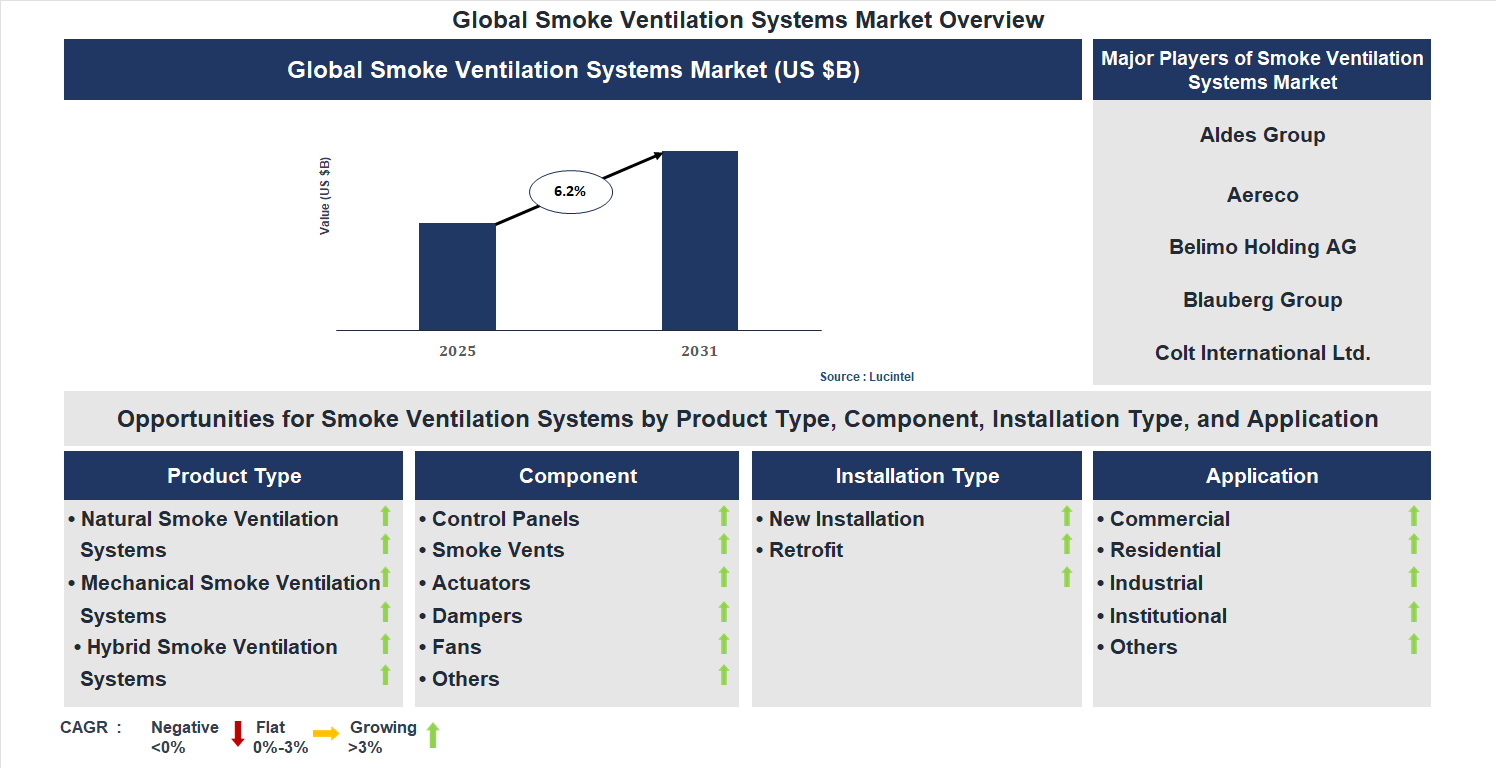
The future of the global smoke ventilation system market looks promising with opportunities in the commercial, residential, industrial, and institutional markets. The global smoke ventilation system market is expected to grow with a CAGR of 6.2% from 2025 to 2031. The major drivers for this market are the rising construction activities in residential, commercial & industrial sector, the increasing government investment & incentive, and the growing demand in industrial facilities with stringent safety standards.• Lucintel forecasts that, within the product type category, natural smoke ventilation system is expected to witness the highest growth over the forecast period.
• Within the application category, commercial is expected to witness the highest growth.
• In terms of region, APAC is expected to witness the highest growth over the forecast period. Gain valuable insights for your business decisions with our comprehensive 150+ page report. Sample figures with some insights are shown below.
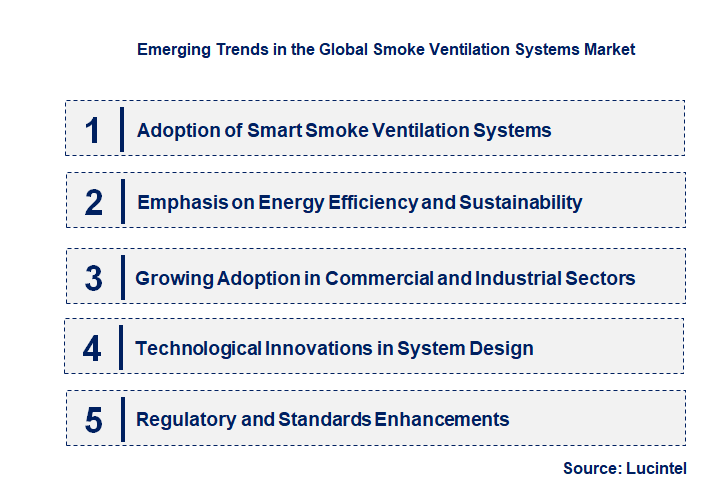
Emerging Trends in the Smoke Ventilation System Market
The smoke ventilation system market is experiencing rapid evolution driven by increasing safety regulations, technological advancements, and a growing emphasis on building safety and sustainability. As urbanization accelerates and building codes become more stringent, the demand for innovative and efficient smoke ventilation solutions is rising. Market players are focusing on integrating smart technologies, enhancing energy efficiency, and expanding their product portfolios to meet diverse architectural needs. These developments are not only improving safety standards but also influencing design practices and operational efficiencies across various sectors. The following key trends highlight the major shifts shaping this dynamic market landscape.• Adoption of Smart Smoke Ventilation Systems: Integration of IoT and automation technologies is transforming the market by enabling real-time monitoring and control of ventilation systems. These smart solutions improve response times during emergencies, optimize energy consumption, and facilitate maintenance through predictive analytics. As building safety regulations evolve, the demand for intelligent systems that can adapt to changing conditions is increasing, leading to safer and more efficient building environments.
• Emphasis on Energy Efficiency and Sustainability: The market is witnessing a shift towards eco-friendly and energy-efficient ventilation solutions. Manufacturers are developing systems that utilize renewable energy sources, incorporate energy recovery features, and meet stringent environmental standards. This trend aligns with global sustainability goals and reduces operational costs for building owners. Enhanced energy performance not only ensures compliance with regulations but also appeals to environmentally conscious consumers and developers.
• Growing Adoption in Commercial and Industrial Sectors: The expansion of smoke ventilation systems beyond traditional applications into commercial complexes, industrial facilities, and public infrastructure is notable. These sectors require large-scale, reliable systems to ensure safety during emergencies. Increased investments in infrastructure development and urban planning are driving demand, with customized solutions tailored to specific building layouts and safety requirements becoming more prevalent.
• Technological Innovations in System Design: Advances in materials, sensor technology, and airflow management are leading to more efficient and compact systems. Innovations such as modular designs, improved fire-resistant materials, and enhanced airflow control mechanisms are making systems easier to install and maintain. These technological improvements reduce costs, improve performance, and expand the applicability of the smoke ventilation system across diverse building types.
• Regulatory and Standards Enhancements: Evolving safety standards and building codes are mandating higher performance levels for smoke ventilation systems. Governments and industry bodies are implementing stricter regulations, which compel manufacturers to innovate and improve product offerings. This trend ensures higher safety benchmarks, encourages market competition, and accelerates the adoption of advanced ventilation solutions across regions. In summary, these emerging trends are fundamentally reshaping the smoke ventilation system market by fostering innovation, promoting sustainability, and enhancing safety standards. The integration of smart technologies, focus on energy efficiency, sector diversification, technological advancements, and regulatory pressures are collectively driving growth and transforming how buildings are designed and operated for safety and efficiency.
Recent Development in the Smoke Ventilation System Market
The smoke ventilation system market has experienced significant growth driven by increasing safety regulations, urbanization, and technological advancements. As buildings become taller and more complex, the demand for effective smoke management solutions has surged. Governments and regulatory bodies are emphasizing fire safety, prompting building owners to adopt advanced ventilation systems. Innovations in automation, energy efficiency, and integration with smart building systems are shaping the market landscape. Additionally, the rise in construction activities worldwide and the need for sustainable solutions are further fueling market expansion. These developments reflect a dynamic industry focused on enhancing safety, efficiency, and technological integration.• Technological Advancements: Integration of smart sensors and automation systems has improved smoke detection and ventilation efficiency, reducing response times and enhancing safety. These innovations enable real-time monitoring and automatic activation, minimizing fire damage and ensuring occupant safety. The adoption of IoT-enabled systems is also facilitating predictive maintenance, reducing operational costs, and increasing reliability.
• Regulatory Enhancements: Governments worldwide are tightening fire safety standards, mandating the installation of a smoke ventilation system in new and existing buildings. These regulations are driving market growth by compelling building owners to upgrade or install compliant systems. Stricter codes are also encouraging innovation in system design to meet evolving safety requirements.
• Growing Construction Activities: Rapid urbanization and infrastructure development, especially in emerging economies, are boosting demand for smoke ventilation solutions. High-rise buildings, commercial complexes, and industrial facilities require advanced systems to ensure safety during emergencies. This trend is expanding the market geographically and across various building types.
• Sustainability and Energy Efficiency: The focus on eco-friendly and energy-efficient solutions is influencing product development. Manufacturers are designing systems that consume less energy and utilize sustainable materials, aligning with green building standards. These efforts are attracting environmentally conscious clients and complying with regulations aimed at reducing carbon footprints.
• Market Consolidation and Strategic Partnerships: The industry is witnessing mergers, acquisitions, and collaborations among key players to enhance technological capabilities and expand market reach. Strategic partnerships facilitate the development of innovative products and integrated solutions, strengthening competitive positioning and accelerating market growth. In summary, these developments are collectively transforming the smoke ventilation system market by enhancing safety standards, promoting technological innovation, and expanding market reach. The integration of smart, sustainable, and regulatory-compliant solutions is driving growth and shaping the future landscape of fire safety infrastructure worldwide.
Strategic Growth Opportunities in the Smoke Ventilation System Market
The smoke ventilation system market is experiencing rapid growth driven by increasing safety regulations, urbanization, and the need for effective fire management solutions. As buildings become more complex and densely populated, the demand for innovative ventilation systems that ensure safety and compliance is rising. Key applications such as commercial, residential, industrial, transportation, and healthcare sectors are presenting unique opportunities for market expansion. Companies are focusing on technological advancements, sustainable solutions, and customized systems to meet diverse needs. These developments are shaping the future landscape of smoke ventilation, making it more efficient, reliable, and adaptable to various building types and safety standards.• Enhanced Fire Safety Compliance: Growing urbanization and stricter safety regulations are driving demand for advanced smoke ventilation systems in commercial spaces, ensuring occupant safety and regulatory adherence. Smart, integrated solutions improve system efficiency and enable real-time monitoring, reducing response times during emergencies. The need for tailored solutions in skyscrapers and large malls is creating opportunities for innovative, scalable ventilation designs. This enhances safety and operational efficiency in complex commercial environments.
• Adoption of Smart Ventilation Solutions: Rising awareness of fire safety in residential buildings is encouraging the adoption of automated, intelligent smoke ventilation systems. Upgrading existing residential structures with modern systems offers significant growth potential, especially in urban areas with aging infrastructure. Developing energy-efficient ventilation options aligns with sustainability goals and reduces operational costs, appealing to eco-conscious consumers.
• Explosion and Fire Hazard Mitigation: Industries such as chemicals and manufacturing are investing in specialized smoke ventilation systems to manage fire risks and ensure worker safety. Large industrial complexes require tailored ventilation systems capable of handling high heat and smoke volumes, creating niche market opportunities. Increasing regulatory requirements are prompting industries to upgrade their ventilation infrastructure, fostering market growth.
• Enhanced Safety in Tunnels and Stations: Smoke ventilation systems are critical for safe evacuation and fire control in transportation hubs, including airports, subways, and tunnels. Combining ventilation with alarm and suppression systems improves overall safety and operational coordination. Developing portable and quickly deployable systems addresses the need for emergency preparedness in transportation infrastructure.
• Improved Fire Safety in Hospitals: Advanced smoke management systems are essential for protecting patients and staff, especially in large healthcare complexes. Meeting stringent safety regulations drives demand for specialized ventilation solutions tailored to healthcare environments. Smart systems that integrate with hospital management enhance safety, operational efficiency, and emergency response capabilities. In summary, these key growth opportunities across applications are significantly impacting the smoke ventilation system market by driving innovation, expanding market reach, and enhancing safety standards. The focus on technological integration, customization, and sustainability is enabling companies to meet evolving regulatory requirements and customer expectations, ultimately fostering a more resilient and efficient fire safety infrastructure across various sectors.
Smoke Ventilation System Market Driver and Challenges
The smoke ventilation system market is influenced by a variety of technological, economic, and regulatory factors that shape its growth and development. Advances in building safety standards and increasing urbanization drive demand for efficient smoke management solutions. Economic factors such as construction activity and infrastructure investments further propel market expansion. Regulatory frameworks mandating fire safety measures compel building owners and developers to adopt advanced ventilation systems. Additionally, technological innovations in automation and sensor integration enhance system performance, making them more reliable and cost-effective. However, the market also faces challenges related to high installation costs, regulatory compliance complexities, and technological integration issues, which could hinder growth. Understanding these drivers and challenges is essential for stakeholders to navigate the evolving landscape effectively. The factors responsible for driving the smoke ventilation system market include:• Technological Advancements: The development of a smart, automated smoke ventilation system with IoT integration has significantly improved system efficiency and reliability. These innovations enable real-time monitoring, predictive maintenance, and seamless integration with building management systems, reducing operational costs and enhancing safety. As technology continues to evolve, demand for sophisticated solutions increases, especially in high-rise and complex structures. This ongoing innovation fosters market growth by providing more effective and user-friendly options, encouraging adoption across various sectors.
• Stringent Building Safety Regulations: Governments and regulatory bodies worldwide are implementing stricter fire safety codes that mandate the installation of a smoke ventilation system in commercial, residential, and industrial buildings. These regulations aim to minimize fire-related casualties and property damage, compelling builders and property owners to invest in compliant systems. The enforcement of such standards directly boosts market demand, especially in regions with rapidly expanding urban infrastructure, ensuring that safety remains a priority in construction practices.
• Growing Construction and Infrastructure Development: Rapid urbanization and infrastructure development projects across emerging and developed economies are fueling the demand for smoke ventilation systems. New commercial complexes, airports, hospitals, and high-rise residential buildings require advanced smoke management solutions to meet safety standards. Increased construction activity, coupled with investments in smart city initiatives, creates a substantial market opportunity for manufacturers and service providers, driving overall growth in the sector.
• Rising Awareness of Fire Safety: Increasing awareness among property owners, tenants, and the general public about fire safety and the importance of early smoke detection and ventilation is boosting market adoption. Educational campaigns and safety audits emphasize the benefits of installing a reliable smoke ventilation system, leading to higher demand. This heightened awareness encourages property upgrades and retrofitting of existing buildings, expanding the market beyond new constructions.
• Technological Integration and Innovation: The integration of the smoke ventilation system with building automation and IoT technologies enhances its functionality and ease of use. Features such as remote monitoring, automated activation during fire incidents, and data analytics improve safety and operational efficiency. Continuous innovation in materials, sensors, and control systems ensures that products meet evolving safety standards and customer expectations, thereby expanding market opportunities and encouraging widespread adoption. The challenges facing this Market include:
• High Installation and Maintenance Costs: The initial investment required for installing an advanced smoke ventilation system can be substantial, especially for retrofitting existing structures. Ongoing maintenance and periodic upgrades add to the total cost of ownership, which may deter small and medium-sized property owners from adopting these solutions. Cost barriers can slow market penetration, particularly in regions with budget constraints, limiting the overall growth potential.
• Regulatory Compliance Complexities: Navigating diverse and evolving fire safety regulations across different regions poses a significant challenge for manufacturers and developers. Ensuring that systems meet varying standards requires extensive testing, certification, and customization, which can delay project timelines and increase costs. Non-compliance risks, including legal penalties and safety liabilities, further complicate market operations and may hinder rapid adoption.
• Technological Integration Challenges: While technological advancements offer numerous benefits, integrating new systems with existing building infrastructure can be complex. Compatibility issues, lack of standardized protocols, and technical expertise shortages can impede seamless implementation. These challenges may lead to delays, increased costs, and reduced confidence among stakeholders, potentially restraining market growth and innovation. In summary, the smoke ventilation system market is driven by technological innovations, regulatory mandates, and expanding construction activities, which collectively foster growth and modernization. However, high costs, regulatory complexities, and integration challenges present notable hurdles that could slow progress. Overall, the markets future depends on balancing these drivers and challenges through technological advancements, cost-effective solutions, and regulatory harmonization, ensuring enhanced safety and sustainable growth in the fire safety sector.
List of Smoke Ventilation System Companies
Companies in the market compete on the basis of product quality offered. Major players in this market focus on expanding their manufacturing facilities, R&D investments, infrastructural development, and leverage integration opportunities across the value chain. With these strategies smoke ventilation system companies cater increasing demand, ensure competitive effectiveness, develop innovative products & technologies, reduce production costs, and expand their customer base. Some of the smoke ventilation system companies profiled in this report include-• Aldes Group
• Aereco
• Belimo Holding AG
• Blauberg Group
• Colt International Ltd.
• FlaktGroup
• Greenheck Fan Corporation
• Honeywell International Inc.
• Johnson Controls International plc
• Kingspan Group plc
Smoke Ventilation System Market by Segment
The study includes a forecast for the global smoke ventilation system market by product type, component, installation type, application, and region.Smoke Ventilation System Market by Product Type [Value from 2019 to 2031]:
• Natural Smoke Ventilation Systems
• Mechanical Smoke Ventilation Systems
• Hybrid Smoke Ventilation Systems
Smoke Ventilation System Market by Component [Value from 2019 to 2031]:
• Control Panels
• Smoke Vents
• Actuators
• Dampers
• Fans
• Others
Smoke Ventilation System Market by Installation Type [Value from 2019 to 2031]:
• New Installation
• Retrofit
Smoke Ventilation System Market by Application [Value from 2019 to 2031]:
• Commercial
• Residential
• Industrial
• Institutional
• Others
Smoke Ventilation System Market by Region [Value from 2019 to 2031]:
• North America
• Europe
• Asia Pacific
• The Rest of the World
Country Wise Outlook for the Smoke Ventilation System Market
The smoke ventilation system market has experienced significant growth driven by increasing safety regulations, urbanization, and technological advancements worldwide. Countries are investing in innovative solutions to improve building safety and comply with stricter standards. The markets evolution reflects a focus on energy efficiency, automation, and integration with smart building systems. As fire safety remains a priority, developments are tailored to diverse building types, from commercial to residential. The following summaries highlight recent key developments in the United States, China, Germany, India, and Japan, illustrating regional trends and innovations shaping the global landscape.• United States: The U.S. market has seen increased adoption of automated smoke ventilation systems integrated with building management systems. Regulatory standards like NFPA 92 have driven innovations, emphasizing energy efficiency and smart controls. There is a growing trend toward retrofit projects in existing buildings, with a focus on enhancing safety and compliance. Companies are investing in IoT-enabled solutions for real-time monitoring and maintenance, improving system reliability and response times.
• China: China’s market is rapidly expanding due to urbanization and stringent safety regulations in high-rise buildings. The country is witnessing increased adoption of advanced smoke extraction systems with improved automation features. Local manufacturers are innovating to reduce costs and enhance performance, making these systems more accessible. Government initiatives promote green and energy-efficient ventilation solutions, aligning with China’s broader sustainability goals.
• Germany: Germany’s market emphasizes high-quality, energy-efficient smoke ventilation systems compliant with EU standards. There is a focus on integrating systems with building automation for enhanced safety and operational efficiency. The adoption of innovative materials and design practices ensures durability and performance. The market also benefits from strict regulatory frameworks that encourage the use of environmentally friendly and sustainable solutions.
• India: The Indian market is experiencing growth driven by rapid urbanization, infrastructure development, and increasing safety awareness. There is a rising demand for cost-effective, reliable smoke ventilation systems suitable for diverse building types. Local manufacturers are expanding their product offerings, incorporating automation and energy-saving features. Government initiatives and building codes are gradually promoting the adoption of advanced fire safety systems across commercial and residential sectors.
• Japan: Japan’s market is characterized by advanced technological integration and high standards for safety and energy efficiency. The focus is on developing compact, highly reliable systems suitable for densely populated urban areas. Innovations include smart, sensor-based systems that enable real-time response and maintenance. The country’s strict building codes and emphasis on disaster preparedness continue to drive the adoption of sophisticated smoke ventilation solutions.

Features of the Global Smoke Ventilation System Market
Market Size Estimates: Smoke ventilation system market size estimation in terms of value ($B). Trend and Forecast Analysis: Market trends (2019 to 2024) and forecast (2025 to 2031) by various segments and regions. Segmentation Analysis: Smoke ventilation system market size by various segments, such as by product type, component, installation type, application, and region in terms of value ($B). Regional Analysis: Smoke ventilation system market breakdown by North America, Europe, Asia Pacific, and Rest of the World. Growth Opportunities: Analysis of growth opportunities in different product type, component, installation type, application, and regions for the smoke ventilation system market. Strategic Analysis: This includes M&A, new product development, and competitive landscape of the smoke ventilation system market. Analysis of competitive intensity of the industry based on Porter’s Five Forces model.
FAQ
Q1. What is the growth forecast for smoke ventilation system market? Answer: The global smoke ventilation system market is expected to grow with a CAGR of 6.2% from 2025 to 2031. Q2. What are the major drivers influencing the growth of the smoke ventilation system market? Answer: The major drivers for this market are the rising construction activities in residential, commercial & industrial sector, the increasing government investment & incentive, and the growing demand in industrial facilities with stringent safety standards. Q3. What are the major segments for smoke ventilation system market? Answer: The future of the smoke ventilation system market looks promising with opportunities in the commercial, residential, industrial, and institutional markets. Q4. Who are the key smoke ventilation system market companies? Answer: Some of the key smoke ventilation system companies are as follows:• Aldes Group
• Aereco
• Belimo Holding AG
• Blauberg Group
• Colt International Ltd.
• FlaktGroup
• Greenheck Fan Corporation
• Honeywell International Inc.
• Johnson Controls International plc
• Kingspan Group plc Q5. Which smoke ventilation system market segment will be the largest in future? Answer: Lucintel forecasts that, within the product type category, natural smoke ventilation system is expected to witness the highest growth over the forecast period. Q6. In smoke ventilation system market, which region is expected to be the largest in next 5 years? Answer: In terms of region, APAC is expected to witness the highest growth over the forecast period. Q7. Do we receive customization in this report? Answer: Yes, Lucintel provides 10% customization without any additional cost.
Table of Contents
List of Figures
List of Tables
Methodology
- In-depth interviews of the major players in this market
- Detailed secondary research from competitors’ financial statements and published data
- Extensive searches of published works, market, and database information pertaining to industry news, company press releases, and customer intentions
- A compilation of the experiences, judgments, and insights of Lucintel’s professionals, who have analyzed and tracked this market over the years.


Buy Now
Choose a license that fits your team. Instant PDF delivery.
Prices exclude taxes. Instant delivery. Custom licensing available on request.
Key Questions
- • What are some of the most promising, high-growth opportunities for the smoke ventilation system market by product type (natural smoke ventilation systems, mechanical smoke ventilation systems, and hybrid smoke ventilation systems), component (control panels, smoke vents, actuators, dampers, fans, and others), installation type (new installation and retrofit), application (commercial, residential, industrial, institutional, and others), and region (North America, Europe, Asia Pacific, and the Rest of the World)?
- • Which segments will grow at a faster pace and why?
- • Which region will grow at a faster pace and why?
- • What are the key factors affecting market dynamics? What are the key challenges and business risks in this market?
- • What are the business risks and competitive threats in this market?
- • What are the emerging trends in this market and the reasons behind them?
- • What are some of the changing demands of customers in the market?
- • What are the new developments in the market? Which companies are leading these developments?
- • Who are the major players in this market? What strategic initiatives are key players pursuing for business growth?
- • What are some of the competing products in this market and how big of a threat do they pose for loss of market share by material or product substitution?
- • What M&A activity has occurred in the last 5 years and what has its impact been on the industry? For any questions related to Smoke Ventilation System Market, Smoke Ventilation System Market Size, Smoke Ventilation System Market Growth, Smoke Ventilation System Market Analysis, Smoke Ventilation System Market Report, Smoke Ventilation System Market Share, Smoke Ventilation System Market Trends, Smoke Ventilation System Market Forecast, Smoke Ventilation System Companies, write Lucintel analyst at email: helpdesk@lucintel.com. We will be glad to get back to you soon.


