
Market Report · May 18, 2026

This market report covers trends, opportunities, and forecasts in the global smart trash bins market to 2031 by technology (wi-fi, wired, and wireless), end use industry (commercial and residential), and region (North America, Europe, Asia Pacific, and the Rest of the World)
We'll send your sample report shortly.
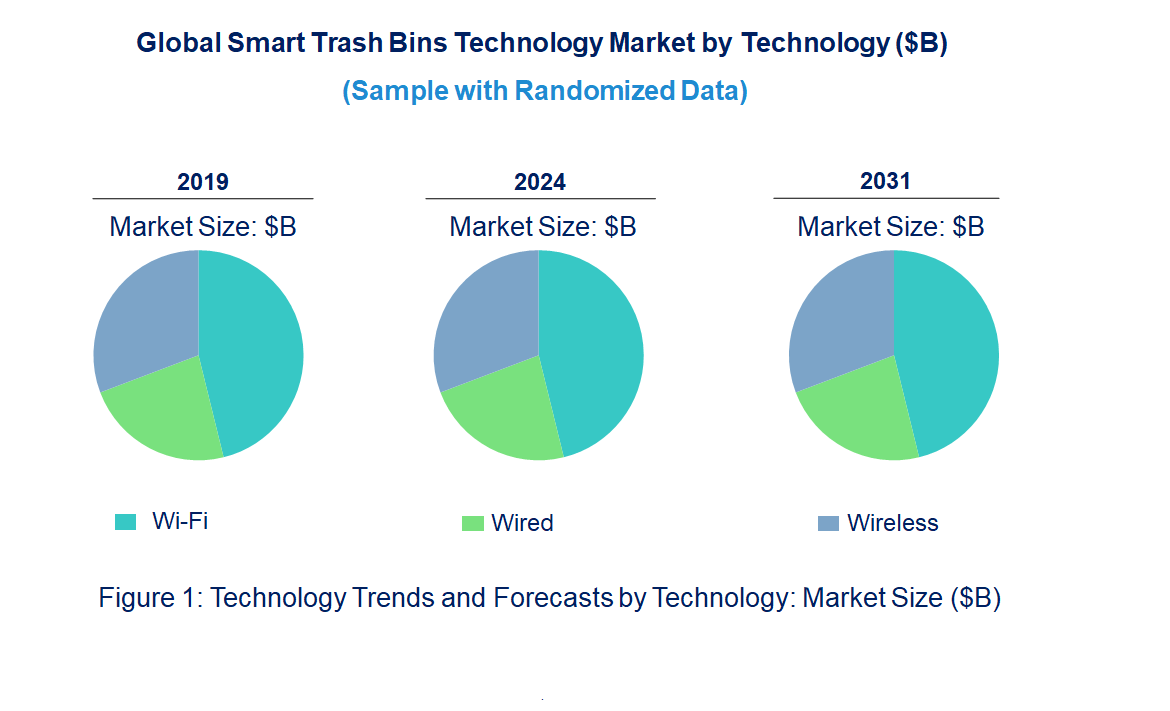
![Smart Trash Bins Market Trend and Forecast by End Use Industry [Value from 2019 to 2031]:](https://lucintel.com/images/Smart-Trash-Bins-Technology-Market-Segment.png "Smart Trash Bins Market Trend and Forecast by End Use Industry [Value from 2019 to 2031]:")
• Integration of IoT Connectivity: Smart garbage bins with IoT can forward real-time data regarding fill levels, location, and status. This connectivity makes it possible for waste management companies to optimize collection schedules and routes to reduce fuel consumption and operating costs. With increased data collection, cities are in a better position to handle their waste, minimizing impact on the environment.
• AI-Powered Waste Sorting: AI algorithms are being integrated into advanced smart bins for automatic sorting of waste. This helps in segregating recyclables, non-recyclables, and hazardous materials, thereby improving the efficiency of recycling. Sustainability is promoted by AI-driven sorting; it also reduces the manpower required for processing waste and makes recycling operations cost-effective.
• Newer smart bins have built-in automated compaction technologies that compress the waste upon entry. This will increase storage capacity and decrease collection frequencies. It increases efficiency by maximizing space use and minimizing the impact of taking waste away from the environment.
• Sustainability With Solar-Powered Systems: Smart trash cans that use solar power are being adopted and have helped in reducing dependency on external sources of power. The solar-powered system provides renewable energy to run the sensors, communication modules, and compaction mechanisms for an eco-friendly waste management practice.
• Improved User Engagement and Feedback: Smart waste bins, nowadays, have been engineered with user-friendly interfaces and feedback mechanisms. Voice commands, mobile application interfaces, and collection time notifications and overflow alerts provide the user experience, making him or her more likely to dispose of waste appropriately and encouraging people to be more active participants in their community’s waste management. These trends are transforming smart trash bins into smarter, more efficient, and eco-friendly waste containers. Integration of IoT and AI, automated compaction, solar-powered systems, and interactive user features will collectively transform waste management from a reactive to a proactive process. With the advancement of these technologies, smart trash cans will become one of the cornerstones for sustainable urban living and reducing environmental impact.

• Potential in Technology: This technology captures the power of IoT, sensors, and advanced analytics for real-time monitoring, automated collection, and data-driven decision-making processes. These capabilities enable smart trash bins to optimize the schedule of waste collection, reduce transportation costs, and increase recycling rates for a sustainable urban waste management approach. Integration of AI-empowered waste sorting and Automated compaction makes smart bins far more effective in handling substantial waste and preserving space.
• Degree of Disruption: The maturity level is highly disruptive and highly innovative as it develops this type of smart trash to transform traditional waste management techniques and replace such techniques from manual and responsive handling with an intelligent and self-run technology.
• Current Technology Maturity Level: The most basic models of smart bins that only use simple sensors are available and already in use, while the advanced versions that have IoT connectivity, AI, and other automated features are still in development. The maturity of technology varies, and the more fundamental parts are developed well, but more advanced systems, especially those having AI-driven analytics and solar-powered solutions, are still in the growth stages.
• Regulatory Compliance: Regulatory compliance for smart bins is region and application-dependent. Environmental and safety compliance regulations ensure that smart trash systems meet the standards of having durable, safe, and low-environmental impact systems in operation. Data privacy regulatory compliance is also important for bins embedded with IoT and tracking features to protect end-user data.
• Ausko Pte: Ausko Pte has introduced smart trash bins with integrated sensor technology that monitors fill levels and alerts waste management teams when the bins are full. This advancement optimizes collection schedules, reducing operational costs and carbon emissions associated with waste transportation. The technology also aids in enhancing urban waste management efficiency.
• EcubeLabs: EcubeLabs has launched solar-powered smart bins equipped with compacting technology and IoT connectivity. These bins can compress waste, increasing their storage capacity and extending collection intervals. The solar power feature reduces energy consumption, promoting eco-friendly waste management practices, especially in urban areas with limited resources.
• Simplehuman: Simplehuman has developed smart trash cans that use motion sensors for touch-free operation and include built-in odor control systems. These features improve user convenience and hygiene. The company’s focus on premium materials and user-friendly designs sets it apart in the residential market, providing an enhanced waste disposal experience.
• HANGSHAU Houseware: HANGSHAU Houseware has enhanced its trash bin offerings with integrated smart sensors and app connectivity. This development allows users to monitor waste levels and receive alerts for collection times, ensuring efficient waste disposal in smart homes and offices.
• Home Depot: Home Depot has collaborated with various smart home brands to offer a selection of connected trash bins that integrate with home automation systems. This trend supports user convenience by allowing automated waste management in residential settings, providing convenience and promoting cleaner, more organized living spaces.
• EvoEco: EvoEco has made strides in sustainable waste management by introducing smart bins that use biodegradable liners and sensors for waste detection. Their smart bins are designed to work with renewable energy sources, thus aligning with eco-friendly initiatives that appeal to environmentally conscious consumers.
• iTouchless Housewares & Products: iTouchless has expanded its lineup of touchless smart trash bins with motion sensors that open and close lids automatically. These bins are equipped with technology that allows them to minimize bacterial contamination and provide a more hygienic waste disposal solution for households and commercial establishments.
• CleanRobotics: CleanRobotics has developed a smart waste bin that uses AI and computer vision for automated waste sorting. The system can identify recyclables and non-recyclables, streamlining the recycling process and significantly reducing the amount of waste that ends up in landfills. This innovation aids cities and organizations in achieving higher recycling rates.
• Nine Stars Group Inc: Nine Stars Group has focused on creating user-friendly smart bins that combine motion-activated lids and odor control technology. Their designs cater to residential and commercial needs, ensuring convenient waste disposal and improved hygiene, which are essential for high-traffic areas and homes.
• Binology LLC: Binology LLC has introduced smart waste solutions equipped with sensors that communicate with smart city systems for efficient waste management. These bins optimize collection routes and times, helping municipalities reduce fuel consumption and emissions. The technology’s impact on urban waste management includes improved resource allocation and minimized environmental impact. These recent developments from key players highlight how the smart trash bins market is evolving through innovations that integrate connectivity, sustainability, and automation. With features such as sensor technology, AI-driven waste sorting, solar power, and odor control, smart trash bins are becoming an integral part of modern waste management strategies. These advancements support cleaner cities, better resource management, and a shift towards more eco-conscious practices.
• IoT and Connectivity: IoT integration in smart bins enables real-time monitoring and data collection, optimizing waste collection schedules and reducing unnecessary transportation. This leads to cost savings and lower carbon emissions, contributing to sustainable urban development and smarter city infrastructure.
• AI-Powered Waste Sorting: The usage of AI in smart bins with waste sorting capabilities facilitates auto-recycling processes. Increased recycling rates, less physical labor, and decreased percentage of waste sent to landfills all result in the achievement of environmental conservation goals and help achieve world recycling goals.
• Solar-Powered Smart Bins: The use of renewable energy sources, such as solar panels, reduces the environmental impact of waste management operations. Solar-powered bins promote sustainability by using clean energy, reducing reliance on conventional power, and aligning with eco-friendly urban practices.
• Enhanced User Experience and Hygiene Features: Features such as touch-free operation, odor control, and automated compaction improve the convenience and hygiene of waste disposal. These enhancements increase user adoption and improve public satisfaction with smart waste management systems.
• Integration with other parts of Smart City Infrastructure: One smart trash can that keeps communication with other smart city components allows developing interconnected ecosystems. With the integration, it means there is efficient resource management for support towards broader initiatives to more sustainably and responsively make places such as cities. The prospects of integration of IoT, AI waste sorting, solar power, and better user features in the smart trash bins technology market are highly influencing. These are changing the way waste management is being done in a more efficient, eco-friendly, and user-centric manner. With technological advancement, the growth will be further driven, and smart trash solutions will become inevitable for cities looking to be sustainable and innovative.
• Ausko PTE
• Ecubelabs
• Simplehuman
• Hangshau Houseware
• Home Depot
• Evoeco
• Technology Readiness: Wi-Fi technology is mature and widely used for home, office, and public internet access, supporting applications such as streaming, remote work, and IoT devices. Wired technologies, such as Ethernet, are reliable and remain the backbone for data centers, high-speed enterprise networks, and industrial automation, where minimal latency is critical. Wireless technologies - including 5G - are getting increasingly advanced, enabling more rapid internet speeds, ultra-low-latency communication, and richer mobile connectivity, which are critical for the realization of smart cities, connected vehicles, and telemedicine. Each technology has unique strengths and applications that serve particular market needs, driving this connectivity evolution.
• Competitive Intensity: Competitive intensity in smart trash bins within the connectivity market is intense because it involves all major technology companies battling to be first in developing and deploying Wi-Fi, wired, and wireless solutions. The sector with high speed and reliability, for instance, has been relying on wired networks; however, with increased adoption of mobile and IoT solutions, Wi-Fi and wireless solutions are being adopted in more and more areas. Regulatory compliance differs: wired networks would generally have less regulation, whereas wireless technologies will have to work with spectrum licensing, security, and privacy compliance. Compliance issues are also important for proper data transmission and frequency band usage, but they affect how a company deploys its infrastructure and services.
• The disruption potential of different technologies, such as Wi-Fi, wired, and wireless, has transformed connectivity and data transmission in all industries. Wi-Fi provides flexibility and convenience through wireless connectivity, allowing mobile devices and smart home systems to work smoothly. Wired connections are stable and have a higher bandwidth, making them a strong support for high-demand applications such as data centers and industrial operations. With the advent of 5G and Bluetooth, wireless technologies can be seen as the future in terms of mobility and speed. Such technologies will provide new opportunities for innovations in IoT, smart cities, and autonomous vehicles. More integrated solutions, better user experiences, new business models, and optimization of network efficiency are some of the advantages that come from these technologies. Each of them supports different use cases such as consumer internet access and remote work, industrial automation, and healthcare.
• Wi-Fi
• Wired
• Wireless
• Commercial
• Residential
• North America
• Europe
• Asia Pacific
• The Rest of the World
• Latest Developments and Innovations in the Smart Trash Bins Technologies
• Companies / Ecosystems
• Strategic Opportunities by Technology Type


Choose a license that fits your team. Instant PDF delivery.
Prices exclude taxes. Instant delivery. Custom licensing available on request.
Market Report · May 18, 2026
Market Report · May 18, 2026
Market Report · May 18, 2026
Trusted partner for strategic intelligence and business growth


Receive a complimentary market analysis tailored to your industry. Our analysts will identify key growth opportunities and competitive dynamics specific to your business.

Market size, growth rate, and key trend analysis for your specific sector.

Top competitor positioning and market share analysis.

Strategic recommendations backed by data-driven insights.
Get curated market intelligence and competitive moves straight to your inbox.
By subscribing, you agree to receive our monthly insights. Unsubscribe anytime.
Receive a complimentary market analysis tailored to your industry. Our analysts will identify key growth opportunities and competitive dynamics specific to your business.
Market size, growth rate, and key trend analysis for your specific sector.
Top competitor positioning and market share analysis.
Strategic recommendations backed by data-driven insights.
Get curated market intelligence, emerging trends, and competitive moves straight to your inbox each month.
By subscribing, you agree to receive our monthly insights. Unsubscribe anytime.
We'll send your sample report shortly.