
Report Feature
Smart Translator Market Trends and Forecast
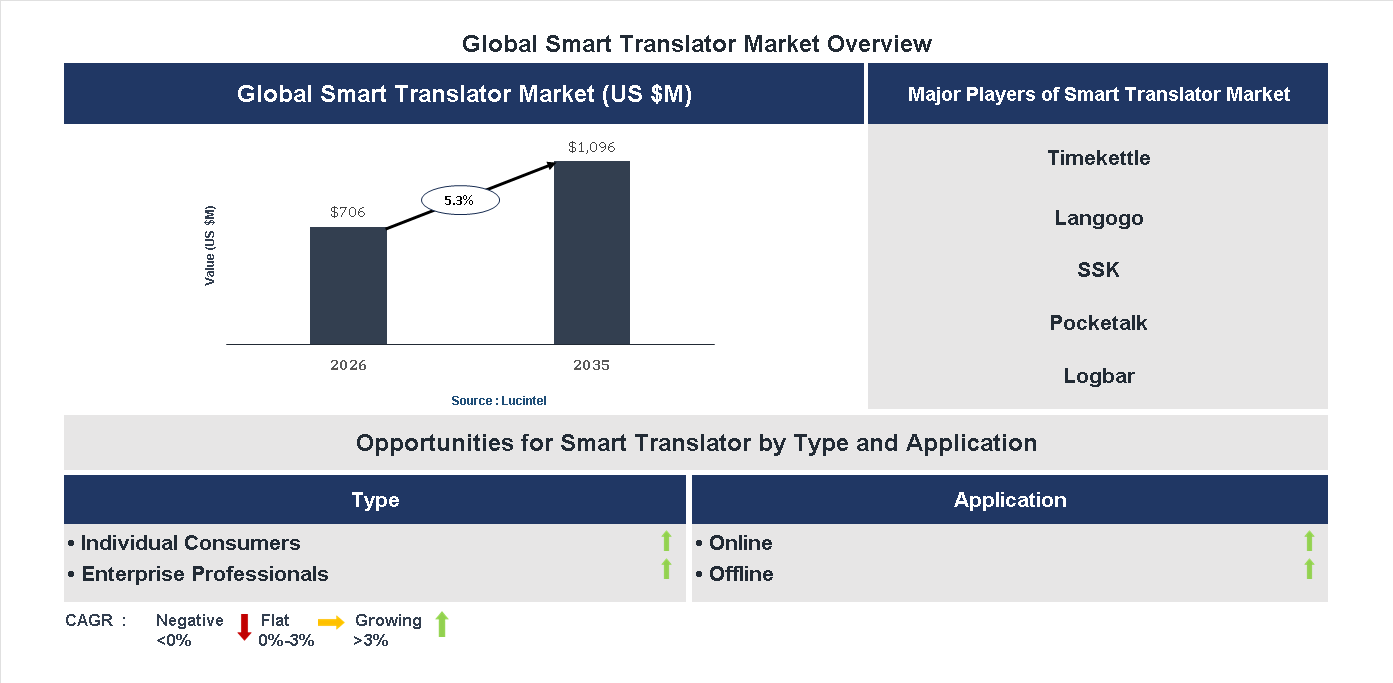
The future of the global smart translator market looks promising with opportunities in the online and offline markets. The global smart translator market is expected to reach an estimated $1,096 million by 2035 with a CAGR of 5.3% from 2026 to 2035. The major drivers for this market are the increasing need for seamless communication tools, the rising demand for language translation solutions, and the growing adoption of portable tech devices.• Lucintel forecasts that, within the type category, individual consumer is expected to witness higher growth over the forecast period.
• Within the application category, online is expected to witness higher growth.
• In terms of region, APAC is expected to witness the highest growth over the forecast period. Gain valuable insights for your business decisions with our comprehensive 150+ page report. Sample figures with some insights are shown below.
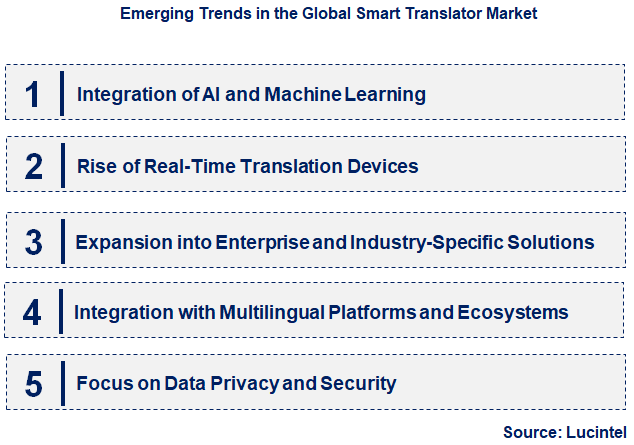
Emerging Trends in the Smart Translator Market
The smart translator market is experiencing rapid growth driven by advancements in artificial intelligence, machine learning, and global connectivity. As businesses and consumers seek seamless communication across language barriers, innovative solutions are emerging to meet these demands. The market is characterized by increasing adoption of real-time translation devices, integration with various platforms, and a focus on enhancing user experience. These developments are transforming how people communicate, collaborate, and access information worldwide. The following key trends highlight the major shifts shaping the future of the smart translator market and its expanding influence across industries and regions.• Integration of AI and Machine Learning: The use of advanced AI algorithms and machine learning models is significantly improving translation accuracy and contextual understanding. These technologies enable smart translators to interpret idiomatic expressions, slang, and cultural nuances, making translations more natural and reliable. As AI continues to evolve, smart translators are becoming more intuitive, reducing language barriers in real-time communication. This trend enhances user experience and broadens application scope, from business meetings to casual conversations, fostering global connectivity and collaboration.
• Rise of Real-Time Translation Devices: The demand for portable, real-time translation gadgets is surging, driven by travelers, international businesses, and remote workers. These devices offer instant speech-to-speech translation, facilitating seamless communication without language barriers. Innovations include voice-activated assistants and wearable gadgets that provide instant translations in various languages. The convenience and immediacy of these devices are making them essential tools for cross-cultural interactions, expanding market reach, and encouraging adoption in everyday scenarios, including tourism, education, and customer service.
• Expansion into Enterprise and Industry-Specific Solutions: Companies are increasingly deploying smart translation solutions tailored to specific industries such as healthcare, legal, and hospitality. These specialized tools address sector-specific terminology and compliance requirements, ensuring accurate and secure communication. For example, healthcare providers use translation apps for patient interactions, while legal firms rely on them for document translation. This trend enhances operational efficiency, reduces misunderstandings, and opens new revenue streams for providers. Industry-specific solutions are driving market growth by meeting the unique needs of diverse sectors.
• Integration with Multilingual Platforms and Ecosystems: Smart translators are now being integrated into larger digital ecosystems, including messaging apps, customer support platforms, and enterprise software. This integration allows for seamless multilingual communication within existing workflows, improving productivity and customer engagement. For instance, chatbots with embedded translation capabilities can serve global clients more effectively. Such integrations facilitate widespread adoption across various digital touchpoints, making multilingual communication more accessible and efficient, and reinforcing the importance of smart translation technology in digital transformation strategies.
• Focus on Data Privacy and Security: As smart translation solutions handle sensitive information, there is a growing emphasis on data privacy and security features. Market players are investing in encryption, secure data storage, and compliance with international privacy standards to build trust with users. This focus is crucial for sectors like healthcare, legal, and government, where confidentiality is paramount. Enhanced security measures not only protect user data but also differentiate products in a competitive market. Addressing privacy concerns is vital for the broader adoption and long-term growth of smart translation technologies. These trends are collectively reshaping the smart translator market by making translation tools more accurate, accessible, secure, and integrated into daily life and business operations. They are breaking down language barriers more effectively than ever before, fostering global communication, and opening new opportunities across industries and regions.
Recent Development in the Smart Translator Market
The smart translator market is experiencing rapid growth driven by technological advancements and increasing global connectivity. As businesses and individuals seek seamless communication across languages, innovative solutions are emerging to meet these demands. The markets evolution is influenced by AI integration, cloud-based platforms, and user-friendly interfaces, making real-time translation more accessible and accurate. These developments are transforming how people communicate, collaborate, and access information worldwide, creating new opportunities for providers and users alike.• Advancements in AI and Machine Learning: Enhanced accuracy and contextual understanding in translations, enabling more natural conversations and reducing misunderstandings. These improvements are expanding the market by attracting enterprise clients and individual users seeking reliable, real-time language solutions. As AI models become more sophisticated, the market is poised for increased adoption across various sectors, including travel, healthcare, and customer service, fostering global communication and collaboration.
• Integration of Cloud-Based Platforms: Facilitates scalable, accessible, and cost-effective translation services that can be integrated into existing applications and workflows. Cloud technology allows for real-time updates, seamless data sharing, and remote access, broadening the market reach. Businesses benefit from flexible deployment options, while consumers enjoy instant translations on their devices. This development is driving market growth by making smart translation tools more versatile and widely available across industries.
• Development of Multilingual Support: Expanding language options to include less common and regional languages, increasing accessibility for diverse user groups. This inclusivity opens new markets in emerging economies and underserved communities, fostering global inclusivity. Enhanced multilingual support also benefits multinational corporations by enabling better communication with local markets. As language coverage broadens, the market is expected to grow significantly, driven by demand for comprehensive translation solutions.
• Focus on User Experience and Interface Design: Creating intuitive, easy-to-use translation applications that appeal to a broad user base. Improved interfaces increase adoption among non-technical users and enhance overall satisfaction. User-centric design features, such as voice input and offline capabilities, are making smart translators more practical and appealing. This focus on usability is expanding the market by attracting a wider demographic, including travelers, students, and casual users, thereby accelerating growth.
• Adoption of Voice and Visual Translation Technologies: Enabling real-time spoken and image-based translations for more natural and efficient communication. These innovations are particularly impactful in travel, hospitality, and emergency services, where quick understanding is crucial. Voice and visual translation tools reduce language barriers instantly, fostering smoother interactions and enhancing user confidence. As these technologies mature, they are expected to significantly boost market penetration and user engagement across various sectors. These developments are collectively transforming the smart translator market by making translation services more accurate, accessible, and user-friendly. AI advancements, cloud integration, expanded language support, improved interfaces, and innovative translation methods are driving widespread adoption across industries and regions. As a result, the market is experiencing accelerated growth, fostering global communication, and opening new opportunities for businesses and consumers worldwide.
Strategic Growth Opportunities in the Smart Translator Market
The smart translator market is experiencing rapid expansion driven by increasing globalization, technological advancements, and the demand for real-time language translation across various sectors. Innovations in AI and machine learning are enhancing translation accuracy and speed, making these solutions more accessible and efficient. Key applications include travel, business, healthcare, education, and government, each presenting unique growth opportunities. As the market evolves, strategic investments and technological integration will be crucial for capturing emerging demand and maintaining competitive advantage.• Expansion in Travel and Tourism Sector: The growing global travel industry is fueling demand for instant, accurate translation tools to facilitate communication between travelers and locals. Smart translators enable seamless interactions, improving customer experience and safety. Increased adoption in airports, hotels, and tour services is driving market growth. The need for multilingual support in travel apps and devices further accelerates this trend, making real-time translation essential for enhancing international travel experiences and reducing language barriers.
• Adoption in Business for Multilingual Communication: Companies expanding globally require efficient communication tools to bridge language gaps. Smart translators support negotiations, customer service, and internal collaboration across diverse languages. They enable faster decision-making and reduce misunderstandings, fostering smoother international operations. Integration with enterprise software and communication platforms enhances productivity. As globalization intensifies, businesses increasingly rely on these solutions to maintain a competitive advantage and reach new markets effectively.
• Integration into Healthcare for Multilingual Patient Support: The healthcare sector benefits from smart translation solutions by improving patient-provider communication, especially in multicultural regions. Accurate translation of medical records, instructions, and consultations enhances patient safety and care quality. These tools help overcome language barriers in emergencies and routine care, ensuring compliance with healthcare regulations. Growing demand for multilingual healthcare services and telemedicine adoption further expands the market, making smart translators vital for inclusive healthcare delivery.
• Utilization in Education for Language Learning and Accessibility: Educational institutions leverage smart translation tools to facilitate language learning and promote inclusivity. These solutions support real-time translation of lectures, study materials, and communication between students and teachers of different languages. They enable remote learning and global collaboration, breaking down language barriers in academia. The increasing need for accessible education for diverse student populations drives adoption, positioning smart translators as essential tools in modern educational environments.
• Deployment in Government and Public Services for Multilingual Communication: Governments utilize smart translation solutions to improve communication with diverse populations, especially in multicultural and multilingual regions. These tools assist in public announcements, legal documentation, and emergency response efforts, ensuring clear and effective dissemination of information. They also support diplomatic communications and international cooperation. As governments prioritize inclusivity and efficient service delivery, the demand for reliable, real-time translation solutions continues to grow, strengthening community engagement and international relations. These growth opportunities significantly influence the smart translator market by expanding its application scope across critical sectors. The integration of advanced AI-driven translation technologies will enhance communication efficiency, foster global connectivity, and support inclusive services. As demand increases, strategic focus on innovation and sector-specific solutions will be essential for market players to capitalize on emerging opportunities and sustain competitive growth.
Smart Translator Market Driver and Challenges
The smart translator market is influenced by a variety of technological, economic, and regulatory factors that shape its growth trajectory. Rapid advancements in artificial intelligence, machine learning, and natural language processing are enabling more accurate and real-time translation solutions. Economic factors such as increasing globalization and the need for cross-cultural communication are driving demand across industries. Regulatory considerations, including data privacy laws and standards for language processing, also impact market development. Together, these drivers and challenges create a dynamic environment that requires continuous innovation and adaptation to meet evolving customer needs and compliance requirements. The factors responsible for driving the smart translator market include:-• Technological Innovation: The rapid development of AI and machine learning algorithms enhances translation accuracy and speed, making smart translators more reliable and user-friendly. These technological advancements enable real-time translation, voice recognition, and contextual understanding, which are critical for global communication. As technology continues to evolve, the market benefits from increased adoption across sectors such as travel, healthcare, and business, fueling growth and expanding application scope.
• Rising Globalization and Cross-Border Trade: The increasing interconnectedness of economies and businesses necessitates effective communication tools. Smart translators facilitate seamless interactions in international trade, tourism, and diplomatic relations, reducing language barriers. This demand is further amplified by the growth of e-commerce and remote working, which require instant and accurate translation services to operate efficiently across diverse linguistic regions.
• Growing Adoption of IoT and Smart Devices: The proliferation of IoT devices and smart gadgets integrates translation capabilities into everyday technology. Smartphones, wearables, and smart home devices now incorporate translation features, making language assistance more accessible. This integration broadens the market reach, encouraging manufacturers to embed smart translation solutions into their products, thus driving market expansion.
• Increasing Investment in R&D: Companies and governments are investing heavily in research and development to improve translation accuracy, contextual understanding, and multilingual support. These investments lead to innovative features such as emotion detection and cultural nuance recognition, which enhance user experience. R&D efforts also focus on reducing latency and improving offline capabilities, making smart translators more versatile and appealing to a broader audience. The challenges in the smart translator market are:
• Data Privacy and Security Concerns: As smart translators process vast amounts of personal and sensitive data, ensuring privacy and security becomes paramount. Regulatory frameworks like GDPR impose strict compliance requirements, which can hinder deployment and adoption. Data breaches or misuse can damage brand reputation and erode consumer trust, posing significant challenges for market players to develop secure and compliant solutions.
• Language and Dialect Limitations: Despite technological progress, translating less common languages and dialects remains challenging. Many languages lack sufficient training data, resulting in lower accuracy and reliability. This limitation restricts market penetration in regions with diverse linguistic landscapes and hampers the development of truly universal translation solutions, thereby constraining growth opportunities.
• Regulatory and Ethical Issues: The deployment of AI-powered translation tools raises ethical questions related to bias, misinformation, and cultural sensitivity. Regulatory bodies are increasingly scrutinizing AI applications, which may lead to restrictions or additional compliance costs. Navigating these regulatory landscapes requires ongoing adjustments, potentially slowing innovation and market expansion. The smart translator market is driven by technological advancements, globalization, IoT integration, and R&D investments, which collectively foster growth and innovation. However, challenges such as data privacy, language limitations, and regulatory concerns pose significant hurdles. These factors create a complex environment that demands continuous technological improvements and strategic compliance efforts. Overall, the markets future depends on balancing innovation with responsible data management and inclusivity, ensuring sustainable growth and broader adoption across diverse sectors.
List of Smart Translator Companies
Companies in the market compete on the basis of product quality offered. Major players in this market focus on expanding their manufacturing facilities, R&D investments, infrastructural development, and leverage integration opportunities across the value chain. With these strategies smart translator companies cater increasing demand, ensure competitive effectiveness, develop innovative products & technologies, reduce production costs, and expand their customer base. Some of the smart translator companies profiled in this report include-• Timekettle
• Langogo
• SSK
• Pocketalk
• Logbar
• Ectaco
• Vasco Electronics
• Pulomi
• Lingo
• iFlytek
Smart Translator Market by Segment
The study includes a forecast for the global smart translator market by type, application, and region.Smart Translator Market by Type [Value from 2019 to 2035]:
• Individual Consumers
• Enterprise Professionals
Smart Translator Market by Application [Value from 2019 to 2035]:
• Online
• Offline
Smart Translator Market by Region [Value from 2019 to 2035]:
• North America
• Europe
• Asia Pacific
• The Rest of the World
Country Wise Outlook for the Smart Translator Market
The smart translator market has experienced rapid growth driven by advancements in artificial intelligence, machine learning, and natural language processing. As globalization accelerates, the demand for real-time, accurate translation tools has surged across various sectors, including business, tourism, and education. Countries are investing heavily in developing innovative solutions to bridge language barriers, enhance communication, and facilitate international collaboration. The markets evolution reflects a focus on improving user experience, expanding language coverage, and integrating with other digital platforms. These developments are shaping a more interconnected world, with each country contributing uniquely to the global landscape of smart translation technologies.• United States: The US market has seen significant innovation with major tech companies launching advanced AI-powered translation apps. Investment in neural machine translation (NMT) technology has increased, improving accuracy and contextual understanding. Startups are also emerging, focusing on industry-specific solutions such as legal and medical translations. Government initiatives aim to enhance multilingual communication in public services and defense sectors. Additionally, collaborations between tech giants and academic institutions are fostering research in multilingual AI systems, positioning the US as a leader in smart translation development.
• China: China has rapidly expanded its smart translation capabilities, driven by government support and domestic tech giants like Baidu, Tencent, and Alibaba. The focus is on integrating translation tools into popular social media and e-commerce platforms to facilitate cross-border trade and communication. Advances in deep learning have improved contextual accuracy, especially for Asian languages. The country is also investing in multilingual AI research to support initiatives like the Belt and Road. Localized solutions tailored to regional dialects and languages are being developed, making China a key player in the global smart translator market.
• Germany: Germany emphasizes precision and technical robustness in its smart translation solutions, with a strong focus on industrial and technical sectors. Companies are leveraging AI to develop specialized translation tools for manufacturing, automotive, and engineering fields. The German government promotes research collaborations between industry and academia to enhance language technology. There is also a growing trend toward integrating smart translation with Industry 4.0 initiatives, enabling seamless multilingual communication in smart factories. Overall, Germany’s approach combines technological excellence with industry-specific applications, strengthening its position in the European market.
• India: India’s market is characterized by a focus on multilingual support for its diverse languages and dialects. Local startups and tech giants are developing affordable, user-friendly translation apps to cater to rural and urban populations. The government’s Digital India initiative encourages the adoption of AI-driven language tools to improve access to education, healthcare, and government services. Recent developments include the integration of translation features into popular messaging apps and regional language content platforms. These efforts aim to bridge language gaps and promote digital inclusion, making India a rapidly growing hub for innovative, localized smart translation solutions.
• Japan: Japan is advancing in the development of context-aware translation systems, especially for the business and tourism sectors. Companies are investing in AI that can handle complex technical language and cultural nuances. The focus is on improving real-time translation for international meetings, conferences, and travel. Japan’s strong emphasis on robotics and AI research has led to the integration of smart translation features into robotic assistants and smart devices. Collaborations between tech firms and government agencies aim to enhance multilingual support in public services and transportation. Japan’s innovations are contributing significantly to the global smart translator ecosystem, emphasizing accuracy and cultural sensitivity.

Features of the Global Smart Translator Market
Market Size Estimates: Smart translator market size estimation in terms of value ($M). Trend and Forecast Analysis: Market trends (2019 to 2025) and forecast (2026 to 2035) by various segments and regions. Segmentation Analysis: Smart translator market size by type, application, and region in terms of value ($M). Regional Analysis: Smart translator market breakdown by North America, Europe, Asia Pacific, and Rest of the World. Growth Opportunities: Analysis of growth opportunities in different types, applications, and regions for the smart translator market. Strategic Analysis: This includes M&A, new product development, and competitive landscape of the smart translator market. Analysis of competitive intensity of the industry based on Porter’s Five Forces model.
FAQ
Q1. What is the smart translator market size? Answer: The global smart translator market is expected to reach an estimated $1,096 million by 2035. Q2. What is the growth forecast for smart translator market? Answer: The global smart translator market is expected to grow with a CAGR of 5.3% from 2026 to 2035. Q3. What are the major drivers influencing the growth of the smart translator market? Answer: The major drivers for this market are the increasing need for seamless communication tools, the rising demand for language translation solutions, and the growing adoption of portable tech devices. Q4. What are the major segments for smart translator market? Answer: The future of the smart translator market looks promising with opportunities in the online and offline markets. Q5. Who are the key smart translator market companies? Answer: Some of the key smart translator companies are as follows:• Timekettle
• Langogo
• SSK
• Pocketalk
• Logbar
• Ectaco
• Vasco Electronics
• Pulomi
• Lingo
• iFlytek Q6. Which smart translator market segment will be the largest in future? Answer: Lucintel forecasts that, within the type category, individual consumer is expected to witness higher growth over the forecast period. Q7. In smart translator market, which region is expected to be the largest in next 5 years? Answer: In terms of region, APAC is expected to witness the highest growth over the forecast period. Q8. Do we receive customization in this report? Answer: Yes, Lucintel provides 10% customization without any additional cost.
Table of Contents
List of Figures
List of Tables
Methodology
- In-depth interviews of the major players in this market
- Detailed secondary research from competitors’ financial statements and published data
- Extensive searches of published works, market, and database information pertaining to industry news, company press releases, and customer intentions
- A compilation of the experiences, judgments, and insights of Lucintel’s professionals, who have analyzed and tracked this market over the years.


Buy Now
Choose a license that fits your team. Instant PDF delivery.
Prices exclude taxes. Instant delivery. Custom licensing available on request.
Key Questions
- • What are some of the most promising, high-growth opportunities for the smart translator market by type (individual consumers and enterprise professionals), application (online and offline), and region (North America, Europe, Asia Pacific, and the Rest of the World)?
- • Which segments will grow at a faster pace and why?
- • Which region will grow at a faster pace and why?
- • What are the key factors affecting market dynamics? What are the key challenges and business risks in this market?
- • What are the business risks and competitive threats in this market?
- • What are the emerging trends in this market and the reasons behind them?
- • What are some of the changing demands of customers in the market?
- • What are the new developments in the market? Which companies are leading these developments?
- • Who are the major players in this market? What strategic initiatives are key players pursuing for business growth?
- • What are some of the competing products in this market and how big of a threat do they pose for loss of market share by material or product substitution?
- • What M&A activity has occurred in the last 7 years and what has its impact been on the industry? For any questions related to Smart Translator Market, Smart Translator Market Size, Smart Translator Market Growth, Smart Translator Market Analysis, Smart Translator Market Report, Smart Translator Market Share, Smart Translator Market Trends, Smart Translator Market Forecast, Smart Translator Companies, write Lucintel analyst at email: helpdesk@lucintel.com. We will be glad to get back to you soon.


