Smart Home Market Trends and Forecast
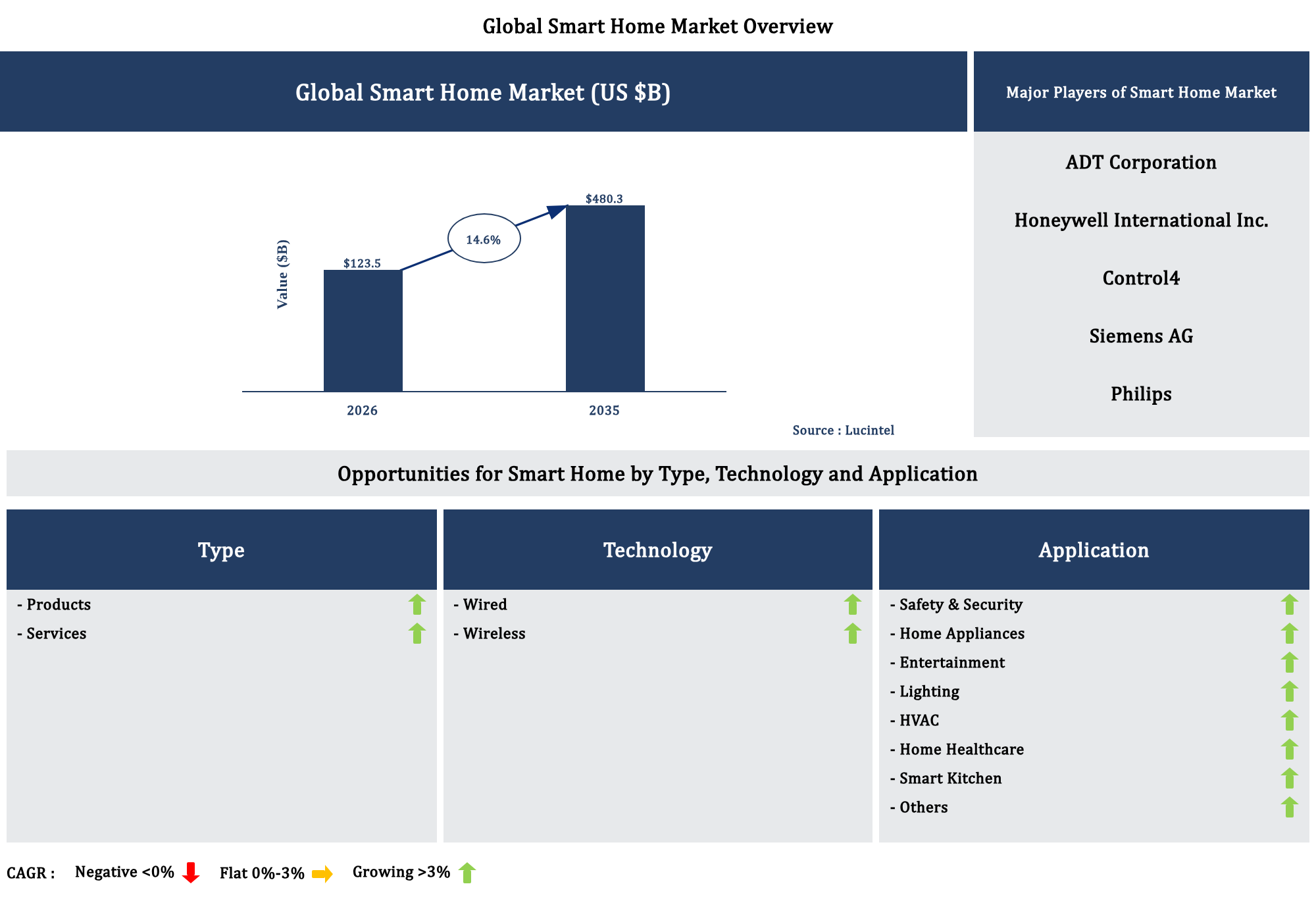
The future of the global smart home market looks promising with opportunities in the safety & security, home appliance, entertainment, lighting, hvac, home healthcare, and smart kitchen markets. The global smart home market is expected to reach an estimated $226,887 million by 2035 with a CAGR of 6.6% from 2026 to 2035. The major drivers for this market are the growing adoption of smart speakers & assistants, the rising demand for energy saving solutions, and the increasing demand for smartphone usage for home control.
• Lucintel forecasts that, within the type category, product is expected to witness higher growth over the forecast period.
• Within the application category, safety & security is expected to witness the highest growth.
• In terms of region, APAC is expected to witness the highest growth over the forecast period.
Gain valuable insights for your business decisions with our comprehensive 150+ page report. Sample figures with some insights are shown below.
Emerging Trends in the Smart Home Market
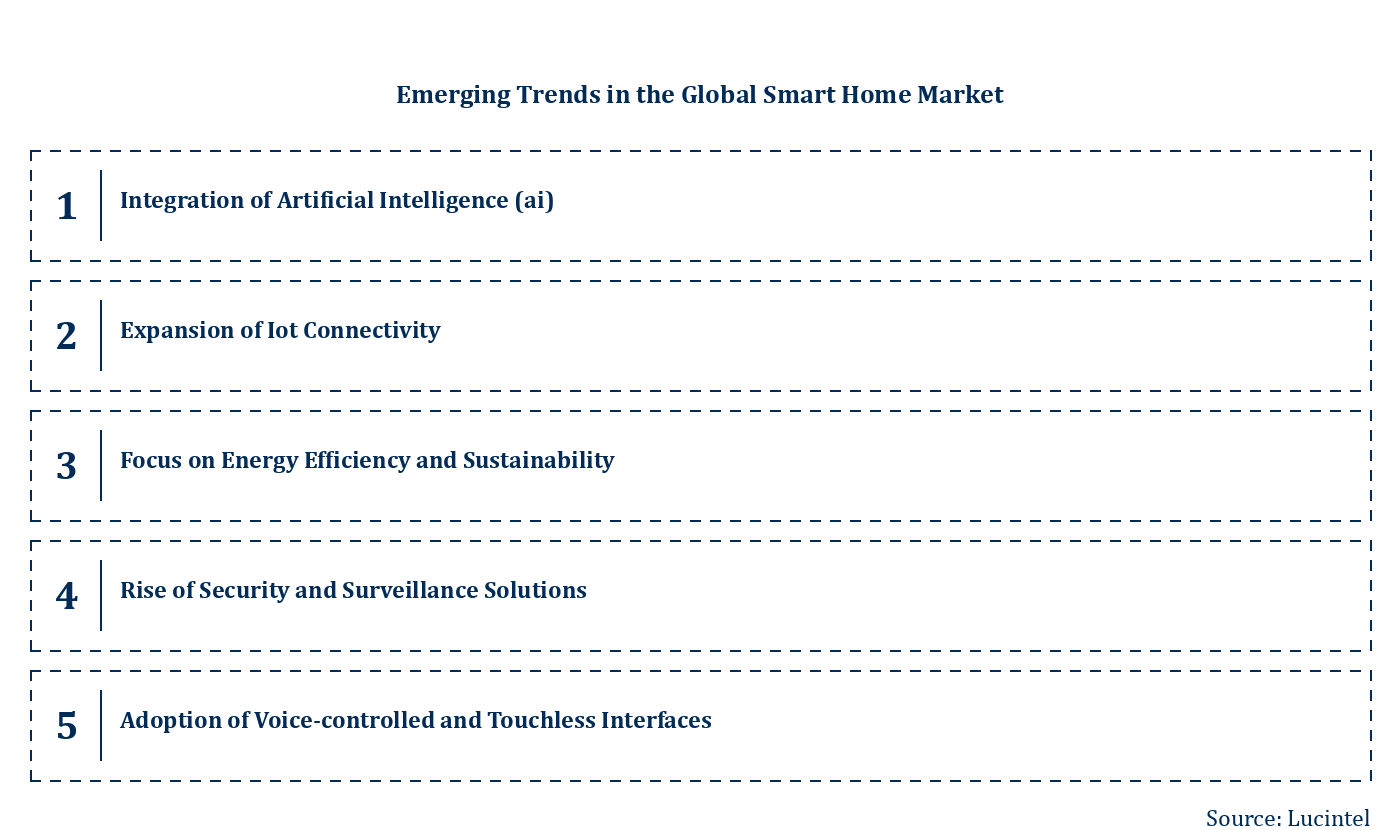
The smart home market is rapidly evolving as it moves from basic connected devices toward fully integrated, intelligent living ecosystems. Driven by advancements in artificial intelligence, IoT, voice assistants, 5G connectivity, and interoperability standards like Matter, smart homes are becoming more seamless, automated, and energy efficient. Consumers are increasingly prioritizing convenience, safety, sustainability, and personalized experiences, while manufacturers focus on ecosystem integration and cross-device compatibility. Rising demand for smart security, energy management, and AI-enabled automation is shaping innovation across global markets. At the same time, affordability improvements and wider broadband access are accelerating adoption in both developed and emerging economies, making smart homes a mainstream trend rather than a luxury concept.
• Artificial Intelligence Integration in Smart Homes: AI is becoming a core trend in the smart home market as devices increasingly shift from rule-based automation to predictive and adaptive intelligence. Smart assistants now learn user behavior patterns to optimize lighting, temperature, and security settings automatically. AI-powered home ecosystems are also improving voice recognition, facial detection, and energy optimization. This trend is enhancing personalization and convenience while reducing manual control requirements. It is also enabling proactive security alerts and maintenance predictions for appliances. As AI models become more advanced, smart homes are evolving into self-managing environments that improve efficiency, comfort, and safety across residential spaces.
• Interoperability and Unified Ecosystems: A major emerging trend is the growing emphasis on interoperability across smart home devices and platforms. Consumers often face challenges when devices from different brands do not communicate effectively, leading to fragmented experiences. To address this, industry players are adopting unified standards such as Matter, which enable seamless connectivity between devices regardless of manufacturer. This trend is driving ecosystem-based strategies where companies focus on integrated platforms rather than standalone products. As a result, users can control lighting, security, entertainment, and appliances through a single interface. This shift is significantly improving user experience, reducing complexity, and increasing overall market adoption.
• Smart Energy Management and Sustainability: Energy efficiency and sustainability are becoming central drivers in the smart home market. Consumers are increasingly adopting smart thermostats, automated lighting systems, and intelligent energy monitoring tools to reduce electricity consumption and lower utility costs. Smart grids and home energy management systems are also gaining traction, allowing real-time optimization of power usage. Integration with renewable energy sources such as solar panels and EV charging systems is further strengthening this trend. This shift is not only reducing environmental impact but also helping households manage rising energy prices, making sustainability a key value proposition in smart home adoption.
• Expansion of Smart Security and Surveillance Systems: Security remains one of the strongest growth areas in the smart home market. There is increasing adoption of smart cameras, video doorbells, motion sensors, and AI-based surveillance systems that offer real-time monitoring and alerts. Advanced features such as facial recognition, object detection, and cloud-based video storage are enhancing home safety. Remote access through mobile applications allows homeowners to monitor properties from anywhere, increasing convenience and peace of mind. This trend is also being driven by rising urbanization and safety concerns in residential areas. As technology improves, smart security systems are becoming more accurate, responsive, and widely accessible.
• Growth of Healthcare and Aging-in-Place Solutions: A growing trend in the smart home market is the integration of healthcare and elder-care technologies. Smart homes are increasingly being designed to support aging populations through remote health monitoring, emergency alert systems, and automated assistance devices. Wearable integration and connected health sensors allow real-time tracking of vital signs and daily activities. Voice-enabled assistants and automation features also help elderly individuals manage household tasks more easily. This trend is particularly strong in countries with aging demographics, where independent living solutions are in high demand. It is transforming smart homes into supportive environments that enhance safety, well-being, and quality of life.
These emerging trends are reshaping the smart home market by making it more intelligent, interconnected, energy-efficient, and user-centric. The industry is shifting from simple automation toward fully adaptive ecosystems that integrate lifestyle, security, sustainability, and healthcare. As a result, smart homes are becoming essential infrastructure for modern living, driving long-term global market expansion.
Recent Developments in the Smart Home Market
The smart home market is experiencing significant transformation as technological innovation, digital infrastructure expansion, and consumer lifestyle changes accelerate adoption worldwide. Increasing integration of artificial intelligence, Internet of Things connectivity, and cloud-based platforms is enabling seamless automation across residential environments. Rising demand for energy efficiency, home security, and personalized living experiences is further strengthening market growth. Companies are investing heavily in ecosystem development, interoperability standards, and advanced device integration to enhance user convenience. At the same time, affordability improvements and wider broadband penetration are making smart home solutions accessible to a broader population across developed and emerging economies, reshaping how modern households operate and interact with technology.
• AI Powered Home Automation Expansion: Artificial intelligence integration in smart homes has become a major development, enabling devices to learn user behavior and optimize household functions automatically. Smart assistants now manage lighting, temperature, entertainment, and security based on predictive analytics. Recent advancements include more accurate voice recognition, facial identification, and contextual automation across devices. AI driven systems also support energy optimization and predictive maintenance for appliances, reducing operational costs. This development is enhancing convenience, efficiency, and personalization in residential environments. It is also driving deeper ecosystem integration, where multiple devices communicate intelligently, creating fully adaptive and self-learning home environments that continuously improve user experience.
• Interoperable Smart Home Ecosystems: A key development in the smart home market is the rise of interoperability standards that enable seamless communication between devices from different manufacturers. The introduction and adoption of unified frameworks such as Matter are reducing fragmentation in smart home systems. Recent progress includes major technology companies aligning their platforms to support cross device compatibility and centralized control systems. This is improving consumer experience by allowing users to manage lighting, security, entertainment, and appliances through a single interface. It is also encouraging faster adoption, as compatibility concerns are reduced, leading to stronger ecosystem based competition rather than isolated product offerings in the market.
• Smart Energy Management Integration: Energy management solutions have emerged as a significant development in the smart home market due to rising electricity costs and environmental concerns. Smart thermostats, automated lighting systems, and connected energy monitoring devices are being widely adopted to optimize consumption. Recent innovations include integration with renewable energy systems such as rooftop solar panels and home battery storage. These technologies allow real time tracking and adjustment of energy usage, improving efficiency and reducing waste. This development is helping consumers lower utility bills while supporting sustainability goals. It is also aligning with government initiatives promoting energy efficient housing and smart grid infrastructure expansion globally.
• Advanced Home Security and Surveillance Technologies: The smart home market is witnessing rapid advancement in security and surveillance solutions, driven by increasing demand for safety and real time monitoring. New developments include AI powered cameras, motion detection systems, and smart door locks with biometric authentication. Cloud based video storage and remote access via mobile applications are becoming standard features. These systems provide instant alerts and predictive threat detection, improving household safety. Integration with broader smart home ecosystems allows security devices to interact with lighting and alarm systems. This development is significantly strengthening consumer trust and making smart security one of the fastest growing segments in the market.
• Expansion of Healthcare Enabled Smart Homes: Healthcare integration within smart home systems is emerging as a critical development, particularly in aging populations and urban households. Smart homes are increasingly incorporating remote health monitoring devices, emergency response systems, and wearable connectivity solutions. Recent advancements include AI based fall detection, real time vital sign tracking, and automated alerts to caregivers or medical services. Voice enabled assistance and automated daily support systems are improving independence for elderly users. This development is transforming smart homes into proactive care environments that enhance safety, health management, and quality of life. It is also driving demand for specialized healthcare focused smart home solutions across global markets.
These developments are collectively transforming the smart home market into a highly connected, intelligent, and user centric ecosystem. Advancements in artificial intelligence, interoperability, energy efficiency, security, and healthcare integration are expanding the functional scope of smart homes beyond basic automation. As a result, the market is shifting toward fully integrated living environments that enhance convenience, safety, and sustainability. This evolution is accelerating global adoption, increasing competition among technology providers, and driving continuous innovation across hardware, software, and service layers, ultimately reshaping modern residential living standards.
Strategic Growth Opportunities in the Smart Home Market
The smart home market is expanding rapidly as digital transformation, artificial intelligence, and connected technologies redefine residential living experiences. Increasing demand for automation, energy efficiency, security, and personalized services is driving adoption across both developed and emerging economies. Smart home ecosystems are evolving from standalone devices to fully integrated platforms that connect lighting, appliances, security, and healthcare systems. Rising urbanization, improving internet infrastructure, and affordability of smart devices are further accelerating market penetration. Companies are focusing on ecosystem expansion, interoperability, and user friendly interfaces to capture long term growth opportunities across diverse residential applications and evolving consumer lifestyles worldwide.
• Smart Home Security and Surveillance Applications are Expanding Rapidly Across Residential Markets: Smart security systems represent one of the strongest growth opportunities in the smart home market due to increasing concerns about safety and property protection. Advanced technologies such as AI powered cameras, facial recognition, motion detection, and real time alerts are enhancing residential surveillance capabilities. Cloud based storage and mobile app integration allow remote monitoring from anywhere. Integration with broader smart home ecosystems enables automated responses such as triggering lights or alarms during suspicious activity. Growing urbanization, rising crime awareness, and affordability improvements are further driving adoption, making smart security a core application area for future market expansion.
• Smart Energy Management and Efficiency Applications are Creating Strong Demand in Modern Households: Energy management solutions are emerging as a key growth opportunity as consumers focus on reducing electricity consumption and utility costs. Smart thermostats, intelligent lighting systems, and connected energy monitoring devices enable real time optimization of household energy use. Integration with renewable energy sources such as solar panels and home battery systems is further strengthening adoption. These systems allow automated adjustments based on occupancy and usage patterns. Government incentives promoting energy efficient housing and sustainability goals are also supporting growth. This application is becoming essential for cost saving, environmental responsibility, and smart grid integration across residential sectors.
• Smart Home Healthcare and Assisted Living Applications are Gaining Significant Traction Globally: Healthcare focused smart home solutions are emerging as a major opportunity due to aging populations and increasing demand for home based care. These systems include remote health monitoring devices, wearable integration, fall detection sensors, and emergency alert systems. AI enabled assistants help elderly individuals manage daily tasks and medication reminders. Real time data sharing with healthcare providers improves response times and patient outcomes. This application is especially important in countries with high aging demographics. It is transforming homes into supportive environments that enhance safety, independence, and overall quality of life for residents requiring continuous care support.
• Smart Home Entertainment and Connected Media Applications are Expanding Rapidly With Digital Consumption Growth: Entertainment systems are becoming highly integrated within smart home ecosystems as consumers demand seamless multimedia experiences. Smart TVs, voice controlled speakers, streaming devices, and connected gaming systems are enabling unified control of digital content. AI based recommendation engines personalize content delivery across devices. Multi room audio and synchronized viewing experiences are also gaining popularity. Integration with voice assistants enhances user convenience and accessibility. Rising demand for subscription based streaming platforms and immersive entertainment experiences is driving adoption. This application is strengthening consumer engagement and positioning smart homes as centralized digital entertainment hubs.
• Smart Home Automation and Integrated Control Applications are Driving Ecosystem Consolidation: Home automation platforms represent a key growth opportunity by unifying control of lighting, appliances, security, and climate systems into a single interface. Advanced voice assistants and mobile applications enable centralized management of all connected devices. AI driven automation allows predictive adjustments based on user behavior and environmental conditions. Interoperability standards are improving cross device communication, reducing fragmentation. This application is driving ecosystem based competition among technology providers. It is also enhancing convenience, efficiency, and user experience, making fully automated smart homes more accessible and attractive to mainstream consumers across global residential markets.
These strategic growth opportunities across smart security, energy management, healthcare, entertainment, and automation applications are significantly reshaping the smart home market. They are expanding the functional scope of residential technologies while enhancing convenience, safety, and sustainability. As these applications continue to converge into unified ecosystems, the market is shifting toward fully integrated smart living environments. This transformation is driving stronger consumer adoption, encouraging innovation among technology providers, and creating long term growth potential across global residential sectors, ultimately redefining modern home experiences worldwide.
Smart Home Market Driver and Challenges
The smart home market is evolving rapidly as digital technologies, connected ecosystems, and intelligent automation reshape residential living experiences worldwide. Growth is influenced by a combination of technological advancements such as artificial intelligence, Internet of Things connectivity, and cloud computing, along with economic factors like rising disposable incomes and affordability of smart devices. Regulatory frameworks supporting energy efficiency and data privacy are also shaping market direction. At the same time, challenges such as interoperability issues, cybersecurity risks, and high installation costs continue to influence adoption patterns. Together, these drivers and challenges are redefining how consumers interact with home environments and accelerating the shift toward fully connected smart living solutions.
The factors responsible for driving the Smart Home Market include:-
• Rising Adoption of Artificial Intelligence and IoT Enabled Automation: Artificial intelligence and IoT integration are major drivers transforming smart homes into intelligent ecosystems. These technologies enable devices to communicate, analyze user behavior, and automate household functions such as lighting, temperature control, and security. AI powered assistants improve convenience through voice commands and predictive actions, while IoT connectivity ensures seamless device synchronization. This advancement enhances personalization, energy efficiency, and operational convenience for users. Increasing affordability of sensors and connected devices is further accelerating adoption. As AI algorithms become more advanced, smart homes are evolving into self learning environments that continuously adapt to user preferences and improve overall living standards.
• Growing Demand for Energy Efficiency and Sustainable Living Solutions: Rising energy costs and environmental concerns are driving strong demand for smart energy management systems in homes. Smart thermostats, automated lighting systems, and real time energy monitoring tools help reduce electricity consumption and optimize usage patterns. Integration with renewable energy sources such as solar panels and home battery storage systems is further strengthening this trend. Governments across various regions are promoting energy efficient housing through incentives and regulations. Consumers are increasingly adopting smart home technologies to reduce utility expenses while contributing to sustainability goals. This driver is significantly expanding the adoption of eco friendly smart home ecosystems globally.
• Increasing Urbanization and Rising Disposable Income Levels: Rapid urbanization and improving income levels, especially in emerging economies, are significantly boosting smart home adoption. Growing middle class populations are investing in modern housing equipped with connected technologies for enhanced convenience and security. Urban residential developments increasingly include built in automation systems such as smart lighting, security, and climate control. Higher disposable income allows consumers to upgrade from basic appliances to advanced smart devices. This trend is also supported by expanding internet penetration and smartphone usage, enabling easier access to smart home ecosystems. As urban lifestyles become more technology dependent, demand for integrated smart living solutions continues to rise steadily.
• Expansion of Smart Security and Surveillance Solutions: Security remains one of the most important drivers in the smart home market, with increasing adoption of intelligent surveillance systems. Smart cameras, video doorbells, motion detectors, and biometric locks are becoming standard residential features. These systems offer real time monitoring, remote access, and instant alerts through mobile applications, enhancing household safety. AI based features such as facial recognition and anomaly detection further improve accuracy and responsiveness. Rising urban crime awareness and demand for property protection are accelerating adoption. Integration with broader smart home ecosystems allows automated responses, making security solutions a key pillar of modern smart home infrastructure.
The challenges in the Smart Home Market are:
• Interoperability and Lack of Standardized Ecosystem Integration: One of the major challenges in the smart home market is the lack of seamless interoperability between devices from different manufacturers. Many smart home systems operate within closed ecosystems, limiting cross platform communication and creating fragmented user experiences. Although standards like Matter are emerging, widespread adoption is still developing. Consumers often face difficulties in integrating lighting, security, and appliances from multiple brands into a single control system. This fragmentation increases complexity, reduces convenience, and slows down mass adoption. Until full standardization is achieved, interoperability issues will continue to restrict the efficiency of smart home ecosystems.
• Cybersecurity and Data Privacy Concerns in Connected Homes: As smart homes become more connected, cybersecurity risks and data privacy concerns are emerging as significant challenges. Devices collect large volumes of personal data, including usage patterns, voice commands, and security footage, making them vulnerable to hacking or unauthorized access. Weak security protocols in some devices increase exposure to cyber threats. Consumers are becoming more cautious about sharing data within connected ecosystems. Regulatory requirements for data protection are also becoming stricter, increasing compliance costs for manufacturers. Ensuring secure communication, encrypted data storage, and robust authentication systems is essential to building consumer trust and supporting long term market growth.
• High Initial Installation and System Integration Costs: The cost of setting up a comprehensive smart home system remains a significant barrier, particularly in price sensitive markets. While individual devices such as smart bulbs or speakers are becoming affordable, fully integrated systems involving automation hubs, security networks, and energy management solutions can be expensive. Installation and maintenance costs further increase the overall investment required. This limits adoption among middle income households in developing regions. Additionally, upgrading traditional homes to smart homes often requires technical expertise and infrastructure changes. High upfront costs continue to slow down widespread penetration despite strong consumer interest in smart home technologies.
The smart home market is experiencing rapid transformation driven by technological innovation, urbanization, and rising demand for connected living solutions. At the same time, challenges such as interoperability limitations, cybersecurity risks, and high implementation costs are influencing adoption rates. These opposing forces are shaping a dynamic market environment where innovation and standardization efforts are critical for sustained growth. As technology continues to mature and costs gradually decline, smart home solutions are expected to become more accessible and widely adopted. Overall, the balance between strong growth drivers and existing challenges will determine the pace of global smart home market expansion in the coming years.
List of Smart Home Companies
Companies in the market compete on the basis of product quality offered. Major players in this market focus on expanding their manufacturing facilities, R&D investments, infrastructural development, and leverage integration opportunities across the value chain. With these strategies smart home companies cater increasing demand, ensure competitive effectiveness, develop innovative products & technologies, reduce production costs, and expand their customer base. Some of the smart home companies profiled in this report include-
• ADT Corporation
• Honeywell International Inc.
• Control4
• Siemens AG
• Philips
• Acuity Brands
• Vivint Inc.
Smart Home Market by Segment
The study includes a forecast for the global smart home market by type, technology, application, and region.
Smart Home Market by Type [Value from 2019 to 2035]:
• Products
• Services
Smart Home Market by Technology [Value from 2019 to 2035]:
• Wired
• Wireless
Smart Home Market by Application [Value from 2019 to 2035]:
• Safety & Security
• Home Appliances
• Entertainment
• Lighting
• HVAC
• Home Healthcare
• Smart Kitchen
• Others
Smart Home Market by Region [Value from 2019 to 2035]:
• North America
• Europe
• Asia Pacific
• The Rest of the World
Country Wise Outlook for the Smart Home Market
The smart home market is undergoing rapid transformation globally, driven by advancements in IoT, artificial intelligence, voice assistants, energy-efficient systems, and increasing consumer demand for connected living. Governments and private companies are investing heavily in digital infrastructure, smart devices, and home automation ecosystems to improve safety, convenience, and sustainability. The adoption of smart security systems, intelligent lighting, connected appliances, and integrated home platforms is rising across developed and emerging economies. Regional markets are evolving at different speeds based on income levels, urbanization, broadband penetration, and regulatory support. Overall, smart homes are shifting from luxury adoption to mainstream residential integration, reshaping modern living standards worldwide.
• United States: The United States smart home market is witnessing strong expansion driven by high broadband penetration, advanced digital ecosystems, and widespread consumer adoption of voice-controlled devices and AI-based home automation. Recent developments include rapid integration of smart security systems, energy management solutions, and interoperability platforms across brands. Major tech companies are focusing on ecosystem-based strategies, enabling seamless connectivity between devices. Approximately half of US households are already using smart home technologies, with continued growth in retrofitting existing homes. Rising demand for smart thermostats, cameras, and connected appliances is also supported by energy efficiency incentives and sustainability-focused home upgrades, strengthening overall market maturity and innovation.
• China: China is emerging as one of the fastest-growing smart home markets, supported by large-scale urbanization, expanding middle-class income, and strong government-backed digital infrastructure initiatives. Recent developments include widespread deployment of AI-powered home ecosystems, smart appliances integrated with mobile platforms, and rapid adoption of 5G-enabled devices. Domestic technology giants are leading innovation in connected ecosystems that combine entertainment, security, and energy management. Smart residential construction projects in urban areas are increasingly embedding automation systems from the design stage. Growing consumer preference for convenience, security, and energy efficiency is accelerating demand, making China a key global hub for smart home manufacturing and innovation.
• Germany: Germany’s smart home market is advancing steadily due to strong emphasis on energy efficiency, sustainability regulations, and industrial-grade smart technology integration. Recent developments include expansion of smart heating systems, advanced building automation, and IoT-based energy monitoring solutions in residential and commercial properties. Government initiatives supporting smart grids and energy-efficient housing are boosting adoption of connected thermostats, lighting controls, and security systems. German companies are focusing on interoperable and secure smart home platforms aligned with strict data privacy regulations. Demand is particularly strong in urban housing renovations where energy-saving upgrades and smart infrastructure integration are prioritized for long-term sustainability goals.
• India: India’s smart home market is experiencing rapid growth due to rising smartphone penetration, expanding internet connectivity, increasing disposable income, and urban housing development. Recent developments include affordable smart security devices, voice-assisted home systems, and entry-level automation solutions targeting middle-income households. Domestic and international brands are expanding product portfolios to include cost-effective smart lighting, cameras, and plug-and-play devices. Smart home adoption is also supported by real estate developers integrating automation features into new residential projects. The growing focus on safety, convenience, and energy management is driving adoption, especially in metro cities, positioning India as a high-growth emerging smart home market.
• Japan: Japan’s smart home market is driven by advanced robotics, aging population needs, and strong technological innovation in consumer electronics. Recent developments include widespread adoption of AI-based home assistants, automated appliances, and integrated elder-care smart home systems. Japanese companies are focusing on highly reliable, compact, and energy-efficient devices suited for urban living spaces. Smart home integration with disaster monitoring systems, such as earthquake alerts and emergency response automation, is also a key innovation area. The market is increasingly shifting toward fully connected home ecosystems that combine healthcare, security, and convenience, reflecting Japan’s emphasis on safety, precision, and technological sophistication.
Features of the Global Smart Home Market
Market Size Estimates: Smart home market size estimation in terms of value ($M).
Trend and Forecast Analysis: Market trends (2019 to 2025) and forecast (2026 to 2035) by various segments and regions.
Segmentation Analysis: Smart home market size by type, technology, application, and region in terms of value ($M).
Regional Analysis: Smart home market breakdown by North America, Europe, Asia Pacific, and Rest of the World.
Growth Opportunities: Analysis of growth opportunities in different type, technology, application, and regions for the smart home market.
Strategic Analysis: This includes M&A, new product development, and competitive landscape of the smart home market.
Analysis of competitive intensity of the industry based on Porter’s Five Forces model.
FAQ
Q1. What is the smart home market size?
Answer: The global smart home market is expected to reach an estimated $226,887 million by 2035.
Q2. What is the growth forecast for smart home market?
Answer: The global smart home market is expected to grow with a CAGR of 6.6% from 2026 to 2035.
Q3. What are the major drivers influencing the growth of the smart home market?
Answer: The major drivers for this market are the growing adoption of smart speakers & assistants, the rising demand for energy saving solutions, and the increasing demand for smartphone usage for home control.
Q4. What are the major segments for smart home market?
Answer: The future of the smart home market looks promising with opportunities in the safety & security, home appliance, entertainment, lighting, hvac, home healthcare, and smart kitchen markets.
Q5. Who are the key smart home market companies?
Answer: Some of the key smart home companies are as follows:
• ADT Corporation
• Honeywell International Inc.
• Control4
• Siemens AG
• Philips
• Acuity Brands
• Vivint Inc.
Q6. Which smart home market segment will be the largest in future?
Answer: Lucintel forecasts that, within the type category, product is expected to witness higher growth over the forecast period.
Q7. In smart home market, which region is expected to be the largest in next 8 years?
Answer: In terms of region, APAC is expected to witness the highest growth over the forecast period.
Q8. Do we receive customization in this report?
Answer: Yes, Lucintel provides 10% customization without any additional cost.
This report answers following 11 key questions:
Q.1. What are some of the most promising, high-growth opportunities for the smart home market by type (products and services), technology (wired and wireless), application (safety & security, home appliances, entertainment, lighting, HVAC, home healthcare, smart kitchen, and others), and region (North America, Europe, Asia Pacific, and the Rest of the World)?
Q.2. Which segments will grow at a faster pace and why?
Q.3. Which region will grow at a faster pace and why?
Q.4. What are the key factors affecting market dynamics? What are the key challenges and business risks in this market?
Q.5. What are the business risks and competitive threats in this market?
Q.6. What are the emerging trends in this market and the reasons behind them?
Q.7. What are some of the changing demands of customers in the market?
Q.8. What are the new developments in the market? Which companies are leading these developments?
Q.9. Who are the major players in this market? What strategic initiatives are key players pursuing for business growth?
Q.10. What are some of the competing products in this market and how big of a threat do they pose for loss of market share by material or product substitution?
Q.11. What M&A activity has occurred in the last 5 years and what has its impact been on the industry?
For any questions related to Smart Home Market, Smart Home Market Size, Smart Home Market Growth, Smart Home Market Analysis, Smart Home Market Report, Smart Home Market Share, Smart Home Market Trends, Smart Home Market Forecast, Smart Home Companies, write Lucintel analyst at email: helpdesk@lucintel.com. We will be glad to get back to you soon.