
Report Feature
Smart Electric Meter Market Trends and Forecast
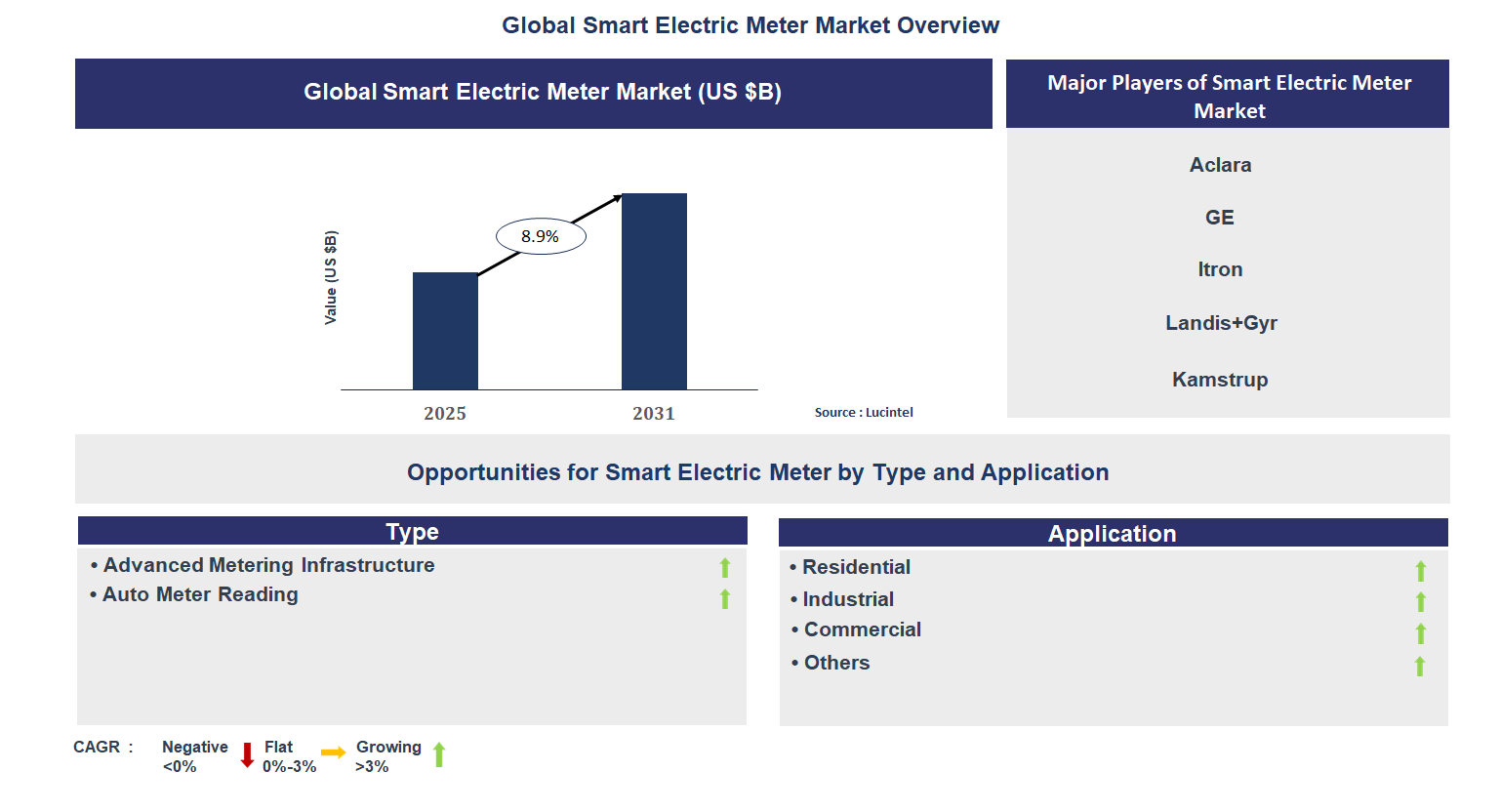
The future of the global smart electric meter market looks promising with opportunities in the residential, industrial, and commercial markets. The global smart electric meter market is expected to grow with a CAGR of 8.9% from 2025 to 2031. The major drivers for this market are the increasing adoption of smart grid technologies, the rising demand for real-time energy consumption monitoring, and the growing government initiatives for energy efficiency programs.• Lucintel forecasts that, within the type category, advanced metering infrastructure is expected to witness higher growth over the forecast period.
• Within the application category, residential is expected to witness the highest growth.
• In terms of region, APAC is expected to witness the highest growth over the forecast period. Gain valuable insights for your business decisions with our comprehensive 150+ page report. Sample figures with some insights are shown below.
Emerging Trends in the Smart Electric Meter Market
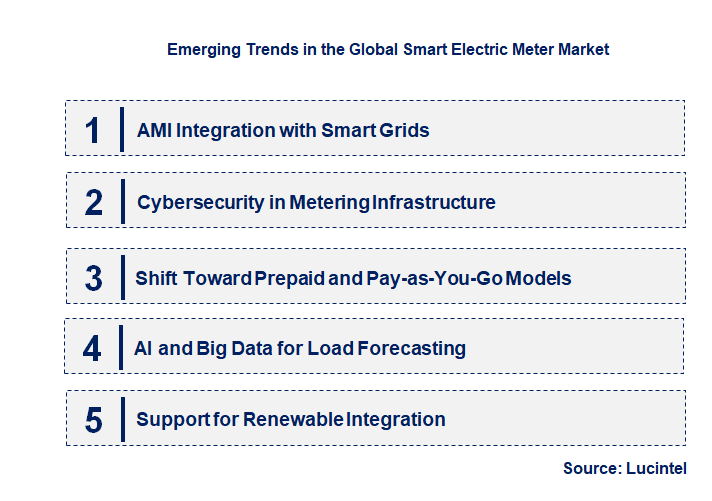
The smart electric meter market is evolving through the integration of digital technologies, enhanced connectivity, and grid intelligence. As utilities and governments aim for smarter, more resilient energy systems, several key trends are shaping the development and deployment of next-generation metering infrastructure globally.• AMI Integration with Smart Grids: Advanced Metering Infrastructure is being integrated with smart grids to allow real-time data collection, remote meter management, and dynamic energy pricing. This trend improves grid responsiveness, reduces outages, and enables better demand forecasting, supporting utilities in optimizing power distribution and enhancing consumer satisfaction.
• Cybersecurity in Metering Infrastructure: As smart meters become critical IoT nodes, cybersecurity has emerged as a top priority. Utilities are investing in secure communication protocols, encryption technologies, and regulatory-compliant systems to protect against cyber threats. This trend is essential to safeguard consumer data and maintain the integrity of national power grids.
• Shift Toward Prepaid and Pay-as-You-Go Models: In emerging markets, prepaid smart meters are gaining traction. These meters enable consumers to manage energy budgets more effectively while helping utilities reduce revenue losses. The flexibility of pay-as-you-go systems makes electricity more accessible, especially in underserved or remote areas with limited grid reliability.
• AI and Big Data for Load Forecasting: Utilities are increasingly leveraging AI and big data analytics to interpret the massive volumes of data generated by smart meters. This enables predictive maintenance, accurate load forecasting, and optimized grid operations. These capabilities are driving operational efficiency and proactive management of power networks.
• Support for Renewable Integration: Smart meters are playing a vital role in integrating distributed renewable energy sources like solar and wind. By enabling real-time monitoring and bidirectional energy flow, smart meters facilitate net metering, virtual power plants (VPPs), and energy trading. This supports the shift toward decentralized and low-carbon energy systems. Emerging trends in the smart electric meter market are enabling a transition to intelligent, responsive, and sustainable energy networks. From grid digitization and cybersecurity to AI analytics and renewable integration, these trends are reshaping the energy landscape and empowering consumers and utilities alike with data-driven insights and control.
Recent Development in the Smart Electric Meter Market
The smart electric meter market is being reshaped by rapid technological innovation, evolving regulations, and changing consumer behavior. Recent developments are focused on digital transformation, grid modernization, and enhancing energy access and reliability across both developed and developing markets.• 5G-Enabled Smart Meters: The deployment of 5G-enabled smart meters is enhancing data transmission speeds and latency, enabling near-instantaneous two-way communication. These meters support advanced applications like remote diagnostics, real-time pricing, and predictive maintenance, making grid systems more agile and responsive.
• Mass Rollout in Emerging Economies: Countries like India, Brazil, and Indonesia have launched nationwide smart meter programs aimed at improving billing accuracy and reducing theft. These mass rollouts, often supported by government incentives and public-private partnerships, are expanding market reach and transforming legacy infrastructure.
• Interoperable and Modular Meter Designs: Smart meters are being designed with modular and interoperable components, allowing utilities to integrate new technologies without replacing entire systems. This reduces long-term costs, simplifies upgrades, and ensures compatibility with evolving standards and communication protocols.
• Cloud-Based Meter Data Management: Utilities are shifting from on-premise to cloud-based meter data management systems (MDMS). This transition allows for scalable data storage, advanced analytics, and seamless integration with distributed energy resources. Cloud-based MDMS enhances flexibility, reduces IT overhead, and supports remote workforces.
• Focus on Edge Computing: Smart meters are increasingly equipped with edge computing capabilities to process data locally. This reduces latency, enables faster decision-making, and lowers dependence on central servers. Edge-enabled meters enhance the resilience of energy systems by ensuring uninterrupted performance even during connectivity disruptions. Recent developments in the smart electric meter market are transforming energy infrastructure by enhancing connectivity, interoperability, and intelligence. These innovations support the global shift to digital, decentralized, and decarbonized energy systems, enabling utilities to improve efficiency, security, and customer engagement.
Strategic Growth Opportunities in the Smart Electric Meter Market
Smart electric meter market contribute to global energy transformation efforts. Their role in enabling real-time monitoring, demand response, and integration of renewables is unlocking new growth opportunities across applications, particularly in grid modernization, rural electrification, and smart city infrastructure.• Smart Cities and Urban Infrastructure: Smart meters are foundational to smart cities, enabling data-driven energy management, traffic control, and lighting systems. Their deployment supports energy optimization, utility automation, and enhanced citizen engagement. Utilities partnering with urban development projects can unlock long-term growth opportunities by embedding meters into city-wide IoT ecosystems.
• Prepaid Metering in Developing Regions: Prepaid metering presents a significant opportunity in developing countries by improving electricity access, reducing losses, and promoting responsible consumption. Utilities can deploy these systems to improve revenue collection and serve previously unconnected populations, especially in Africa and South Asia.
• Residential Sector Electrification: As the residential sector increasingly adopts electric vehicles, solar panels, and smart appliances, smart meters enable real-time monitoring and load balancing. Growth in this segment is driven by the need to manage complex residential energy profiles and offer customized billing.
• Demand Response and Load Management: Smart meters allow utilities to implement demand response programs, incentivizing consumers to shift usage during peak times. These programs reduce grid strain and defer costly infrastructure upgrades. Demand response integration presents growth potential in both mature and emerging energy markets.
• Industrial Energy Management Solutions: Industrial sectors are adopting smart meters for energy efficiency, compliance, and cost reduction. These meters provide granular energy usage data that helps optimize processes and monitor power quality. Tailored industrial solutions represent a growing opportunity, particularly in manufacturing and heavy industries. Strategic growth opportunities in the smart meter market span across residential, industrial, and municipal applications. Leveraging prepaid models, demand response programs, and smart city integrations will enable utilities and technology providers to capture new value and enhance energy resilience across regions.
Smart Electric Meter Market Driver and Challenges
The smart electric meter market is driven by technological innovation, energy efficiency goals, and supportive policies, but also faces challenges such as cybersecurity risks, high costs, and integration complexity. Understanding these forces is crucial to unlocking growth and mitigating barriers in smart grid development. The factors responsible for driving the smart electric meter market include: 1. Government Mandates and Incentives: National and regional mandates for smart meter rollouts are accelerating deployment. Governments offer subsidies and regulatory support to promote grid modernization and reduce transmission losses. These policies create a strong foundation for market growth across public and private sectors. 2. Rising Energy Demand and Urbanization: Rapid urban growth and rising electricity consumption are pressuring utilities to modernize grid infrastructure. Smart meters offer real-time monitoring and control, helping utilities manage load fluctuations and plan for future demand growth efficiently. 3. Need for Energy Efficiency: Utilities and consumers alike are focusing on reducing energy waste and costs. Smart meters enable detailed consumption data, allowing better energy management. Energy efficiency objectives align directly with smart meter adoption, especially under climate action frameworks. 4. Renewable Energy Integration: The global shift toward decentralized and intermittent renewable energy sources requires precise grid coordination. Smart meters facilitate two-way communication and net metering, making them essential tools in balancing renewable inputs with real-time consumption. 5. Technological Advancements in IoT and AI: IoT-enabled meters and AI-driven analytics are transforming data collection and grid intelligence. These technologies enhance predictive maintenance, fraud detection, and usage forecasting, significantly increasing the value proposition of smart meters for utilities. Challenges in the smart electric meter market are: 1. Cybersecurity Threats: As smart meters become part of the critical digital infrastructure, they are exposed to cyberattacks. Breaches could compromise grid stability or leak sensitive data, making security investment vital but also increasing deployment complexity and costs. 2. High Upfront Investment Costs: The cost of smart meter hardware, communication networks, and backend systems remains a barrier for many utilities, especially in developing regions. Although long-term savings are clear, initial capital requirements delay adoption. 3. Integration with Legacy Systems: Utilities often face challenges integrating new smart meters with aging grid infrastructure and outdated IT systems. Compatibility issues and lack of skilled labor can hinder smooth deployment and performance optimization. The smart electric meter market is advancing rapidly due to strong regulatory support, rising energy demands, and technological innovations. However, overcoming challenges like cybersecurity, integration complexity, and cost barriers is essential to achieving scalable and secure energy transformation globally. Stakeholders must align efforts to drive robust, future-ready deployments.List of Smart Electric Meter Companies
Companies in the market compete on the basis of product quality offered. Major players in this market focus on expanding their manufacturing facilities, R&D investments, infrastructural development, and leverage integration opportunities across the value chain. With these strategies smart electric meter companies cater increasing demand, ensure competitive effectiveness, develop innovative products & technologies, reduce production costs, and expand their customer base. Some of the smart electric meter companies profiled in this report include-• Aclara
• GE
• Itron
• Landis+Gyr
• Kamstrup
• Honeywell
• Siemens
• Sensus
• ABB
• ZPA Smart Energy
Smart Electric Meter Market by Segment
The study includes a forecast for the global smart electric meter market by type, application, and region.Smart Electric Meter Market by Type [Value from 2019 to 2031]:
• Advanced Metering Infrastructure
• Auto Meter Reading
Smart Electric Meter Market by Application [Value from 2019 to 2031]:
• Residential
• Industrial
• Commercial
• Others
Smart Electric Meter Market by Region [Value from 2019 to 2031]:
• North America
• Europe
• Asia Pacific
• The Rest of the World
Country Wise Outlook for the Smart Electric Meter Market
The global smart electric meter market is witnessing rapid expansion, driven by digitization of energy systems, government mandates, and increasing demand for real-time consumption monitoring. Countries like the United States, China, Germany, India, and Japan are implementing large-scale smart meter rollouts to modernize grids, improve efficiency, and support renewable energy integration.• United States: The U.S. is experiencing widespread smart meter deployment, with utilities investing heavily in advanced metering infrastructure (AMI). Federal and state-level incentives are accelerating adoption, while integration with smart grids and renewable energy systems remains a focus. Advanced data analytics, outage detection, and time-of-use billing features are enhancing grid reliability and consumer engagement across the country.
• China: China leads the world in smart meter installations, backed by strong government support and large-scale urbanization. Recent developments include the rollout of next-gen smart meters capable of handling high-frequency data transmission and renewable integration. State Grid Corporation is deploying millions of intelligent meters annually, enabling demand response and grid automation as part of China’s energy transition strategy.
• Germany: Germany is advancing smart meter deployment to meet EU energy directives and support its Energiewende policy. The country’s focus is on secure, GDPR-compliant data handling, along with integrating meters into decentralized renewable energy systems. Rollouts are targeted, prioritizing high-consumption households and commercial users. The shift toward digital grid infrastructure is enhancing energy transparency and supporting real-time energy trading.
• India: India’s smart meter market is growing rapidly under the government’s Revamped Distribution Sector Scheme (RDSS). Recent initiatives aim to install 250 million smart meters by 2025. Discoms are partnering with private firms to deploy prepaid and AMI-enabled meters, enhancing billing efficiency and reducing technical losses. The market is also benefiting from increasing electricity access in rural areas.
• Japan: Japan has nearly completed its nationwide smart meter rollout, driven by liberalization of the electricity market and a focus on disaster resilience. Smart meters are being integrated with home energy management systems (HEMS) to enable demand-side response. Japanese utilities are now focusing on upgrading meters with enhanced communication protocols and cybersecurity features for greater grid stability and efficiency.

Features of the Global Smart Electric Meter Market
Market Size Estimates: Smart electric meter market size estimation in terms of value ($B). Trend and Forecast Analysis: Market trends (2019 to 2024) and forecast (2025 to 2031) by various segments and regions. Segmentation Analysis: Smart electric meter market size by type, application, and region in terms of value ($B). Regional Analysis: Smart electric meter market breakdown by North America, Europe, Asia Pacific, and Rest of the World. Growth Opportunities: Analysis of growth opportunities in different types, applications, and regions for the smart electric meter market. Strategic Analysis: This includes M&A, new product development, and competitive landscape of the smart electric meter market. Analysis of competitive intensity of the industry based on Porter’s Five Forces model.
FAQ
Q1. What is the growth forecast for smart electric meter market? Answer: The global smart electric meter market is expected to grow with a CAGR of 8.9% from 2025 to 2031. Q2. What are the major drivers influencing the growth of the smart electric meter market? Answer: The major drivers for this market are the increasing adoption of smart grid technologies, the rising demand for real-time energy consumption monitoring, and the growing government initiatives for energy efficiency programs. Q3. What are the major segments for smart electric meter market? Answer: The future of the smart electric meter market looks promising with opportunities in the residential, industrial, and commercial markets. Q4. Who are the key smart electric meter market companies? Answer: Some of the key smart electric meter companies are as follows:• Aclara
• GE
• Itron
• Landis+Gyr
• Kamstrup
• Honeywell
• Siemens
• Sensus
• ABB
• ZPA Smart Energy Q5. Which smart electric meter market segment will be the largest in future? Answer: Lucintel forecasts that, within the type category, advanced metering infrastructure is expected to witness higher growth over the forecast period. Q6. In smart electric meter market, which region is expected to be the largest in next 5 years? Answer: In terms of region, APAC is expected to witness the highest growth over the forecast period. Q7. Do we receive customization in this report? Answer: Yes, Lucintel provides 10% customization without any additional cost.
Table of Contents
List of Figures
List of Tables
Methodology
- In-depth interviews of the major players in this market
- Detailed secondary research from competitors’ financial statements and published data
- Extensive searches of published works, market, and database information pertaining to industry news, company press releases, and customer intentions
- A compilation of the experiences, judgments, and insights of Lucintel’s professionals, who have analyzed and tracked this market over the years.


Buy Now
Choose a license that fits your team. Instant PDF delivery.
Prices exclude taxes. Instant delivery. Custom licensing available on request.
Key Questions
- • What are some of the most promising, high-growth opportunities for the smart electric meter market by type (advanced metering infrastructure and auto meter reading), application (residential, industrial, commercial, and others), and region (North America, Europe, Asia Pacific, and the Rest of the World)?
- • Which segments will grow at a faster pace and why?
- • Which region will grow at a faster pace and why?
- • What are the key factors affecting market dynamics? What are the key challenges and business risks in this market?
- • What are the business risks and competitive threats in this market?
- • What are the emerging trends in this market and the reasons behind them?
- • What are some of the changing demands of customers in the market?
- • What are the new developments in the market? Which companies are leading these developments?
- • Who are the major players in this market? What strategic initiatives are key players pursuing for business growth?
- • What are some of the competing products in this market and how big of a threat do they pose for loss of market share by material or product substitution?
- • What M&A activity has occurred in the last 5 years and what has its impact been on the industry? For any questions related to Smart Electric Meter Market, Smart Electric Meter Market Size, Smart Electric Meter Market Growth, Smart Electric Meter Market Analysis, Smart Electric Meter Market Report, Smart Electric Meter Market Share, Smart Electric Meter Market Trends, Smart Electric Meter Market Forecast, Smart Electric Meter Companies, write Lucintel analyst at email: helpdesk@lucintel.com. We will be glad to get back to you soon.


