
Report Feature
Smart Building Acoustic Sensor Market Trends and Forecast
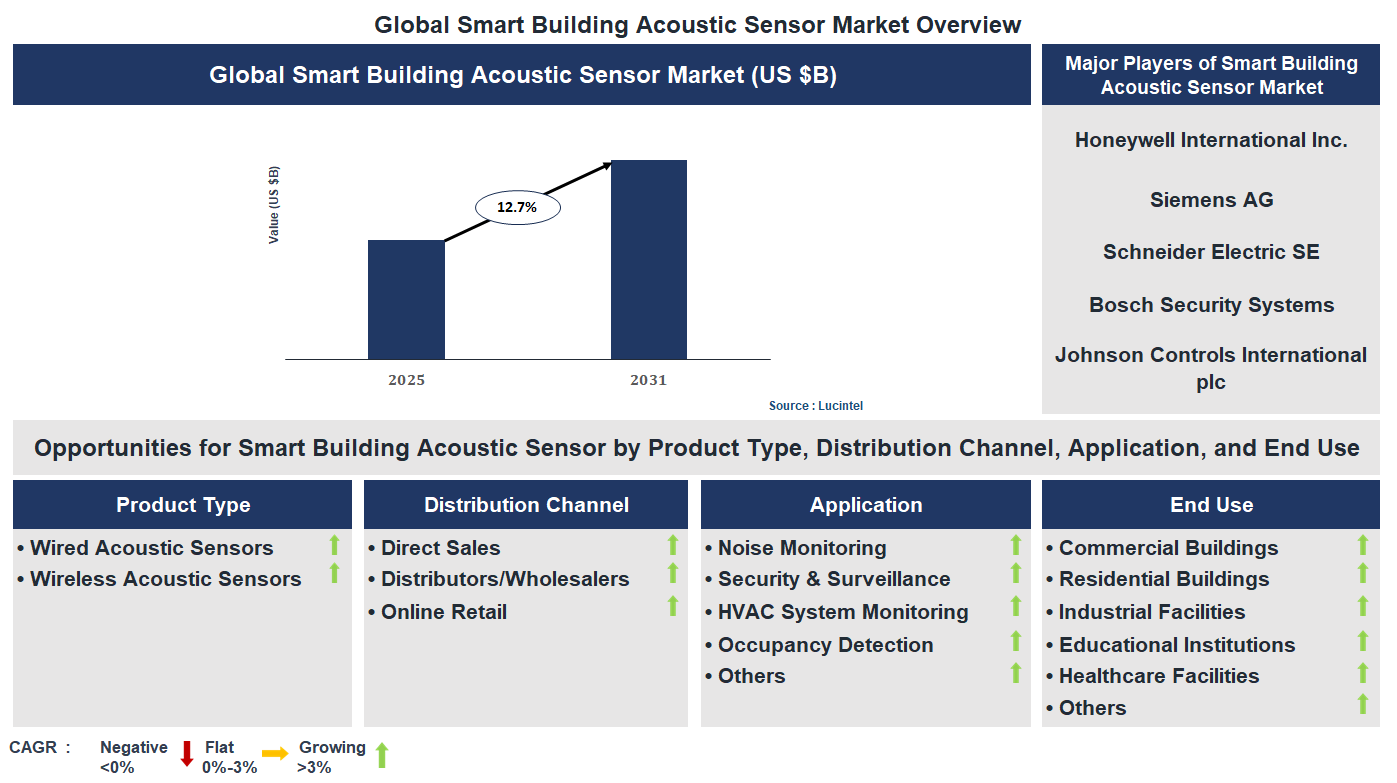
The future of the global smart building acoustic sensor market looks promising with opportunities in the commercial building, residential building, industrial facility, educational institution, and healthcare facility markets. The global smart building acoustic sensor market is expected to grow with a CAGR of 12.7% from 2025 to 2031. The major drivers for this market are the increasing demand for intelligent noise monitoring, the rising need for advanced acoustic analytics, and the growing adoption of smart building sensors.• Lucintel forecasts that, within the product type category, wired acoustic sensor is expected to witness higher growth over the forecast period.
• Within the end use category, commercial building is expected to witness the highest growth.
• In terms of region, North America is expected to witness the highest growth over the forecast period. Gain valuable insights for your business decisions with our comprehensive 150+ page report. Sample figures with some insights are shown below.
Emerging Trends in the Smart Building Acoustic Sensor Market
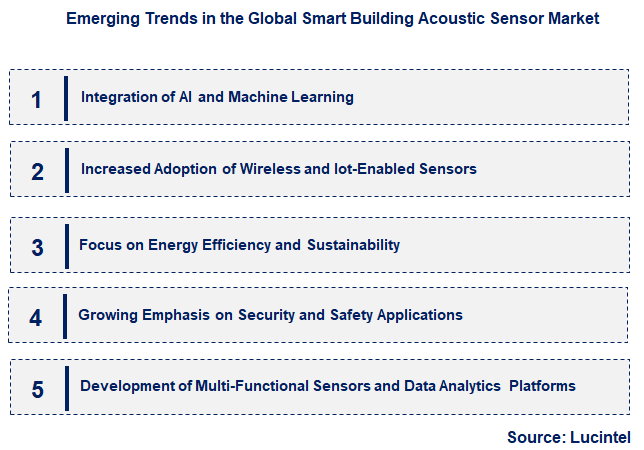
The smart building acoustic sensor market is experiencing rapid growth driven by advancements in IoT technology, increasing demand for energy efficiency, and the need for enhanced security and safety in modern infrastructure. As buildings become smarter and more connected, acoustic sensors play a crucial role in monitoring environmental conditions, detecting anomalies, and optimizing building operations. These developments are transforming traditional building management systems into intelligent, responsive environments. The market is characterized by innovation, integration, and a focus on sustainability, which are shaping the future landscape of smart building management. The following key trends highlight the major directions this market is heading toward.• Integration of AI and Machine Learning: The incorporation of AI and machine learning algorithms into acoustic sensors enhances their ability to analyze sound patterns accurately. This integration allows for real-time detection of anomalies such as unauthorized access, fire, or equipment failure, improving safety and security. AI-driven sensors can also predict maintenance needs, reducing downtime and operational costs. As these technologies become more affordable and sophisticated, their adoption is expected to accelerate, making smart buildings more autonomous and efficient.
• Increased Adoption of Wireless and IoT-Enabled Sensors: Wireless acoustic sensors connected via IoT networks are gaining popularity due to their ease of installation and scalability. These sensors facilitate seamless data collection across large building complexes without extensive wiring, reducing costs and disruption. IoT connectivity enables centralized monitoring and control, providing building managers with real-time insights into acoustic environments. This trend supports the development of fully integrated smart building ecosystems, enhancing occupant comfort, safety, and energy management.
• Focus on Energy Efficiency and Sustainability: Acoustic sensors are increasingly being used to optimize HVAC systems, lighting, and other building operations to reduce energy consumption. By monitoring sound levels and environmental noise, these sensors help identify inefficiencies and areas for improvement. The push toward green building certifications and sustainability goals is driving the deployment of acoustic sensors that contribute to energy conservation. This trend aligns with the broader shift toward environmentally responsible construction and operation practices, making buildings more sustainable and cost-effective.
• Growing Emphasis on Security and Safety Applications: Acoustic sensors are vital for security systems, detecting sounds such as glass breaking, gunshots, or unauthorized entry. Their ability to provide early warning and situational awareness enhances building safety. As urban areas become more security-conscious, the demand for advanced acoustic sensing solutions is rising. These sensors are integrated with surveillance and alarm systems to create comprehensive security networks, reducing response times and preventing incidents. This trend underscores the importance of acoustic sensors in safeguarding occupants and assets in smart buildings.
• Development of Multi-Functional Sensors and Data Analytics Platforms: The market is witnessing a shift toward multi-functional acoustic sensors capable of performing various tasks, such as environmental monitoring, security, and occupancy detection. Coupled with advanced data analytics platforms, these sensors enable comprehensive building management solutions. Data collected is analyzed to optimize operations, improve occupant comfort, and predict maintenance needs. This convergence of sensor technology and analytics is creating smarter, more responsive buildings, offering significant value to property owners and facility managers by streamlining operations and enhancing user experience. In summary, these emerging trends are fundamentally reshaping the smart building acoustic sensor market by fostering greater integration, intelligence, and sustainability. They are enabling buildings to become more adaptive, secure, and energy-efficient, ultimately transforming the way we design, operate, and experience modern infrastructure.
Recent Development in the Smart Building Acoustic Sensor Market
The smart building acoustic sensor market has experienced rapid growth driven by advancements in IoT technology, increasing demand for energy efficiency, and the need for enhanced security in commercial and residential buildings. As buildings become smarter, acoustic sensors play a crucial role in monitoring sound patterns for security, maintenance, and automation purposes. Recent developments reflect technological innovations, expanding applications, and strategic collaborations that are shaping the market landscape. These changes are not only improving building management but also contributing to sustainability and safety, making the market highly dynamic and competitive.• Integration of AI and Machine Learning: The incorporation of AI and machine learning algorithms into acoustic sensors has significantly improved sound recognition accuracy. This development enables real-time analysis and predictive maintenance, reducing operational costs and enhancing security. The ability to distinguish between different sound sources allows for more precise alerts and automation, thus increasing the sensors reliability and expanding their application scope in smart buildings.
• Miniaturization and Wireless Technology: Advances in miniaturization and wireless communication have led to more discreet and easily deployable acoustic sensors. Wireless sensors facilitate flexible installation without extensive wiring, making them ideal for retrofit projects and complex building layouts. This development reduces installation costs and time, broadening market reach and enabling widespread adoption in various building types.
• Enhanced Data Analytics and Cloud Integration: The integration of acoustic sensors with cloud platforms and advanced data analytics tools has transformed data management. This allows for centralized monitoring, long-term data storage, and sophisticated analysis, leading to better decision-making. Cloud connectivity also supports remote access and control, improving operational efficiency and enabling predictive insights for building management.
• Focus on Security and Surveillance Applications: There is a growing emphasis on using acoustic sensors for security and surveillance in smart buildings. These sensors can detect unusual sounds such as glass breaking, gunshots, or forced entry, providing early alerts and enhancing safety. This focus is driven by increasing security concerns and regulatory requirements, expanding the market for acoustic sensors in security systems.
• Strategic Collaborations and Market Expansion: Major players are forming strategic alliances with technology providers, construction firms, and government agencies to expand market reach. These collaborations facilitate the development of integrated solutions and entry into emerging markets. Such partnerships accelerate innovation, improve product offerings, and drive market growth by addressing diverse customer needs and regulatory standards. In summary, recent developments in the smart building acoustic sensor market—such as AI integration, miniaturization, cloud analytics, security applications, and strategic collaborations—are significantly enhancing the functionality, deployment, and market penetration of acoustic sensors. These advancements are leading to smarter, safer, and more efficient buildings, thereby fueling market growth and innovation.
Strategic Growth Opportunities in the Smart Building Acoustic Sensor Market
The smart building acoustic sensor market is experiencing rapid growth driven by increasing demand for intelligent building management systems, enhanced security, and energy efficiency. As urbanization accelerates and smart infrastructure becomes a priority, acoustic sensors are playing a vital role in monitoring and optimizing building operations. Key applications such as security, HVAC management, fire detection, occupancy sensing, and maintenance are expanding, creating new opportunities for market players. These developments are transforming building automation, improving safety, reducing operational costs, and enhancing occupant comfort. The following are five key growth opportunities across different applications in this evolving market.• Security Monitoring: The deployment of acoustic sensors for security enhances building safety by detecting unauthorized access, glass breakage, or suspicious sounds. This application reduces response times and prevents security breaches, making buildings safer and more secure. As security concerns grow, demand for advanced acoustic-based surveillance systems is expected to rise significantly.
• HVAC Optimization: Acoustic sensors help monitor sound levels and vibrations within HVAC systems, enabling predictive maintenance and energy-efficient operation. This reduces downtime and operational costs while improving indoor air quality. The integration of acoustic data with building management systems enhances overall HVAC performance, driving market growth.
• Fire and Smoke Detection: Acoustic sensors can identify the sounds of smoke alarms, fire crackling, or abnormal noises indicating fire hazards. This early detection capability improves safety and minimizes property damage. Increasing adoption of smart fire safety systems is fueling growth in this application area.
• Occupancy and Space Utilization: Acoustic sensors facilitate real-time occupancy detection and space utilization analysis, optimizing building layouts and energy use. This application supports flexible workspace management and reduces energy wastage, aligning with smart building sustainability goals.
• Maintenance and Asset Management: Acoustic sensors enable predictive maintenance by detecting abnormal sounds from equipment, reducing unexpected failures and extending asset lifespan. This proactive approach lowers maintenance costs and enhances operational efficiency, making it a critical growth area. In summary, these growth opportunities are significantly impacting the smart building acoustic sensor market by driving innovation, improving safety, and optimizing operational efficiency. As applications expand and technology advances, the market is poised for substantial growth, supporting smarter, safer, and more sustainable building environments.
Smart Building Acoustic Sensor Market Driver and Challenges
The smart building acoustic sensor market is influenced by a variety of technological, economic, and regulatory factors. Rapid advancements in sensor technology, increasing demand for energy-efficient and sustainable buildings, and the integration of IoT devices are key drivers. Additionally, government regulations promoting smart infrastructure and the need for enhanced security systems further propel market growth. However, the market also faces challenges such as high installation costs, data privacy concerns, and technological compatibility issues. Understanding these drivers and challenges is essential for stakeholders to navigate the evolving landscape and capitalize on emerging opportunities effectively. The factors responsible for driving the smart building acoustic sensor market include:-• Technological Advancements: The continuous development of more sensitive, accurate, and cost-effective acoustic sensors has significantly contributed to market growth. These sensors enable real-time monitoring of building environments, improving energy efficiency, security, and occupant comfort. Integration with IoT platforms allows for smarter building management systems, which are increasingly in demand. As technology evolves, the ability to detect and analyze sound patterns more precisely enhances the value proposition for building owners and facility managers. This ongoing innovation fosters market expansion by enabling new applications and improving existing solutions.
• Growing Adoption of Smart Building Technologies: The rising adoption of smart building solutions across commercial, residential, and industrial sectors is a major driver. These technologies aim to optimize energy consumption, enhance security, and improve occupant experience. Acoustic sensors play a crucial role in noise monitoring, intrusion detection, and environmental control. Governments and private organizations are investing heavily in smart infrastructure projects, which accelerates market growth. The increasing awareness of the benefits of intelligent building management systems encourages stakeholders to incorporate acoustic sensors, thereby expanding the market.
• Regulatory and Environmental Policies: Stringent government regulations aimed at reducing energy consumption and improving building safety are fueling market demand. Policies promoting green building certifications and sustainable construction practices incentivize the integration of advanced sensor systems. Acoustic sensors help in maintaining acoustic comfort and noise regulation compliance, which are often mandated by building codes. Additionally, regulations related to security and safety standards necessitate the deployment of acoustic sensors for intrusion detection and emergency response, further boosting market growth.
• Rising Demand for Energy Efficiency and Sustainability: The global emphasis on reducing carbon footprints and enhancing energy efficiency in buildings is a significant driver. Acoustic sensors contribute to this goal by enabling precise control of HVAC systems, detecting leaks, and optimizing energy use based on occupancy and environmental conditions. As building owners seek to achieve sustainability certifications like LEED, the integration of acoustic sensors becomes increasingly vital. This trend not only reduces operational costs but also aligns with corporate social responsibility initiatives, thereby expanding the market.
• Increasing Use of IoT and Data Analytics: The proliferation of IoT devices and advancements in data analytics are transforming building management. Acoustic sensors generate valuable data that can be analyzed to predict maintenance needs, improve security, and enhance occupant comfort. The ability to connect sensors to centralized platforms allows for comprehensive building oversight and automation. This integration facilitates proactive decision-making and operational efficiency, encouraging widespread adoption. As IoT ecosystems expand, the market for acoustic sensors is expected to grow correspondingly, driven by the demand for smarter, more connected buildings. The challenges facing this smart building acoustic sensor market include:-
• High Installation and Maintenance Costs: Implementing acoustic sensors across large building complexes involves significant initial investment. Costs associated with sensor procurement, installation, and integration with existing systems can be prohibitive, especially for small and medium-sized enterprises. Additionally, ongoing maintenance and calibration are required to ensure optimal performance, adding to operational expenses. These financial barriers may hinder market penetration in cost-sensitive regions and slow down the adoption rate of advanced acoustic sensor solutions.
• Data Privacy and Security Concerns: The deployment of acoustic sensors involves collecting and transmitting sensitive environmental and security data. Concerns over data breaches, unauthorized access, and misuse pose significant challenges. Regulatory frameworks around data privacy are becoming more stringent, requiring robust security measures that can increase costs and complexity. Ensuring compliance while maintaining system integrity is critical, and failure to do so could result in legal liabilities and loss of stakeholder trust, impeding market growth.
• Technological Compatibility and Standardization Issues: The integration of acoustic sensors with diverse building management systems presents compatibility challenges. Lack of standardized protocols can lead to interoperability issues, complicating deployment and increasing costs. Rapid technological evolution also risks obsolescence, requiring frequent upgrades. These factors create barriers for widespread adoption, especially in existing buildings where retrofitting is complex. Addressing standardization and compatibility is essential for seamless integration and sustained market growth. In summary, the smart building acoustic sensor market is driven by technological innovation, regulatory support, and a focus on sustainability, which collectively foster growth opportunities. However, high costs, data security concerns, and compatibility issues pose significant challenges. Balancing these factors will be crucial for market participants to capitalize on emerging trends and expand their presence in this evolving landscape. The overall impact suggests a promising yet complex market environment that requires strategic planning and technological advancements to overcome barriers and harness growth potential.
List of Smart Building Acoustic Sensor Companies
Companies in the market compete on the basis of product quality offered. Major players in this market focus on expanding their manufacturing facilities, R&D investments, infrastructural development, and leverage integration opportunities across the value chain. With these strategies smart building acoustic sensor companies cater increasing demand, ensure competitive effectiveness, develop innovative products & technologies, reduce production costs, and expand their customer base. Some of the smart building acoustic sensor companies profiled in this report include-• Honeywell International Inc.
• Siemens AG
• Schneider Electric SE
• Bosch Security Systems
• Johnson Controls International plc
• ABB Ltd.
• Legrand SA
• Eaton Corporation plc
• Delta Electronics, Inc.
• Cisco Systems, Inc.
Smart Building Acoustic Sensor Market by Segment
The study includes a forecast for the global smart building acoustic sensor market by product type, distribution channel, application, end use, and region.Smart Building Acoustic Sensor Market by Product Type [Value from 2019 to 2031]:
• Wired Acoustic Sensors
• Wireless Acoustic Sensors
Smart Building Acoustic Sensor Market by Distribution Channel [Value from 2019 to 2031]:
• Direct Sales
• Distributors/Wholesalers
• Online Retail
Smart Building Acoustic Sensor Market by Application [Value from 2019 to 2031]:
• Noise Monitoring
• Security & Surveillance
• HVAC System Monitoring
• Occupancy Detection
• Others
Smart Building Acoustic Sensor Market by End Use [Value from 2019 to 2031]:
• Commercial Buildings
• Residential Buildings
• Industrial Facilities
• Educational Institutions
• Healthcare Facilities
• Others
Smart Building Acoustic Sensor Market by Region [Value from 2019 to 2031]:
• North America
• Europe
• Asia Pacific
• The Rest of the World
Country Wise Outlook for the Smart Building Acoustic Sensor Market
The smart building acoustic sensor market is experiencing rapid growth driven by advancements in IoT technology, increasing demand for energy efficiency, and the need for enhanced security in commercial and residential buildings. Governments and private sectors are investing heavily in smart infrastructure to improve building management and occupant safety. Innovations in sensor technology, data analytics, and integration with smart systems are transforming the market landscape across the globe. This evolution is particularly notable in major economies where urbanization and technological adoption are accelerating. The following summarizes recent developments in this market for the United States, China, Germany, India, and Japan.• United States: The US market has seen significant adoption of acoustic sensors in smart buildings for security and energy management. Major tech firms are developing integrated solutions that combine acoustic data with AI for real-time building monitoring. Regulatory incentives for energy efficiency are also boosting market growth, alongside increased investments in smart infrastructure projects.
• China: China is rapidly expanding its smart building infrastructure, with government initiatives promoting IoT integration. Acoustic sensors are increasingly used for security, noise monitoring, and energy optimization. Domestic manufacturers are innovating with cost-effective sensors, and urban smart city projects are driving widespread adoption across commercial and residential sectors.
• Germany: Germanys market emphasizes high-quality, reliable acoustic sensors for building automation and security. The focus on energy efficiency and sustainability aligns with EU regulations, leading to increased deployment of sensors in green building projects. Collaborations between tech firms and construction companies are fostering innovative sensor applications.
• India: The Indian market is witnessing growing interest in acoustic sensors for security and energy management amid urbanization. Cost-effective solutions are prioritized to suit local infrastructure needs. Government initiatives for smart cities and digital infrastructure are catalyzing market expansion, with startups and local manufacturers playing key roles.
• Japan: Japans market is characterized by advanced sensor technology integration in smart buildings, emphasizing security, noise control, and energy efficiency. The focus on disaster resilience and smart city initiatives is driving the adoption of acoustic sensors. Collaborations between technology providers and construction firms are enhancing market penetration.

Features of the Global Smart Building Acoustic Sensor Market
Market Size Estimates: Smart building acoustic sensor market size estimation in terms of value ($B). Trend and Forecast Analysis: Market trends (2019 to 2024) and forecast (2025 to 2031) by various segments and regions. Segmentation Analysis: Smart building acoustic sensor market size by various segments, such as by product type, distribution channel, application, end use, and region in terms of value ($B). Regional Analysis: Smart building acoustic sensor market breakdown by North America, Europe, Asia Pacific, and Rest of the World. Growth Opportunities: Analysis of growth opportunities in different product types, distribution channels, applications, end uses, and regions for the smart building acoustic sensor market. Strategic Analysis: This includes M&A, new product development, and competitive landscape of the smart building acoustic sensor market. Analysis of competitive intensity of the industry based on Porter’s Five Forces model.
FAQ
Q1. What is the growth forecast for smart building acoustic sensor market? Answer: The global smart building acoustic sensor market is expected to grow with a CAGR of 12.7% from 2025 to 2031. Q2. What are the major drivers influencing the growth of the smart building acoustic sensor market? Answer: The major drivers for this market are the increasing demand for intelligent noise monitoring, the rising need for advanced acoustic analytics, and the growing adoption of smart building sensors. Q3. What are the major segments for smart building acoustic sensor market? Answer: The future of the smart building acoustic sensor market looks promising with opportunities in the commercial building, residential building, industrial facility, educational institution, and healthcare facility markets. Q4. Who are the key smart building acoustic sensor market companies? Answer: Some of the key smart building acoustic sensor companies are as follows:• Honeywell International Inc.
• Siemens AG
• Schneider Electric SE
• Bosch Security Systems
• Johnson Controls International plc
• ABB Ltd.
• Legrand SA
• Eaton Corporation plc
• Delta Electronics, Inc.
• Cisco Systems, Inc. Q5. Which smart building acoustic sensor market segment will be the largest in future? Answer: Lucintel forecasts that, within the product type category, wired acoustic sensor is expected to witness higher growth over the forecast period. Q6. In smart building acoustic sensor market, which region is expected to be the largest in next 5 years? Answer: In terms of region, North America is expected to witness the highest growth over the forecast period. Q7. Do we receive customization in this report? Answer: Yes, Lucintel provides 10% customization without any additional cost.
Table of Contents
List of Figures
List of Tables
Methodology
- In-depth interviews of the major players in this market
- Detailed secondary research from competitors’ financial statements and published data
- Extensive searches of published works, market, and database information pertaining to industry news, company press releases, and customer intentions
- A compilation of the experiences, judgments, and insights of Lucintel’s professionals, who have analyzed and tracked this market over the years.


Buy Now
Choose a license that fits your team. Instant PDF delivery.
Prices exclude taxes. Instant delivery. Custom licensing available on request.
Key Questions
- • What are some of the most promising, high-growth opportunities for the smart building acoustic sensor market by product type (wired acoustic sensors and wireless acoustic sensors), distribution channel (direct sales, distributors/wholesalers, and online retail), application (noise monitoring, security & surveillance, HVAC system monitoring, occupancy detection, and others), end use (commercial buildings, residential buildings, industrial facilities, educational institutions, healthcare facilities, and others), and region (North America, Europe, Asia Pacific, and the Rest of the World)?
- • Which segments will grow at a faster pace and why?
- • Which region will grow at a faster pace and why?
- • What are the key factors affecting market dynamics? What are the key challenges and business risks in this market?
- • What are the business risks and competitive threats in this market?
- • What are the emerging trends in this market and the reasons behind them?
- • What are some of the changing demands of customers in the market?
- • What are the new developments in the market? Which companies are leading these developments?
- • Who are the major players in this market? What strategic initiatives are key players pursuing for business growth?
- • What are some of the competing products in this market and how big of a threat do they pose for loss of market share by material or product substitution?
- • What M&A activity has occurred in the last 5 years and what has its impact been on the industry? For any questions related to Smart Building Acoustic Sensor Market, Smart Building Acoustic Sensor Market Size, Smart Building Acoustic Sensor Market Growth, Smart Building Acoustic Sensor Market Analysis, Smart Building Acoustic Sensor Market Report, Smart Building Acoustic Sensor Market Share, Smart Building Acoustic Sensor Market Trends, Smart Building Acoustic Sensor Market Forecast, Smart Building Acoustic Sensor Companies, write Lucintel analyst at email: helpdesk@lucintel.com. We will be glad to get back to you soon.


