
Report Feature
Small UAV Market Trends and Forecast
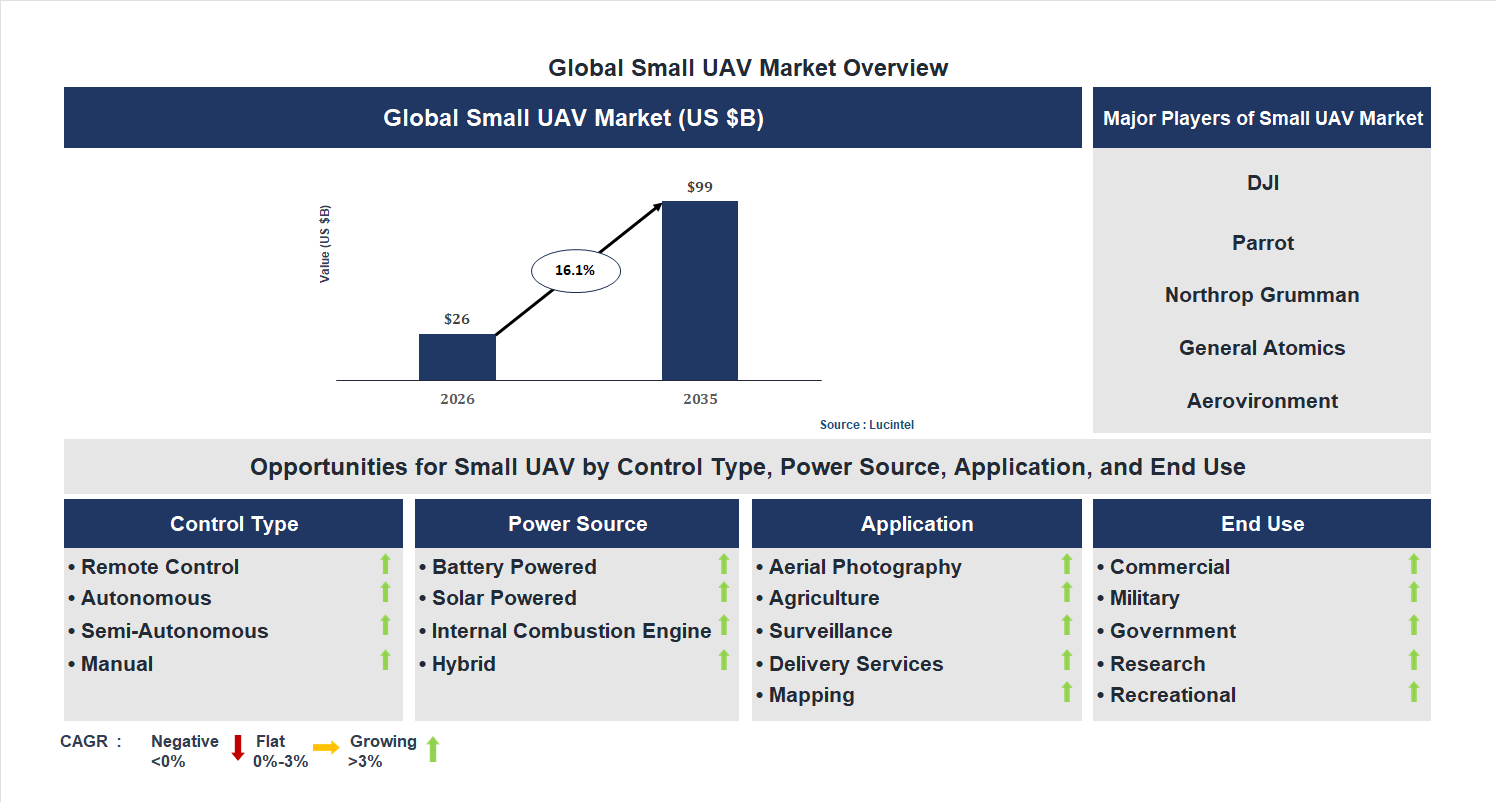
The future of the global small UAV market looks promising with opportunities in the commercial, military, government, research, and recreational markets. The global small UAV market is expected to reach an estimated $99 billion by 2035 with a CAGR of 16.1% from 2026 to 2035. The major drivers for this market are the increasing demand for surveillance drone applications, the rising defense investments boosting UAV adoption, and the growing use in commercial inspection activities.• Lucintel forecasts that, within the control type category, remote control is expected to witness the highest growth over the forecast period.
• Within the end use category, commercial is expected to witness the highest growth.
• In terms of region, APAC is expected to witness the highest growth over the forecast period. Gain valuable insights for your business decisions with our comprehensive 150+ page report. Sample figures with some insights are shown below.
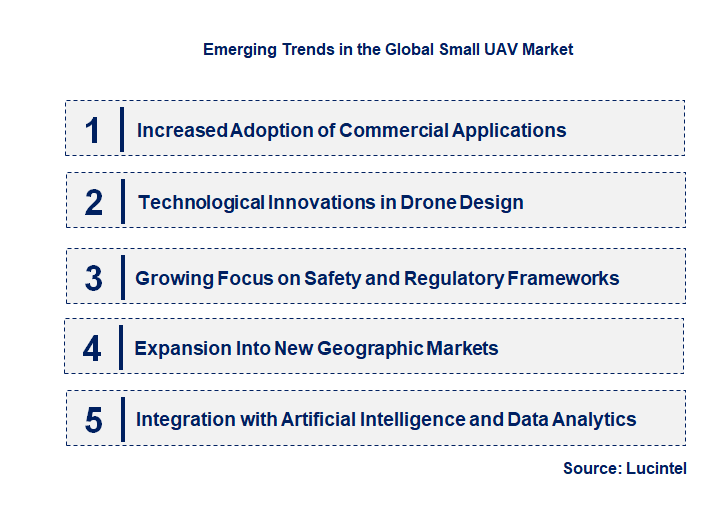
Emerging Trends in the Small UAV Market
The small UAV market is experiencing rapid growth driven by technological advancements, increasing demand across various sectors, and evolving regulatory landscapes. As industries adopt unmanned aerial vehicles (UAVs) for applications such as surveillance, agriculture, and delivery services, the market is witnessing significant innovations and shifts. These developments are not only expanding the scope of UAV capabilities but also making them more accessible and cost-effective. The following key trends highlight the transformative changes shaping the future of the small UAV market, reflecting its dynamic nature and vast potential for diverse applications.• Increased Adoption Of Commercial Applications: The market is seeing a surge in UAV use for commercial purposes such as agriculture, infrastructure inspection, and media coverage. Companies are leveraging small UAVs for precise data collection, reducing operational costs, and improving safety. This trend is driven by technological improvements like longer battery life and enhanced payload capacities, making UAVs more viable for routine commercial tasks. As regulations become more accommodating, the adoption rate is expected to accelerate, broadening the market scope and creating new revenue streams.
• Technological Innovations In Drone Design: Advances in miniaturization, battery technology, and sensor integration are significantly improving UAV performance. Innovations such as obstacle avoidance, autonomous flight, and real-time data transmission are making small UAVs more reliable and efficient. These technological strides are enabling UAVs to operate in complex environments and perform sophisticated tasks, which were previously challenging. The impact is a more versatile fleet of small UAVs capable of supporting diverse industries, from security to environmental monitoring, thus expanding market opportunities.
• Growing Focus On Safety And Regulatory Frameworks: As UAV usage increases, governments and regulatory bodies are establishing clearer guidelines to ensure safe operation. This includes restrictions on flight zones, pilot licensing requirements, and standards for data privacy. The development of these frameworks is crucial for market growth, as they foster trust among users and stakeholders. Companies are also investing in safety features like geofencing and automatic return-to-home functions. The evolving regulatory landscape is shaping market dynamics by balancing innovation with safety, encouraging responsible deployment of small UAVs.
• Expansion Into New Geographic Markets: Emerging economies in Asia-Pacific, Latin America, and Africa are witnessing increased UAV adoption due to rising infrastructure development and agricultural modernization. These regions offer significant growth opportunities for small UAV manufacturers and service providers. Local governments are also promoting UAV integration through supportive policies and funding initiatives. This geographic expansion is diversifying the market, reducing dependency on traditional regions, and fostering global competitiveness. It also encourages innovation tailored to specific regional needs, such as crop monitoring or disaster management.
• Integration With Artificial Intelligence And Data Analytics: The incorporation of AI and advanced analytics is transforming small UAV capabilities. AI enables autonomous navigation, object recognition, and predictive maintenance, while data analytics enhances decision-making processes. These integrations allow UAVs to perform complex tasks with minimal human intervention, increasing efficiency and accuracy. Industries such as agriculture, security, and logistics benefit from real-time insights and automated operations. This trend is driving the development of smarter UAV systems, opening new avenues for market growth and technological leadership. These trends are collectively reshaping the small UAV market by making UAVs more accessible, intelligent, and versatile. Increased commercial adoption, technological innovations, regulatory clarity, geographic expansion, and AI integration are creating a robust ecosystem that supports diverse applications. As these developments continue, the market is poised for sustained growth, driven by technological progress and expanding use cases. The evolving landscape promises to unlock new opportunities, enhance operational efficiencies, and redefine how industries leverage small UAVs for strategic advantage.
Recent Developments in the Small UAV Market
The small UAV market is experiencing rapid growth driven by technological advancements, expanding applications, and increasing demand across various sectors. Innovations in drone design, battery life, and autonomous capabilities are opening new opportunities for commercial, military, and recreational uses. As regulatory frameworks evolve, market players are exploring diverse sub-segments to capitalize on emerging needs. This dynamic environment fosters competition and innovation, ultimately transforming how small UAVs are integrated into daily operations and strategic initiatives worldwide.• Market Expansion in Commercial Sector: The commercial segment is witnessing significant growth as small UAVs are increasingly used for agriculture, surveying, and delivery services. Enhanced payload capacities and improved flight stability enable precise data collection and efficient operations. Companies are investing in specialized drones for crop monitoring, infrastructure inspection, and logistics, which boosts productivity and reduces costs. This expansion is attracting new entrants and fostering partnerships, thereby accelerating market penetration and technological innovation.
• Military and Defense Applications Growth: Small UAVs are becoming vital for reconnaissance, surveillance, and tactical operations in defense. Advances in stealth, endurance, and real-time data transmission enhance battlefield intelligence. Governments are investing heavily in drone technology to improve national security and reduce operational risks. The integration of AI and autonomous systems further increases operational efficiency. This growth in military applications is driving R&D, creating a competitive landscape, and expanding the market’s scope globally.
• Technological Innovations in Drone Design: Recent developments include lightweight materials, longer battery life, and improved sensors, which significantly enhance UAV performance. These innovations enable longer flight times, higher payloads, and better image resolution. The integration of AI and machine learning allows for autonomous navigation and obstacle avoidance. Such technological progress broadens application possibilities, attracts investment, and encourages startups to develop niche solutions, thereby fueling overall market growth and diversification.
• Regulatory Frameworks and Policy Developments: Evolving regulations are shaping the small UAV market by establishing safety standards and operational guidelines. Governments are working to balance innovation with security concerns, leading to clearer licensing procedures and airspace management. These policies facilitate commercial deployment and international trade. As regulations become more streamlined, market confidence increases, encouraging investment and innovation. This regulatory evolution is crucial for sustainable growth and wider adoption of small UAVs across sectors.
• Emerging Sub-segments and Niche Markets: New sub-segments such as drone-based delivery, inspection, and entertainment are emerging rapidly. Specialized drones for agriculture, filmmaking, and emergency response are gaining popularity. The development of customized solutions for specific industries enhances market diversity. These niche markets offer high growth potential and open avenues for startups and established players to diversify revenue streams. The expansion into these areas is significantly impacting overall market dynamics and competitiveness. The overall impact of these developments is a robust, innovative, and expanding small UAV market. Increased applications, technological advancements, and supportive regulations are driving growth, attracting investments, and fostering competitive innovation. This evolution is transforming industries, creating new business opportunities, and establishing small UAVs as essential tools across multiple sectors worldwide.
Strategic Growth Opportunities in the Small UAV Market
The small UAV market is experiencing rapid expansion driven by technological advancements, increasing demand across various sectors, and evolving regulatory frameworks. Opportunities for growth are emerging in diverse applications such as defense, agriculture, surveillance, and commercial delivery. Companies are focusing on innovation, cost reduction, and strategic partnerships to capitalize on these trends. Understanding key growth opportunities helps stakeholders align their strategies to maximize market potential and address emerging needs effectively.• Defense and Security Applications: Expanding use of small UAVs for surveillance, reconnaissance, and tactical operations offers significant growth. Military and law enforcement agencies seek lightweight, portable drones for real-time intelligence, border patrol, and disaster response. Advances in stealth, endurance, and payload capacity enhance operational effectiveness. The integration of AI and sensor technology further boosts capabilities, creating opportunities for defense contractors and technology providers to develop specialized solutions tailored to security needs.
• Precision Agriculture and Crop Monitoring: Small UAVs are increasingly used in agriculture for crop health assessment, irrigation management, and pest control. They provide high-resolution imagery, enabling farmers to make data-driven decisions, optimize resource use, and increase yields. Sub-segments like multispectral and thermal imaging are gaining popularity for detailed analysis. The affordability and ease of deployment of small drones make them accessible to small and large farms alike, fostering growth in Agri-tech markets and supporting sustainable farming practices.
• Infrastructure Inspection and Maintenance: Small UAVs are transforming infrastructure management by enabling safe, efficient, and cost-effective inspections of bridges, power lines, pipelines, and wind turbines. They reduce the need for manual inspections in hazardous environments, providing high-quality visual data for maintenance planning. The development of specialized payloads such as LiDAR and thermal cameras enhances inspection accuracy. This application segment is expected to grow as industries seek to improve safety standards and reduce operational costs through drone technology.
• Commercial Delivery and Logistics: The deployment of small UAVs for last-mile delivery is a promising growth area, especially in urban and remote regions. They offer rapid, contactless delivery of parcels, medical supplies, and food, reducing delivery times and operational costs. Regulatory advancements and technological innovations in navigation and payload capacity are facilitating pilot programs and commercial trials. This segment is poised for expansion as companies seek to optimize logistics networks and meet consumer demand for quick, reliable delivery services.
• Media, Entertainment, and Aerial Photography: Small UAVs are increasingly used in media production, filmmaking, and live event coverage for capturing dynamic aerial footage. Their maneuverability and affordability enable creative content creation and real-time broadcasting. Sub-segments like 4K video, panoramic imaging, and drone racing are expanding the market. The growth is driven by technological improvements, regulatory acceptance, and increasing consumer demand for immersive visual experiences, opening new revenue streams for media companies and content creators. The overall market growth is significantly influenced by these opportunities, fostering innovation and diversification across applications. As technology advances and regulations evolve, the small UAV market is set to experience sustained expansion, offering numerous avenues for stakeholders to capitalize on emerging needs and enhance operational efficiencies across sectors.
Small UAV Market Driver and Challenges
The small UAV market is influenced by a variety of technological, economic, and regulatory factors that shape its growth and development. Advances in drone technology, decreasing costs, and increasing applications across industries are key drivers. Simultaneously, regulatory hurdles, safety concerns, and market saturation pose significant challenges. Understanding these drivers and challenges is essential for stakeholders to navigate the evolving landscape effectively. As the market continues to expand, balancing innovation with regulation will be crucial for sustainable growth and competitive advantage. The factors responsible for driving the small UAV market include:-• Technological Innovation: The rapid development of lightweight, efficient, and versatile drone technologies has expanded the capabilities of small UAVs. Improvements in battery life, payload capacity, and autonomous navigation systems have enabled applications in surveillance, agriculture, and delivery services. These technological advancements reduce costs and increase reliability, making small UAVs more accessible to various industries. As innovation continues, the market is expected to see increased adoption and new use cases, fueling overall growth.
• Cost Reduction and Affordability: The decreasing costs of components such as sensors, cameras, and batteries have made small UAVs more affordable for commercial and recreational users. This affordability broadens market access, encouraging small businesses, farmers, and hobbyists to adopt drone technology. Economies of scale and mass production further drive down prices, enabling rapid market penetration and increased competition among manufacturers.
• Growing Applications Across Industries: Small UAVs are increasingly being adopted in diverse sectors such as agriculture, defense, logistics, media, and public safety. Their ability to perform tasks like crop monitoring, disaster management, and security surveillance enhances operational efficiency. The expanding scope of applications is a major driver, as organizations recognize the value of real-time data collection and remote operation, leading to sustained market growth.
• Regulatory Support and Policy Frameworks: Governments worldwide are developing regulations that facilitate the safe integration of small UAVs into airspace. Clear guidelines, licensing procedures, and no-fly zones are being established to promote responsible usage. Regulatory support encourages innovation and investment, reducing uncertainties for manufacturers and users, and fostering a conducive environment for market expansion. The challenges in the small UAV market are:
• Regulatory and Legal Barriers: Despite progress, inconsistent regulations across regions create barriers to market entry and expansion. Strict licensing requirements, privacy concerns, and airspace restrictions can hinder deployment, especially for commercial applications. Navigating complex legal frameworks increases operational costs and delays, limiting growth opportunities for small UAV providers.
• Safety and Security Concerns: Incidents involving small UAVs, such as crashes or unauthorized surveillance, raise safety and security issues. These concerns lead to stricter regulations and public apprehension, which can slow adoption. Ensuring safe operation, preventing misuse, and addressing privacy issues are ongoing challenges that impact market confidence and acceptance.
• Market Saturation and Intense Competition: As the market matures, increased competition among manufacturers and service providers leads to price wars and reduced profit margins. Market saturation in certain regions limits growth potential and forces companies to innovate continuously. Differentiating products and services becomes critical, but the high level of competition can pose significant barriers for new entrants and smaller players. The small UAV market is driven by technological advancements, decreasing costs, expanding applications, and supportive regulations. However, regulatory complexities, safety concerns, and market saturation present notable challenges. These factors collectively influence the pace and direction of market growth. While opportunities for innovation and expansion are substantial, addressing regulatory and safety issues will be vital for sustainable development. Overall, the markets future hinges on balancing technological progress with effective regulation and safety measures to unlock its full potential.
List of Small UAV Companies
Companies in the market compete on the basis of product quality offered. Major players in this market focus on expanding their manufacturing facilities, R&D investments, infrastructural development, and leverage integration opportunities across the value chain. With these strategies small UAV companies cater increasing demand, ensure competitive effectiveness, develop innovative products & technologies, reduce production costs, and expand their customer base. Some of the small UAV companies profiled in this report include-• DJI
• Parrot
• Northrop Grumman
• General Atomics
• Aerovironment
• Insitu
• SenseFly
Small UAV Market by Segment
The study includes a forecast for the global small UAV market by control type, power source, application, end use, and region.Small UAV Market by Control Type [Value from 2019 to 2035]:
• Remote Control
• Autonomous
• Semi-Autonomous
• Manual
Small UAV Market by Power Source [Value from 2019 to 2035]:
• Battery Powered
• Solar Powered
• Internal Combustion Engine
• Hybrid
Small UAV Market by Application [Value from 2019 to 2035]:
• Aerial Photography
• Agriculture
• Surveillance
• Delivery Services
• Mapping
Small UAV Market by End Use [Value from 2019 to 2035]:
• Commercial
• Military
• Government
• Research
• Recreational
Small UAV Market by Region [Value from 2019 to 2035]:
• North America
• Europe
• Asia Pacific
• The Rest of the World
Country Wise Outlook for the Small UAV Market
The small UAV market has experienced rapid growth globally, driven by technological advancements, increasing applications in commercial, military, and recreational sectors, and evolving regulatory frameworks. Countries are investing heavily in research and development to enhance UAV capabilities, improve safety standards, and expand market reach. The United States, China, Germany, India, and Japan are leading players, each contributing unique innovations and strategic initiatives to shape the future of this dynamic industry. These developments reflect a broader trend toward integrating UAVs into various sectors, including agriculture, logistics, surveillance, and defense, fostering economic growth and technological progress.• United States: The US market has seen significant advancements in drone technology, with increased adoption in military and commercial sectors. Major companies like DJI and Lockheed Martin are developing autonomous UAVs with enhanced payload capacities and longer flight times. Regulatory frameworks are evolving to facilitate commercial drone operations, including beyond visual line of sight (BVLOS) flights. The US government is investing in research to improve drone safety, cybersecurity, and integration into airspace systems, fostering innovation and market expansion.
• China: China remains a dominant force in the small UAV market, with companies like DJI leading globally in consumer and professional drone segments. Recent developments include the launch of lightweight, portable drones tailored for agriculture, surveillance, and delivery services. The Chinese government is promoting UAV innovation through supportive policies and funding initiatives, aiming to establish China as a global UAV manufacturing hub. Advances in AI and sensor technology are enhancing drone capabilities, making them more autonomous and versatile.
• Germany: Germany is focusing on integrating UAVs into industrial and environmental applications, emphasizing safety and regulatory compliance. Recent developments include the deployment of UAVs for infrastructure inspection, environmental monitoring, and precision agriculture. The country is investing in research collaborations between academia and industry to develop robust, reliable drone systems. Germany’s regulatory agencies are working to streamline approval processes, encouraging innovation while ensuring safety standards are met.
• India: India’s UAV market is rapidly expanding, driven by government initiatives like the Digital Sky platform and the Drone Rules 2021, which aim to simplify drone registration and operations. Recent advancements include the development of indigenous drone technology for military and civilian use, including surveillance, agriculture, and disaster management. The government is promoting startups and research institutions to innovate in drone design, payload capacity, and autonomous navigation, positioning India as a key player in the emerging UAV ecosystem.
• Japan: Japan is advancing UAV technology with a focus on urban air mobility, disaster response, and industrial inspection. Recent developments include the deployment of drones for infrastructure maintenance and emergency response during natural disasters. The country is investing in research to improve drone safety, noise reduction, and autonomous flight capabilities. Regulatory reforms are underway to facilitate commercial drone operations, and collaborations between government, academia, and industry are fostering innovation in urban drone applications and robotics integration.

Features of the Global Small UAV Market
Market Size Estimates: Small UAV market size estimation in terms of value ($B). Trend and Forecast Analysis: Market trends (2019 to 2025) and forecast (2026 to 2035) by various segments and regions. Segmentation Analysis: Small UAV market size by various segments, such as by control type, power source, application, end use, and region in terms of value ($B). Regional Analysis: Small UAV market breakdown by North America, Europe, Asia Pacific, and Rest of the World. Growth Opportunities: Analysis of growth opportunities in different control types, power sources, applications, end uses, and regions for the small UAV market. Strategic Analysis: This includes M&A, new product development, and competitive landscape of the small UAV market. Analysis of competitive intensity of the industry based on Porter’s Five Forces model.
FAQ
Q1. What is the small UAV market size? Answer: The global small UAV market is expected to reach an estimated $99 billion by 2035. Q2. What is the growth forecast for small UAV market? Answer: The global small UAV market is expected to grow with a CAGR of 16.1% from 2026 to 2035. Q3. What are the major drivers influencing the growth of the small UAV market? Answer: The major drivers for this market are the increasing demand for surveillance drone applications, the rising defense investments boosting UAV adoption, and the growing use in commercial inspection activities. Q4. What are the major segments for small UAV market? Answer: The future of the small UAV market looks promising with opportunities in the commercial, military, government, research, and recreational markets. Q5. Who are the key small UAV market companies? Answer: Some of the key small UAV companies are as follows:• DJI
• Parrot
• Northrop Grumman
• General Atomics
• Aerovironment
• Insitu
• SenseFly Q6. Which small UAV market segment will be the largest in future? Answer: Lucintel forecasts that, within the control type category, remote control is expected to witness the highest growth over the forecast period. Q7. In small UAV market, which region is expected to be the largest in next 8 years? Answer: In terms of region, APAC is expected to witness the highest growth over the forecast period. Q8. Do we receive customization in this report? Answer: Yes, Lucintel provides 10% customization without any additional cost.
Table of Contents
List of Figures
List of Tables
Methodology
- In-depth interviews of the major players in this market
- Detailed secondary research from competitors’ financial statements and published data
- Extensive searches of published works, market, and database information pertaining to industry news, company press releases, and customer intentions
- A compilation of the experiences, judgments, and insights of Lucintel’s professionals, who have analyzed and tracked this market over the years.


Buy Now
Choose a license that fits your team. Instant PDF delivery.
Prices exclude taxes. Instant delivery. Custom licensing available on request.
Key Questions
- • What are some of the most promising, high-growth opportunities for the small UAV market by control type (remote control, autonomous, semi-autonomous, and manual), power source (battery powered, solar powered, internal combustion engine, and hybrid), application (aerial photography, agriculture, surveillance, delivery services, and mapping), end use (commercial, military, government, research, and recreational), and region (North America, Europe, Asia Pacific, and the Rest of the World)?
- • Which segments will grow at a faster pace and why?
- • Which region will grow at a faster pace and why?
- • What are the key factors affecting market dynamics? What are the key challenges and business risks in this market?
- • What are the business risks and competitive threats in this market?
- • What are the emerging trends in this market and the reasons behind them?
- • What are some of the changing demands of customers in the market?
- • What are the new developments in the market? Which companies are leading these developments?
- • Who are the major players in this market? What strategic initiatives are key players pursuing for business growth?
- • What are some of the competing products in this market and how big of a threat do they pose for loss of market share by material or product substitution?
- • What M&A activity has occurred in the last 5 years and what has its impact been on the industry? For any questions related to Small UAV Market, Small UAV Market Size, Small UAV Market Growth, Small UAV Market Analysis, Small UAV Market Report, Small UAV Market Share, Small UAV Market Trends, Small UAV Market Forecast, Small UAV Companies, write Lucintel analyst at email: helpdesk@lucintel.com. We will be glad to get back to you soon.


