
Report Feature
SLC NAND Flash Memory Market Trends and Forecast
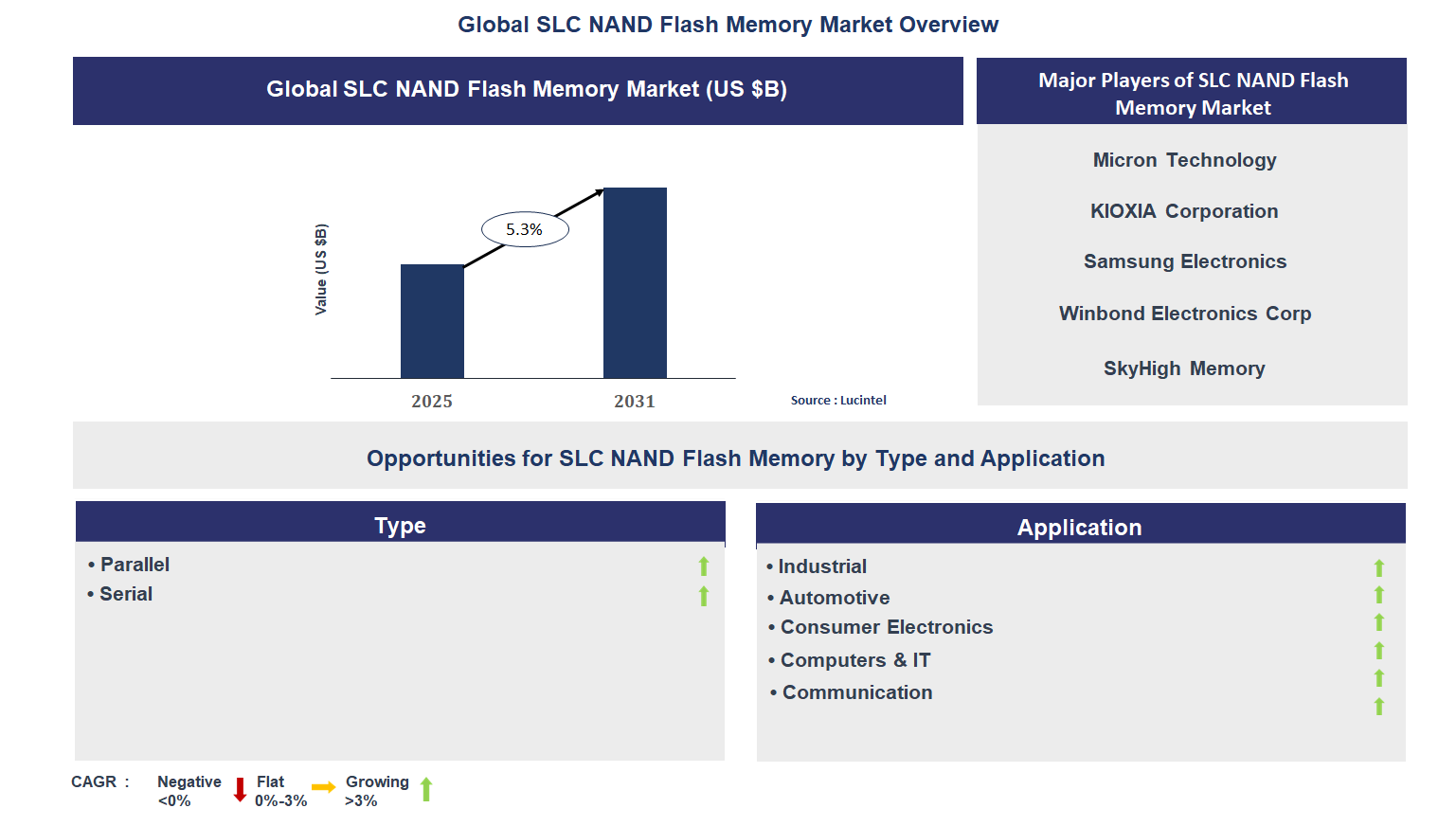
The future of the global SLC NAND flash memory market looks promising with opportunities in the industrial, automotive, consumer electronics, computer & it, and communication markets. The global SLC NAND flash memory market is expected to grow with a CAGR of 5.3% from 2025 to 2031. The major drivers for this market are the increasing demand for high-performance storage solutions, the rising need for reliable memory in industrial applications, and the growing adoption of SLC in automotive electronics.• Lucintel forecasts that, within the type category, parallel is expected to witness higher growth over the forecast period.
• Within the application category, industrial is expected to witness the highest growth.
• In terms of region, APAC is expected to witness the highest growth over the forecast period. Gain valuable insights for your business decisions with our comprehensive 150+ page report. Sample figures with some insights are shown below.
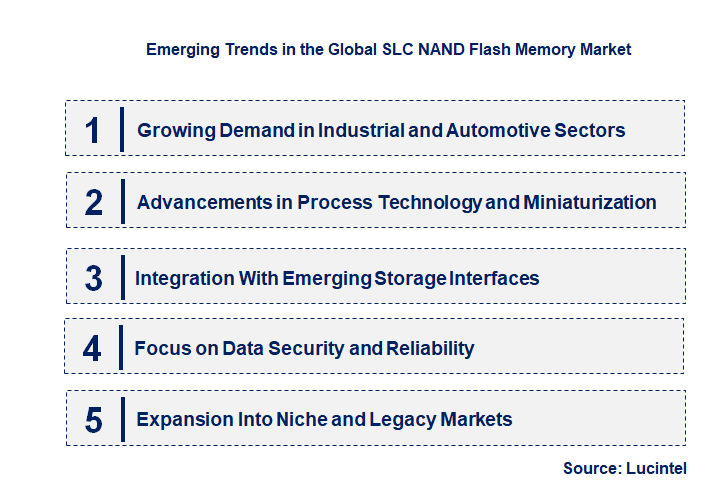
Emerging Trends in the SLC NAND Flash Memory Market
The SLC NAND flash memory market is experiencing significant transformation driven by technological advancements, evolving application requirements, and shifting industry dynamics. SLC NAND, known for its high endurance, reliability, and speed, remains a preferred choice for industrial, automotive, and mission-critical applications despite the growing popularity of MLC and TLC alternatives. As industries demand more robust and efficient storage solutions, manufacturers are innovating to meet these needs. The following emerging trends highlight how the SLC NAND Flash Memory market is adapting to new challenges and opportunities, shaping its future trajectory and competitive landscape.• Growing demand in industrial and automotive sectors: SLC NAND Flash is increasingly favored in industrial and automotive applications due to its superior endurance and reliability. These sectors require memory solutions that can withstand extreme temperatures, vibrations, and long operational lifespans. As automation, IoT, and connected vehicles proliferate, the need for robust storage grows, driving SLC adoption despite higher costs compared to MLC or TLC. This trend ensures SLC remains relevant in environments where data integrity and longevity are critical.
• Advancements in process technology and miniaturization: Manufacturers are investing in advanced process technologies to enhance SLC NAND performance and reduce die sizes. Shrinking process nodes allow for higher storage densities and lower power consumption, making SLC more competitive. These advancements also help reduce production costs, enabling broader adoption in cost-sensitive applications. As a result, SLC NAND is becoming more efficient and accessible, supporting its use in emerging markets and new device categories.
• Integration with emerging storage interfaces: The adoption of new storage interfaces such as NVMe and PCIe is influencing SLC NAND Flash design and deployment. These interfaces offer higher data transfer rates and lower latency, which complement the inherent speed advantages of SLC NAND. Integration with modern interfaces expands SLC’s applicability in high-performance computing, edge devices, and real-time data processing, further solidifying its market position.
• Focus on data security and reliability: With increasing concerns over data breaches and system failures, there is a heightened emphasis on the security and reliability features of SLC NAND Flash. Manufacturers are incorporating advanced error correction, encryption, and power-loss protection mechanisms. These enhancements make SLC NAND an attractive option for applications where data integrity and security are paramount, such as medical devices, financial systems, and defense electronics.
• Expansion into niche and legacy markets: While mainstream consumer electronics are shifting towards higher-density NAND types, SLC NAND is finding new opportunities in niche and legacy markets. Applications that require predictable performance, long-term availability, and extended product lifecycles continue to rely on SLC technology. This trend is driving manufacturers to offer long-term support and customization options, ensuring SLC NAND remains viable for specialized use cases. In summary, these trends are reshaping the SLC NAND Flash Memory market by reinforcing its strengths in reliability, endurance, and performance. As industries prioritize robust storage solutions for critical applications, SLC NAND continues to evolve through technological innovation and targeted market strategies, ensuring its continued relevance in a rapidly changing digital landscape.
Recent Development in the SLC NAND Flash Memory Market
The SLC NAND flash memory market has experienced significant changes in recent years, driven by evolving technological demands and shifting industry priorities. SLC NAND, known for its high endurance and reliability, remains crucial in applications requiring robust data integrity, such as industrial automation, automotive systems, and enterprise storage. As the digital landscape expands, manufacturers and technology providers are innovating to address challenges like cost efficiency, performance, and supply chain disruptions. These developments are shaping the competitive landscape, influencing product offerings, and redefining the value proposition of SLC NAND in a market increasingly dominated by multi-level cell alternatives.• Increased Adoption in Industrial and Automotive Applications: SLC NAND Flash is increasingly favored in industrial and automotive sectors due to its superior endurance and reliability compared to MLC and TLC alternatives. This trend is driven by the need for memory solutions that can withstand harsh environments and frequent write cycles, ensuring data integrity in mission-critical systems. As a result, manufacturers are expanding their SLC product lines and enhancing features tailored to these demanding applications, reinforcing SLC NAND’s position as the preferred choice for high-reliability markets.
• Technological Advancements in SLC NAND Architecture: Recent innovations in SLC NAND architecture, such as smaller process nodes and improved controller technologies, have enhanced performance and reduced power consumption. These advancements enable higher storage densities and faster data transfer rates, making SLC NAND more competitive against newer memory technologies. The improved efficiency and scalability are attracting new customers and opening up additional use cases, particularly in embedded systems and edge computing devices where performance and reliability are paramount.
• Strategic Partnerships and Mergers: The SLC NAND market has seen a rise in strategic partnerships and mergers among key players, aiming to consolidate resources and accelerate innovation. These collaborations are facilitating the development of next-generation SLC products and expanding global distribution networks. By pooling expertise and capital, companies are better positioned to address market demands, streamline production, and offer more comprehensive solutions to customers, ultimately strengthening their market presence.
• Supply Chain Optimization and Localization: In response to global supply chain disruptions, SLC NAND manufacturers are investing in supply chain optimization and localization strategies. This includes diversifying supplier bases, increasing local production capacities, and adopting just-in-time inventory practices. These measures are improving supply reliability, reducing lead times, and mitigating risks associated with geopolitical tensions and logistical challenges, thereby ensuring a steady supply of SLC NAND products to critical industries.
• Focus on Cost Efficiency and Value-Added Services: To remain competitive, SLC NAND providers are emphasizing cost efficiency through process improvements and economies of scale. Additionally, companies are offering value-added services such as extended warranties, customization, and technical support to differentiate their offerings. These initiatives are helping customers maximize the return on investment in SLC NAND solutions, fostering long-term partnerships and driving market growth despite pricing pressures from alternative memory technologies. In summary, these developments are reinforcing the relevance of SLC NAND Flash Memory in high-reliability applications, driving innovation, and ensuring supply chain resilience. As the market evolves, SLC NAND continues to carve out a vital niche, balancing performance, reliability, and cost to meet the specialized needs of industrial, automotive, and enterprise customers.
Strategic Growth Opportunities in the SLC NAND Flash Memory Market
The SLC NAND flash memory market is experiencing significant transformation, driven by the increasing demand for high-performance, reliable, and durable storage solutions. SLC NAND, known for its superior endurance and speed compared to MLC and TLC variants, is finding renewed relevance in applications where data integrity and longevity are critical. As industries such as automotive, industrial automation, healthcare, and telecommunications embrace digitalization, the need for robust memory solutions is accelerating. This context sets the stage for strategic growth opportunities across various applications, positioning SLC NAND as a key enabler of next-generation technologies.• Industrial Automation: The adoption of SLC NAND in industrial automation systems is rising due to its high endurance and reliability. These features are essential for mission-critical applications such as programmable logic controllers (PLCs) and human-machine interfaces (HMIs), where data loss or corruption can lead to costly downtime. SLC NAND’s ability to withstand harsh environments and frequent write cycles makes it the preferred choice, driving growth in this sector as factories become smarter and more connected.
• Automotive Electronics: SLC NAND is increasingly used in automotive applications, including advanced driver-assistance systems (ADAS), infotainment, and telematics. The automotive sector demands memory solutions that can operate reliably under extreme temperatures and vibrations. SLC NAND’s robustness and longevity ensure data integrity for safety-critical functions, supporting the evolution of connected and autonomous vehicles and fueling market expansion.
• Healthcare Devices: Medical devices such as diagnostic equipment, patient monitoring systems, and portable imaging devices require reliable and secure data storage. SLC NAND’s high endurance and low error rates make it ideal for these applications, where data accuracy and device uptime are paramount. The growing adoption of digital health technologies is creating new opportunities for SLC NAND in this highly regulated sector.
• Networking and Telecommunications: The rapid expansion of 5G networks and edge computing is increasing the demand for reliable storage in networking equipment. SLC NAND’s fast write speeds and durability are critical for routers, switches, and base stations that require continuous operation and minimal maintenance. This trend is driving growth as telecom operators upgrade infrastructure to support higher data volumes and lower latency.
• Industrial IoT (IIoT): The proliferation of IIoT devices in sectors such as energy, transportation, and manufacturing is boosting demand for SLC NAND. These devices often operate in remote or harsh environments and require memory that can handle frequent data logging and updates. SLC NAND’s resilience and long lifespan make it a strategic choice for IIoT deployments, supporting the expansion of connected ecosystems. In summary, these strategic growth opportunities are reshaping the SLC NAND Flash Memory market by aligning its unique strengths with the evolving needs of key industries. As demand for reliable, high-performance storage continues to rise, SLC NAND is poised to play a pivotal role in enabling innovation and ensuring operational continuity across diverse applications.
SLC NAND Flash Memory Market Driver and Challenges
The SLC NAND flash memory market is shaped by a complex interplay of technological advancements, economic trends, and regulatory considerations. As demand for reliable, high-performance storage solutions grows across industries, the market experiences both significant opportunities and notable obstacles. Key drivers include the proliferation of data-centric applications, advancements in manufacturing processes, and the increasing adoption of IoT and automotive electronics. However, the market also faces challenges such as intense competition, price volatility, and evolving regulatory standards. Understanding these factors is essential for stakeholders aiming to navigate the dynamic landscape of the SLC NAND Flash Memory Market. The factors responsible for driving the SLC NAND flash memory market include:-• Growing demand for high-reliability storage: SLC NAND flash memory is preferred in applications requiring high endurance and reliability, such as industrial automation, automotive systems, and enterprise storage. Its ability to withstand a higher number of write-erase cycles compared to MLC or TLC variants makes it ideal for mission-critical environments. This demand is further fueled by the increasing digitization of industrial processes and the need for robust data retention in harsh operating conditions, ensuring steady market growth.
• Expansion of IoT and embedded systems: The rapid proliferation of IoT devices and embedded systems across sectors like healthcare, transportation, and smart cities is driving the need for compact, durable, and energy-efficient storage solutions. SLC NAND flash memory, with its low power consumption and fast data access speeds, is well-suited for these applications. As IoT adoption accelerates globally, the demand for SLC NAND is expected to rise, supporting market expansion.
• Advancements in manufacturing technology: Continuous improvements in semiconductor fabrication techniques have enhanced the performance, density, and cost-effectiveness of SLC NAND flash memory. Innovations such as 3D NAND architecture and process node scaling have enabled manufacturers to produce higher-capacity chips with improved reliability. These advancements not only reduce production costs but also make SLC NAND more accessible to a broader range of applications, driving market growth.
• Increasing adoption in automotive electronics: Modern vehicles are equipped with advanced infotainment systems, ADAS, and telematics, all of which require reliable and fast storage solutions. SLC NAND flash memory’s superior endurance and data integrity make it a preferred choice for automotive applications, where safety and reliability are paramount. The ongoing evolution of connected and autonomous vehicles further amplifies the demand for high-performance storage, bolstering the SLC NAND market. The challenges in the SLC NAND flash memory market are:
• Intense competition from alternative technologies: The market faces stiff competition from other types of NAND flash memory, such as MLC, TLC, and emerging storage technologies like MRAM and 3D XPoint. These alternatives often offer higher storage densities at lower costs, making them attractive for cost-sensitive applications. As a result, SLC NAND must continually justify its premium pricing through superior reliability and performance, which can limit its adoption in certain segments.
• Price volatility and supply chain disruptions: The SLC NAND market is susceptible to fluctuations in raw material prices, changes in demand-supply dynamics, and geopolitical factors affecting the global semiconductor supply chain. Price volatility can impact profit margins for manufacturers and create uncertainty for end-users. Additionally, supply chain disruptions, such as those caused by natural disasters or trade restrictions, can lead to shortages and delayed product launches, hindering market growth.
• Regulatory and environmental compliance: Increasingly stringent regulations regarding electronic waste, hazardous materials, and energy efficiency pose challenges for SLC NAND manufacturers. Compliance with global standards such as RoHS and REACH requires ongoing investment in research, development, and process optimization. Failure to meet these requirements can result in legal penalties, product recalls, and reputational damage, adding complexity to market operations. The SLC NAND Flash Memory Market is influenced by a dynamic set of drivers and challenges that collectively shape its trajectory. While technological advancements, expanding application areas, and the need for high-reliability storage fuel market growth, challenges such as competition from alternative technologies, price volatility, and regulatory compliance create hurdles for stakeholders. Successfully navigating these factors requires continuous innovation, strategic partnerships, and proactive risk management. Ultimately, the market’s future will depend on its ability to balance reliability and performance with cost-effectiveness and regulatory adherence, ensuring sustained relevance in a rapidly evolving digital landscape.
List of SLC NAND Flash Memory Companies
Companies in the market compete on the basis of product quality offered. Major players in this market focus on expanding their manufacturing facilities, R&D investments, infrastructural development, and leverage integration opportunities across the value chain. With these strategies SLC NAND flash memory companies cater increasing demand, ensure competitive effectiveness, develop innovative products & technologies, reduce production costs, and expand their customer base. Some of the SLC NAND flash memory companies profiled in this report include-• Micron Technology
• KIOXIA Corporation
• Samsung Electronics
• Winbond Electronics Corp
• SkyHigh Memory
• Macronix International
• Flexxon
• Greenliant Systems
• UNIM Innovation
• Shanghai Fudan Microelectronics Group
SLC NAND Flash Memory Market by Segment
The study includes a forecast for the global SLC NAND flash memory market by type, application, and region.SLC NAND Flash Memory Market by Type [Value from 2019 to 2031]:
• Parallel
• Serial
SLC NAND Flash Memory Market by Application [Value from 2019 to 2031]:
• Industrial
• Automotive
• Consumer Electronics
• Computers & IT
• Communication
SLC NAND Flash Memory Market by Region [Value from 2019 to 2031]:
• North America
• Europe
• Asia Pacific
• The Rest of the World
Country Wise Outlook for the SLC NAND Flash Memory Market
The SLC NAND flash memory market is experiencing significant transformation driven by the growing demand for high-performance, reliable storage solutions across various industries. As digitalization accelerates and applications such as automotive, industrial automation, and consumer electronics expand, countries worldwide are investing in advanced memory technologies. The market is also influenced by supply chain dynamics, technological innovation, and government policies. Recent developments in major economies reflect both global trends and local priorities, shaping the competitive landscape and future growth prospects for SLC NAND Flash Memory.• United States: The US market has seen increased investment in domestic semiconductor manufacturing, spurred by government initiatives like the CHIPS Act. Major players are expanding production capacity and focusing on advanced SLC NAND solutions for automotive and industrial applications. Collaborations between tech companies and research institutions are driving innovation, while supply chain resilience remains a key priority amid global uncertainties.
• China: China continues to prioritize self-sufficiency in semiconductor technology, with significant funding directed toward local SLC NAND Flash Memory production. Domestic companies are ramping up R&D and expanding manufacturing capabilities to reduce reliance on imports. The government’s support for the electronics and automotive sectors is fueling demand, while trade tensions with the US are influencing strategic partnerships and technology transfers.
• Germany: Germany’s SLC NAND Flash Memory market is benefiting from the country’s strong automotive and industrial sectors. Local and international firms are investing in advanced memory solutions to support Industry 4.0 initiatives. Emphasis on quality and reliability is driving adoption in critical applications, while collaborations with European partners are fostering innovation and supply chain stability.
• India: India is emerging as a promising market for SLC NAND Flash Memory, driven by the government’s push for electronics manufacturing and digital infrastructure. Investments in local assembly and testing facilities are increasing, and demand is rising from sectors such as telecommunications, automotive, and consumer electronics. Efforts to attract global semiconductor players are expected to further boost market growth.
• Japan: Japan remains a key player in the SLC NAND Flash Memory market, with established manufacturers focusing on high-reliability products for automotive and industrial uses. Ongoing R&D investments are leading to technological advancements, while partnerships with global companies are enhancing competitiveness. The country’s emphasis on quality and innovation continues to set industry standards.

Features of the Global SLC NAND Flash Memory Market
Market Size Estimates: Slc NAND flash memory market size estimation in terms of value ($B). Trend and Forecast Analysis: Market trends (2019 to 2024) and forecast (2025 to 2031) by various segments and regions. Segmentation Analysis: Slc NAND flash memory market size by type, application, and region in terms of value ($B). Regional Analysis: Slc NAND flash memory market breakdown by North America, Europe, Asia Pacific, and Rest of the World. Growth Opportunities: Analysis of growth opportunities in different types, applications, and regions for the SLC NAND flash memory market. Strategic Analysis: This includes M&A, new product development, and competitive landscape of the SLC NAND flash memory market. Analysis of competitive intensity of the industry based on Porter’s Five Forces model.
FAQ
Q1. What is the growth forecast for SLC NAND flash memory market? Answer: The global SLC NAND flash memory market is expected to grow with a CAGR of 5.3% from 2025 to 2031. Q2. What are the major drivers influencing the growth of the SLC NAND flash memory market? Answer: The major drivers for this market are the increasing demand for high-performance storage solutions, the rising need for reliable memory in industrial applications, and the growing adoption of SLC in automotive electronics. Q3. What are the major segments for SLC NAND flash memory market? Answer: The future of the SLC NAND flash memory market looks promising with opportunities in the industrial, automotive, consumer electronics, computer & it, and communication markets. Q4. Who are the key SLC NAND flash memory market companies? Answer: Some of the key SLC NAND flash memory companies are as follows:• Micron Technology
• KIOXIA Corporation
• Samsung Electronics
• Winbond Electronics Corp
• SkyHigh Memory
• Macronix International
• Flexxon
• Greenliant Systems
• UNIM Innovation
• Shanghai Fudan Microelectronics Group Q5. Which SLC NAND flash memory market segment will be the largest in future? Answer: Lucintel forecasts that, within the type category, parallel is expected to witness higher growth over the forecast period. Q6. In SLC NAND flash memory market, which region is expected to be the largest in next 5 years? Answer: In terms of region, APAC is expected to witness the highest growth over the forecast period. Q7. Do we receive customization in this report? Answer: Yes, Lucintel provides 10% customization without any additional cost.
Table of Contents
List of Figures
List of Tables
Methodology
- In-depth interviews of the major players in this market
- Detailed secondary research from competitors’ financial statements and published data
- Extensive searches of published works, market, and database information pertaining to industry news, company press releases, and customer intentions
- A compilation of the experiences, judgments, and insights of Lucintel’s professionals, who have analyzed and tracked this market over the years.


Buy Now
Choose a license that fits your team. Instant PDF delivery.
Prices exclude taxes. Instant delivery. Custom licensing available on request.
Key Questions
- • What are some of the most promising, high-growth opportunities for the SLC NAND flash memory market by type (parallel and serial), application (industrial, automotive, consumer electronics, computers & IT, and communication), and region (North America, Europe, Asia Pacific, and the Rest of the World)?
- • Which segments will grow at a faster pace and why?
- • Which region will grow at a faster pace and why?
- • What are the key factors affecting market dynamics? What are the key challenges and business risks in this market?
- • What are the business risks and competitive threats in this market?
- • What are the emerging trends in this market and the reasons behind them?
- • What are some of the changing demands of customers in the market?
- • What are the new developments in the market? Which companies are leading these developments?
- • Who are the major players in this market? What strategic initiatives are key players pursuing for business growth?
- • What are some of the competing products in this market and how big of a threat do they pose for loss of market share by material or product substitution?
- • What M&A activity has occurred in the last 5 years and what has its impact been on the industry? For any questions related to SLC NAND Flash Memory Market, SLC NAND Flash Memory Market Size, SLC NAND Flash Memory Market Growth, SLC NAND Flash Memory Market Analysis, SLC NAND Flash Memory Market Report, SLC NAND Flash Memory Market Share, SLC NAND Flash Memory Market Trends, SLC NAND Flash Memory Market Forecast, SLC NAND Flash Memory Companies, write Lucintel analyst at email: helpdesk@lucintel.com. We will be glad to get back to you soon.


