
Report Feature
Single-Phase Liquid Immersion Cooling Server Market Trends and Forecast
The future of the global single-phase liquid immersion cooling server market looks promising with opportunities in the internet, telecommunication, financial, and government markets. The global single-phase liquid immersion cooling server market is expected to reach an estimated $8 billion by 2035 with a CAGR of 16.4% from 2026 to 2035. The major drivers for this market are the increasing demand for efficient cooling solutions, the rising adoption of high-density computing systems, and the growing need for energy-efficient data centers.• Lucintel forecasts that, within the type category, AI server is expected to witness higher growth over the forecast period.
• Within the application category, internet is expected to witness the highest growth.
• In terms of region, APAC is expected to witness the highest growth over the forecast period. Gain valuable insights for your business decisions with our comprehensive 150+ page report. Sample figures with some insights are shown below.
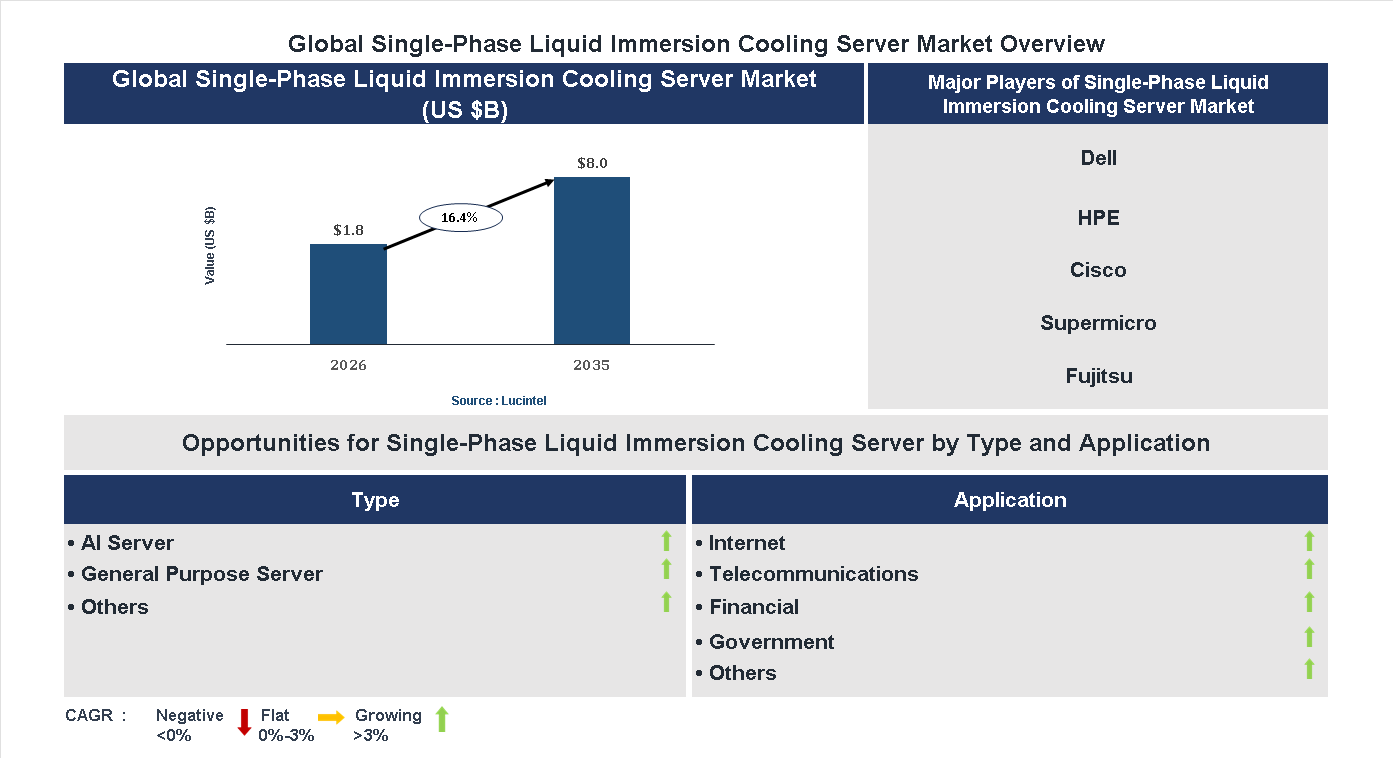
Emerging Trends in the Single-Phase Liquid Immersion Cooling Server Market
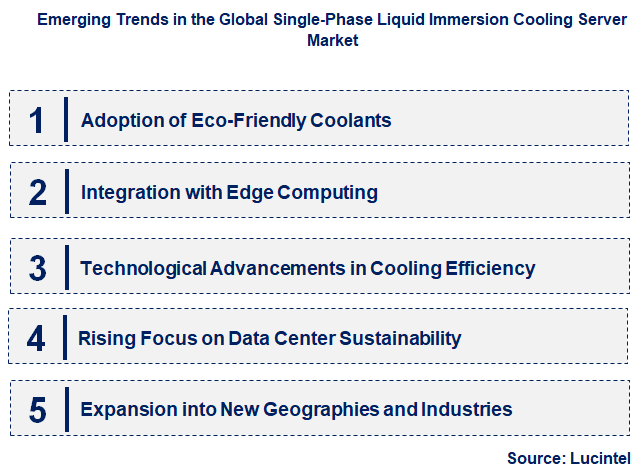
The single-phase liquid immersion cooling server market is experiencing rapid growth driven by the increasing demand for energy-efficient and high-performance data center solutions. As data centers expand and the need for sustainable infrastructure intensifies, innovative cooling technologies are becoming essential. Liquid immersion cooling, particularly single-phase systems, offers significant advantages over traditional air cooling, including improved thermal management, reduced energy consumption, and enhanced server performance. These developments are transforming the landscape of data center operations, making cooling solutions more effective and environmentally friendly. The following key trends highlight the markets evolving dynamics and future potential.• Adoption of Eco-Friendly Coolants: The market is witnessing a shift towards environmentally sustainable coolants such as biodegradable and non-toxic liquids. These eco-friendly coolants reduce environmental impact and comply with stringent regulations, making them attractive to data center operators. The adoption of such coolants enhances sustainability efforts and minimizes ecological footprints, aligning with global environmental goals. This trend is expected to drive innovation in coolant formulations and expand the use of liquid immersion cooling in various sectors.
• Integration with Edge Computing: As edge computing gains prominence, there is a rising demand for compact, efficient cooling solutions like single-phase immersion cooling. These systems are ideal for small-scale, high-density deployments at the edge, where traditional cooling methods are less feasible. The integration of immersion cooling with edge infrastructure improves thermal management, reduces noise, and lowers energy costs. This trend supports the deployment of high-performance computing at remote locations, expanding the market’s reach and application scope.
• Technological Advancements in Cooling Efficiency: Continuous innovations are enhancing the thermal performance of single-phase immersion cooling systems. Developments include advanced heat transfer materials, optimized tank designs, and smart monitoring systems. These improvements lead to higher cooling efficiency, lower operational costs, and increased server reliability. As technology advances, immersion cooling becomes more accessible and cost-effective, encouraging broader adoption across data centers seeking sustainable and efficient cooling solutions.
• Rising Focus on Data Center Sustainability: Sustainability is a key driver influencing market growth. Data centers are increasingly adopting liquid immersion cooling to meet environmental standards and reduce energy consumption. This trend is supported by government incentives and corporate sustainability commitments. Single-phase immersion cooling significantly lowers carbon footprints by reducing power usage effectiveness (PUE). As organizations prioritize green initiatives, the market for sustainable cooling solutions is expected to expand rapidly, fostering innovation and competitive differentiation.
• Expansion into New Geographies and Industries: The market is expanding beyond traditional data centers into industries such as cryptocurrency mining, healthcare, and manufacturing. These sectors require high-density computing and reliable cooling solutions, making immersion cooling attractive. Additionally, emerging markets with growing digital infrastructure are adopting these technologies to meet local demands. This geographic and industry diversification broadens the market scope, accelerates adoption, and stimulates new product development tailored to specific sector needs. In summary, these emerging trends are reshaping the single-phase liquid immersion cooling server market by promoting sustainability, technological innovation, and broader application. They are enabling data centers and other industries to achieve higher efficiency, lower environmental impact, and greater operational reliability, thus driving the market toward a more sustainable and technologically advanced future.
Recent Development in the Single-Phase Liquid Immersion Cooling Server Market
The single-phase liquid immersion cooling server market is experiencing rapid growth driven by increasing data center demands, energy efficiency needs, and technological advancements. As data processing requirements expand, innovative cooling solutions are becoming essential to improve performance, reduce costs, and minimize environmental impact. Recent developments reflect a shift towards more sustainable and efficient cooling methods, attracting investments and fostering industry competition. These advancements are shaping the future landscape of data center infrastructure, emphasizing the importance of innovative cooling technologies in supporting digital transformation.• Technological Innovations in Cooling Systems: The development of advanced single-phase liquid immersion cooling technologies has significantly improved heat dissipation efficiency. These systems enable higher server densities and reduce energy consumption, leading to cost savings and environmental benefits. The integration of smart monitoring and automation further optimizes performance, making cooling more reliable and scalable. This innovation is attracting data center operators seeking sustainable solutions, thus expanding market adoption and driving industry growth.
• Increased Adoption in Data Centers: Data centers worldwide are increasingly adopting liquid immersion cooling to meet rising computational demands. This shift is driven by the need for energy-efficient cooling solutions that support high-performance computing (HPC) and artificial intelligence (AI) workloads. The benefits include reduced cooling infrastructure costs, lower power consumption, and enhanced hardware lifespan. As more organizations recognize these advantages, the market is witnessing accelerated adoption, fostering a competitive environment and encouraging further technological development.
• Rising Focus on Sustainability and Energy Efficiency: Environmental concerns and rising energy costs are prompting data centers to seek greener cooling options. Single-phase liquid immersion cooling offers a sustainable alternative to traditional air cooling, significantly reducing carbon footprints. Governments and industry standards are increasingly supporting energy-efficient practices, incentivizing adoption. This focus on sustainability is driving innovation, investment, and regulatory compliance, positioning liquid immersion cooling as a key component in achieving eco-friendly data center operations.
• Strategic Partnerships and Investments: Major industry players are forming strategic alliances and investing heavily in liquid immersion cooling technologies. These collaborations aim to develop scalable, cost-effective solutions tailored for diverse data center needs. Investments are also directed toward research and development to enhance system performance and reliability. Such partnerships accelerate market penetration, foster innovation, and create competitive advantages, ultimately expanding the market scope and encouraging widespread adoption of single-phase liquid immersion cooling solutions.
• Regulatory and Standardization Developments: Governments and industry bodies are establishing standards and regulations to promote energy-efficient data center cooling solutions. These frameworks encourage the adoption of innovative technologies like liquid immersion cooling by setting performance and safety benchmarks. Standardization efforts facilitate interoperability and reduce barriers to market entry, boosting confidence among investors and operators. As regulations evolve, they are expected to accelerate the deployment of sustainable cooling systems, shaping a more regulated and environmentally conscious market landscape. These recent developments are significantly transforming the single-phase liquid immersion cooling server market by enhancing efficiency, sustainability, and scalability. Technological innovations, increased adoption, strategic investments, and regulatory support are collectively driving growth and competitiveness. As these factors converge, the market is poised for rapid expansion, enabling data centers to meet increasing demands sustainably. This evolution not only benefits industry stakeholders but also contributes to global efforts toward energy conservation and environmental responsibility.
Strategic Growth Opportunities in the Single-Phase Liquid Immersion Cooling Server Market
The single-phase liquid immersion cooling server market is experiencing rapid growth driven by increasing data center demands, energy efficiency needs, and technological advancements. As data processing requirements expand, innovative cooling solutions are becoming essential to improve performance, reduce operational costs, and support sustainable practices. This market presents significant opportunities for manufacturers and service providers to capitalize on emerging trends, address environmental concerns, and meet the evolving needs of data centers worldwide.• Market Expansion in Data Centers: The rising demand for high-performance computing and data storage is fueling the adoption of liquid immersion cooling in data centers. This technology offers superior thermal management, enabling servers to operate at higher densities with reduced cooling infrastructure. As data centers seek energy-efficient solutions, immersion cooling provides a scalable, reliable, and cost-effective alternative, driving market growth across various regions and sectors.
• Increasing Focus on Energy Efficiency and Sustainability: Growing environmental concerns and energy costs are prompting data centers to adopt greener cooling methods. Single-phase liquid immersion cooling significantly reduces the power consumption associated with traditional air cooling systems. Its ability to lower carbon footprints and improve energy efficiency aligns with corporate sustainability goals, encouraging widespread adoption. This shift supports regulatory compliance and enhances corporate reputation, creating substantial opportunities for market players.
• Technological Innovations Enhancing Cooling Performance: Advances in liquid cooling materials, system design, and automation are improving the efficiency and reliability of immersion cooling solutions. Innovations such as biodegradable coolants and smart monitoring systems enable better thermal management and maintenance. These technological developments reduce operational risks and costs, making immersion cooling more accessible and appealing to a broader range of data center operators, thus expanding market potential.
• Growing Adoption in High-Performance Computing and AI Applications: The surge in AI, machine learning, and high-performance computing workloads demands advanced cooling solutions to prevent overheating and ensure optimal performance. Single-phase liquid immersion cooling offers direct contact cooling, enabling higher server densities and faster processing speeds. This application-specific growth presents lucrative opportunities for vendors to target specialized markets, fostering innovation and increasing market penetration in these high-demand sectors.
• Regulatory Support and Industry Standards Development: Governments and industry bodies are establishing regulations and standards promoting energy-efficient and environmentally friendly data center practices. These policies incentivize the adoption of liquid immersion cooling technologies. Compliance with emerging standards can reduce operational risks and enhance market credibility. As regulatory frameworks evolve, they will likely accelerate the deployment of immersion cooling solutions, creating a favorable environment for market expansion and technological standardization. The overall impact of these growth opportunities is poised to significantly transform the single-phase liquid immersion cooling server market, fostering innovation, sustainability, and efficiency. As demand for high-performance, eco-friendly data center solutions increases, market players are positioned to benefit from expanding applications and supportive regulatory environments, ensuring sustained growth and technological advancement in this sector.
Single-Phase Liquid Immersion Cooling Server Market Driver and Challenges
The single-phase liquid immersion cooling server market is influenced by a variety of technological, economic, and regulatory factors. Rapid advancements in data center infrastructure, increasing demand for energy-efficient cooling solutions, and stringent environmental regulations are shaping its growth trajectory. Additionally, the rising adoption of high-performance computing and the need to reduce operational costs further drive market expansion. However, challenges such as high initial investment, safety concerns related to liquid cooling, and regulatory uncertainties pose significant hurdles. Understanding these drivers and challenges is essential for stakeholders to navigate the evolving landscape effectively and capitalize on emerging opportunities. The factors responsible for driving the single-phase liquid immersion cooling server market include:• Technological Advancements: The continuous development of innovative cooling technologies enhances efficiency and reliability. Single-phase liquid immersion cooling offers superior thermal management compared to traditional air cooling, enabling servers to operate at higher densities. This technological progress reduces energy consumption and minimizes hardware downtime, making it attractive for data centers seeking sustainable solutions. As R&D efforts increase, the cost of implementation is expected to decrease, further accelerating adoption. The integration of IoT and automation in cooling systems also optimizes performance, providing a competitive edge to early adopters and fostering market growth.
• Rising Data Center Deployment: The exponential growth of data generation due to cloud computing, IoT, and AI applications necessitates advanced cooling solutions. Data centers are expanding rapidly worldwide, especially in regions with favorable economic conditions. Liquid immersion cooling allows for higher server densities within limited space, reducing the physical footprint and associated costs. Governments and private enterprises are investing heavily in data infrastructure, which propels demand for efficient cooling technologies. This trend is expected to continue, supporting the market’s expansion as organizations seek sustainable and scalable cooling options to meet increasing computational needs.
• Energy Efficiency and Sustainability Goals: Increasing awareness of environmental impact and energy consumption has prompted data centers to adopt greener solutions. Single-phase liquid immersion cooling significantly reduces energy usage compared to traditional air cooling by minimizing fan and pump power. It also enables the use of renewable energy sources more effectively. Regulatory pressures to lower carbon emissions and achieve sustainability targets motivate organizations to implement eco-friendly cooling methods. As a result, the market benefits from a growing emphasis on energy-efficient infrastructure, aligning with global sustainability initiatives and driving demand for liquid immersion cooling systems.
• Cost Savings and Operational Efficiency: Although initial setup costs are high, liquid immersion cooling offers substantial long-term savings through reduced energy bills, lower cooling maintenance, and decreased hardware failure rates. The enhanced thermal management extends hardware lifespan and minimizes downtime, leading to improved operational efficiency. Companies aiming to optimize operational costs are increasingly adopting this technology, especially in high-density data centers. The ability to support higher server densities without additional cooling infrastructure further enhances cost-effectiveness. These economic benefits make liquid immersion cooling an attractive investment, encouraging broader market adoption.
• Regulatory and Environmental Incentives: Governments and industry bodies are implementing regulations to promote energy efficiency and reduce environmental impact. Incentives such as tax benefits, grants, and subsidies for adopting green technologies encourage data centers to transition to liquid immersion cooling. Additionally, stricter standards on refrigerants and emissions favor environmentally friendly cooling solutions. These regulatory frameworks create a conducive environment for market growth by reducing barriers to adoption and fostering innovation. Companies that align with these policies can gain competitive advantages, further propelling the market forward. The challenges facing this single-phase liquid immersion cooling server market include:
• High Initial Investment: Implementing single-phase liquid immersion cooling requires significant capital expenditure on specialized equipment, infrastructure modifications, and training. This high upfront cost can deter small and medium-sized enterprises from adopting the technology, limiting market penetration. Additionally, the return on investment may take several years to realize, which can be a barrier for organizations with limited budgets or short-term financial goals. Overcoming this challenge requires demonstrating clear cost-benefit advantages and developing financing options to facilitate adoption.
• Safety and Reliability Concerns: Liquid immersion cooling involves submerging hardware in conductive liquids, raising safety issues such as leaks, spills, and electrical hazards. Ensuring system integrity and preventing hardware damage is critical, but the complexity of maintenance and potential risks can hinder confidence among users. Moreover, long-term reliability data is limited, making some organizations hesitant to transition from traditional cooling methods. Addressing these concerns necessitates rigorous safety standards, robust system design, and extensive testing to build trust and ensure operational stability.
• Regulatory Uncertainty and Standardization: The lack of comprehensive regulations and industry standards for liquid immersion cooling creates uncertainty for market participants. Variations in safety protocols, environmental policies, and certification requirements can complicate deployment and increase compliance costs. This regulatory ambiguity may slow down adoption, especially in regions with stringent safety and environmental standards. Establishing clear guidelines and standardized practices is essential to facilitate widespread acceptance and streamline market growth, but current inconsistencies pose a significant challenge. In summary, the single-phase liquid immersion cooling server market is driven by technological innovation, increasing data center deployment, sustainability initiatives, economic benefits, and supportive regulations. However, high initial costs, safety concerns, and regulatory uncertainties present notable challenges. These factors collectively influence the pace and scope of market growth. While the market shows promising potential for sustainable and efficient cooling solutions, overcoming barriers related to cost, safety, and regulation is crucial for widespread adoption. Strategic investments, standardization efforts, and technological advancements will be key to unlocking the full potential of this emerging market.
List of Single-Phase Liquid Immersion Cooling Server Companies
Companies in the market compete on the basis of product quality offered. Major players in this market focus on expanding their manufacturing facilities, R&D investments, infrastructural development, and leverage integration opportunities across the value chain. With these strategies single-phase liquid immersion cooling server companies cater increasing demand, ensure competitive effectiveness, develop innovative products & technologies, reduce production costs, and expand their customer base. Some of the single-phase liquid immersion cooling server companies profiled in this report include-• Dell
• HPE
• Cisco
• Supermicro
• Fujitsu
• 2CRSI
• Inspur
• Sugon
• H3C
• Lenovo
Single-Phase Liquid Immersion Cooling Server Market by Segment
The study includes a forecast for the global single-phase liquid immersion cooling server market by type, application, and region.Single-Phase Liquid Immersion Cooling Server Market by Type [Value from 2019 to 2035]:
• AI Server
• General Purpose Server
• Others
Single-Phase Liquid Immersion Cooling Server Market by Application [Value from 2019 to 2035]:
• Internet
• Telecommunications
• Financial
• Government
• Others
Single-Phase Liquid Immersion Cooling Server Market by Region [Value from 2019 to 2035]:
• North America
• Europe
• Asia Pacific
• The Rest of the World
Country Wise Outlook for the Single-Phase Liquid Immersion Cooling Server Market
The single-phase liquid immersion cooling server market has seen significant advancements driven by the increasing demand for energy-efficient and high-performance data center solutions worldwide. As data centers expand and technology evolves, countries are adopting innovative cooling techniques to reduce operational costs and environmental impact. The United States, China, Germany, India, and Japan are at the forefront of these developments, each contributing unique strategies and technological innovations to this growing market. These countries are investing in research, infrastructure, and sustainable practices to enhance server cooling efficiency and meet the rising digital infrastructure needs.• United States: The US market is experiencing rapid growth with major tech giants investing in liquid immersion cooling to improve data center efficiency. Innovations include the deployment of advanced cooling systems in hyperscale data centers, driven by energy efficiency regulations and sustainability goals. Companies like Google and Facebook are pioneering large-scale implementations, focusing on reducing carbon footprints and operational costs. The US government is also supporting research initiatives to develop eco-friendly cooling solutions, fostering a competitive environment for technological advancements.
• China: China is rapidly adopting liquid immersion cooling technology to support its expanding data center infrastructure and cloud computing services. Major Chinese firms are investing heavily in R&D to develop cost-effective and scalable cooling solutions. The government’s emphasis on green energy and sustainable development has accelerated the adoption of immersion cooling, especially in large data centers in regions like Beijing and Shanghai. Chinese companies are also collaborating with international firms to enhance technological capabilities and expand market reach.
• Germany: Germany’s market is characterized by a focus on energy efficiency and environmental sustainability. Leading data center operators are integrating liquid immersion cooling to meet strict EU regulations on energy consumption and carbon emissions. Germany is also investing in research projects aimed at optimizing cooling system performance and reducing operational costs. The country’s emphasis on green technology and innovation has made it a hub for developing eco-friendly server cooling solutions, with several startups and established firms leading the way.
• India: India’s rapidly growing digital economy is driving demand for efficient cooling solutions to manage increasing data center loads. The market is witnessing a surge in the adoption of liquid immersion cooling, especially in Tier 2 and Tier 3 cities, to address power and cooling challenges. Government initiatives promoting digital infrastructure and renewable energy are supporting this trend. Local companies are exploring cost-effective and scalable immersion cooling technologies to cater to the expanding market, with a focus on reducing energy consumption and operational costs.
• Japan: Japan is leveraging its technological expertise to advance liquid immersion cooling solutions for servers. The country’s focus on disaster resilience and energy efficiency has led to innovations in cooling technology that enhance server reliability and reduce energy use. Major corporations are investing in research to develop compact, high-performance immersion cooling systems suitable for space-constrained data centers. Japan’s commitment to sustainability and technological innovation continues to drive the adoption of eco-friendly cooling methods in the server market.

Features of the Global Single-Phase Liquid Immersion Cooling Server Market
Market Size Estimates: Single-phase liquid immersion cooling server market size estimation in terms of value ($B). Trend and Forecast Analysis: Market trends (2019 to 2025) and forecast (2026 to 2035) by various segments and regions. Segmentation Analysis: Single-phase liquid immersion cooling server market size by type, application, and region in terms of value ($B). Regional Analysis: Single-phase liquid immersion cooling server market breakdown by North America, Europe, Asia Pacific, and Rest of the World. Growth Opportunities: Analysis of growth opportunities in different types, applications, and regions for the single-phase liquid immersion cooling server market. Strategic Analysis: This includes M&A, new product development, and competitive landscape of the single-phase liquid immersion cooling server market. Analysis of competitive intensity of the industry based on Porter’s Five Forces model.
FAQ
Q1. What is the single-phase liquid immersion cooling server market size? Answer: The global single-phase liquid immersion cooling server market is expected to reach an estimated $8 billion by 2035. Q2. What is the growth forecast for single-phase liquid immersion cooling server market? Answer: The global single-phase liquid immersion cooling server market is expected to grow with a CAGR of 16.4% from 2026 to 2035. Q3. What are the major drivers influencing the growth of the single-phase liquid immersion cooling server market? Answer: The major drivers for this market are the increasing demand for efficient cooling solutions, the rising adoption of high-density computing systems, and the growing need for energy-efficient data centers. Q4. What are the major segments for single-phase liquid immersion cooling server market? Answer: The future of the single-phase liquid immersion cooling server market looks promising with opportunities in the internet, telecommunication, financial, and government markets. Q5. Who are the key single-phase liquid immersion cooling server market companies? Answer: Some of the key single-phase liquid immersion cooling server companies are as follows:• Dell
• HPE
• Cisco
• Supermicro
• Fujitsu
• 2CRSI
• Inspur
• Sugon
• H3C
• Lenovo Q6. Which single-phase liquid immersion cooling server market segment will be the largest in future? Answer: Lucintel forecasts that, within the type category, AI server is expected to witness higher growth over the forecast period. Q7. In single-phase liquid immersion cooling server market, which region is expected to be the largest in next 5 years? Answer: In terms of region, APAC is expected to witness the highest growth over the forecast period. Q8. Do we receive customization in this report? Answer: Yes, Lucintel provides 10% customization without any additional cost.
Table of Contents
List of Figures
List of Tables
Methodology
- In-depth interviews of the major players in this market
- Detailed secondary research from competitors’ financial statements and published data
- Extensive searches of published works, market, and database information pertaining to industry news, company press releases, and customer intentions
- A compilation of the experiences, judgments, and insights of Lucintel’s professionals, who have analyzed and tracked this market over the years.


Buy Now
Choose a license that fits your team. Instant PDF delivery.
Prices exclude taxes. Instant delivery. Custom licensing available on request.
Key Questions
- • What are some of the most promising, high-growth opportunities for the single-phase liquid immersion cooling server market by type (AI server, general purpose server, and others), application (internet, telecommunications, financial, government, and others), and region (North America, Europe, Asia Pacific, and the Rest of the World)?
- • Which segments will grow at a faster pace and why?
- • Which region will grow at a faster pace and why?
- • What are the key factors affecting market dynamics? What are the key challenges and business risks in this market?
- • What are the business risks and competitive threats in this market?
- • What are the emerging trends in this market and the reasons behind them?
- • What are some of the changing demands of customers in the market?
- • What are the new developments in the market? Which companies are leading these developments?
- • Who are the major players in this market? What strategic initiatives are key players pursuing for business growth?
- • What are some of the competing products in this market and how big of a threat do they pose for loss of market share by material or product substitution?
- • What M&A activity has occurred in the last 7 years and what has its impact been on the industry? For any questions related to Single-Phase Liquid Immersion Cooling Server Market, Single-Phase Liquid Immersion Cooling Server Market Size, Single-Phase Liquid Immersion Cooling Server Market Growth, Single-Phase Liquid Immersion Cooling Server Market Analysis, Single-Phase Liquid Immersion Cooling Server Market Report, Single-Phase Liquid Immersion Cooling Server Market Share, Single-Phase Liquid Immersion Cooling Server Market Trends, Single-Phase Liquid Immersion Cooling Server Market Forecast, Single-Phase Liquid Immersion Cooling Server Companies, write Lucintel analyst at email: helpdesk@lucintel.com. We will be glad to get back to you soon.


