
Market Report · July 22, 2026

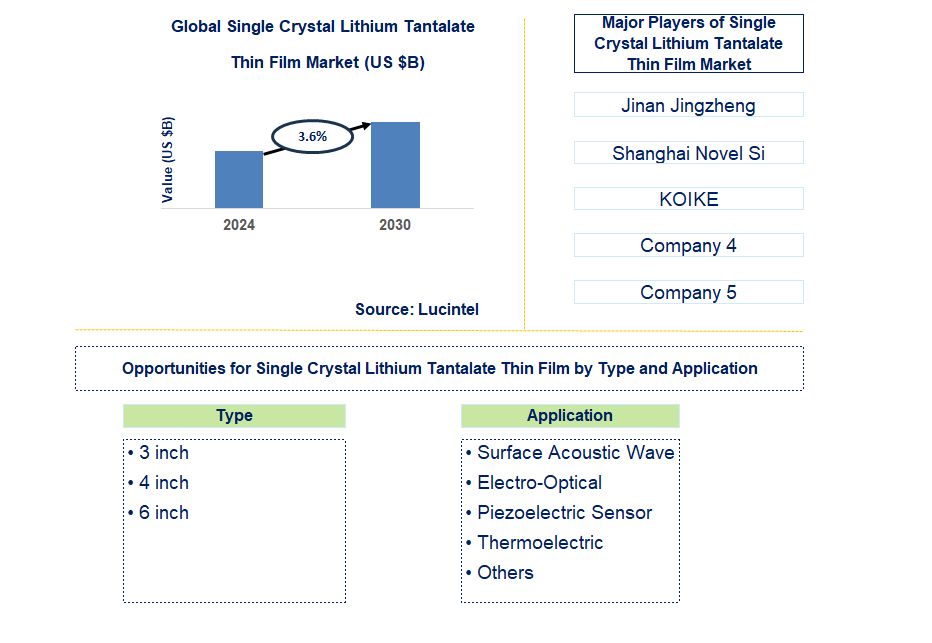
Key data points: The growth forecast = 3.6% annually next for the 6 years. Scroll below to get more insights. This market report covers trends, opportunities, and forecasts in the global single crystal lithium tantalate thin film market to 2030 by type (3 inch, 4 inch, and 6 inch), application (surface acoustic wave, electro-optical, piezoelectric sensor, thermoelectric, and others), and region (North America, Europe, Asia Pacific, and the Rest of the World)
We'll send your sample report shortly.
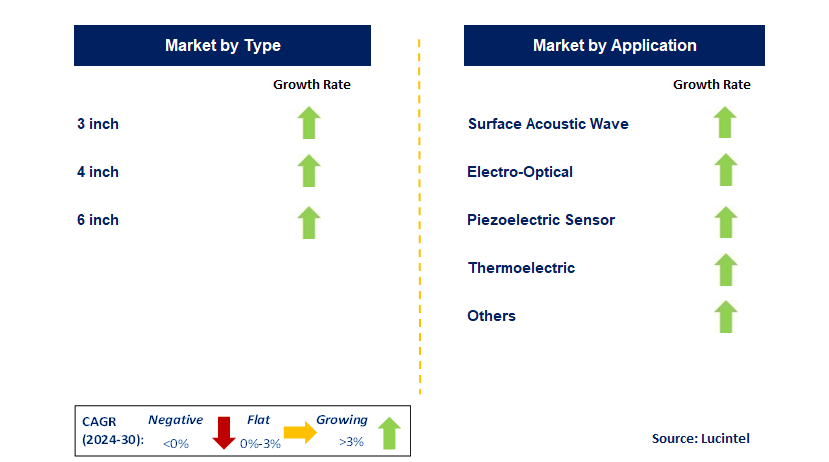
• Lucintel forecasts that, within the type category, 3 inch is expected to witness the highest growth over the forecast period.
• Within this application category, surface acoustic wave is expected to witness the highest growth.
• In terms of regions, APAC is expected to witness the highest growth over the forecast period. Gain valuable insight for your business decisions with our comprehensive 150+ page report.
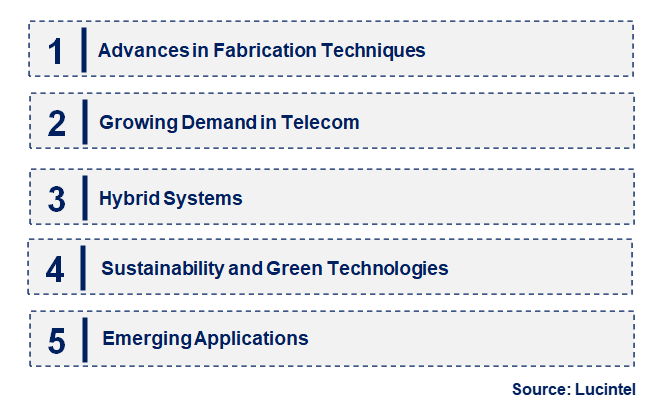
• Advances in Fabrication Techniques: Techniques such as pulsed laser deposition and molecular beam epitaxy are advancing with improvements in the quality and uniformity of the films. Such advances make devices based on lithium tantalate films more viable competitors in high-tech applications.
• Growing Demand in Telecom: Next-generation telecom devices, such as 5G and photonic devices, demand high-performance materials. The applications here will most likely offer critical functionalities for filters and modulators, given the attractiveness of single crystal lithium tantalate thin films.
• Hybrid Systems: Scientists are developing hybrid systems by depositing single crystal lithium tantalate on other materials. These hybrid systems show enhanced properties compared to the materials alone. This development will unveil new applications and better performance in various devices across different sectors.
• Sustainability and Green Technologies: Improvements in this segment stem from rising awareness of environmental issues, leading to increased research aimed at enhancing sustainability during the production of lithium tantalate films. The industry is now more focused on waste reduction and energy consumption.
• Emerging Applications: With developments in medical devices, single crystal lithium tantalate is increasingly being used in sensing and imaging applications in medical technology. This trend can be attributed to the unique properties associated with this material, which complement precision and reliability for intended use in diagnostics. These trends make the single crystal lithium tantalate thin film market more optimal in performance, expand applications, and promote healthy practices. Due to increasing demand from the telecommunication and medical sectors, the application of these materials poses challenges in advancing high-tech solutions, which propels further research and development in the field.
• Improved Growth Techniques: New growth techniques, including hydrothermal synthesis, have yielded much higher-quality single-crystal films with electro-optic coefficients larger than those of the much-studied, but harder-to-grow, lithium niobate. Most applications in telecommunications and sensor areas have stringent requirements for reliability, while performance always plays the biggest role.
• Improved Film Characterization Techniques: Characterization methods have improved, including atomic force microscopy and X-ray diffraction, allowing precise analysis of the properties of films. This improved understanding of the behavior of films under different conditions, including their application in devices, can be used to optimize performance.
• Development of Lead-Free Alternatives: Interest is increasing in lead-free variants of lithium tantalate. As environmental regulations have been rising, this has led to increased interest in lead-free alternatives that retain desired properties while reducing toxicity, thus bringing about a wider range of applications for the material.
• Integration in Photonic Devices: Single-crystal lithium tantalate films are achieving notable advancements as they integrate into photonic devices and improve functionality in modulators and frequency filters. The sector will demand much because of high-speed technologies for use in telecommunications.
• Commercialization Efforts: Interdisciplinary collaboration between academia and industry is enabling accelerated commercialization of advanced lithium tantalate technologies. Increasing entrepreneurial activity in this regard is seen in start-ups and established companies co-developing new products that are introduced into the market, reflecting the growing economic potential of the field. These developments will have a strong effect on the landscape of thin film technology for single-crystal lithium tantalate, thus improving material properties and applications. As these developments become more substantial with market growth, such innovations will continue to play a crucial role in fulfilling the growing needs of high-tech industries for advanced materials.
• Telecom Infrastructure: Increased demands for telecommunications, particularly the necessities of the 5G network, may create significant opportunities for single crystal lithium tantalate films. The material is critical in constructing high-performance filters and modulators required for efficient data transmission.
• Lithium Tantalate in Optical Sensors: Lithium tantalate thin film optical sensors are becoming increasingly important as the technology is utilized in applications that require high sensitivity and precision. This promises a bright future in medical diagnostics and environmental monitoring technology.
• Consumer Electronics: Advances in smart devices provide avenues for incorporating single crystal lithium tantalate films into various consumer electronics, enhancing functionalities such as superior audio and video response. Advanced and interactive products may emerge.
• Aerospace and Defense Applications: The aerospace and defense sectors are adopting advanced materials for sensors and communication systems. Therefore, single crystal lithium tantalate films offer tremendous opportunities to meet the stringent specifications demanded in such applications.
• Medical Imaging Technologies: With high-resolution imaging becoming essential in the medical field, single crystal lithium tantalate films open new avenues of opportunity. Their unique properties assist in the development of new imaging solutions that significantly improve diagnostic possibilities. These strategic growth opportunities emphasize the versatility and potential of single crystal lithium tantalate thin films in various applications. Such opportunities will undoubtedly foster strong innovation and market growth in the near future.
• Technological Advancements: Continuous innovations in fabrication and characterization techniques serve as significant drivers. Advances in material quality and performance will facilitate the creation of future devices and enhance competitiveness in high-tech markets, leading to better opportunities in related sectors.
• Regulatory Support for Advanced Materials: Government initiatives supporting research in advanced materials are crucial. Funding and support for innovative technologies create a favorable environment for investment and development.
• Increasing Demand for High-Performance Materials: The rising demand for high-performance materials arises from the need for efficient solutions in telecommunications, sensing, and imaging. The desire for advanced technologies in emerging industries presents growth opportunities for single crystal lithium tantalate films.
• Industry-Academia Partnerships: Establishing innovation partnerships between research institutions and industry players is essential. These initiatives help translate research breakthroughs into commercially available products, providing a competitive advantage in the market.
• Global Dynamics in Supply Chain: The global supply chain dynamics are evolving within the raw materials supply chain and manufacturing processes. Companies need to address gaps arising from geopolitical factors and ensure resilience in handling supply chain disruptions without compromising production efficiency and quality. Challenges in the single crystal lithium tantalate thin film market include:
• Technological Advancements: Continuous innovations in fabrication and characterization techniques pose challenges as well. While these advancements drive growth, they require constant adaptation and investment.
• Regulatory Support for Advanced Materials: The complex landscape of regulatory support can be challenging for companies. Navigating compliance requirements demands significant resources and can impact development timelines.
• Increasing Demand for High-Performance Materials: While demand is rising, meeting this demand requires continuous innovation and investment in new technologies to remain competitive.
• Industry-Academia Partnerships: Establishing effective partnerships can be difficult. Successful collaboration requires alignment of goals and effective communication between academic and industry stakeholders.
• Global Dynamics in Supply Chain: Geopolitical factors can disrupt supply chains, posing risks to production and delivery. Companies must remain agile to manage these challenges effectively. The drivers and challenges in the single crystal lithium tantalate thin film market highlight the dynamism of this industry. Technological advances and regulatory assistance present numerous opportunities that must be balanced against environmental considerations and competitive pressures for sustainable growth and innovation.
• Jinan Jingzheng Electronics
• Shanghai Novel Si Integration Technology
• KOIKE
• 3 inch
• 4 inch
• 6 inch
• Surface Acoustic Wave
• Electro-Optical
• Piezoelectric Sensor
• Thermoelectric
• Others
• North America
• Europe
• Asia Pacific
• The Rest of the World
• United States: Significant research is ongoing to optimize the fabrication process for single-crystal lithium tantalate thin films in the United States. Recently, pulsed laser deposition (PLD) and molecular beam epitaxy (MBE) techniques are being developed to improve film quality and uniformity. Researchers at leading universities and laboratories are studying the applicability of these films for integrated optics and telecommunication purposes, particularly for future photonic devices.
• China: Rapid development of capabilities in single-crystal lithium tantalate thin film technology is occurring in China. The key growth driver is investments in photonic and sensor applications. With breakthroughs in growth techniques such as hydrothermal synthesis and chemical vapor deposition, high-quality film production with superior properties is becoming achievable.
• Germany: Germany continues to excel in single-crystal lithium tantalate thin film research, especially in optics and sensor technology. Improving electro-optic coefficients and thermal stability in these films is the focus of research activities, enhancing their application scope in telecommunications and medical devices. Recent advancements in fabrication methods, including sputtering and sol-gel processes, are contributing to higher-quality films.
• India: India is emerging as a key player in the field of thin-film single-crystal lithium tantalate, with increasing research activities in photonics and sensor applications. Recently discovered innovative growth methods related to this material have been reported. Local scientists are currently developing methods to reduce production costs without compromising quality. Indian research institutions are collaborating with industries for applications in telecommunications and medical diagnostics, positioning the country as a potential hub for advanced materials.
• Japan: Japan remains at the forefront of innovations in single-crystal lithium tantalate thin films, particularly in advanced telecommunications and optical devices. Recent studies have focused on improving nonlinear optical properties for high-speed communication technology.


• Jinan Jingzheng Electronics
• Shanghai Novel Si Integration Technology
• KOIKE Q5. Which single crystal lithium tantalate thin film market segment will be the largest in future? Answer: Lucintel forecasts that 3 inch is expected to witness the highest growth over the forecast period. Q6. In single crystal lithium tantalate thin film market, which region is expected to be the largest in next 5 years? Answer: APAC is expected to witness highest growth over the forecast period. Q.7 Do we receive customization in this report? Answer: Yes, Lucintel provides 10% customization without any additional cost.


Choose a license that fits your team. Instant PDF delivery.
Prices exclude taxes. Instant delivery. Custom licensing available on request.
Market Report · July 22, 2026
Market Report · July 22, 2026
Market Report · July 22, 2026
Trusted partner for strategic intelligence and business growth


Receive a complimentary market analysis tailored to your industry. Our analysts will identify key growth opportunities and competitive dynamics specific to your business.

Market size, growth rate, and key trend analysis for your specific sector.

Top competitor positioning and market share analysis.

Strategic recommendations backed by data-driven insights.
Get curated market intelligence and competitive moves straight to your inbox.
By subscribing, you agree to receive our monthly insights. Unsubscribe anytime.
Receive a complimentary market analysis tailored to your industry. Our analysts will identify key growth opportunities and competitive dynamics specific to your business.
Market size, growth rate, and key trend analysis for your specific sector.
Top competitor positioning and market share analysis.
Strategic recommendations backed by data-driven insights.
Get curated market intelligence, emerging trends, and competitive moves straight to your inbox each month.
By subscribing, you agree to receive our monthly insights. Unsubscribe anytime.
We'll send your sample report shortly.