
Market Report · May 18, 2026

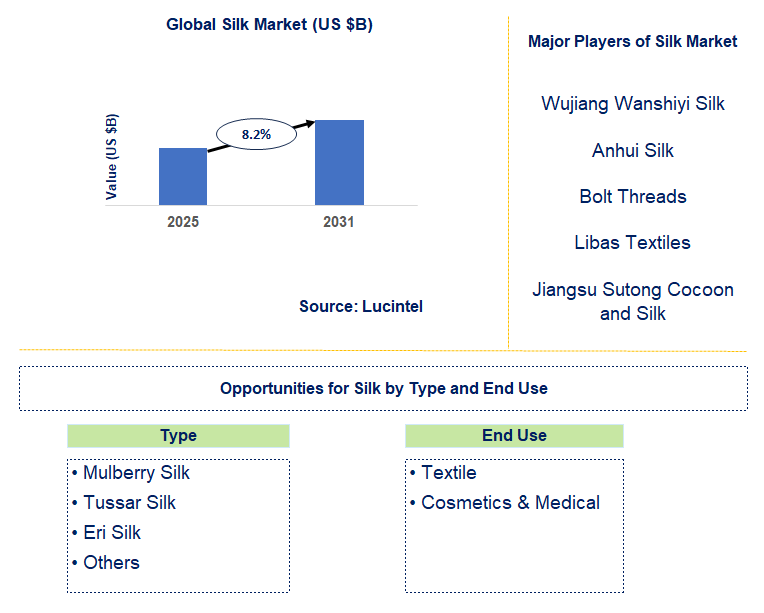
Key data points: The growth forecast = 8.2% annually for the next 7 years. Scroll below to get more insights. This market report covers trends, opportunities and forecasts in silk market to 2031 by type (mulberry silk, tussar silk, eri silk, and others), end use (textile and cosmetics & medical), and region (North America, Europe, Asia Pacific, and the Rest of the World)
We'll send your sample report shortly.
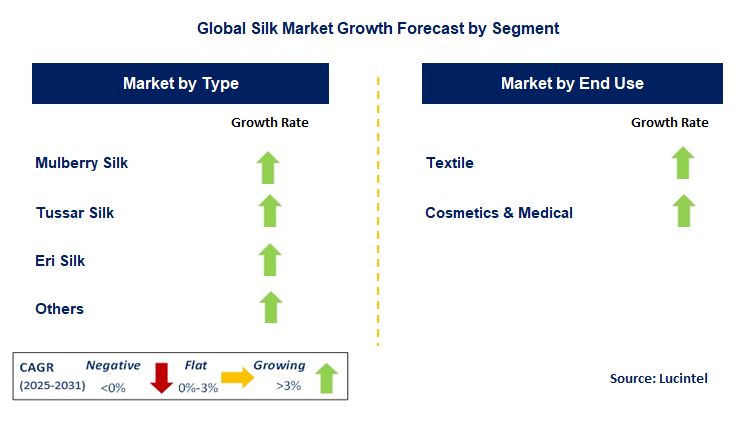
• Lucintel forecasts that, within the type category, mulberry silk is expected to witness the highest growth over the forecast period.
• Within the end use category, textile is expected to witness the highest growth.
• In terms of region, APAC is expected to witness the highest growth over the forecast period. Gain valuable insights for your business decisions with our comprehensive 150+ page report. Sample figures with some insights are shown below.
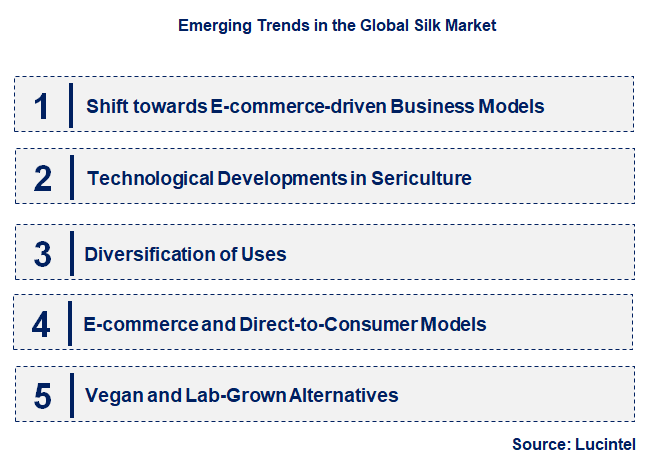
• Shift towards E-commerce-driven Business Models: The proliferation of smartphones and internet penetration across the globe is driving the shift towards e-commerce-driven business models. This has resulted in a greater demand for "peace silk" or "Ahimsa silk," where the silkworms can emerge from their cocoons naturally. It also encompasses organic silk farming, which excludes the use of pesticides. This trend is forcing the industry towards more responsible production and is appealing to a new generation of aware consumers and creating a premium market niche.
• Technological Developments in Sericulture: Technology is transforming the silk industry. The application of artificial intelligence and biotechnology is making sericulture more efficient and productive. AI-based systems can track silkworm health and regulate feeding, and genetic engineering is developing new silkworm varieties with improved characteristics. This is not only enhancing the quality and quantity of silk, but also decreasing labor expenses and environmental degradation, making production more uniform and sustainable.
• Diversification of Uses: Its application is being diversified from conventional textiles. There is a strong trend towards its usage in high-tech and non-textile applications. Silk fibroin is also being researched for its biocompatibility in biomedical applications such as sutures and drug delivery systems. The cosmetics and skincare industry is also using silk proteins for moisturizing properties in cosmetics and skincare products. The diversification is opening new, high-value markets for silk and its derivatives.
• E-commerce and Direct-to-Consumer Models: E-commerce is a strong rising trend in the silk market. It enables manufacturers and artisans to cut through middlemen and sell products online directly to people across the world. This model is empowering medium and small-sized businesses to acquire global visibility, promoting more transparency and enabling consumers to get associated with brands and their history. This trend is leveling the playing field of the market and making it wider.
• Vegan and Lab-Grown Alternatives: Due to ethical issues, a trend of creating and selling vegan and lab-grown alternatives to silk is emerging. Synthetic biology and genetic engineering are being utilized by companies to develop materials that replicate the qualities of natural silk without the use of silkworms. Such innovations like spider silk derived from yeast are being lapped up by increasingly large vegan consumer markets and solving scalability problems, providing a cruelty-free and sustainable option. These trends are inherently transforming the silk market from a conventional luxury item to a contemporary, multifunctional, and eco-friendly product. The transition towards sustainable production, technological advancement, and product diversification is fueling market growth and opening up new opportunities. By adopting these changes, the silk industry not only fulfills the expectations of a generation of consumers but is also poised to become a leader in the creation of sustainable and high-tech biomaterials for the future.
• Technology Advances in Sericulture: One of the most important developments is the application of new technologies in sericulture farming. Some of the new innovations are automated reeling machines for cocoons that enhance efficiency and production, and climate-controlled rearing houses that help maintain constant quality. Genetic studies are also creating disease-resistant silkworm varieties. These technological advances are increasing the efficiency of sericulture and reducing labor costs, solving long-running production problems.
• Biotechnology Arrival in Silk Production: The industry has witnessed significant arrival with the introduction of biotechnology to produce bio-engineered and laboratory-grown silks. Bolt Threads and other companies are utilizing microorganisms to synthesize silk proteins, which are then processed into a material that replicates natural silk. This is an answer to ethical issues surrounding conventional sericulture and offers a scalable, sustainable option for multiple applications beyond clothing.
• Non-Textile Applications: Application of silk in non-textile products has also witnessed great advancement. Silk fibroin, a silk-derived protein, is finding applications in the biomedical area for use in sutures, tissue engineering scaffolds, and drug delivery systems because of its biocompatibility. In cosmetics too, silk proteins are being used in skincare and hair care products for their special properties and there emerges a new and premium segment in the market.
• Sustainable and Ethical Production Emphasis: A significant trend is the increasing focus on sustainable and ethical production. This involves the increasing popularity of "Ahimsa silk," which enables the silkworm to fulfill its cycle of life. It also consists of the use of green dyeing and finishing techniques that minimize water consumption and chemical effluents. This trend is a direct response to consumer pressures for environmentally and socially conscious products.
• Marketing and Sales Digital Transformation: The silk market is experiencing a digital transformation with e-commerce and social media becoming indispensable for marketing and sales. Direct-to-consumer models are on the rise, allowing for small-scale producers and artisans to connect globally. This trend is expanding market access, decreasing dependency on intermediaries, and offering consumers more products and greater transparency. These dramatic developments are essentially shaping the silk market. Advances in technology and the application of biotechnology are boosting the efficiency and quality of production. The diversification into non-textile uses and the emphasis on sustainability are making the market more diversified and opening new revenue channels. The digitalization of the industry is expanding its coverage and enhancing its resilience. These developments are placing silk on the path to a future of innovation and steady growth.
• Activewear and High-Performance Apparel: One of the biggest growth prospects is the creation of high-performance activewear apparel made from silk. Although silk is traditionally seen as fragile, its inherent qualities—moisture-wicking and breathable nature—render it ideal for activewear. Blends or treated silk fabrics can be used to realize this potential, targeting the sports and leisure segment with a lavish yet snug substitute for synthetic fibers.
• Biomedical and Medical Applications: The biomedical industry presents a significant strategic potential for silk. Silk fibroin’s mechanical strength and biocompatibility render it a suitable material for tissue regeneration scaffolds, medical implants, and medical sutures. Its application in drug delivery systems is also being researched. This application is a high-tech, high-value market segment far divorced from conventional textiles with a massive growth potential.
• Sustainable Home Furnishings and Decor: As consumers become increasingly interested in sustainable home architecture and using natural materials in the home, there is an opportunity to grow in home furnishings. Silk has applications in a range of products such as bed sheets, curtains, and furniture upholstery. By positioning the natural, hypoallergenic, and luxurious attributes of silk, firms can market to consumers who are willing to spend on quality, long-term, and eco-friendly home items.
• Anti-Aging and Premium Cosmetics: Another prime sector for expansion is the cosmetics industry. Silk proteins (sericin and fibroin) are applied to skincare, hair care, and makeup products. They are renowned for their moisturizing, anti-aging, and protective capabilities. This potential enables the silk industry to access the high-value beauty and personal care market, as consumers are demanding more natural and effective ingredients.
• Cruelty-Free and Vegan Alternatives: The expanding marketplace for cruelty-free and vegan goods presents a strategic possibility to create and sell alternatives to conventional silk. This involves "peace silk," in which cocoons are not boiled, as well as bio-engineered silks. By emphasizing these ethical alternatives, companies can reach a new, conscious consumer segment and respond to the ethical issues that have perennially plagued the conventional silk industry. These growth opportunities through strategy are transforming the silk market by catapulting it out of its traditional limits. The move into high-performance clothing, biomedical uses, eco-friendly home textiles, and the beauty segment identifies the versatility and worth of silk. In addition, the emphasis on cruelty-free products and vegan ingredients show that the market can evolve to meet current consumer culture. With these developments, the silk industry can find a solid and forward-thinking future.
• Wujiang Wanshiyi Silk
• Anhui Silk
• Bolt Threads
• Libas Textiles
• Jiangsu Sutong Cocoon and Silk
• ShengKun Silk Manufacturing
• Sichuan Nanchong Liuhe
• Amsilk
• Zhejiang Jiaxin Silk
• Wujiang First Textile
• Mulberry Silk
• Tussar Silk
• Eri Silk
• Others
• Textile
• Cosmetics & Medical
• North America
• Europe
• Asia Pacific
• The Rest of the World
• United States: The United States market for silk is growing due to a rise in consumer interest in luxury and sustainable materials. Recent news involves the global expansion of brands such as LILYSILK, which just opened its first concept store in New York City, emphasizing a retail strategy of luxury and sustainable shopping experiences. Also on the radar is major innovation in biotech silk, with beauty companies such as Bolt Threads collaborating with beauty companies to put bio-engineered silk into a new line of clean beauty products. This innovation is broadening the market from conventional textiles and into new usage.
• China: China, which is the world’s largest producer and exporter of silk, is working on mechanizing its sericulture industry. Recent trends see the incorporation of artificial intelligence and Internet of Things (IoT) to maximize silk production, from cultivation to processing. An example is the Wenski Group, which has introduced an AI-based design system that supports quick customization and effective production. There is also an endeavor towards environmentally friendly practices, as the use of digital machines which does away with water consumption in dyeing and printing tackles longstanding environmental issues.
• Germany: In Germany, the market for silk is largely fueled by a high emphasis on ethical and sustainable fashion. Recent trends indicate a taste for cruelty-free and organic silk products as a result of the country’s environmentally friendly consumer base. Brands are increasingly obtaining silk from producers who meet these standards. A demand for novel silk applications in the biomedical community also exists, as German companies consider silk fibroin as a medical suture and implant material because it is biocompatible and strong.
• India: India, which is one of the world’s leading silk producers, is undergoing recent developments with regard to production as well as market expansion. The government has come out with schemes such as Silk Samara to enhance the quality and productivity of silk cultivation. Technical interventions in the form of those offered by ago-tech firms are enabling silk farmers to enhance their earnings through the use of AI and IoT. This not only augments local production but also enhances India’s position as an important exporter of silk clothing and made-ups, especially to economies such as the US and the UAE.
• Japan: The Japanese silk industry is a fusion of tradition and high technology. Its recent trends are a reemphasis on preserving and developing its traditional silk culture as well as seeking new uses. There is increasing demand for high-quality, domestic silk products. At the same time, Japanese firms are leaders in the search to utilize silk in advanced biomedical uses and functional materials. This dual emphasis enables the market to hold on to cultural relevance while tapping new, high-value markets.


• Wujiang Wanshiyi Silk
• Anhui Silk
• Bolt Threads
• Libas Textiles
• Jiangsu Sutong Cocoon and Silk
• ShengKun Silk Manufacturing
• Sichuan Nanchong Liuhe
• Amsilk
• Zhejiang Jiaxin Silk
• Wujiang First Textile Q5. Which silk market segment will be the largest in future? Answer: Lucintel forecasts that, within the type category, mulberry silk is expected to witness the highest growth over the forecast period. Q6. In silk market, which region is expected to be the largest in next 5 years? Answer: In terms of region, APAC is expected to witness the highest growth over the forecast period. Q7. Do we receive customization in this report? Answer: Yes, Lucintel provides 10% customization without any additional cost.


Choose a license that fits your team. Instant PDF delivery.
Prices exclude taxes. Instant delivery. Custom licensing available on request.
Market Report · May 18, 2026
Market Report · May 18, 2026
Market Report · May 18, 2026
Trusted partner for strategic intelligence and business growth


Receive a complimentary market analysis tailored to your industry. Our analysts will identify key growth opportunities and competitive dynamics specific to your business.

Market size, growth rate, and key trend analysis for your specific sector.

Top competitor positioning and market share analysis.

Strategic recommendations backed by data-driven insights.
Get curated market intelligence and competitive moves straight to your inbox.
By subscribing, you agree to receive our monthly insights. Unsubscribe anytime.
Receive a complimentary market analysis tailored to your industry. Our analysts will identify key growth opportunities and competitive dynamics specific to your business.
Market size, growth rate, and key trend analysis for your specific sector.
Top competitor positioning and market share analysis.
Strategic recommendations backed by data-driven insights.
Get curated market intelligence, emerging trends, and competitive moves straight to your inbox each month.
By subscribing, you agree to receive our monthly insights. Unsubscribe anytime.
We'll send your sample report shortly.