
Silicon Carbide Fiber Market Report: Trends, Forecast and Competitive Analysis to 2035

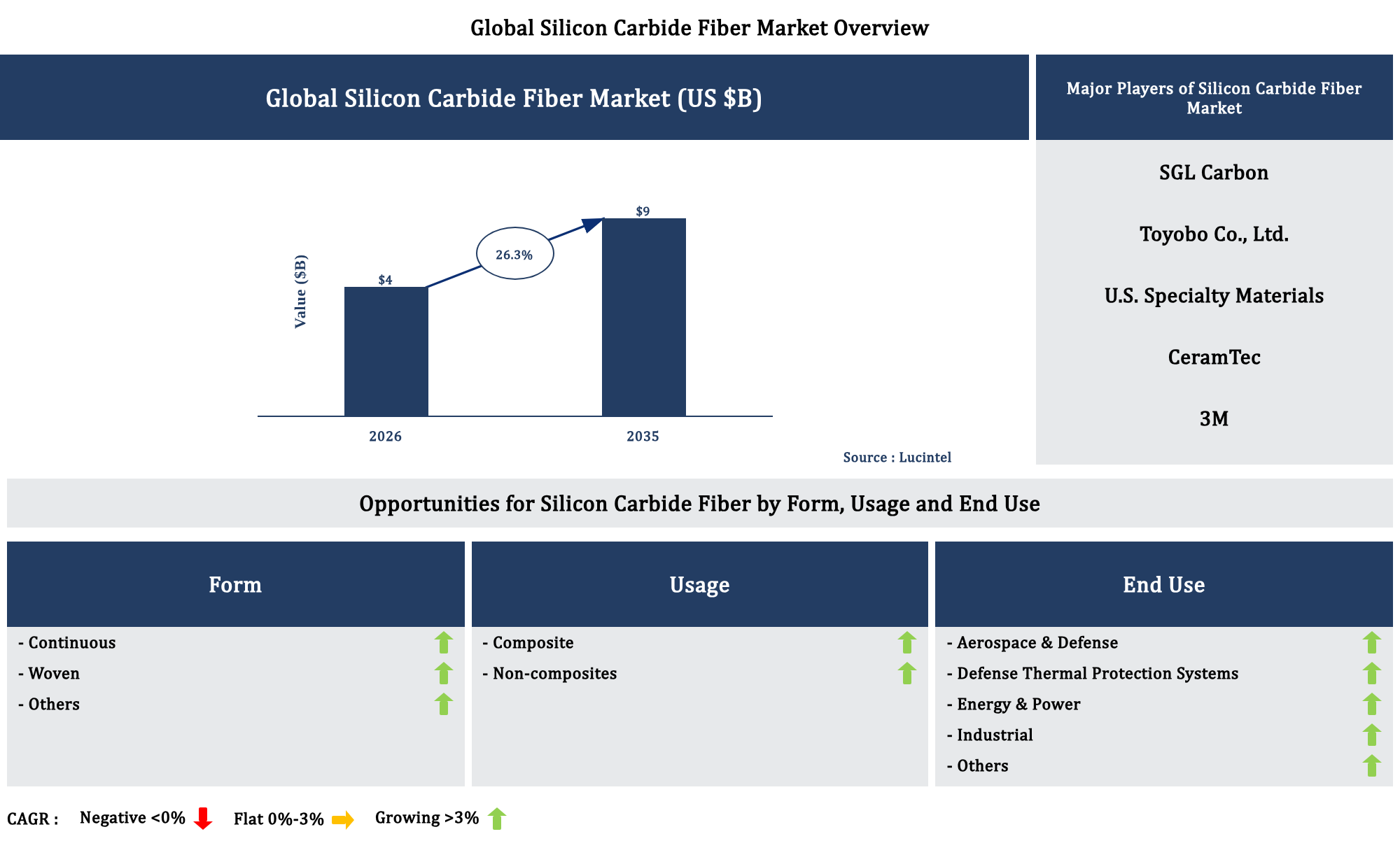
Key data points: The market size in 2035 = $9 billion, growth forecast = 26.3% annually for the next 9 years. Scroll below to get more insights. This market report covers trends, opportunities and forecasts in silicon carbide fiber market to 2035 by form (continuous, woven, and others), usage (composite and non-composites), end use (aerospace & defense, defense thermal protection systems, energy & power, industrial, and others), and region (North America, Europe, Asia Pacific, and the Rest of the World)

Publisher: Lucintel Last Updated: July 2026
See Pricing

Download Sample Report

| ✨ New Download Sample report — Get instant insights! | ✨ New Download Sample report — Get instant insights!

Silicon Carbide Fiber Market Report: Trends, Forecast and Competitive Analysis to 2035

Silicon Carbide Fiber Market

The future of the global silicon carbide fiber market looks promising with opportunities in the aerospace & defense, defense thermal protection system, and energy & power markets. The global silicon carbide fiber market is expected to reach an estimated $9 billion by 2035 with a CAGR of 26.3% from 2026 to 2035. The major drivers for this market are the increasing demand for ceramic matrix composites, the rising adoption in aerospace engine components, and the growing use in high-temperature applications.

  • Lucintel forecasts that, within the form category, continuous is expected to witness higher growth over the forecast period due to the increasing demand for continuous thermal protection materials.
  • Within the end use category, defense thermal protection system is expected to witness the highest growth due to the rising adoption of defense thermal protection systems.
  • In terms of regions, North America will remain the largest region over the forecast period due to the growing need for advanced protection technologies.

Gain valuable insights for your business decisions with our comprehensive 150+ page report. Sample figures with some insights are shown below.
Silicon Carbide Fiber Market

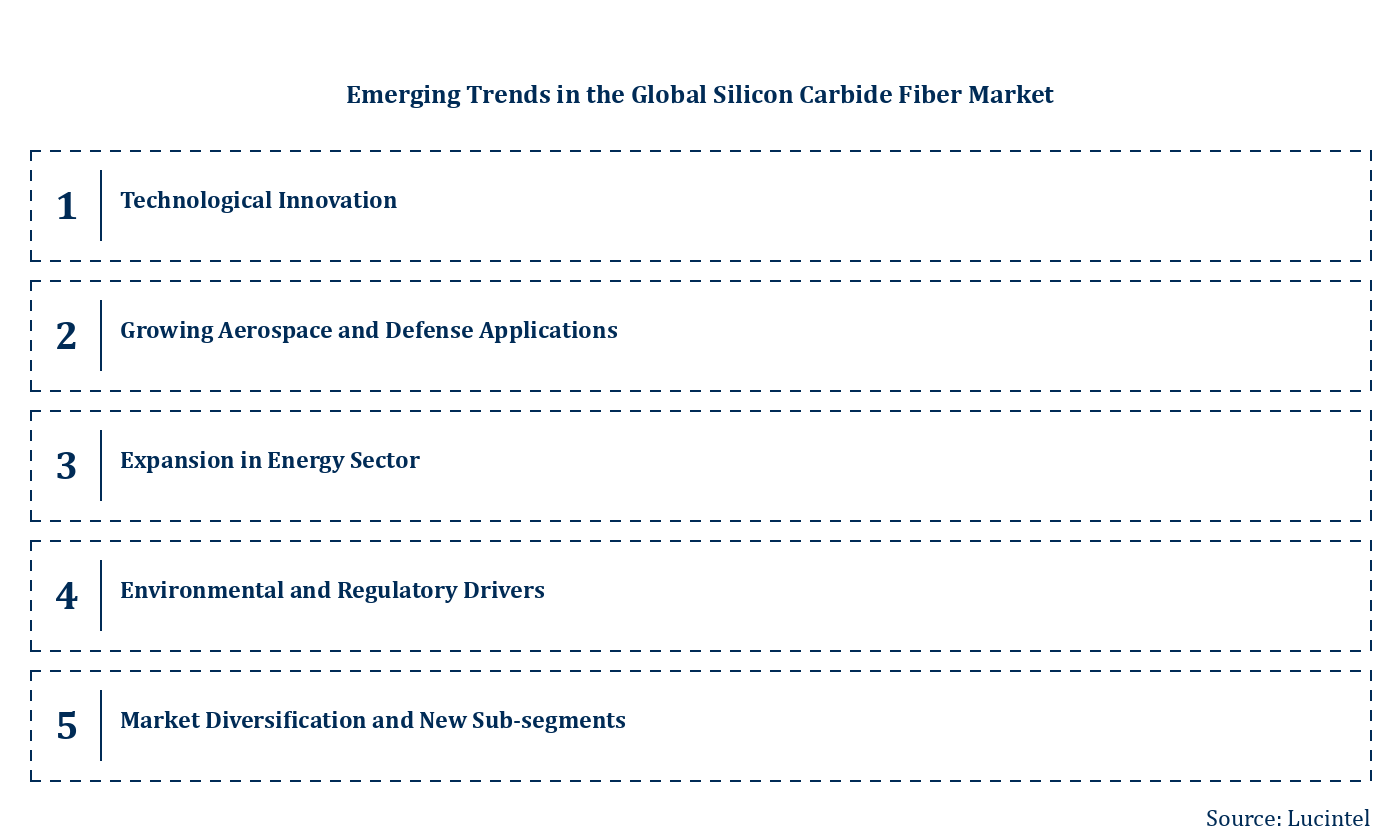
Emerging Trends in the Silicon Carbide Fiber Market

The silicon carbide fiber market is experiencing rapid growth driven by technological advancements and increasing demand across various industries. As industries such as aerospace, defense, and energy seek materials that offer superior performance, the market is evolving with innovative solutions and expanding applications. Emerging trends are shaping the future landscape, influencing product development, manufacturing processes, and market strategies. These developments are not only enhancing product capabilities but also opening new avenues for growth and competition. Understanding these key trends is essential for stakeholders aiming to capitalize on the market's potential and stay ahead in this dynamic environment.

  • Technological Innovation: Advancements in manufacturing processes are leading to higher quality silicon carbide fibers with improved strength, flexibility, and thermal stability. Innovations such as chemical vapor deposition (CVD) and sol-gel techniques are enabling the production of fibers with enhanced performance characteristics. These improvements are expanding the application scope, especially in high-temperature environments like aerospace and industrial heating. The focus on innovation is also driving cost reductions, making silicon carbide fibers more accessible and attractive for various end-use industries.
  • Growing Aerospace and Defense Applications: The aerospace and defense sectors are increasingly adopting silicon carbide fibers due to their lightweight, high-strength, and thermal resistance properties. These fibers are used in composite materials for aircraft components, missile systems, and space exploration equipment. The trend is driven by the need for materials that can withstand extreme conditions while reducing overall weight, thereby improving fuel efficiency and performance. As these industries continue to evolve, the demand for advanced silicon carbide fiber composites is expected to rise significantly.
  • Expansion in Energy Sector: The energy industry is leveraging silicon carbide fibers for applications such as gas turbines, nuclear reactors, and solar thermal systems. Their excellent thermal stability and corrosion resistance make them ideal for high-temperature and harsh environments. The increasing focus on renewable energy sources and efficient power generation is fueling demand. Additionally, silicon carbide fibers are being explored for use in energy storage systems and advanced batteries, further broadening their market scope and contributing to sustainable energy solutions.
  • Environmental and Regulatory Drivers: Stricter environmental regulations are encouraging industries to adopt materials that offer better performance with lower environmental impact. Silicon carbide fibers, being lightweight and durable, contribute to energy efficiency and reduced emissions in transportation and industrial processes. The push for sustainable manufacturing practices is also promoting the development of eco-friendly production methods. These regulatory pressures are accelerating innovation and adoption, positioning silicon carbide fibers as a key material in achieving environmental compliance and sustainability goals.
  • Market Diversification and New Sub-Segments: The market is witnessing diversification into new sub-segments such as automotive, electronics, and medical devices. In automotive, silicon carbide fibers are used in high-performance brake systems and lightweight structural components. In electronics, they serve as thermal management materials for high-power devices. Medical applications include durable, heat-resistant implants and surgical tools. This diversification is driven by the unique properties of silicon carbide fibers, opening up new revenue streams and reducing dependency on traditional markets. It also encourages cross-industry collaborations and innovative product development.

These emerging trends are fundamentally reshaping the silicon carbide fiber market by enhancing product capabilities, expanding application areas, and promoting sustainable practices. The focus on innovation, industry-specific demands, and environmental considerations is creating a dynamic landscape that offers significant growth opportunities for market participants. As these trends continue to evolve, they will drive increased adoption, technological breakthroughs, and competitive differentiation across sectors.
Silicon Carbide Fiber Market by country

Recent Developments in the Silicon Carbide Fiber Market

The silicon carbide fiber market is experiencing rapid growth driven by technological advancements and increasing demand across various industries. Innovations in material properties and manufacturing processes are expanding applications in aerospace, defense, and energy sectors. Market players are investing heavily in research to develop high-performance fibers that meet stringent safety and durability standards. The evolving landscape presents significant opportunities for new entrants and established companies to capitalize on emerging trends and expand their market share.

  • Aerospace Industry Adoption: Silicon carbide fibers are increasingly used in aerospace for lightweight, high-strength composites, improving fuel efficiency and safety standards. This adoption enhances aircraft performance and reduces emissions, creating a substantial market for high-temperature resistant fibers. The demand is driven by the need for durable, lightweight materials in commercial and military aircraft, leading to increased R&D investments and new product launches.
  • Energy Sector Expansion: The energy industry benefits from silicon carbide fibers in thermal insulation, nuclear reactors, and solar panel components. Their high thermal stability and corrosion resistance make them ideal for extreme environments. As renewable energy and nuclear power projects grow, so does the demand for advanced fibers, encouraging manufacturers to develop specialized products that cater to these sectors, thus expanding market reach and application scope.
  • Defense and Military Applications: Silicon carbide fibers are critical in defense for ballistic protection, missile components, and high-performance armor. Their ability to withstand extreme conditions enhances military equipment durability. Increasing defense budgets and technological upgrades are fueling demand, prompting innovation in fiber formulations to meet specific military standards, which in turn boosts market growth and opens new avenues for specialized fiber applications.
  • Automotive Industry Innovations: The automotive sector is adopting silicon carbide fibers for lightweight composites in electric vehicles (EVs) and high-performance parts. These fibers improve vehicle efficiency and safety while reducing weight. As EV adoption accelerates globally, the demand for advanced, lightweight materials rises, leading to increased investments in fiber manufacturing and new product development tailored for automotive applications.
  • Advancements in Manufacturing Technologies: Innovations in production processes, such as chemical vapor infiltration and polymer-derived methods, are enabling cost-effective, high-quality fiber production. These advancements reduce manufacturing costs and improve fiber performance, making silicon carbide fibers more accessible across industries. Enhanced scalability and quality control are attracting new market entrants and expanding existing applications, thereby strengthening the overall market position.

These developments are significantly transforming the silicon carbide fiber market by broadening application horizons and improving product performance. The integration of advanced manufacturing techniques and expanding industry demands are driving market growth, fostering innovation, and attracting investments. As a result, the market is poised for sustained expansion, with increased competitiveness and diversification across sectors, ultimately shaping a robust future for silicon carbide fiber applications worldwide.

Strategic Growth Opportunities in the Silicon Carbide Fiber Market

The silicon carbide fiber market is experiencing rapid expansion driven by increasing demand in aerospace, defense, and industrial sectors. Advancements in material technology and growing applications in high-temperature environments are fueling growth opportunities. Market players are focusing on innovation, strategic partnerships, and expanding manufacturing capacities to meet rising global demand. This dynamic landscape presents numerous avenues for strategic growth, enabling companies to strengthen their market positions and capitalize on emerging opportunities across various industries.

  • Emerging Applications in Aerospace and Defense: Silicon carbide fibers are increasingly used in aerospace and defense for thermal protection systems, lightweight composites, and missile components. Their high-temperature resistance, strength, and durability make them ideal for extreme environments. As aerospace manufacturers seek lighter, more efficient materials, the demand for silicon carbide fibers is expected to grow significantly. This segment offers substantial growth potential through technological innovations and strategic collaborations with aerospace OEMs.
  • Expansion of Industrial High-Temperature Applications: Industrial sectors such as energy, metallurgy, and chemical processing are adopting silicon carbide fibers for high-temperature insulation, furnace linings, and heat exchangers. These fibers provide excellent thermal stability, corrosion resistance, and mechanical strength, enabling safer and more efficient operations. The increasing need for energy efficiency and process optimization drives market growth. Developing cost-effective manufacturing processes and expanding application-specific product lines will further enhance market penetration.
  • Growing Demand in Automotive and Electric Vehicles: The automotive industry is exploring silicon carbide fibers for lightweight composites, brake systems, and thermal management components in electric vehicles (EVs). Their ability to withstand high temperatures and reduce weight contributes to improved vehicle performance and energy efficiency. As EV adoption accelerates globally, the demand for advanced materials like silicon carbide fibers is expected to rise. Strategic investments in R&D and collaborations with automotive OEMs will be crucial for capturing this expanding market segment.
  • Technological Innovations and Material Advancements: Continuous research is leading to improved silicon carbide fiber properties, such as enhanced tensile strength, flexibility, and processability. Innovations in fiber manufacturing techniques, like chemical vapor deposition and polymer-derived methods, are expanding application possibilities. These advancements enable the development of tailored solutions for specific industry needs, fostering market growth. Companies investing in R&D and intellectual property rights will gain competitive advantages and open new avenues for high-performance applications.
  • Strategic Partnerships and Market Expansion in Asia-Pacific: The Asia-Pacific region is witnessing rapid growth due to expanding manufacturing bases, government initiatives, and increasing industrialization. Strategic alliances, joint ventures, and local manufacturing facilities are helping companies penetrate this lucrative market. Additionally, rising infrastructure projects and industrial modernization are boosting demand for silicon carbide fibers. Focusing on regional customization, supply chain optimization, and local partnerships will be key to capturing market share and driving long-term growth in this high-potential region.

The overall impact of these opportunities is set to significantly accelerate market growth, foster innovation, and diversify application areas. Companies that leverage technological advancements, strategic collaborations, and regional expansion will be well-positioned to capitalize on the rising demand. This evolving landscape promises a robust future for the silicon carbide fiber market, driven by increasing industrial needs and technological progress.

Silicon Carbide Fiber Market Drivers and Challenges

The silicon carbide fiber market is influenced by a variety of technological, economic, and regulatory factors that shape its growth trajectory. Advances in composite materials and high-performance applications drive demand, while economic fluctuations impact investment levels. Regulatory standards concerning environmental and safety concerns also play a crucial role. Additionally, innovations in manufacturing processes and the development of new end-use industries further influence market dynamics. Navigating these drivers and challenges is essential for stakeholders aiming to capitalize on emerging opportunities and mitigate potential risks within this specialized sector.

The factors responsible for driving the silicon carbide fiber market include:-

  • Technological Advancements: The development of high-strength, lightweight silicon carbide fibers has significantly enhanced their application in aerospace, defense, and industrial sectors. Innovations in manufacturing processes, such as chemical vapor deposition, have improved fiber quality and performance, enabling the creation of advanced composites. These technological improvements have expanded the scope of silicon carbide fibers, making them more viable for high-temperature and high-stress environments. As industries seek materials that offer superior durability and thermal stability, the demand for silicon carbide fibers continues to grow, fueling market expansion and encouraging further R&D investments.
  • Growing Aerospace and Defense Industry: The aerospace and defense sectors are major consumers of silicon carbide fibers due to their exceptional thermal resistance, lightweight nature, and mechanical strength. The increasing demand for fuel-efficient aircraft and space exploration vehicles has driven the adoption of advanced composite materials. Governments and private companies are investing heavily in aerospace innovations, which directly boosts the need for high-performance fibers like silicon carbide. This trend is expected to persist, as the industry seeks materials that can withstand extreme conditions while reducing overall weight, thereby enhancing fuel efficiency and operational performance.
  • Rising Demand for High-Performance Composites: The automotive, energy, and industrial sectors are increasingly adopting silicon carbide fibers to develop high-performance composites. These composites offer superior thermal stability, corrosion resistance, and mechanical strength, making them ideal for applications such as turbine blades, heat exchangers, and structural components. The push towards lightweight and durable materials to improve efficiency and safety standards is a key driver. As industries aim to meet stringent environmental regulations and improve product longevity, the demand for silicon carbide fiber-reinforced composites is expected to grow substantially, supporting market expansion.
  • Expansion in Industrial Applications: Silicon carbide fibers are gaining traction in industrial applications such as chemical processing, electronics, and manufacturing due to their excellent thermal and chemical stability. The need for materials that can operate reliably in harsh environments is increasing, especially in high-temperature filters, insulation, and protective coatings. The growth of these industrial sectors, coupled with technological innovations, is expanding the application scope of silicon carbide fibers. This diversification into new industrial markets is a significant factor propelling market growth, as companies seek to leverage the unique properties of silicon carbide fibers for enhanced performance and safety.
  • Increasing Investment in R&D and Manufacturing Capacity: To meet rising demand, companies and governments are investing heavily in research and development, as well as expanding manufacturing capacities for silicon carbide fibers. These investments aim to improve fiber quality, reduce production costs, and develop new applications. Enhanced R&D efforts are also focused on creating more sustainable and scalable production methods. The expansion of manufacturing facilities ensures a steady supply to meet global demand, fostering innovation and competitiveness within the market. This proactive approach is crucial for maintaining technological leadership and capturing emerging opportunities.

The challenges facing the silicon carbide fiber market include:-

  • High Production Costs: Manufacturing silicon carbide fibers involves complex processes such as chemical vapor deposition, which are energy-intensive and require specialized equipment. These factors contribute to high production costs, making the fibers expensive compared to traditional materials. The cost barrier limits widespread adoption, especially in price-sensitive industries like automotive. Additionally, fluctuations in raw material prices and energy costs can further impact profitability. Overcoming these cost challenges requires technological innovations to streamline production and scale operations, which may take time and significant investment, potentially hindering market growth in the short term.
  • Technological Complexity and Scalability Issues: Producing high-quality silicon carbide fibers with consistent properties remains a technical challenge. The manufacturing process is intricate, requiring precise control over parameters to ensure fiber uniformity and performance. Scaling up production from laboratory to industrial levels introduces additional complexities, such as maintaining quality and reducing defects. These issues can delay product commercialization and increase costs. Overcoming technological hurdles is essential for broader market penetration, but it demands substantial R&D efforts and expertise, which may slow down the pace of market expansion.
  • Regulatory and Environmental Concerns: The production and use of silicon carbide fibers are subject to stringent environmental and safety regulations due to the hazardous chemicals involved in manufacturing. Compliance with these regulations can increase operational costs and complicate supply chains. Additionally, concerns about the environmental impact of raw material extraction and waste disposal pose challenges for sustainable growth. Navigating regulatory landscapes requires significant investment in safety measures and environmental management systems. Failure to comply or address environmental concerns could result in legal penalties, reputational damage, and restricted market access, impeding overall market development.

The silicon carbide fiber market is driven by technological innovations, expanding industrial applications, and increasing demand from aerospace and defense sectors. However, high production costs, technological complexities, and regulatory challenges pose significant hurdles. The interplay of these factors will shape the market’s future trajectory, requiring strategic investments and technological advancements to capitalize on growth opportunities while mitigating risks. Overall, the market’s evolution hinges on balancing innovation with sustainability and cost-efficiency, ensuring long-term competitiveness and resilience.

List of Silicon Carbide Fiber Market Companies

Companies in the market compete on the basis of product quality offered. Major players in this market focus on expanding their manufacturing facilities, R&D investments, infrastructural development, and leverage integration opportunities across the value chain. Through these strategies silicon carbide fiber market companies cater increasing demand, ensure competitive effectiveness, develop innovative products & technologies, reduce production costs, and expand their customer base. Some of the silicon carbide fiber market companies profiled in this report include-

  • SGL Carbon
  • Toyobo Co., Ltd.
  • U.S. Specialty Materials
  • CeramTec
  • 3M
  • H.C. Starck
  • Nippon Carbon Co., Ltd.
  • GE Aviation
  • Dow Chemical
  • Applied Materials

Silicon Carbide Fiber Market by Segment

The study includes a forecast for the global silicon carbide fiber market by form, usage, end use, and region.

  • Silicon Carbide Fiber Market by Form [Value from 2019 to 2035]:
    • Continuous
    • Woven
    • Others
  • Silicon Carbide Fiber Market by Usage [Value from 2019 to 2035]:
    • Composite
    • Non-composites
  • Silicon Carbide Fiber Market by End Use [Value from 2019 to 2035]:
    • Aerospace & Defense
    • Defense Thermal Protection Systems
    • Energy & Power
    • Industrial
    • Others
  • Silicon Carbide Fiber Market by Region [Value ($B) from 2019 to 2035]:
    • North America
    • Europe
    • Asia Pacific
    • The Rest of the World

Country Wise Outlook for the Silicon Carbide Fiber Market

The silicon carbide fiber market has experienced significant growth driven by increasing demand for high-performance materials across various industries such as aerospace, automotive, and energy. Technological advancements, expanding applications, and government initiatives to promote sustainable and efficient solutions have contributed to market evolution. Countries are investing heavily in research and development to enhance fiber properties and production capabilities, positioning themselves as leaders in this sector. The following summaries highlight recent developments in the United States, China, Germany, India, and Japan, reflecting their strategic focus and market dynamics.

  • United States: The US market has seen substantial investments in aerospace and defense sectors, with innovations in high-temperature resistant fibers. Leading companies are expanding production capacities and collaborating with research institutions to develop next-generation silicon carbide fibers, emphasizing sustainability and cost reduction. Government agencies are also supporting R&D initiatives to enhance fiber performance and application scope.
  • China: China has rapidly advanced its silicon carbide fiber industry, focusing on scaling up manufacturing and reducing costs. The country is investing in domestic research to improve fiber quality and develop new composite materials for aerospace and industrial applications. Strategic partnerships between government and private firms are fostering innovation and increasing export capabilities.
  • Germany: Germany remains a key player in the European market, emphasizing high-quality, durable fibers for automotive and industrial uses. The country is integrating silicon carbide fibers into lightweight vehicle components and energy storage systems. German research institutions are pioneering efforts to improve fiber strength and thermal stability, aligning with sustainability goals.
  • India: India is witnessing growing demand for silicon carbide fibers in defense, automotive, and renewable energy sectors. The government’s focus on self-reliance and manufacturing expansion is driving local production and technological development. Indian companies are collaborating with international firms to adopt advanced manufacturing techniques and enhance fiber properties.
  • Japan: Japan continues to lead in innovation, with a focus on aerospace and electronics applications. The country is investing in cutting-edge research to develop ultra-high-performance fibers capable of withstanding extreme conditions. Japanese firms are also exploring new composite materials and expanding their global footprint through strategic alliances and exports.

Features of the Silicon Carbide Fiber Market

  • Market Size Estimates: Silicon carbide fiber market size estimation in terms of value ($B).
  • Trend and Forecast Analysis: Market trends (2019 to 2025) and forecast (2026 to 2035) by various segments and regions.
  • Segmentation Analysis: Silicon carbide fiber market size by form, usage, end use, and region in terms of value ($B).
  • Regional Analysis: Silicon carbide fiber market breakdown by North America, Europe, Asia Pacific, and Rest of the World.
  • Growth Opportunities: Analysis of growth opportunities in different forms, usage, end uses, and regions for the silicon carbide fiber market.
  • Strategic Analysis: This includes M&A, new product development, and competitive landscape of the silicon carbide fiber market.
  • Analysis of competitive intensity of the industry based on Porter’s Five Forces model.

Top 5 Companies

  • SGL Carbon
  • Toyobo Co., Ltd.
  • U.S. Specialty Materials
  • CeramTec
  • 3M

Table of Contents

1. Executive Summary
14.1 Competitive Analysis Overview

List of Figures

List of Tables

Methodology

Lucintel has been in the business of market research and management consulting since 2000 and has published over 1000 market intelligence reports in various markets / applications and served over 1,000 clients worldwide. This study is a culmination of four months of full-time effort performed by Lucintel's analyst team. The analysts used the following sources for the creation and completion of this valuable report:

  • In-depth interviews of the major players in this market
  • Detailed secondary research from competitors' financial statements and published data
  • Extensive searches of published works, market, and database information pertaining to industry news, company press releases, and customer intentions
  • A compilation of the experiences, judgments, and insights of Lucintel's professionals, who have analyzed and tracked this market over the years.

Extensive research and interviews are conducted across the supply chain of this market to estimate market share, market size, trends, drivers, challenges, and forecasts. Below is a brief summary of the primary interviews that were conducted by job function for this report.

Lucintel's methodology for market research

Thus, Lucintel compiles vast amounts of data from numerous sources, validates the integrity of that data, and performs a comprehensive analysis. Lucintel then organizes the data, its findings, and insights into a concise report designed to support the strategic decision-making process. The figure below is a graphical representation of Lucintel's research process.

Primary interviews by job function

Buy Now

Choose a license that fits your team. Instant PDF delivery.

Market Report

1 User PDF

$4,850
Buy Now

Market Report

2-5 Users PDF

$6,700
Buy Now

Market Report

Corporate PDF

$8,850
Buy Now

Market Report

Global PDF

$10,000
Buy Now

Prices exclude taxes. Instant delivery. Custom licensing available on request.

Frequently Asked Questions

What is the silicon carbide fiber market size?
The global silicon carbide fiber market is expected to reach an estimated $9 billion by 2035.
What is the growth forecast for silicon carbide fiber market?
The global silicon carbide fiber market is expected to grow with a CAGR of 26.3% from 2026 to 2035.
What are the major drivers influencing the growth of the silicon carbide fiber market?
The major drivers for this market are the increasing demand for ceramic matrix composites, the rising adoption in aerospace engine components, and the growing use in high-temperature applications.
What are the major segments for silicon carbide fiber market?
The future of the silicon carbide fiber market looks promising with opportunities in the aerospace & defense, defense thermal protection system, and energy & power markets.
Who are the key silicon carbide fiber market companies?

Some of the key silicon carbide fiber companies are as follows:

  • SGL Carbon
  • Toyobo Co., Ltd.
  • U.S. Specialty Materials
  • CeramTec
  • 3M
  • H.C. Starck
  • Nippon Carbon Co., Ltd.
  • GE Aviation
  • Dow Chemical
  • Applied Materials
Which silicon carbide fiber market segment will be the largest in future?
Lucintel forecasts that, within the form category, continuous is expected to witness higher growth over the forecast period.
In silicon carbide fiber market, which region is expected to be the largest in next 9 years?
In terms of region, North America will remain the largest region over the forecast period.
Do we receive customization in this report?
Yes, Lucintel provides 10% customization without any additional cost.

Key Questions

  • What are some of the most promising, high-growth opportunities for the silicon carbide fiber market by form (continuous, woven, and others), usage (composite and non-composites), end use (aerospace & defense, defense thermal protection systems, energy & power, industrial, and others), and region (North America, Europe, Asia Pacific, and the Rest of the World)?
  • Which segments will grow at a faster pace and why?
  • Which region will grow at a faster pace and why?
  • What are the key factors affecting market dynamics? What are the key challenges and business risks in this market?
  • What are the business risks and competitive threats in this market?
  • What are the emerging trends in this market and the reasons behind them?
  • What are some of the changing demands of customers in the market?
  • What are the new developments in the market? Which companies are leading these developments?
  • Who are the major players in this market? What strategic initiatives are key players pursuing for business growth?
  • What are some of the competing products in this market and how big of a threat do they pose for loss of market share by material or product substitution?
  • What M&A activity has occurred in the last 6 years and what has its impact been on the industry?
Why Choose Us

The Lucintel Advantage

Trusted partner for strategic intelligence and business growth

25+ Years Excellence

25+ Years Excellence

Quarter century of proven expertise in management consulting and market research across global markets.
Game-Changer Ideas

Game-Changer Ideas

Innovative strategies and actionable insights that help clients become the smartest in their industry.
Global Reach

Global Reach

Extensive coverage across 50+ industries and markets worldwide with localized expertise.
Start Your Growth Journey

Get Your Free
Market Intelligence
Briefing

Receive a complimentary market analysis tailored to your industry. Our analysts will identify key growth opportunities and competitive dynamics specific to your business.

Custom Market Snapshot

Market size, growth rate, and key trend analysis for your specific sector.

Competitive Landscape Overview

Top competitor positioning and market share analysis.

Growth Opportunity Identification

Strategic recommendations backed by data-driven insights.

Subscribe

Subscribe to our Newsletter

Get curated market intelligence and competitive moves straight to your inbox.

By subscribing, you agree to receive our monthly insights. Unsubscribe anytime.

Industry Trends Market Signals Opportunities Competitor Moves