
Market Report · May 18, 2026

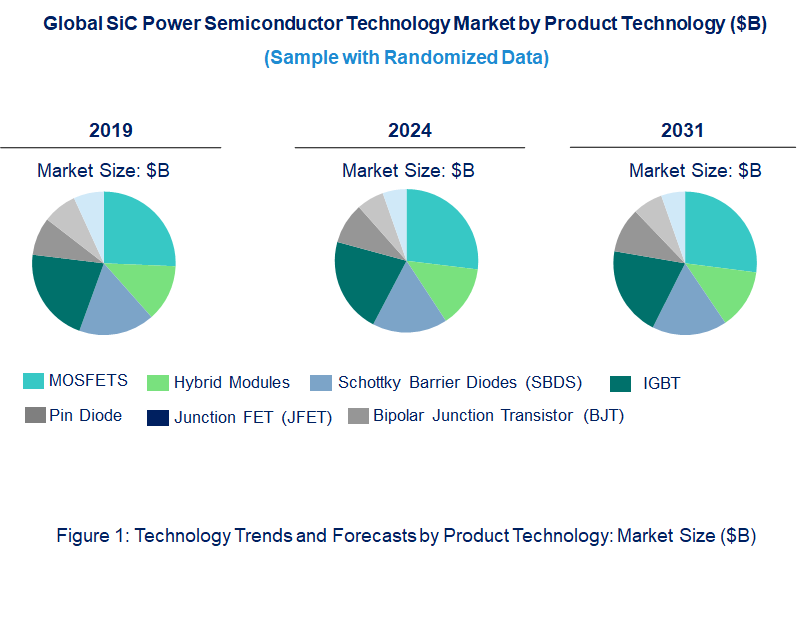
This market report covers trends, opportunities, and forecasts in the global sic power semiconductor technology market to 2031 by product technology (mosfets, hybrid modules, schottky barrier diodes (sbds), igbt, bipolar junction transistor (bjt), pin diode, and junction fet (jfet)), end use industry (automotive, utilities and energy, industrial, transportation, it and telecommunication, consumer electronics, aerospace and defense, commercial, and others), and region (North America, Europe, Asia Pacific, and the Rest of the World)
We'll send your sample report shortly.
![SiC Power Semiconductor Technology Market Trend and Forecast by End Use Industry [Value from 2019 to 2031]:](https://lucintel.com/images/SiC-Power-Semiconductor-Technology-Market-Segment.png "SiC Power Semiconductor Technology Market Trend and Forecast by End Use Industry [Value from 2019 to 2031]:")
• Moving away from Silicon-based MOSFETs to SiC MOSFETs: SiC MOSFETs are gaining popularity for their superior efficiency and thermal performance over traditional silicon MOSFET devices. These devices can handle higher voltages, temperatures, and frequencies, making them ideal for high-power industries such as electric vehicles and renewable energy systems.
• SiC-Based Diodes and SBDs Market Development: Silicon diodes are increasingly being replaced by SiC-based Schottky Barrier Diodes (SBDs) as users demand faster switching times and reduced power losses. SiC SBDs are essential in high-voltage, high-current applications, including motor drives, power inverters, and industrial equipment.
• SiC-Based IGBTs Adoption: SiC-based Insulated-Gate Bipolar Transistors (IGBTs) are now available as alternatives to traditional silicon-based IGBTs. These SiC IGBTs offer advantages such as increased switching frequencies, lower conduction losses, and efficient thermal management, making them suitable for power conversion in energy-efficient applications within renewable energy and electric transportation industries.
• SiC Hybrid Module Growth: Hybrid modules, which combine SiC MOSFETs, diodes, and other device components into one package, are gaining popularity. These modules increase power density, enhance thermal performance, and improve reliability. They are highly beneficial for use in electric vehicles, industrial automation, and renewable energy systems.
• Emergence of SiC BJTs for High-Power Applications: SiC Bipolar Junction Transistors (BJTs) are gradually replacing traditional silicon BJTs in high-power applications. SiC BJTs typically have lower power dissipation and superior thermal stability, making them highly suitable for power-dense and high-efficiency applications, especially in industrial motors and power electronics. The SiC Power Semiconductor Technology Market reflects a shift towards more effective, reliable, and high-performance power devices. Advancements in SiC MOSFETs, diodes, IGBTs, hybrid modules, and BJTs are enabling higher energy efficiency and better thermal management in critical applications. These innovations are transforming the power semiconductor landscape, especially in sectors like automotive, aerospace, energy, and industrial applications.

• Potential in Technology: High-power semiconductors based on SiC have tremendous potential for improving energy efficiency, increasing power density, and offering better thermal performance compared to traditional silicon-based devices. The properties of SiC make it an ideal candidate for high-power applications, such as electric vehicles, industrial motors, and renewable energy systems.
• Degree of Disruption: SiC technologies are currently disrupting traditional power semiconductor markets by displacing silicon-based solutions. With capabilities like faster switching, higher voltage tolerance, and improved thermal management, SiC is revolutionizing industries, particularly electric vehicles and renewable energy.
• Current Technology Maturity Level: SiC power semiconductor technology is becoming increasingly mature, with wide acceptance across most industries. However, there are still areas under development, such as SiC hybrid modules and high-frequency applications, which are being refined to meet growing market demands.
• Regulatory Compliance: SiC power semiconductors are environmentally friendly because they adhere to stringent sustainability standards, including lead-free materials and energy-efficient designs. This compliance is crucial for industries to meet the rising environmental and safety requirements worldwide.
• WOLFSPEED, INC.: WOLFSPEED remains a market leader in SiC power semiconductor technology. Recent developments in their SiC MOSFETs and diodes have enhanced their portfolio of high-performance, high-voltage products targeted at growing markets for electric vehicles and renewable energy applications to improve power conversion efficiency and reduce system size.
• STMicroelectronics: STMicroelectronics has made impressive advances with SiC-based devices. The company has released new series of MOSFETs and diodes with improved switching performance, energy efficiency, and thermal management. Its solutions are particularly tailored for automotive and industrial applications, providing solutions for power converters, motor drives, and EV charging infrastructure.
• ROHM CO., LTD.: ROHM has continued to enhance its portfolio of SiC-based components with the launch of high-efficiency power modules featuring SiC diodes and MOSFETs. Their work improves power density, reduces switching losses, and facilitates faster switching speeds, especially in industrial applications such as motor drives and inverters.
• Fuji Electric Co., Ltd.: Fuji Electric has continuously advanced the development of SiC-based power semiconductors for high-power applications. Their SiC modules demonstrate improved reliability and better thermal performance to meet energy-efficient needs from the automotive, renewable energy, and industrial sectors.
• Mitsubishi Electric: Mitsubishi Electric has developed a portfolio of SiC power devices, including MOSFETs and diodes, focusing on improving power efficiency while achieving significant reductions in energy consumption. Its products are ideal for use in EVs, power inverters, and industrial equipment that require high-performance power conversion.
• Texas Instruments: Texas Instruments has developed SiC-based power management ICs and modules to optimize power supplies in industrial and automotive applications. The company focuses on innovations that reduce system complexity, increase energy efficiency, and provide superior thermal performance for power electronics.
• Infineon Technologies: Infineon has further diversified its portfolio of SiC power devices with a particular emphasis on applications in the automotive, industrial, and renewable energy segments. The company offers SiC MOSFETs and diodes that promise increased power density, faster switching speeds, and reliability, among solutions for high-efficiency power conversion in electric vehicles and industrial automation.
• Semikron Danfoss: Semikron Danfoss has made significant progress in SiC-based power modules, which integrate MOSFETs, diodes, and other components in a way that enhances performance and reduces the overall system footprint. Their SiC solutions are applied in renewable energy applications, electric mobility, and industrial areas where high-power density and efficiency play a crucial role.
• Renesas Electronics: Under its product line of SiC power semiconductors, Renesas Electronics has added MOSFETs and power modules that support low-loss energy conversion in automotive and industrial applications. These products provide enhanced efficiency, high reliability, and improved thermal performance to support the development of next-generation power systems.
• Microchip Technology: Microchip has focused on developing SiC-based power devices, particularly for high-power applications such as motor drives, power supplies, and automotive systems. Their SiC MOSFETs and diodes provide improved switching characteristics and significantly higher efficiency with advanced thermal management, suited to the increased need for energy-efficient power electronics. These developments by leaders in the SiC power semiconductor technology market emphasize a shift toward high-efficiency, high-performance solutions that reduce energy consumption, enhance power density, and improve system reliability. As industries such as automotive, renewable energy, and industrial automation continue to require better power conversion technologies, SiC-based solutions will increasingly be needed to meet these demands.
• Increased Demand for Energy Efficiencies: Energy consumption is one of the aspects with which industries are concerned. The SiC devices are highly energy-efficient and offer a much better power density and thermal performance than their silicon-based counterparts. This increased demand for energy-efficient devices explains the enormous growth in Electric Vehicles, renewable energy, and industrial sectors.
• Electric Vehicles: With more people adopting electric vehicles, growth in the SiC Power Semiconductor Technology Market has increased. SiC devices are the key enablers for battery performance enhancements, power conversion systems, and fast-charging infrastructure, enabling the automotive sector to shift to electric power.
• Renewable Energy Expansion: The use of SiC technology in power electronics is the basis for efficient power conversion capability of renewable energy systems, such as solar and wind power, by withstanding higher voltages and frequencies. Demand continues to increase for SiC-based solutions in renewable energy applications, as governments and companies continue to focus on sustainability.
• Industrial Automation and Smart Grids: The advancement of smart grids and automation technologies are driving high-performance semiconductors. SiC devices prove to be excellent candidates for industrial automation with much faster switching speeds, power efficiency, and reliability, particularly in motor drives and inverters.
• Government Regulations and Sustainability Initiatives: Increasing environmental and energy efficiency standards have focused on forcing advanced technologies such as SiC in the automobile and industrial sectors. The recent government regulations are motivating the application of SiC semiconductors as they meet the sustainability criterion by having a higher efficiency level with fewer carbon footprints. Challenges
• High production cost: The manufacturing cost of SiC-based power devices is relatively higher than silicon-based alternatives. The advanced production process of SiC wafers, combined with the higher material cost, makes a stumbling block for widespread adoption, particularly for markets sensitive to cost.
• Technology and Application Maturity: While SiC technology has advanced, its adoption in certain high-power applications is still in the development phase. Technologies like SiC BJTs and JFETs are emerging but are not as mature as MOSFETs and IGBTs, limiting their market reach.
• SiC availability and supply chain: The huge demand for SiC and other forms of silicon carbide may eventually lead to a bottleneck in the supply chain. A short supply of high-quality raw materials for the preparation of SiC wafers may impact consistency and cost-effectiveness in manufacturing. The SiC Power Semiconductor Technology Market is being shaped by significant growth opportunities across sectors like electric vehicles, renewable energy, and industrial automation. Drivers include innovation and adoption of SiC-based solutions, as challenges in terms of high production costs and supply chain issues have to be addressed for sustainable market expansion.
• Wolfspeed, Inc.
• STMicroelectronics
• ROHM Co., Ltd.
• Fuji Electric Co., Ltd.
• Mitsubishi Electric
• Texas Instruments
• Technology Readiness: SiC MOSFETs have reached high technology readiness. They are now common in electric vehicles and renewable energy applications due to their efficiency and thermal management. Hybrid modules using MOSFETs along with diodes are getting ready for mass production as efficient, compact solutions. From a maturity point of view, SBDs are well-matured and widely used for fast-switching applications in high-power motor drives. SiC IGBTs are also maturing and are being used in renewable energy and electric vehicles. SiC BJTs are gaining market share but are less mature than MOSFETs and IGBTs. Pin Diodes, primarily used in RF applications, continue to advance into power electronics, while Junction FETs (JFETs) are emerging as promising candidates for high-speed switching in industrial applications. The maturity level of technologies varies, with SiC MOSFETs and IGBTs being the most mature and widely applied, followed by less mature technologies like SiC JFETs and Pin Diodes, which are still being developed for niche applications. All technologies must meet strict regulatory standards to ensure safe, efficient, and environmentally friendly performance in the automotive, aerospace, and renewable energy sectors.
• Competitive Intensity and Regulatory Compliance: Competition within the SIC power semiconductor technology market is intensifying due to the involvement of many players, such as WOLFSPEED, STMicroelectronics, and ROHM, who pursue innovation in MOSFETs, IGBTs, and hybrid modules. MOSFETs lead in terms of market share and adoption, but SiC IGBTs have become more popular due to their higher power efficiency and thermal performance. Environmental compliance plays a major role in the market, with companies adhering to lead-free material directives and energy efficiency standards. Each technology must also meet environmental regulations, particularly in the automotive and renewable energy markets, which emphasize sustainability and high-performance components. The level of competition is high, as companies race to improve thermal management, reduce energy losses, and increase switching speeds in their products. This has made meeting regulations an integral part of technological advancement.
• Disruption Potential: Various technologies are disrupting the SiC power semiconductor market. SiC MOSFETs lead the charge in faster switching and higher voltage tolerance, thus disrupting traditional silicon-based MOSFETs. Hybrid modules combine several components into a single unit and improve power density, as well as temperature management, with SiC SBDs providing efficiency while reducing switching losses. SiC IGBTs are increasingly used for high-power applications, achieving higher power density and switching frequencies than conventional IGBTs. BJTs are also being replaced by SiC BJTs for high-power applications due to improved thermal performance and energy efficiency. SiC Pin Diodes and Junction FETs (JFETs) are emerging as valuable alternatives, providing high-speed switching and high-power handling capabilities. Each of these technologies is disrupting industries within automotive, renewable energy, and industrial automation while offering specific advantages in particular applications.
• MOSFETS
• Hybrid Modules
• Schottky Barrier Diodes (SBDS)
• IGBT
• Bipolar Junction Transistor (BJT)
• Pin Diode
• Junction FET (JFET)
• Automotive
• Utilities and energy
• Industrial
• Transportation
• IT and telecommunication
• Consumer electronics
• Aerospace and defense
• Commercial
• Others
• North America
• Europe
• Asia Pacific
• The Rest of the World
• Latest Developments and Innovations in the SiC Power Semiconductor Technology Technologies
• Companies / Ecosystems
• Strategic Opportunities by Technology Type


Choose a license that fits your team. Instant PDF delivery.
Prices exclude taxes. Instant delivery. Custom licensing available on request.
Market Report · May 18, 2026
Market Report · May 18, 2026
Market Report · May 18, 2026
Trusted partner for strategic intelligence and business growth


Receive a complimentary market analysis tailored to your industry. Our analysts will identify key growth opportunities and competitive dynamics specific to your business.

Market size, growth rate, and key trend analysis for your specific sector.

Top competitor positioning and market share analysis.

Strategic recommendations backed by data-driven insights.
Get curated market intelligence and competitive moves straight to your inbox.
By subscribing, you agree to receive our monthly insights. Unsubscribe anytime.
Receive a complimentary market analysis tailored to your industry. Our analysts will identify key growth opportunities and competitive dynamics specific to your business.
Market size, growth rate, and key trend analysis for your specific sector.
Top competitor positioning and market share analysis.
Strategic recommendations backed by data-driven insights.
Get curated market intelligence, emerging trends, and competitive moves straight to your inbox each month.
By subscribing, you agree to receive our monthly insights. Unsubscribe anytime.
We'll send your sample report shortly.