
Market Report · July 29, 2026

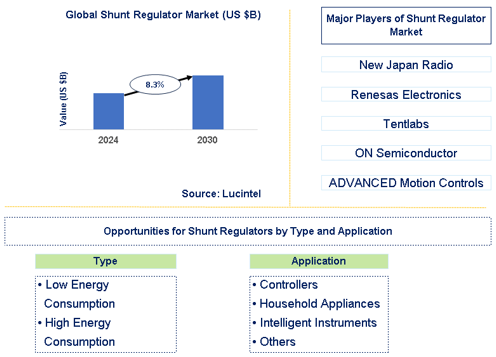
Key data points: The growth forecast = 8.3% annually for the next 6 years. Scroll below to get more insights. This market report covers trends, opportunities, and forecasts in the global shunt regulator market to 2030 by type (low energy consumption and high energy consumption), application (controllers, household appliances, intelligent instruments, and others), and region (North America, Europe, Asia Pacific, and the Rest of the World)
We'll send your sample report shortly.
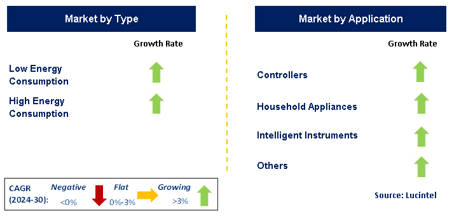
• Lucintel forecasts that, within the type category, low energy consumption is expected to witness higher growth over the forecast period.
• In terms of regions, APAC is expected to witness the highest growth over the forecast period. Gain valuable insights for your business decisions with our comprehensive 150+ page report
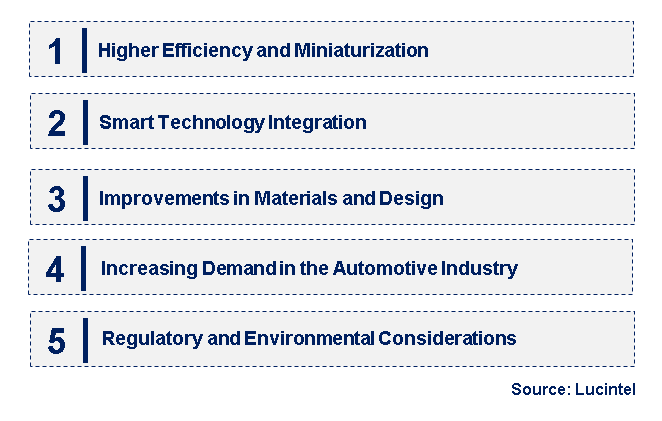
• Higher Efficiency and Miniaturization: The demand for small and low-power-consuming components in consumer electronics and industrial applications drives the development of shunt regulators toward miniaturization. This miniaturization enables finer control, allowing the installation of functions in smaller devices.
• Smart Technology Integration: There is an increasing integration of shunt regulators with smart technology in IoT devices and smart grids. This provides greater capability for real-time monitoring and control over voltage regulation, further improving system performance.
• Improvements in Materials and Design: Advanced materials and design enhancements are improving performance and making shunt regulators more durable. Innovations target thermal management, reliability, and resistance to environmental elements, extending the useful life and efficiency of regulators.
• Increasing Demand in the Automotive Industry: The growing electronic content used in vehicles, driven by the demand for more complex functionalities, is increasing the need for advanced shunt regulators. The push for more electric and autonomous vehicles will further boost demand for these products, which provide constant voltage for various automotive systems.
• Regulatory and Environmental Considerations: Greater emphasis is now placed on designing and manufacturing shunt regulators in anticipation of more stringent regulatory standards and environmental concerns. Manufacturers are focused on offering products that meet these standards while minimizing environmental impact through sustainable practices. In conclusion, trends include increased efficiency and miniaturization, integration with smart technology, improvements in materials and design, demand from the automotive market, and regulatory concerns. Such trends drive innovation, enhance performance, and expand the application base of shunt regulators across various industries.
• More Efficiency and Performance: Recently, development has focused on improving the efficiency and performance of these regulators. Advances in thermal management and low power dissipation enhance the reliability and functionality of components in various fields.
• Advanced Electronics Integration: Shunt regulators are finding applications in advanced electronic integrations. This development addresses the growing complexity in consumer electronics and industrial equipment, providing precision in voltage regulation for better system performance.
• Improved Manufacturing Processes: With improved manufacturing processes, shunt regulators are produced with higher quality at lower costs. Techniques such as precision machining and advanced assembly methods enhance the reliability and performance of the components.
• Expansion of Shunt Regulators into Automotive Applications: The automotive sector represents the largest growth area for shunt regulators. New designs address the growing demand for high-performance regulators in electric vehicles and ADAS systems, where stability and efficiency are crucial for automotive electronics.
• Focus on Environmental Sustainability: Manufacturers of shunt regulators are increasingly focusing on environmental sustainability. Producers are adopting more eco-friendly materials and processes to minimize environmental effects while complying with regulatory standards. Better efficiency, integration with advanced electronics, improved manufacturing processes, adoption in automotive sectors, and sustainability concerns are key changes and innovations marking recent trends in the shunt regulator market. These trends encourage innovation to meet the changing requirements of diversified industries.
• Automotive Electronics: The increasing electronic content in automotive electronics, electric vehicles, and autonomous vehicles continues to create significant opportunities for shunt regulators. Developing high-performance regulators targeted at automotive applications will be key to capturing a share of this expanding market.
• Consumer Electronics: The growing demand for compact and efficient component designs in consumer electronics opens new avenues for advanced shunt regulators. Innovations aimed at improving performance and integration in smartphones, tablets, and other devices are in high demand.
• Industrial Automation: The rapid development of industrial automation and smart manufacturing creates a substantial demand for shunt regulators. Developing regulators that provide high-performance, accurate voltage control in industrial systems holds immense promise for opportunities.
• Renewable Energy Systems: Shunt regulators are vital in renewable energy systems, such as solar power and wind turbines. Development efforts should focus on increasing the efficiency and reliability of these systems to address significant market needs.
• IoT and Smart Grids: The growth of the Internet of Things and smart grid technologies offers new avenues for utilizing shunt regulators. Integrating regulators into smart devices and grid systems can enhance voltage regulation and overall system performance. In conclusion, strategic growth opportunities will drive demand for shunt regulators in automotive electronics, consumer electronics, industrial automation, renewable energy systems, IoT, and smart grids. Identifying these opportunities will foster innovation and market growth to meet the demands of new applications and industries.
• Technological Advances: Innovations in shunt regulator technologies, such as advanced materials and innovative designs, are propelling the market forward. These advancements improve performance, efficiency, and integration capabilities to meet the needs of modern electronic systems.
• Electronics Growth: The rising demand for consumer electronics, automotive systems, and industrial automation drives the demand for advanced shunt regulators. This growth fuels technological innovations and market expansion.
• Automotive Sector Expansion: The automotive industry's shift toward electric and autonomous vehicles creates opportunities for shunt regulators to ensure voltage stability within increasingly complex automotive systems. Challenges in the shunt regulator market include:
• High Production Costs: Manufacturing sophisticated shunt regulators can be costly, affecting profitability. Companies must find ways to reduce production costs without compromising quality and performance.
• Complex Integration: Integrating shunt regulators into existing electronic systems can be challenging. Ensuring compatibility and seamless integration requires technical expertise and careful design considerations.
• Regulatory Compliance: Complying with regulations regarding environmental impact, safety, and other standards involves significant costs for manufacturers. Compliance is essential for market entry and expansion. The main factors driving growth in the shunt regulator market include technological advancements, increasing demand for electronics, expansion of the automotive sector, investments in research and development, and a focus on sustainability. Challenges include high manufacturing costs, complexities in integration, and regulatory compliance, all of which must be addressed to achieve sustainable market growth.
• New Japan Radio
• Renesas Electronics
• Tentlabs
• ON Semiconductor
• ADVANCED Motion Controls
• Diodes
• NXP Semiconductors
• Nexperia
• Maxim
• NTE Electronics
• Low Energy Consumption
• High Energy Consumption
• Controllers
• Household Appliances
• Intelligent Instruments
• Others
• North America
• Europe
• Asia Pacific
• The Rest of the World
• United States: Researchers in the U.S. are striving to make shunt regulators more efficient and compatible with smart devices. New designs are providing better performance in voltage regulation for consumer and industrial electronics. The trend toward miniaturization is increasing demand for compact, high-performance shunt regulators, supported by substantial investments in research and development.
• China: Shunt regulator production is rising in China, driven by a growing electronics market and government incentives for technology development. Emphasis is placed on cost-effective solutions for applications ranging from automotive electronics to renewable energy systems. Additionally, production processes are improving to ensure higher efficiency and output.
• Germany: The German shunt regulator market focuses on high-quality engineering and automotive technologies. Research is underway on high-precision regulators used in automotive and industrial systems. Advancements in materials and techniques for enhanced reliability and performance support the growth of the shunt regulator market.
• India: The expansion of the electronics sector and growth in local manufacturing are driving the development of the shunt regulator market in India. Manufacturers are focusing on producing low-cost and efficient shunt regulators to address a range of applications in telecommunications and consumer electronics. Government initiatives and foreign investments are fostering technological advancement and production capabilities.
• Japan: Japan continues to lead in advanced electronics and high-tech manufacturing, reflected in its shunt regulator market. The focus is on integrating high-performance shunt regulators into complex electronic systems, enhancing their capabilities for higher frequency applications. Japanese companies are also exploring new techniques to improve the efficiency and durability of regulators through innovative research in materials and designs.


• New Japan Radio
• Renesas Electronics
• Tentlabs
• ON Semiconductor
• ADVANCED Motion Controls
• Diodes
• NXP Semiconductors
• Nexperia
• Maxim
• NTE Electronics Q5. Which shunt regulator market segment will be the largest in future? Answer: Lucintel forecasts that low energy consumption is expected to witness a higher growth over the forecast period. Q6. In shunt regulator market, which region is expected to be the largest in next 5 years? Answer: APAC is expected to witness the highest growth over the forecast period. Q.7 Do we receive customization in this report? Answer: Yes, Lucintel provides 10% customization without any additional cost.


Choose a license that fits your team. Instant PDF delivery.
Prices exclude taxes. Instant delivery. Custom licensing available on request.
Market Report · July 29, 2026
Market Report · July 20, 2026
Market Report · July 20, 2026
Trusted partner for strategic intelligence and business growth


Receive a complimentary market analysis tailored to your industry. Our analysts will identify key growth opportunities and competitive dynamics specific to your business.

Market size, growth rate, and key trend analysis for your specific sector.

Top competitor positioning and market share analysis.

Strategic recommendations backed by data-driven insights.
Get curated market intelligence and competitive moves straight to your inbox.
By subscribing, you agree to receive our monthly insights. Unsubscribe anytime.
Receive a complimentary market analysis tailored to your industry. Our analysts will identify key growth opportunities and competitive dynamics specific to your business.
Market size, growth rate, and key trend analysis for your specific sector.
Top competitor positioning and market share analysis.
Strategic recommendations backed by data-driven insights.
Get curated market intelligence, emerging trends, and competitive moves straight to your inbox each month.
By subscribing, you agree to receive our monthly insights. Unsubscribe anytime.
We'll send your sample report shortly.