
Market Report · July 31, 2026

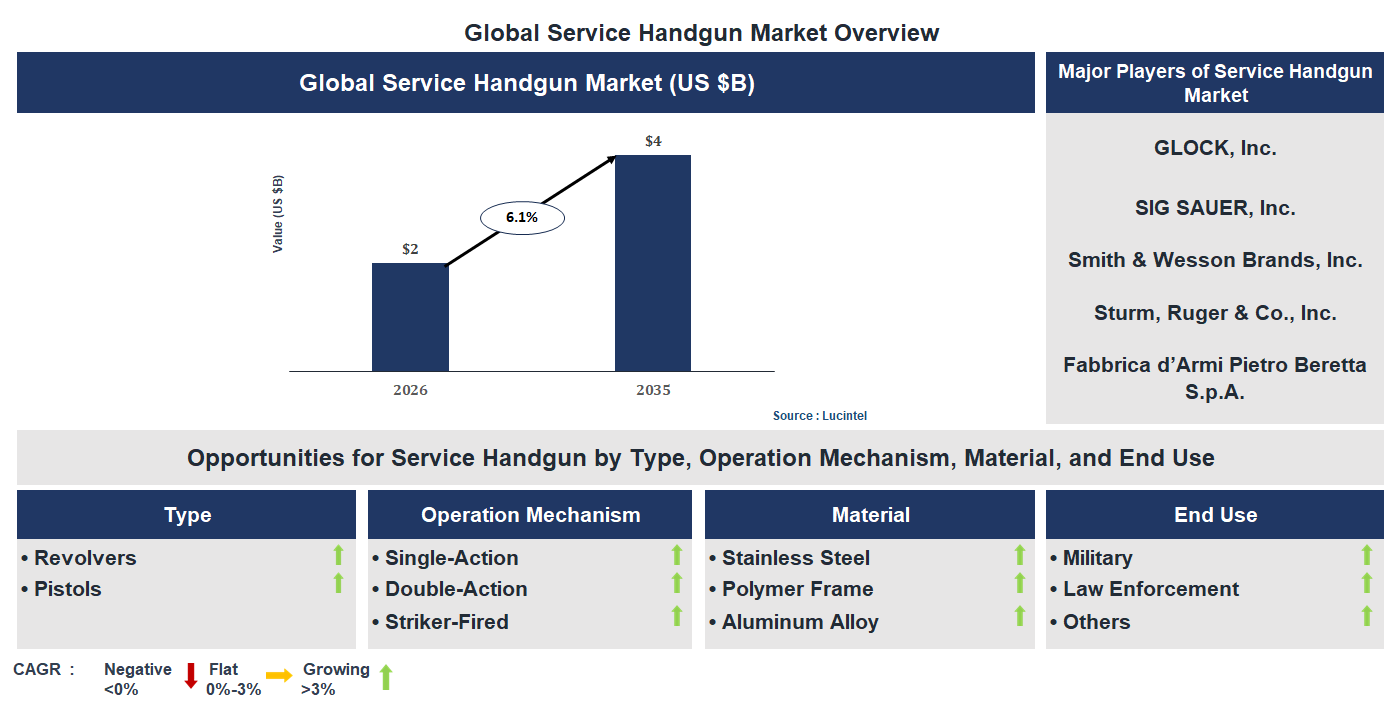
Key data points: The market size in 2035 = $4 billion, growth forecast = 6.1% annually for the next 8 years. Scroll below to get more insights. This market report covers trends, opportunities and forecasts in service handgun market to 2035 by type (revolvers and pistols), operation mechanism (single-action, double-action, and striker-fired), material (stainless steel, polymer frame, and aluminum alloy), end use (military, law enforcement, and others), and region (North America, Europe, Asia Pacific, and the Rest of the World)
We'll send your sample report shortly.
• Lucintel forecasts that, within the type category, pistol is expected to witness higher growth over the forecast period.
• Within the end use category, law enforcement is expected to witness higher growth.
• In terms of region, North America is expected to witness the highest growth over the forecast period. Gain valuable insights for your business decisions with our comprehensive 150+ page report. Sample figures with some insights are shown below.
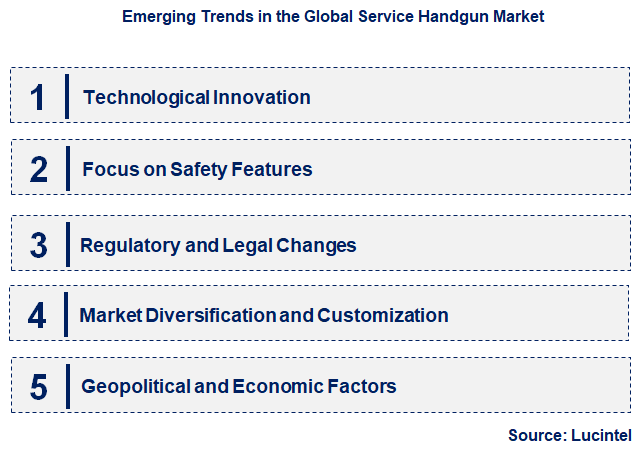
• Technological Innovation: The integration of smart technology and advanced materials is revolutionizing service handguns. Manufacturers are incorporating features such as biometric safeties, digital targeting systems, and lightweight composites to enhance performance, safety, and user experience. These innovations improve accuracy, reduce accidental discharges, and enable better data collection for maintenance and training purposes. As technology becomes more affordable, adoption is expected to increase across law enforcement and security agencies, leading to more efficient and safer firearm use.
• Focus on Safety Features: Safety remains a primary concern in the service handgun market. Manufacturers are developing new safety mechanisms such as trigger safeties, grip sensors, and manual safeties to prevent unauthorized use and accidental discharges. These features are increasingly mandated by regulatory bodies and customer demand for safer firearms. Enhanced safety features not only reduce liability for manufacturers but also build trust among users, especially in environments with high personnel turnover or in civilian security applications.
• Regulatory and Legal Changes: Evolving laws and regulations significantly impact the service handgun market. Stricter licensing requirements, bans on certain calibers, and restrictions on magazine capacities influence product offerings. Manufacturers are adapting by developing compliant models and exploring alternative ammunition types. These regulatory shifts can create barriers to entry but also open opportunities for innovation in design and functionality to meet new legal standards, ultimately shaping the market landscape and influencing procurement decisions.
• Market Diversification and Customization: The market is witnessing increased demand for customized and specialized service handguns tailored to specific operational needs. Agencies seek firearms with modular components, personalized grips, and adjustable sights. This trend allows for better ergonomics, improved accuracy, and user comfort. Manufacturers are offering more options for customization, which enhances user satisfaction and operational efficiency. This diversification also enables companies to target niche markets, expanding their customer base and fostering innovation in firearm design.
• Geopolitical and Economic Factors: Global political tensions and economic fluctuations influence the service handgun market. Increased security threats and military conflicts drive demand from defense and law enforcement agencies. Economic instability can impact procurement budgets, leading to a focus on cost-effective solutions and durable, long-lasting firearms. Additionally, international trade policies and tariffs affect supply chains and pricing strategies. These factors compel manufacturers to adapt their production and distribution strategies, ensuring market resilience amid geopolitical uncertainties. These emerging trends are reshaping the service handgun market by fostering innovation, enhancing safety, navigating regulatory landscapes, offering tailored solutions, and responding to geopolitical influences. Collectively, they are driving a more technologically advanced, safer, and adaptable market that better meets the evolving needs of security and law enforcement agencies worldwide.
• Technological Innovation in Firearm Design: Advancements in materials and smart technology are leading to more durable, lightweight, and customizable handguns. Features like integrated biometric security and modular components improve user safety and operational efficiency. These innovations are attracting law enforcement and civilian buyers seeking reliable, high-tech solutions, thereby expanding market share and encouraging further R&D investments.
• Regulatory Changes and Compliance: Governments worldwide are updating firearm regulations to enhance safety and control. Stricter licensing, background checks, and import-export policies influence market supply and demand. Manufacturers are adapting by developing compliant models, which opens new markets and ensures legal operation. These regulatory shifts also foster innovation in safety features, boosting consumer confidence and market growth.
• Growing Demand from Law Enforcement Agencies: Increased security concerns and anti-terrorism measures are driving demand for service handguns among police and military forces. Agencies seek reliable, easy-to-maintain firearms with advanced features. This demand sustains steady growth in procurement budgets and encourages manufacturers to develop specialized models, ultimately expanding the market and fostering innovation tailored to law enforcement needs.
• Rise of Civilian Self-Defense Market: A surge in personal safety awareness and legal access to firearms has expanded the civilian market segment. Consumers are seeking dependable, easy-to-use handguns for self-defense, prompting manufacturers to offer diverse models with enhanced safety features. This trend boosts overall market volume, encourages product diversification, and stimulates competition, leading to technological improvements and increased consumer confidence.
• Impact of Global Supply Chain Dynamics: Supply chain disruptions and geopolitical factors influence firearm manufacturing and distribution. Manufacturers are exploring local sourcing and inventory strategies to mitigate risks. These dynamics affect pricing, availability, and innovation timelines, ultimately shaping market stability. As supply chains stabilize, the market is expected to see increased product availability and competitive pricing, fostering growth and technological progress. Overall, these developments are significantly impacting the service handgun market by fostering innovation, expanding customer bases, and prompting regulatory adaptations. The market is becoming more dynamic, with increased opportunities for technological advancements and strategic growth. Stakeholders who adapt to these trends will be better positioned to capitalize on emerging opportunities and sustain long-term success.
• Expansion of Law Enforcement and Military Procurement: Growing global security threats and increased government budgets are boosting demand for service handguns by law enforcement agencies and military forces. Modernization initiatives and procurement of advanced firearms enhance operational efficiency and safety. This trend is expected to continue as countries prioritize national security, leading to sustained growth opportunities for manufacturers offering reliable, compliant, and innovative handgun solutions tailored to official use.
• Rising Demand for Personal and Home Defense: Increasing awareness of personal safety and crime rates are driving consumers to seek reliable service handguns for home protection. The market benefits from product innovations such as compact, lightweight, and easy-to-use firearms. Additionally, legal regulations and insurance incentives encourage firearm ownership. This segment is expanding rapidly, with manufacturers focusing on user-friendly designs and safety features to meet the needs of individual consumers and security providers.
• Technological Innovations Enhancing Firearm Safety and Performance: Advancements in firearm technology, including smart guns with biometric access, improved materials, and enhanced accuracy, are transforming the service handgun market. These innovations address safety concerns and operational efficiency, appealing to law enforcement and civilian users alike. Investment in R&D is fostering the development of smarter, more durable, and customizable handguns, which are expected to drive market growth and meet evolving user expectations.
• Regulatory Changes and Standardization Creating Market Opportunities: Evolving firearm regulations and standards across regions influence market dynamics by shaping product design, safety features, and compliance requirements. Manufacturers that adapt quickly to new legal frameworks can access broader markets and avoid restrictions. Standardization efforts also facilitate international trade and procurement processes, opening avenues for growth through compliance with safety and quality standards, and fostering trust among consumers and government agencies.
• Growth of Private Security and Commercial Use Sectors: The expanding private security industry and commercial sectors such as security firms, armored transport, and event security are increasing demand for service handguns. These sectors require reliable, high-capacity, and easy-to-maintain firearms to ensure safety and operational efficiency. As security concerns rise globally, investments in professional-grade firearms are expected to grow, creating sustained opportunities for manufacturers to develop specialized products tailored to commercial and private security needs. These growth opportunities are poised to significantly influence the service handgun market by expanding its scope across government, civilian, and commercial sectors. Technological advancements, regulatory adaptations, and increasing security concerns collectively drive innovation and demand. Stakeholders who strategically leverage these opportunities can enhance market share, improve product offerings, and meet the evolving needs of diverse user groups, ensuring sustained growth in this dynamic industry.
• Technological Innovation: The development of advanced materials, ergonomic designs, and smart firearm features enhances user safety, accuracy, and ease of use. Innovations like modular components and integrated safety systems attract law enforcement and security agencies, boosting market demand. Continuous R&D efforts lead to improved durability and performance, making service handguns more reliable and appealing. As technology evolves, manufacturers gain a competitive edge, encouraging widespread adoption across various sectors.
• Increasing Security Concerns: Rising crime rates, terrorism threats, and geopolitical tensions drive governments and private organizations to invest heavily in security infrastructure. Service handguns are vital for law enforcement, military, and private security personnel, ensuring rapid response and effective threat management. This heightened focus on safety and preparedness sustains steady demand, especially in regions experiencing instability or increased criminal activity, thereby fueling market growth.
• Regulatory Environment: Stringent firearm laws, licensing requirements, and import-export restrictions influence market accessibility and product development. Governments implement policies to control firearm proliferation, impacting manufacturing and distribution channels. While regulations can pose barriers, they also create opportunities for compliant, innovative products that meet safety standards. Navigating these policies is crucial for market players aiming to expand their reach and ensure legal compliance.
• Economic Growth and Defense Spending: Robust economic conditions and increased defense budgets directly impact the market by enabling procurement of service handguns for military and law enforcement agencies. Countries investing in modernization programs tend to upgrade their firearm inventories, creating sustained demand. Conversely, economic downturns can restrict budgets, slowing market growth. Overall, economic stability and strategic defense investments are key drivers shaping the market landscape.
• Market Expansion and Product Diversification: Manufacturers are exploring new markets and diversifying product portfolios to meet diverse customer needs. Entry into emerging markets, customization options, and integration of new technologies broaden market reach. This expansion is supported by strategic partnerships and acquisitions, fostering innovation and competitive advantage. As a result, the market experiences growth through increased adoption across various sectors and geographies. The challenges facing the service handgun market include:-
• Regulatory Restrictions: Strict firearm laws and licensing procedures can hinder market growth by limiting access and increasing compliance costs. Variations across regions create complexities for manufacturers and distributors, often delaying product launches and reducing market penetration. Additionally, evolving regulations require continuous adaptation, which can be resource-intensive and impact profitability.
• Public Perception and Safety Concerns: Negative perceptions regarding firearm safety and misuse can lead to stricter regulations and reduced demand. Incidents of firearm accidents or misuse by unauthorized users influence public opinion, prompting calls for tighter controls. This societal concern can restrict market expansion and necessitate investments in safety features and training programs, increasing costs for manufacturers.
• Economic Uncertainty: Fluctuations in economic conditions, such as recessions or budget cuts, can reduce government and private sector spending on security equipment, including service handguns. Economic instability affects procurement cycles and can lead to delays or cancellations of orders. This unpredictability hampers long-term planning and investment, posing significant risks to market stability and growth prospects. The service handgun market is shaped by rapid technological advancements, increasing security needs, and evolving regulatory landscapes. While economic growth and market diversification offer substantial opportunities, challenges such as regulatory restrictions, safety concerns, and economic uncertainties pose significant hurdles. These factors collectively influence market dynamics, requiring stakeholders to adapt strategically. Overall, the markets future depends on balancing innovation and compliance while addressing societal concerns and economic fluctuations to sustain growth and ensure safety.
• GLOCK, Inc.
• SIG SAUER, Inc.
• Smith & Wesson Brands, Inc.
• Sturm, Ruger & Co., Inc.
• Fabbrica d’Armi Pietro Beretta S.p.A.
• Heckler & Koch GmbH
• FN Browning Group
• Colt’s Manufacturing Company LLC
• Springfield, Inc.
• Caracal International
• Revolvers
• Pistols
• Single-Action
• Double-Action
• Striker-Fired
• Stainless Steel
• Polymer Frame
• Aluminum Alloy
• Military
• Law Enforcement
• Others
• North America
• Europe
• Asia Pacific
• The Rest of the World
• United States: The US market has seen a surge in demand for advanced service handguns with integrated smart technology, such as biometric safeties and modular designs. Law enforcement agencies are prioritizing reliability and customization, leading to increased adoption of locally manufactured firearms. Regulatory discussions around firearm safety and restrictions continue to influence market dynamics, prompting manufacturers to innovate with safer, more compliant models. Additionally, private security firms are expanding their firearm inventories, emphasizing durability and ease of use. Overall, the US remains a leading market for technological innovation and high-end service handgun offerings.
• China: China’s service handgun market is rapidly expanding, driven by government procurement and modernization efforts within its security forces. The focus is on domestically produced firearms that meet strict quality standards and are tailored to local operational needs. Recent developments include the integration of lightweight materials and improved ergonomics to enhance user comfort and performance. The Chinese government is also investing in research to develop more sophisticated, reliable firearms that can compete internationally. The market is characterized by a shift toward more compact, versatile models suitable for various security applications, reflecting China’s strategic emphasis on self-reliance and technological advancement.
• Germany: Germany’s market emphasizes precision engineering, safety, and compliance with stringent European Union regulations. Recent developments include the adoption of innovative materials that improve firearm durability and reduce weight, alongside enhanced safety features such as improved trigger mechanisms and safety locks. German manufacturers are also focusing on modular designs that allow customization for different security needs. The market is witnessing increased demand from police and military units for reliable, high-performance service handguns that meet both safety standards and operational efficiency. Germany continues to lead in integrating advanced manufacturing techniques to produce high-quality, durable firearms.
• India: The Indian service handgun market is experiencing rapid growth due to increased defense spending and modernization initiatives. Recent developments include the introduction of domestically manufactured firearms that meet international standards, reducing reliance on imports. The focus is on developing lightweight, ergonomic models suitable for diverse operational environments. Indian manufacturers are also investing in R&D to incorporate advanced safety features and improve firearm reliability. The government’s push for self-reliance under the Make in India initiative is fostering innovation and expanding the domestic supply chain. The market is poised for significant growth as security agencies upgrade their arsenals with modern, indigenous service handguns.
• Japan: Japan’s market is characterized by a focus on safety, precision, and technological innovation. Recent developments include the integration of advanced materials and manufacturing techniques to produce lightweight, highly durable firearms. Japanese manufacturers are emphasizing safety features such as enhanced trigger safety and user authentication systems. The market is also seeing increased interest in compact, easily concealable service handguns for law enforcement and security personnel. Regulatory standards remain strict, encouraging continuous innovation to meet safety and performance criteria. Japan’s commitment to quality and technological excellence continues to drive the development of sophisticated, reliable service handguns tailored to domestic and regional needs.


• GLOCK, Inc.
• SIG SAUER, Inc.
• Smith & Wesson Brands, Inc.
• Sturm, Ruger & Co., Inc.
• Fabbrica d’Armi Pietro Beretta S.p.A.
• Heckler & Koch GmbH
• FN Browning Group
• Colt’s Manufacturing Company LLC
• Springfield, Inc.
• Caracal International Q6. Which service handgun market segment will be the largest in future? Answer: Lucintel forecasts that, within the type category, pistol is expected to witness higher growth over the forecast period. Q7. In service handgun market, which region is expected to be the largest in next 8 years? Answer: In terms of region, North America is expected to witness the highest growth over the forecast period. Q8. Do we receive customization in this report? Answer: Yes, Lucintel provides 10% customization without any additional cost.


Choose a license that fits your team. Instant PDF delivery.
Prices exclude taxes. Instant delivery. Custom licensing available on request.
Market Report · July 31, 2026
Market Report · July 31, 2026
Market Report · July 31, 2026
Trusted partner for strategic intelligence and business growth


Receive a complimentary market analysis tailored to your industry. Our analysts will identify key growth opportunities and competitive dynamics specific to your business.

Market size, growth rate, and key trend analysis for your specific sector.

Top competitor positioning and market share analysis.

Strategic recommendations backed by data-driven insights.
Get curated market intelligence and competitive moves straight to your inbox.
By subscribing, you agree to receive our monthly insights. Unsubscribe anytime.
Receive a complimentary market analysis tailored to your industry. Our analysts will identify key growth opportunities and competitive dynamics specific to your business.
Market size, growth rate, and key trend analysis for your specific sector.
Top competitor positioning and market share analysis.
Strategic recommendations backed by data-driven insights.
Get curated market intelligence, emerging trends, and competitive moves straight to your inbox each month.
By subscribing, you agree to receive our monthly insights. Unsubscribe anytime.
We'll send your sample report shortly.