
Market Report · July 15, 2026

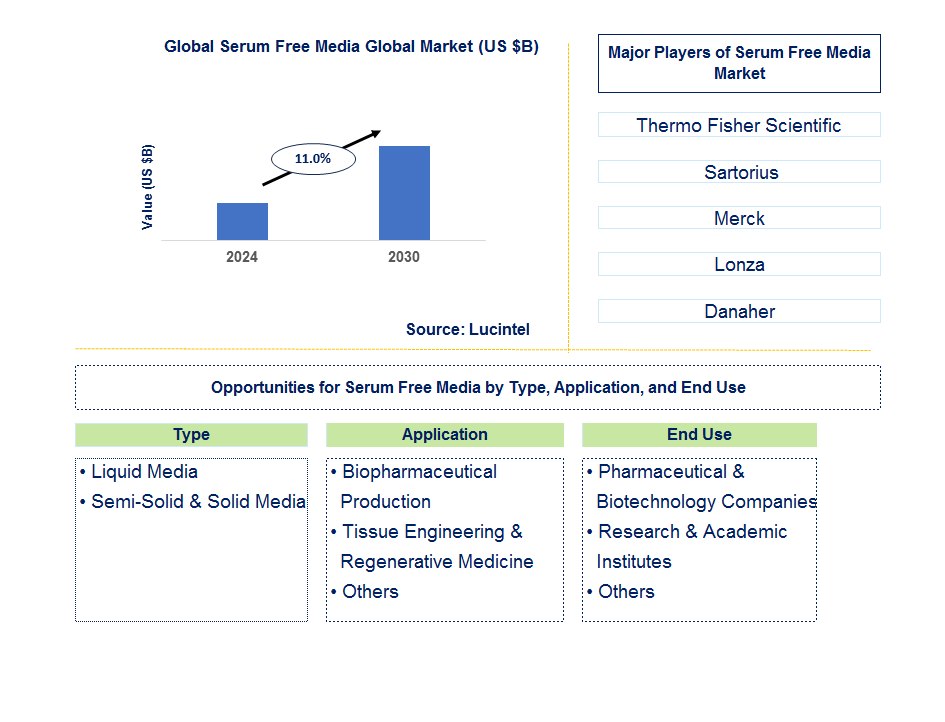
Key data points: The growth forecast = 11.0% annually for the next 6 years. Scroll below to get more insights. This market report covers trends, opportunities, and forecasts in the global serum free media market to 2030 by type (liquid media and semi-solid & solid media), application (biopharmaceutical production, tissue engineering & regenerative medicine, and others), end use (pharmaceutical & biotechnology companies, research & academic institutes, and others), and region (North America, Europe, Asia Pacific, and the Rest of the World)
We'll send your sample report shortly.
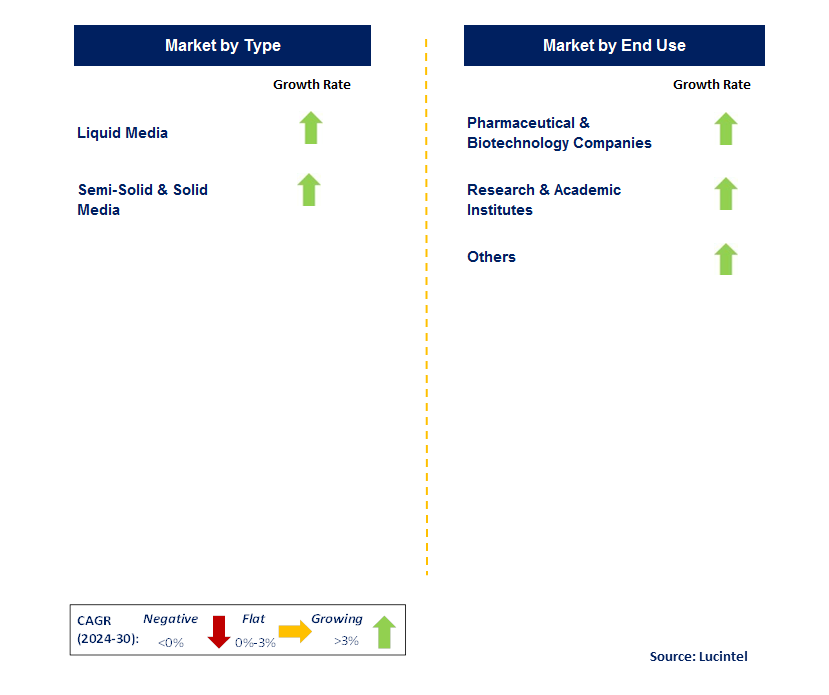
• Lucintel forecasts that, within the type category, liquid media will remain a larger segment over the forecast period due to the increasing number of biosimilar and biologics manufacturers combined with the growing desire for liquid media over pre-mixed powders.
• Within the end use category, biopharmaceutical & pharmaceutical company will remain the largest segment due to the introduction of novel therapies along with generics or biosimilar.
• In terms of regions, North America will remain the largest region over the forecast period due to the existence of a strong R&D infrastructure and a supportive regulatory environment in the region. Gain valuable insights for your business decisions with our comprehensive 150+ page report.
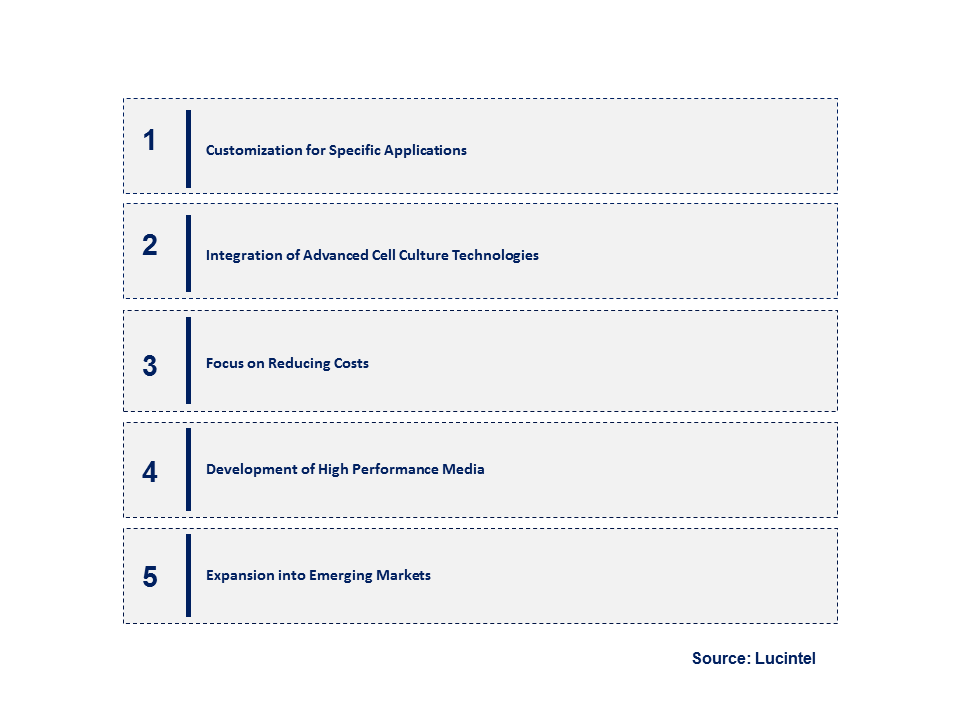
• Customization for Specific Applications: There is an increasing tendency to develop custom-made serum-free media formulations that can cater to specific types of cells used in different applications. This trend is driven by a need for more precise control over cellular culture conditions as well as better performance within specialized fields like regenerative medicine and the production of biopharmaceuticals.
• Integration of Advanced Cell Culture Technologies: The use of 3D culture systems, bioreactors, and other technological developments in cell cultures has impacted how serum-free media are produced today. Consequently, there is a need to design specialized media formulas that support complex interactions between cells, thereby raising their productivity and creating more advanced and efficacious serum-free media than before.
• Focus on Reducing Costs: The demand for serum-free media is growing, and there is a strong focus on cost reduction while maintaining high quality. This requires innovations in the manufacturing process and raw material sourcing to make serum-free media more affordable and accessible, especially at large scales for emerging markets.
• Development of High-Performance Media: Companies are investing in R&D to create high-performance serum-free media that offer superior cell growth and productivity. This trend is driven by the need for enhanced media formulations that support advanced cell culture processes and contribute to the success of biopharmaceutical and research applications.
• Expansion into Emerging Markets: Serum-free media producers are expanding their presence in emerging markets where demand for advanced cell culture solutions is growing. This includes establishing local manufacturing facilities as well as distribution networks to cater to the increasing needs of biopharmaceuticals and research industries within these geographical boundaries. Customization for specific applications, integration of advanced cell culture technologies, focus on cost reduction, development of high-performance media, and expansion into emerging markets are changing the structure of the serum-free market. These trends fuel innovation, enable improved media performance, and increase market awareness.
• Enhanced Formulations: Notably, new developments involve enhanced serum-free media formulations with better growth factors and nutrients. Such strides aim to improve yields during biopharmaceutical production, thereby supporting good cultivation conditions that are much more efficient than before.
• Increased Production Capabilities: Companies are scaling up their production capabilities due to rising demands for serum-free media; such efforts range from improving manufacturing structures through acquisition or leasing while addressing quality issues prevailing at current levels.
• Emergence of New Applications: There have also been new applications for serum-free media, such as gene therapy and cell therapy. These innovative media formulations are specifically designed to meet the demands of these advanced therapies, thus contributing to their success and increasing the potential market size.
• Improved Cost Efficiency: The drive towards cost-effective serum-free media continues with a focus on raw material utilization and optimized manufacturing processes. Such changes aim to make serum-free media more affordable and therefore accessible for a broader range of applications, including large-scale production.
• Increased Focus on Sustainability: Another emerging trend in this market is an increased focus on sustainability in the production of environmentally friendly serum-free media options. This implies that companies are concerned about the environmental impacts related to media production, as they employ sustainable raw materials and eco-friendly fabrication methods. Growth in this field is being driven by improved formulas, higher production capacities, new applications, cost optimization, and environmental consciousness. These developments shape its future trajectory and expand its application profile in various scenarios across different fields.
• Expansion into Biopharmaceutical Production: There is a significant opportunity for serum-free media in biopharmaceuticals due to high demand. To take advantage of this development, companies must create specialized media for biopharmaceutical producers that will boost yields, enabling their transition toward an advanced therapy-based approach while aiding productivity rates.
• Advancements in Regenerative Medicine: In regenerative medicine and cell therapy, serum-free media play an important role. Companies can find their space in this rapidly growing field by focusing on media formulations that support complex cell culture processes and improve outcomes in regenerative treatments.
• Emergence of New Cell Culture Technologies: The development of new cell culture technologies, like 3D culture systems, allows for innovation and the creation of specialized formulations for serum-free media providers. These unique technologies require advanced media solutions to support them and enhance their effectiveness.
• Growth in Emerging Markets: There is a strategic opportunity to move into emerging markets where demand for serum-free media is increasing. To capture new market share and drive growth, companies should establish a presence in these regions and develop locally relevant media solutions.
• Focus on Sustainable Solutions: Developing sustainable and environmentally friendly serum-free media solutions aligns with global trends towards sustainability. Therefore, companies that prioritize sustainability by incorporating it into their media formulations and production processes can differentiate themselves from others while appealing to customers who are concerned about the environment. Expansion into biopharmaceutical production, advancements in regenerative medicine, emergence of new cell culture technologies, growth in emerging markets, and a focus on sustainable solutions are strategic growth opportunities in the serum-free media market, leading to market expansion and innovation resulting in overall industry growth.
• Increased Biopharmaceutical Production: With the growing biopharmaceutical industry comes a demand for serum-free media because it is essential for producing high-quality cell cultures and supporting advanced therapies. Additionally, there is increased use of personalized medicine and gene therapies, raising this demand further.
• Technological Advancements: Innovations related to cell culture technologies and media formulations improve the performance and efficiency of serum-free media. Furthermore, advances in biotechnology and research support the development of new and better media solutions.
• Regulatory Support for Cell Therapies: Serum-free media providers are offered opportunities through regulatory frameworks that support the development and commercialization of cell and gene therapies. Therefore, adherence to regulatory standards creates a platform for innovation and market growth.
• Focus on Sustainability: The emphasis on environmental sustainability leads to the development of eco-friendly serum-free media solutions. As a result, adopting sustainable practices can help companies attract environmentally conscious customers while satisfying existing regulations.
• Demand for Cost-Effective Solutions: Companies are driven by the need for cost-effective serum-free media solutions, compelling them to optimize their production processes while reducing costs. This is especially true for large-scale applications and emerging markets. Challenges in the serum-free media market include:
• High Production Costs: The complexity involved in producing serum-free media, along with the high prices of raw materials, results in elevated costs. Therefore, companies must face quality challenges while trying to reduce expenses at all times.
• Limited Raw Material Availability: In some cases, the availability of specialized raw materials used in manufacturing serum-free media may be scarce, leading to instability in production or supply chain management. Companies should resolve these issues to ensure continuous product availability.
• Regulatory Hurdles: Navigating complex regulatory conditions governing serum-free media requirements can be challenging. Various regulations across different regions affect market entry, and compliance with product development becomes a significant concern. The serum-free media market is driven by factors such as increased biopharmaceutical production, technological advancements, regulatory support for cell therapies, demand for cost-effective solutions, and a focus on sustainability. Additionally, high production costs, limited raw material availability, and regulatory hurdles are the main challenges. These factors influence the progress of the market as a whole.
• Thermo Fisher Scientific
• Sartorius
• Merck
• Lonza
• Danaher
• FUJIFILM
• MP Bio medicals
• Corning
• PAN-Biotech
• R&D Systems
• Liquid Media
• Semi-Solid & Solid Media
• Biopharmaceutical Production
• Tissue Engineering & Regenerative Medicine
• Others
• Pharmaceutical & Biotechnology Companies
• Research & Academic Institutes
• Others
• North America
• Europe
• Asia Pacific
• The Rest of the World
• United States: In the U.S., there has been a movement toward more personalized serum-free media formulations developed specifically for certain cell types and applications. Greater demand from the biopharmaceutical industry, along with innovations in cell culture technology, is contributing to this growth rate. There is more focus on reducing prices and improving performance while using serum-free media so that they become more competitive globally.
• China: China has invested heavily in the production and development of serum-free media. The country aims to enhance domestic capacity instead of relying solely on foreign supplies. The increasing demand from China’s fast-growing biopharmaceutical market has made it necessary to improve the quality and effectiveness of serum-free media.
• Germany: In Germany, advancements in serum-free media are centered on integrating more sophisticated cell culture technologies and improving media formulations for specific research and industrial applications. German companies are focusing on increasing the scalability of producing serum-free media while broadening their product offerings to sustain their strong biotech and pharma sectors.
• India: India's local production has expanded its market share with an emphasis on affordability and accessibility. Companies are investing in the research and development of bioequivalent serum-free media that are cost-effective for both industrial and research needs. This growth is driven by the ever-increasing biopharmaceutical sector and high demand for quality media in different applications.
• Japan: Japan is progressing in the field of serum-free media, with an emphasis on highly efficient special formulations developed for regenerative medicine and cell therapy. Japanese companies are keen to introduce advanced technologies that improve the quality and functionality of serum-free media, aligning with the country’s prioritization of life sciences where innovation and technological advancement are key.


• Thermo Fisher Scientific
• Sartorius
• Merck
• Lonza
• Danaher
• FUJIFILM
• MP Bio medicals
• Corning
• PAN-Biotech
• R&D Systems Q5. Which serum free media market segment will be the largest in future? Answer: Lucintel forecasts that liquid media will remain the larger segment over the forecast period due to the increasing number of biosimilar and biologics manufacturers combined with the growing desire for liquid media over pre-mixed powders. Q6. In serum free media market, which region is expected to be the largest in next 5 years? Answer: North America will remain the largest region over the forecast period due to the existence of a strong R&D infrastructure and a supportive regulatory environment in the region. Q.7 Do we receive customization in this report? Answer: Yes, Lucintel provides 10% customization without any additional cost.


Choose a license that fits your team. Instant PDF delivery.
Prices exclude taxes. Instant delivery. Custom licensing available on request.
Market Report · July 15, 2026
Market Report · May 18, 2026
Market Report · May 18, 2026
Trusted partner for strategic intelligence and business growth


Receive a complimentary market analysis tailored to your industry. Our analysts will identify key growth opportunities and competitive dynamics specific to your business.

Market size, growth rate, and key trend analysis for your specific sector.

Top competitor positioning and market share analysis.

Strategic recommendations backed by data-driven insights.
Get curated market intelligence and competitive moves straight to your inbox.
By subscribing, you agree to receive our monthly insights. Unsubscribe anytime.
Receive a complimentary market analysis tailored to your industry. Our analysts will identify key growth opportunities and competitive dynamics specific to your business.
Market size, growth rate, and key trend analysis for your specific sector.
Top competitor positioning and market share analysis.
Strategic recommendations backed by data-driven insights.
Get curated market intelligence, emerging trends, and competitive moves straight to your inbox each month.
By subscribing, you agree to receive our monthly insights. Unsubscribe anytime.
We'll send your sample report shortly.