
Market Report · July 29, 2026

Key data points: The growth forecast = 9.8% annually for the next 7 years. Scroll below to get more insights. This market report covers trends, opportunities and forecasts in sensor fusion system market to 2031 by component (hardware, software, and services), technology (MEMS and non-MEMS), application (automotive, consumer electronics, healthcare, aerospace & defense, industrial, and others), end use (OEMs and aftermarket), and region (North America, Europe, Asia Pacific, and the Rest of the World)
We'll send your sample report shortly.
• Lucintel forecasts that, within the component category, hardware is expected to witness the highest growth over the forecast period.
• Within the application category, automotive is expected to witness the highest growth.
• In terms of region, APAC is expected to witness the highest growth over the forecast period. Gain valuable insights for your business decisions with our comprehensive 150+ page report. Sample figures with some insights are shown below.

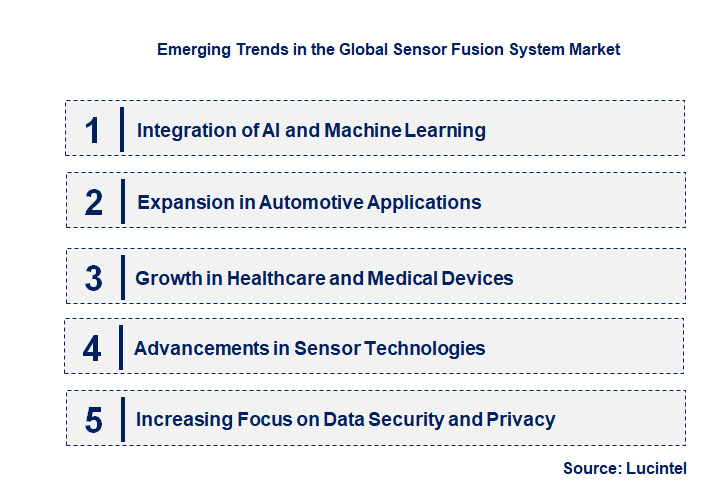
• Integration of AI and Machine Learning: The incorporation of AI and machine learning algorithms into sensor fusion systems is enabling more accurate data interpretation and predictive analytics. This trend enhances system responsiveness and decision-making capabilities, especially in autonomous vehicles and robotics. As AI-driven sensor fusion becomes more sophisticated, it reduces errors, improves safety, and facilitates real-time processing, thereby expanding the potential applications and increasing market competitiveness.
• Expansion in Automotive Applications: The automotive industry is a significant driver of sensor fusion technology, particularly in autonomous vehicles and advanced driver-assistance systems (ADAS). The trend toward integrating multiple sensors, such as LiDAR, radar, and cameras improves vehicle safety, navigation, and obstacle detection. This expansion is pushing the market toward higher adoption rates, with automakers investing heavily in sensor fusion solutions to meet safety regulations and consumer demand for autonomous driving features.
• Growth in Healthcare and Medical Devices: Sensor fusion systems are increasingly used in healthcare for patient monitoring, diagnostics, and wearable devices. The trend toward miniaturization and enhanced accuracy allows for continuous, real-time health data collection, improving patient outcomes. As healthcare providers seek more personalized and remote care solutions, the demand for advanced sensor fusion systems is expected to rise, opening new avenues for innovation and market expansion.
• Advancements in Sensor Technologies: Innovations in sensor hardware, such as improved sensitivity, miniaturization, and energy efficiency, are fueling the market. These advancements enable more seamless integration of sensors into various platforms and devices, broadening application scopes. Enhanced sensor capabilities lead to more reliable data collection, which is critical for complex systems like autonomous vehicles and industrial automation, thereby driving market growth.
• Increasing Focus on Data Security and Privacy: As sensor fusion systems handle vast amounts of sensitive data, there is a growing emphasis on cybersecurity measures to protect information integrity and user privacy. This trend influences system design, with a focus on secure data transmission and storage solutions. Addressing security concerns is vital for market acceptance, especially in sectors like healthcare and automotive, where data breaches could have serious consequences. In summary, these trends are collectively transforming the sensor fusion system market by enhancing system intelligence, expanding application domains, and emphasizing security. They are fostering innovation, improving safety and efficiency, and paving the way for smarter, more connected systems across industries. This evolution is positioning sensor fusion as a critical component in the future landscape of automation and intelligent technology.
• Integration of AI and Machine Learning: The incorporation of AI and machine learning algorithms into sensor fusion systems has significantly improved data processing capabilities. This development enables real-time analysis, predictive maintenance, and enhanced decision-making, especially in autonomous vehicles and industrial automation. The impact is a more intelligent, adaptive system that can handle complex environments with higher accuracy and efficiency.
• Miniaturization of Sensors: Advances in sensor miniaturization have allowed for more compact and lightweight sensor fusion systems. This development benefits wearable devices, drones, and portable medical equipment by reducing size and power consumption. The impact is increased deployment flexibility and broader application possibilities, especially in space-constrained environments.
• Expansion in Automotive Applications: The automotive sector is witnessing a surge in sensor fusion system adoption for ADAS (Advanced Driver Assistance Systems) and autonomous vehicles. This development enhances vehicle safety, navigation, and driver assistance features. The impact is a faster transition toward fully autonomous vehicles and improved road safety standards.
• Enhanced Data Security and Privacy: With the increasing use of sensor fusion systems, data security and privacy concerns have gained prominence. New encryption methods and secure data transmission protocols have been developed to protect sensitive information. The impact is increased trust and compliance with regulatory standards, facilitating wider adoption across industries.
• Development of 5G-Enabled Sensor Networks: The rollout of 5G technology has enabled faster, more reliable communication between sensors and fusion systems. This development supports real-time data sharing and remote monitoring. The impact is improved system responsiveness, scalability, and the ability to support large-scale IoT deployments. In summary, these recent developments are transforming the sensor fusion system market by enhancing system intelligence, miniaturization, application scope, security, and connectivity. As a result, the market is experiencing accelerated growth, increased adoption across diverse sectors, and a shift toward more sophisticated, reliable, and secure sensor fusion solutions.
• Automotive Industry: Enhanced ADAS and autonomous vehicles: Sensor fusion systems improve vehicle safety and enable autonomous driving by integrating data from cameras, radar, and lidar, leading to more reliable navigation and obstacle detection.
• Healthcare Sector: Advanced patient monitoring: Sensor fusion enables real-time, comprehensive health data collection, improving diagnostics, personalized treatment, and remote patient monitoring, thus enhancing healthcare outcomes.
• Aerospace and Defense: Enhanced navigation and situational awareness: Combining sensor data improves aircraft navigation, missile guidance, and battlefield awareness, increasing safety and operational efficiency.
• Industrial Automation: Smart manufacturing and predictive maintenance: Sensor fusion facilitates real-time monitoring of machinery, enabling predictive maintenance, reducing downtime, and optimizing production processes.
• Consumer Electronics: Improved user experiences: Integration of sensors in devices like smartphones and wearables enhances functionalities such as gesture recognition, fitness tracking, and augmented reality applications, boosting consumer engagement. These growth opportunities are significantly impacting the sensor fusion system market by expanding its applications, increasing demand, and driving innovation. As industries adopt more integrated sensor solutions, market growth accelerates, fostering technological advancements and competitive advantages for early adopters.
• Technological Advancements: The continuous evolution of sensor technologies, including LiDAR, radar, and cameras, has significantly enhanced the capabilities of sensor fusion systems. These advancements enable more accurate data collection and processing, which are crucial for applications like autonomous vehicles, robotics, and industrial automation. Improved processing algorithms and increased computational power facilitate real-time data integration, leading to safer and more reliable systems. As technology progresses, costs are decreasing, making sensor fusion systems more accessible across various industries. This ongoing innovation is expected to sustain high growth rates and expand market applications.
• Growing Adoption of Autonomous Vehicles: The surge in autonomous vehicle development is a major driver for sensor fusion systems. These vehicles rely heavily on multiple sensors to perceive their environment accurately. Sensor fusion combines data from different sensors to create a comprehensive understanding, essential for navigation, obstacle detection, and decision-making. The increasing investments by automotive manufacturers and tech companies in autonomous vehicle technology are propelling demand. Regulatory support and consumer acceptance are also improving, further accelerating adoption. As autonomous vehicles become more prevalent, the need for sophisticated sensor fusion systems will continue to grow, fueling market expansion.
• Rising Focus on Safety and Security: Safety regulations and the need to prevent accidents are driving the adoption of sensor fusion systems across various sectors, including automotive, aerospace, and industrial automation. These systems enhance situational awareness by integrating data from multiple sensors, reducing false alarms, and improving response times. In automotive applications, sensor fusion is critical for advanced driver-assistance systems (ADAS), which are increasingly mandated by safety standards. The emphasis on security and safety not only boosts demand but also encourages innovation in sensor integration and data processing techniques, ensuring safer environments and compliance with evolving safety regulations.
• Increasing Investment in Smart Infrastructure and IoT: The expansion of smart city initiatives and IoT deployments is a significant growth factor. Sensor fusion systems are integral to smart infrastructure, enabling real-time monitoring and management of traffic, utilities, and public safety. The proliferation of connected devices generates vast amounts of data that require efficient integration and analysis, which sensor fusion facilitates. Governments and private enterprises are investing heavily in these technologies to improve urban living conditions, optimize resource utilization, and enhance security. This trend is expected to create new opportunities for sensor fusion applications across diverse sectors, further propelling market growth.
• Expansion of Industrial Automation: The industrial sector is increasingly adopting sensor fusion systems to improve operational efficiency, predictive maintenance, and safety. In manufacturing, these systems enable precise monitoring of machinery and processes, reducing downtime and enhancing productivity. The integration of sensors in robotics and automation equipment allows for better control and decision-making. The push towards Industry 4.0 and smart factories is driving demand for advanced sensor fusion solutions. As industries seek to optimize performance and reduce costs, the adoption of sensor fusion technology is expected to accelerate, contributing significantly to market growth. The challenges in the sensor fusion system market are:-
• Data Privacy and Security Concerns: As sensor fusion systems collect and process vast amounts of data, concerns regarding data privacy and cybersecurity are escalating. Unauthorized access or data breaches can compromise sensitive information, especially in autonomous vehicles and critical infrastructure. Regulatory frameworks are still evolving to address these issues, creating uncertainty for market players. Ensuring robust security measures and compliance with data protection laws is essential but can be costly and complex. Failure to adequately address these concerns may hinder adoption and slow market growth, emphasizing the need for advanced security protocols and transparent data management practices.
• High Implementation and Maintenance Costs: The deployment of sensor fusion systems involves significant investment in hardware, software, and integration processes. The complexity of integrating multiple sensors and ensuring system reliability adds to costs. Additionally, ongoing maintenance, calibration, and updates are required to sustain performance, which can be expensive for end-users. These high costs may limit adoption among small and medium-sized enterprises and in developing regions. Overcoming cost barriers through technological innovations and economies of scale will be crucial for broader market penetration and sustained growth.
• Regulatory and Standardization Challenges: The lack of unified standards and regulatory frameworks for sensor fusion systems poses a significant challenge. Variations in safety standards, certification processes, and legal requirements across regions can delay product deployment and increase compliance costs. This fragmentation hampers interoperability and scalability, especially in global markets. Companies face difficulties in navigating diverse regulatory landscapes, which can slow innovation and market expansion. Establishing clear, harmonized standards and regulations is essential to facilitate widespread adoption and ensure safety and reliability across applications. In summary, the sensor fusion system market is driven by rapid technological innovations, increasing adoption in autonomous vehicles, safety and security priorities, investments in smart infrastructure, and industrial automation. However, challenges such as data privacy concerns, high costs, and regulatory complexities must be addressed to sustain growth. The interplay of these factors will shape the market’s evolution, requiring strategic focus on innovation, security, and standardization. Overall, the market holds significant potential for expansion, provided stakeholders effectively navigate these drivers and challenges.
• Bosch Sensortec GmbH
• STMicroelectronics N.V.
• InvenSense Inc.
• NXP Semiconductors N.V.
• Analog Devices, Inc.
• Texas Instruments Incorporated
• Renesas Electronics Corporation
• Infineon Technologies AG
• MEMSIC, Inc.
• Hillcrest Labs (InterDigital
• Hardware
• Software
• Services
• MEMS
• Non-MEMS
• Automotive
• Consumer Electronics
• Healthcare
• Aerospace & Defense
• Industrial
• Others
• OEMs
• Aftermarket
• North America
• Europe
• Asia Pacific
• The Rest of the World
• United States: The US market has seen significant advancements with major tech companies investing heavily in AI-powered sensor fusion solutions for autonomous vehicles and industrial automation. There is a growing focus on integrating sensor systems with IoT platforms, enhancing data accuracy and real-time processing. Regulatory support and substantial R&D funding have accelerated innovation, making the US a leader in sensor fusion technology development and deployment.
• China: China has rapidly expanded its sensor fusion market, driven by government initiatives to develop smart cities and autonomous vehicles. Domestic companies are investing in advanced sensor integration for applications in surveillance, transportation, and healthcare. The country emphasizes cost-effective solutions and local manufacturing, which has boosted the adoption of sensor fusion systems across various sectors, positioning China as a key global player.
• Germany: Germanys market is characterized by its strong automotive industry, with sensor fusion systems being integrated into next-generation driver assistance and autonomous vehicle technologies. The focus is on high-precision sensors and robust data processing capabilities. Additionally, Germany is investing in industrial automation and robotics, leveraging sensor fusion to improve manufacturing efficiency and safety standards.
• India: The Indian market is witnessing rapid growth due to increased adoption of sensor fusion in agriculture, healthcare, and transportation sectors. Government initiatives promoting smart infrastructure and digital transformation are fueling demand. Local startups and global companies are collaborating to develop affordable, scalable sensor fusion solutions tailored to Indias diverse needs, fostering innovation and expanding market reach.
• Japan: Japans market emphasizes advanced sensor fusion applications in robotics, manufacturing, and healthcare. The country is leveraging its technological expertise to develop highly reliable and precise systems, especially for industrial automation and medical diagnostics. Investments in research and collaborations with global tech firms are driving the development of cutting-edge sensor fusion technologies in Japan.


• Bosch Sensortec GmbH
• STMicroelectronics N.V.
• InvenSense Inc.
• NXP Semiconductors N.V.
• Analog Devices, Inc.
• Texas Instruments Incorporated
• Renesas Electronics Corporation
• Infineon Technologies AG
• MEMSIC, Inc.
• Hillcrest Labs (InterDigital, Inc.) Q5. Which sensor fusion system market segment will be the largest in future? Answer: Lucintel forecasts that, within the component category, hardware is expected to witness the highest growth over the forecast period. Q6. In sensor fusion system market, which region is expected to be the largest in next 5 years? Answer: In terms of region, APAC is expected to witness the highest growth over the forecast period. Q7. Do we receive customization in this report? Answer: Yes, Lucintel provides 10% customization without any additional cost.


Choose a license that fits your team. Instant PDF delivery.
Prices exclude taxes. Instant delivery. Custom licensing available on request.
Market Report · July 29, 2026
Market Report · July 20, 2026
Market Report · July 20, 2026
Trusted partner for strategic intelligence and business growth


Receive a complimentary market analysis tailored to your industry. Our analysts will identify key growth opportunities and competitive dynamics specific to your business.

Market size, growth rate, and key trend analysis for your specific sector.

Top competitor positioning and market share analysis.

Strategic recommendations backed by data-driven insights.
Get curated market intelligence and competitive moves straight to your inbox.
By subscribing, you agree to receive our monthly insights. Unsubscribe anytime.
Receive a complimentary market analysis tailored to your industry. Our analysts will identify key growth opportunities and competitive dynamics specific to your business.
Market size, growth rate, and key trend analysis for your specific sector.
Top competitor positioning and market share analysis.
Strategic recommendations backed by data-driven insights.
Get curated market intelligence, emerging trends, and competitive moves straight to your inbox each month.
By subscribing, you agree to receive our monthly insights. Unsubscribe anytime.
We'll send your sample report shortly.