
Market Report · July 15, 2026

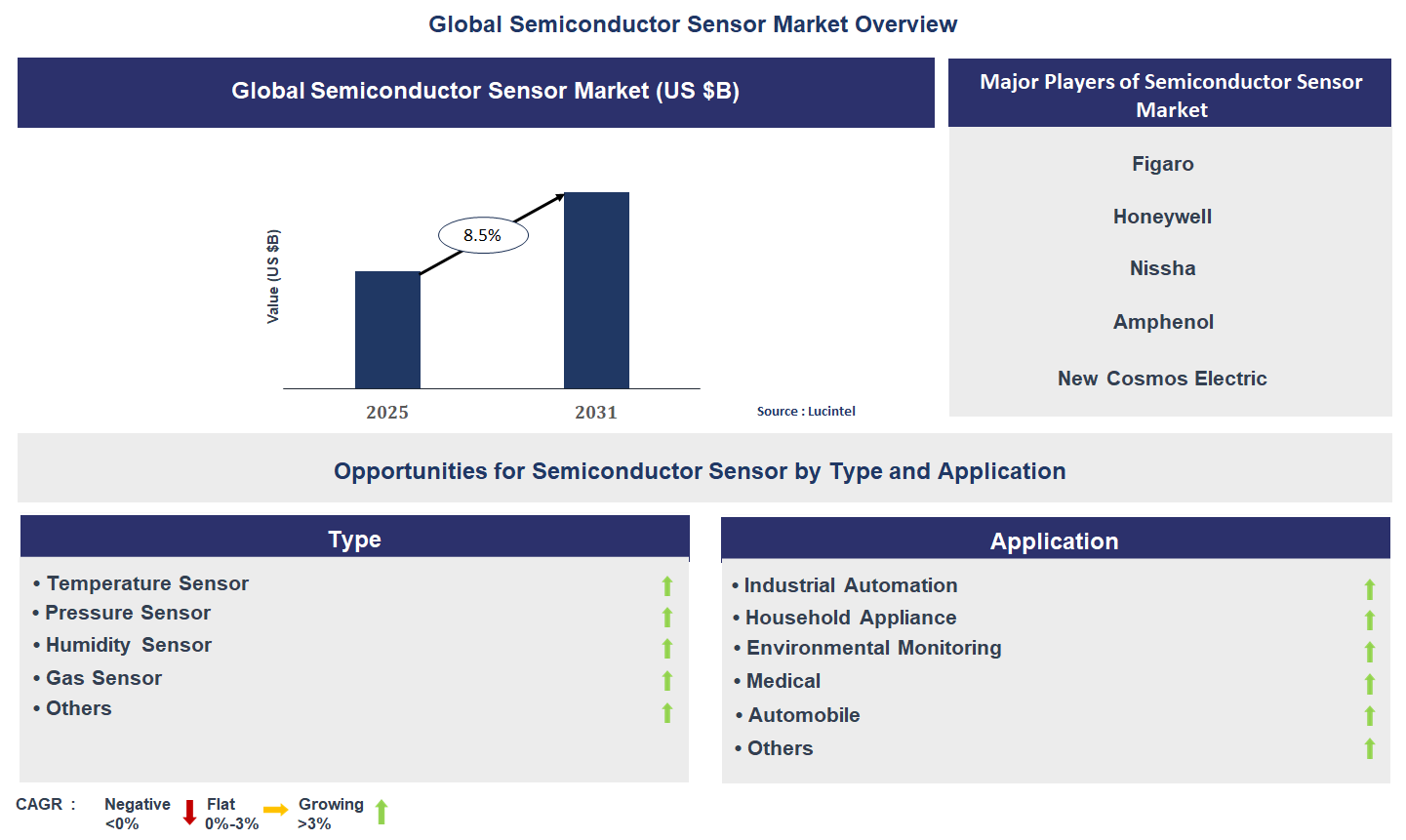
Key data points: The growth forecast = 8.5% annually for the next 7 years. Scroll below to get more insights. This market report covers trends, opportunities and forecasts in semiconductor sensor market to 2031 by type (temperature sensor, pressure sensor, humidity sensor, gas sensor, and others), application (industrial automation, household appliance, environmental monitoring, medical, automobile, and others), and region (North America, Europe, Asia Pacific, and the Rest of the World)
We'll send your sample report shortly.
• Lucintel forecasts that, within the type category, temperature sensor is expected to witness the highest growth over the forecast period.
• Within the application category, automobile is expected to witness the highest growth.
• In terms of region, APAC is expected to witness the highest growth over the forecast period. Gain valuable insights for your business decisions with our comprehensive 150+ page report. Sample figures with some insights are shown below.
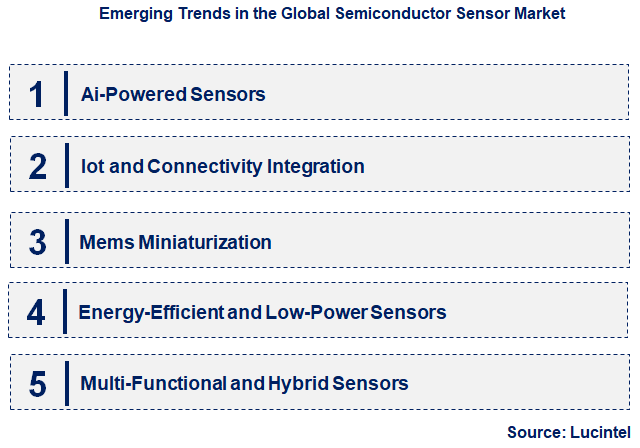
• AI-Powered Sensors: AI embedding in sensors enhances predictive maintenance, autonomous decision-making, and adaptive capability. AI-powered sensors enhance performance, precision, and enable smart applications in automotive, industrial, and robotics industries.
• IoT and Connectivity Integration: IoT connected semiconductor sensors provide real-time sensing, data analysis, and remote control. This trend facilitates smart homes, factories, and cities, improving automation and operating efficiency.
• MEMS Miniaturization: Miniaturization of MEMS sensors enables small, light, and low-energy designs. Small form-factor sensors increase their applicability in mobile, wearable, and robotics applications without any loss of performance.
• Energy-Efficient and Low-Power Sensors: Low-power sensor development lowers energy usage and prolongs the operation of the device. Energy-efficient designs promote sustainability, battery-powered devices, and IoT applications with their limited power supply.
• Multi-Functional and Hybrid Sensors: Sensors with multiple sensing functionalities, like pressure, temperature, and motion sensing, minimize device complexity and enhance system integration. Multi-functional sensors maximize versatility and expand application breadth. Trends like AI integration, IoT connectivity, MEMS miniaturization, energy efficiency, and multi-functional design are transforming the semiconductor sensor industry. These technologies improve performance, lower energy consumption, and broaden applications in automotive, industrial, consumer electronics, and healthcare.
• AI and Machine Learning Integration: The integration of AI enhances sensor accuracy, adaptive response, and predictive maintenance in the automotive, robotics, and industrial sectors.
• MEMS and Miniaturized Sensors: Miniaturization of size and weight enhances device integration, portability, and energy efficiency for electronics, wearables, and industrial systems.
• IoT-Enabled Sensors: Connectivity enables real-time data collection, remote monitoring, and analytics, driving smart infrastructure and automation.
• Energy-Efficient and Low-Power Designs: Lower power consumption enables battery-powered devices, sustainability objectives, and long-term operational efficiency.
• Hybrid and Multi-Functional Sensors: Integration of sensing functions makes device design easier, minimizes components, and increases application flexibility across industries. Crucial advancements such as integration of AI, MEMS miniaturization, IoT connectivity, low-power designs, and multi-functional sensors are fueling the growth in the semiconductor sensor market.
• AI-Enabled Sensing Applications: Sensor technologies using AI enable predictive maintenance, autonomous systems, and real-time decision-making, opening up new opportunities in automotive, industrial, and smart devices.
• Internet-of-Things -Connected Sensors: Increased demand for smart infrastructure, home automation, and connected devices creates a need for sensors offering real-time connectivity and data analytics.
• Miniaturized MEMS Sensors: Miniature sensors allow for integration into mobile phones, wearables, and robots, expanding new market applications and opportunities.
• Energy-Efficient Sensor Solutions: Low-power and energy-efficient sensors enable battery-powered devices, sustainability programs, and cost savings across various industries.
• Hybrid and Multi-Functional Sensors: Sensors with multiple measurement functions are versatile solutions that simplify system complexity and increase adoption in various industrial, automotive, and consumer markets. Strategic opportunities in AI, IoT connectivity, MEMS miniaturization, energy-saving designs, and multi-functional sensors are growing the semiconductor sensor market. These opportunities increase innovation, performance, and application flexibility, which are driving adoption.
• Figaro
• Honeywell
• Nissha
• Amphenol
• New Cosmos Electric
• Alphasense
• Sensorix
• MGK Sensor
• Shanghai AICI
• China Wafer Level CSP
• Temperature Sensor
• Pressure Sensor
• Humidity Sensor
• Gas Sensor
• Others
• Industrial Automation
• Household Appliance
• Environmental Monitoring
• Medical
• Automobile
• Others
• North America
• Europe
• Asia Pacific
• The Rest of the World
• United States: The development of semiconductor sensors in the United States is fueled by automotive innovation, industrial automation, and defense. LiDAR, advanced MEMS sensors, and optical sensors are incorporated in autonomous vehicles, robotics, and aerospace applications. Smart electronics and IoT growth are backed by investments in low-power consumption devices, miniaturization, and AI-powered sensing solutions. R&D is the priority of U.S. companies, followed by collaborative alliances and manufacturing innovations to improve sensor accuracy and dependability. Domestic production and semiconductor innovation are aided by government initiatives in the market. These initiatives place the United States as a high-performance and intelligent sensor leader in multiple industry sectors.
• China: China is rapidly growing its semiconductor sensor industry with investments in automotive, industrial, and consumer electronics markets. Local players concentrate on MEMS, optical, and pressure sensors with enhanced capabilities. Sensor functionality and adoption of smart devices are strengthened with AI, IoT, and 5G technology integration. Government programs encourage domestic manufacturing, R&D, and technology transfer to minimize import dependency. Automotive, industrial automation, and smart manufacturing trends fuel demand for high-precision, low-power sensors. Market expansion is fueled by partnerships with global technology collaborators and growing consumer electronics manufacturing, making China a global leader in semiconductor sensor innovation.
• Germany: Germany focuses on semiconductor sensors for automotive, industrial automation, and smart manufacturing sectors. MEMS, pressure, and optical sensors are incorporated into autonomous cars, factory automation equipment, and quality control products. R&D spend, precision engineering, and environmentally friendly production methods improve performance, dependability, and power efficiency. German producers focus on conformity to European standards and compatibility with Industry 4.0 technologies. Increasing use of smart factories and autonomous car technology drives demand for high-performance sensors. Germany remains committed to innovation, precision, and reliability, emerging as a market leader in industrial, automotive, and automation sector sensor applications.
• India: India is experiencing increased semiconductor sensor usage in the automotive, industrial, healthcare, and consumer electronics industries. MEMS and optical sensors are extensively used in automotive safety systems, robotics, and IoT devices. Domestic manufacturing capacity and government policies support R&D, electronics manufacturing, and smart sensor manufacturing. Low-power, energy-efficient, and miniaturized sensors are needed for consumer products and industrial automation. Collaborations with foreign semiconductor firms and investments in sophisticated manufacturing facilities add to domestic capabilities. Growing digitalization, automation, and smart technology adoption fuel market expansion, making India a growing center for semiconductor sensor manufacturing and use.
• Japan: Japan prioritizes high-precision semiconductor sensors for automotive, robotics, and electronics industries. MEMS, optical, and pressure sensors are integrated into consumer electronics, industrial automation, and autonomous vehicles. Technological development focuses on miniaturization, low power, and high reliability. Advanced sensor development is supported through R&D investment, manufacturing quality, and partnerships with multinational corporations. Environmental regulations, energy saving, and smart device integration are main concerns for Japan. The emphasis on autonomous vehicles, robotics, and IoT use focuses demand for advanced semiconductor sensors to grow. These efforts support Japans competitive edge in precision, performance, and innovation in the global SEMICONDUCTOR SENSOR market.


• Figaro
• Honeywell
• Nissha
• Amphenol
• New Cosmos Electric
• Alphasense
• Sensorix
• MGK Sensor
• Shanghai AICI
• China Wafer Level CSP Q5. Which semiconductor sensor market segment will be the largest in future? Answer: Lucintel forecasts that, within the type category, temperature sensor is expected to witness the highest growth over the forecast period. Q6. In semiconductor sensor market, which region is expected to be the largest in next 5 years? Answer: In terms of region, APAC is expected to witness the highest growth over the forecast period. Q7. Do we receive customization in this report? Answer: Yes, Lucintel provides 10% customization without any additional cost.


Choose a license that fits your team. Instant PDF delivery.
Prices exclude taxes. Instant delivery. Custom licensing available on request.
Market Report · July 15, 2026
Market Report · July 13, 2026
Market Report · July 13, 2026
Trusted partner for strategic intelligence and business growth


Receive a complimentary market analysis tailored to your industry. Our analysts will identify key growth opportunities and competitive dynamics specific to your business.

Market size, growth rate, and key trend analysis for your specific sector.

Top competitor positioning and market share analysis.

Strategic recommendations backed by data-driven insights.
Get curated market intelligence and competitive moves straight to your inbox.
By subscribing, you agree to receive our monthly insights. Unsubscribe anytime.
Receive a complimentary market analysis tailored to your industry. Our analysts will identify key growth opportunities and competitive dynamics specific to your business.
Market size, growth rate, and key trend analysis for your specific sector.
Top competitor positioning and market share analysis.
Strategic recommendations backed by data-driven insights.
Get curated market intelligence, emerging trends, and competitive moves straight to your inbox each month.
By subscribing, you agree to receive our monthly insights. Unsubscribe anytime.
We'll send your sample report shortly.