
Report Feature
Semiconductor Photoresist Trends and Forecast
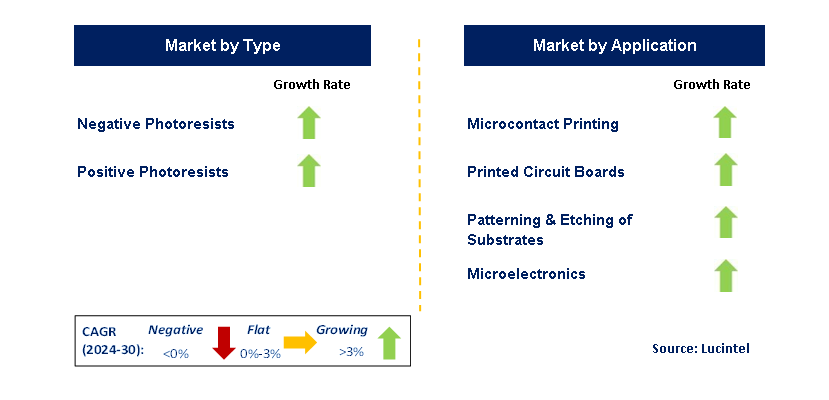
The future of the global semiconductor photoresist market looks promising with opportunities in the microcontact printing, printed circuit board, patterning & etching of substrate, and microelectronic markets. The global semiconductor photoresist market is expected to grow with a CAGR of 5.3% from 2024 to 2030. The major drivers for this market are increasing demand for higher resolution and finer patterning capabilities in semiconductor lithography processes, growing adoption of advanced packaging technologies, and technological advancements in photoresist materials to meet evolving semiconductor node requirements. Lucintel forecasts that negative photoresists is expected to witness higher growth over the forecast period. APAC is expected to witness the highest growth over the forecast period. A more than 150-page report is developed to help in your business decisions.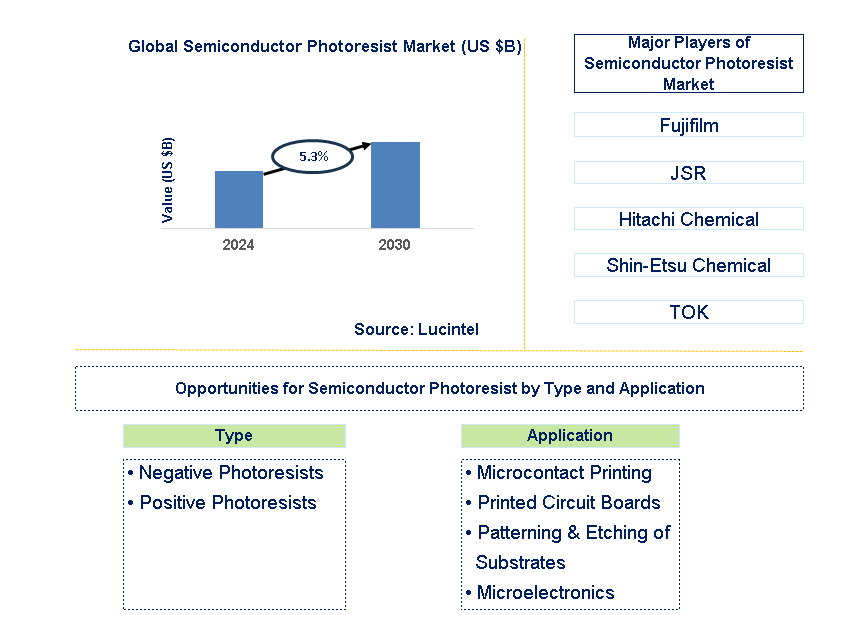
Emerging Trends in the Semiconductor Photoresist Market
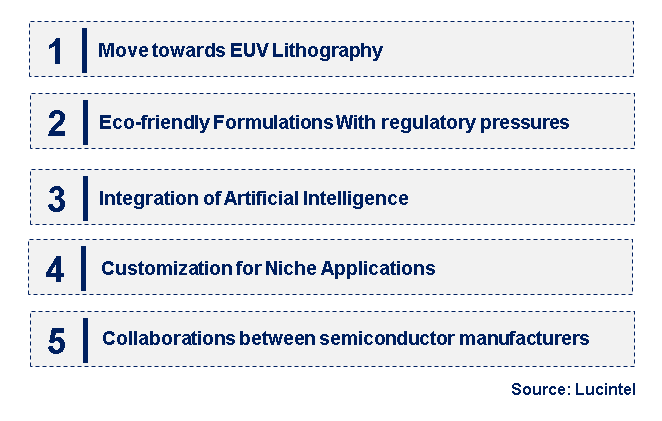
The Silicon Photoresists market is constantly evolving, with several emerging trends shaping the market industry. The main driving forces behind the development of emerging trends are improvements in technology, environmental concerns, and growing demand for advanced performance semiconductor devices.• Move towards EUV Lithography: As semiconductor makers are gradually adopting EUV lithography for the smallest nodes, there is an enormous demand for photoresists that specifically target this technology. These photoresists have been providing an increase in sensitivity and resolution, which allows for more complex and miniaturized devices in semiconductors, thereby leading to improved overall manufacturing efficiency.
• Eco-friendly Formulations With regulatory pressures and sustainability goals demanding more from manufacturers, the environmental friendly photoresist formulations are coming into limelight. These photoresist formulations are containing minimum harmful chemicals; thus, the environmental footprint can be minimized without performance compromise. This direction comes in line with the greener manufacturing practice that is evident in the semiconductor industry of the world.
• Integration of Artificial Intelligence: The adoption of AI is on the increase in the optimization of photoresist processes. AI-based analytics increases the chances of formulative development and process control, which leads to improved yields along with reduced waste. Such an integration can support the better operation of manufacturing operations and could be helpful in achieving a higher level of quality standards.
• Customization for Niche Applications There is significant interest in customization of photoresists for niche applications-for example, automotive and IoT devices. This focus on niche-specific solutions helps manufacturers respond to specific problems that emerge within those specific sectors, which is better in terms of both performance and reliability end.
• Collaborations between semiconductor manufacturers and photoresist manufacturers are now common. Such collaborations and exchanges of ideas give rise to creativity, eventually establishing next-generation photoresist technologies that meet the requirements of advanced semiconductor fabrication. The emerging trends that are fundamentally changing the industry landscape in the Semiconductor Photoresists market include moving toward EUV lithography, green and eco-friendly formulation, integration of AI, customized solutions for niche application, and a growing collaboration that continues to enhance the efficiency and sustainability of semiconductor manufacturing. All these will result in significant advancements in the overall direction taken by the photoresists market.
Recent Developments in the Semiconductor Photoresist Market
The development in Semiconductor Photoresists reflects a strong trend towards innovation and efficiency in meeting the increasing demands of the semiconductor industry. These developments are important for the improvement of photoresist performance in different processes for manufacturing semiconductors.• Advanced EUV Photoresists Advanced photoresists that are formulated for EUV lithography have resulted in advanced EUV photoresists. They allow higher sensitivity and resolution by which smaller and more complex semiconductor devices may be produced. This is one innovation that needs to be realized in order to keep abreast of the miniaturization trends in the industry.
• Green Photoresist Formulations: Today, green photoresist formulations minimize the product's ecological footprint. These products meet stringent compliance standards with high performance levels. The emerging trend underscores the call for sustainability on a global basis and enhances the attractiveness of products in the market.
• Develop specialty photoresists: Especially specialty photoresists for niche applications, such as 5G technology or advanced packaging. With tailored solutions, it ensures optimal performance in specific use cases through addressing new challenges presented in new technologies and enhancing production efficiency.
• AI-based Process Optimization: AI applications are highly applied in the design and use of photoresists as well. Optimizing various manufacturing processes with AI technologies improve quality controls and decrease waste, providing higher yields and better overall production efficiency.
• Stabilizing supply chain: Improving photoresists supply chains is also an area of recent advancements. Companies are adopting local sourcing and diversifying suppliers to reduce the risk of global chain disruptions toward a stable supply of critical resources. Future trends are changing the game in the Semiconductor Photoresists market with increased efficiency, production sustainability, and improved product performance. Innovative trends to be seen are in EUV photoresists, sustainable formulation, specialty products, AI integration, and supply chain resilience. These changes will eventually define the future of the semiconductor manufacturing value chain.
Strategic Growth Opportunities for Semiconductor Photoresist Market
It opens varied strategic growth opportunities across key applications through advancements in technology, market demands, and the innovation push in semiconductor manufacturing.• Growth in 5G Applications- Rollouts of 5G technology will present significant growth opportunities for photoresists with increased demand for high-speed communication devices opening up areas for specialized photoresists used for 5G applications and driving innovation and market expansion in this sector.
• Expansion in automotive electronics: The electric and autonomous vehicles have rendered the automotive electronics much more complex, hence creating the demand for advanced photoresists. There would thus be specific performance criteria in the photoresists, creating this opportunity to innovate and to supply the very best tailored solutions to manufacturers.
• IoT Devices: With the increasing usage of IoT devices, optimum and reliable semiconductor manufacturing will be highly essential. Photoresists manufactured with an emphasis on such IoT applications will be in high demand, and this segment is highly growth potential in this exponentially growing market.
• Advances in Semiconductor Packaging: The innovation of semiconductor packaging technologies has provided a space for custom photoresists. New packaging holds the potential for innovative applications at a materials level while leveraging the properties of high-performance materials and ensuring such packaging can support detailed designs.
• Greater focus on Sustainability: The push on sustainable manufacturing processes will offer a platform for enhancing the photolithography photoresist formulation to become more environmentally friendly. Businesses that will invest in finding sustainability solutions will enjoy not only compliance but also the interest of the environmentally conscious customers. Strategic growth opportunities within the application of Semiconductor Photoresists reveal huge expansion scope in each application. As the applications of these sectors grow and demands for technological developments within semiconductors increase, photoresists will have a vital stand in this situation, driving innovation and growth in the sector concerned.
Semiconductor Photoresist Market Driver and Challenges
The Semiconductor Photoresists industry is highly driven by a cluster of drivers and challenges arising from technological, economic, and regulatory aspects. Understanding these dynamics proves very important for stakeholders as it drives the ever-changing landscape. The factors responsible for driving the semiconductor photoresist market include: 1. Technological Advancements: Ongoing innovations in photoresist formulations and lithography techniques are driving the growth of the market. Enhanced performance characteristics of advanced photoresists allow semiconductor device manufacturers to produce smaller, more efficient devices, which in turn fuels demand for advanced photoresists. 2. Increased consumption of semiconductors in consumer electronics and in the automobile industry. Higher consumption of semiconductors contributes to good growth for a high-quality photoresist market. 3. Sustainability Programs: Environment-friendly manufacturing practices improve the development of sustainable, environment-friendly photoresist formulations. Such companies will have a better competitive advantage and can meet governmental regulations, thereby making them more attractive in the market. Challenges in the semiconductor photoresist market are: 1. High Production Costs: Advanced photoresists may have high production costs, limiting access by smaller manufacturers. Extremely high costs might thus prevent rapid innovation and growth of new products in the market. 2. Compliance with Regulations: The use of chemicals also presents challenges on the regulatory side, specially for the manufacturer of photoresist. More stringent regulations require further investment and resources to comply. 3. Supply Chain Vulnerabilities: Global supply chain disruptions hit potential sources of raw materials used in photoresist production. Sources may face interruptions, with lengthy waiting times and higher prices and thereby affecting overall market stability. This reflects a sophisticated interplay between drivers and problems in the Semiconductor Photoresists industry. Technological advances and increased demand for sustainability will help grow the semiconductor photoresist industry, but such issues as high production costs and regulatory compliance will continue to be large challenges in the sector. These challenges must be dealt with in the aim of best possible use of the market potential and moving further the development of new photoresist solutions in the semiconductor-manufacturing industry.List of Semiconductor Photoresist Companies
Companies in the market compete on the basis of product quality offered. Major players in this market focus on expanding their manufacturing facilities, R&D investments, infrastructural development, and leverage integration opportunities across the value chain. Through these strategies semiconductor photoresist companies cater increasing demand, ensure competitive effectiveness, develop innovative products & technologies, reduce production costs, and expand their customer base. Some of the semiconductor photoresist companies profiled in this report include-• Fujifilm
• JSR
• Hitachi Chemical
• Shin-Etsu Chemical
• TOK
• Sumitomo Chem
• Asahi Kasei
Semiconductor Photoresist by Segment
The study includes a forecast for the global semiconductor photoresist market by type, application, and region.Semiconductor Photoresist Market by Type [Analysis by Value from 2018 to 2030]:
• Negative Photoresists
• Positive Photoresists
Semiconductor Photoresist Market by Application [Analysis by Value from 2018 to 2030]:
• Microcontact Printing
• Printed Circuit Boards
• Patterning & Etching of Substrates
• Microelectronics
Semiconductor Photoresist Market by Region [Analysis by Value from 2018 to 2030]:
• North America
• Europe
• Asia Pacific
• The Rest of the World
Country Wise Outlook for the Semiconductor Photoresist Market
This is one of the fast-moving fields of innovation due to the rise in semiconductor manufacturing technology as well as demands for miniaturization in electronic devices. Some of the key players in the United States, China, Germany, India, and Japan are innovating to produce better photoresists while providing improved functionality and efficiency levels in line with the changing needs of the semiconductor industry. The companies engaged in semiconductor photoresists have to periodically innovate to remain competitive and manage stringent production requirements.• United States: Though the US market continues to focus on high-performance photoresists, it has been customising novelties oriented towards advanced lithography techniques like extreme ultraviolet lithography. Focus is being there to see into susceptibility and resolution, driving the schemes of smaller semiconductor nodes. These developments are making US manufacturers competitive in a fast-evolving global landscape.
• China: Their semiconductor business is expanding their capabilities in Photoresists manufacturing. Through investments, domestically sourced photoresist qualified at world-class levels is now developed. This also helps reduce imports and promote self-sufficiency in the country regarding semiconductor manufacturing-a step closer for China to win in the international market.
• Germany: Sustainability is atop Germany's photoresist market. Some of the recent developments seen in the formulations of photoresist are using levels of eco-friendliness that minimize environmental impact but also provide performances that are significantly high. Innovations led by the above ideas support Germany's pursuit of sustainability and enhance semiconductor manufacturing processes.
• Germany: Government initiatives to boost local manufacturing have India's semiconductor ecosystem gathering pace. Recent developments in photoresist technologies are targeted toward being cost-effective while addressing local needs. This growth is important in making India play an important role in the global semiconductor market.
• Japan: High-performance photoresists for semiconductor manufacturing are still dominated by Japan. Some recent developments are 5G application-specific photoresists, and those used in high-performance computing. All these developments support Japan's image of quality and innovation, enabling its manufacturers to use leading-edge semiconductor technologies.

Features of the Global Semiconductor Photoresist Market
Market Size Estimates: Semiconductor photoresist market size estimation in terms of value ($B). Trend and Forecast Analysis: Market trends (2018 to 2023) and forecast (2024 to 2030) by various segments and regions. Segmentation Analysis: Semiconductor photoresist market size by type, application, and region in terms of value ($B). Regional Analysis: Semiconductor photoresist market breakdown by North America, Europe, Asia Pacific, and Rest of the World. Growth Opportunities: Analysis of growth opportunities in different types, applications, and regions for the semiconductor photoresist market. Strategic Analysis: This includes M&A, new product development, and competitive landscape of the semiconductor photoresist market. Analysis of competitive intensity of the industry based on Porter’s Five Forces model.If you are looking to expand your business in this or adjacent markets, then contact us. We have done hundreds of strategic consulting projects in market entry, opportunity screening, due diligence, supply chain analysis, M & A, and more.

FAQ
Q1. What is the growth forecast for semiconductor photoresist market? Answer: The global semiconductor photoresist market is expected to grow with a CAGR of 5.3% from 2024 to 2030. Q2. What are the major drivers influencing the growth of the semiconductor photoresist market? Answer: The major drivers for this market are increasing demand for higher resolution and finer patterning capabilities in semiconductor lithography processes, growing adoption of advanced packaging technologies, and technological advancements in photoresist materials to meet evolving semiconductor node requirements. Q3. What are the major segments for semiconductor photoresist market? Answer: The future of the semiconductor photoresist market looks promising with opportunities in the microcontact printing, printed circuit board, patterning & etching of substrate, and microelectronic markets. Q4. Who are the key semiconductor photoresist market companies? Answer: Some of the key semiconductor photoresist companies are as follows:• Fujifilm
• JSR
• Hitachi Chemical
• Shin-Etsu Chemical
• TOK
• Sumitomo Chem
• Asahi Kasei Q5. Which semiconductor photoresist market segment will be the largest in future? Answer: Lucintel forecasts that negative photoresists is expected to witness higher growth over the forecast period. Q6. In semiconductor photoresist market, which region is expected to be the largest in next 5 years? Answer: APAC is expected to witness the highest growth over the forecast period. Q.7 Do we receive customization in this report? Answer: Yes, Lucintel provides 10% customization without any additional cost.
Table of Contents
Methodology
- In-depth interviews of the major players in this market
- Detailed secondary research from competitors’ financial statements and published data
- Extensive searches of published works, market, and database information pertaining to industry news, company press releases, and customer intentions
- A compilation of the experiences, judgments, and insights of Lucintel’s professionals, who have analyzed and tracked this market over the years.


Buy Now
Choose a license that fits your team. Instant PDF delivery.
Prices exclude taxes. Instant delivery. Custom licensing available on request.
Key Questions
- • What are some of the most promising, high-growth opportunities for the semiconductor photoresist market by type (negative photoresists and positive photoresists), application (microcontact printing, printed circuit boards, patterning & etching of substrates, and microelectronics), and region (North America, Europe, Asia Pacific, and the Rest of the World)?
- • Which segments will grow at a faster pace and why?
- • Which region will grow at a faster pace and why?
- • What are the key factors affecting market dynamics? What are the key challenges and business risks in this market?
- • What are the business risks and competitive threats in this market?
- • What are the emerging trends in this market and the reasons behind them?
- • What are some of the changing demands of customers in the market?
- • What are the new developments in the market? Which companies are leading these developments?
- • Who are the major players in this market? What strategic initiatives are key players pursuing for business growth?
- • What are some of the competing products in this market and how big of a threat do they pose for loss of market share by material or product substitution?
- • What M&A activity has occurred in the last 5 years and what has its impact been on the industry? For any questions related to Semiconductor Photoresist Market, Semiconductor Photoresist Market Size, Semiconductor Photoresist Market Growth, Semiconductor Photoresist Market Analysis, Semiconductor Photoresist Market Report, Semiconductor Photoresist Market Share, Semiconductor Photoresist Market Trends, Semiconductor Photoresist Market Forecast, Semiconductor Photoresist Market Companies, write Lucintel analyst at email: helpdesk@lucintel.com. We will be glad to get back to you soon.


