
Market Report · July 16, 2026

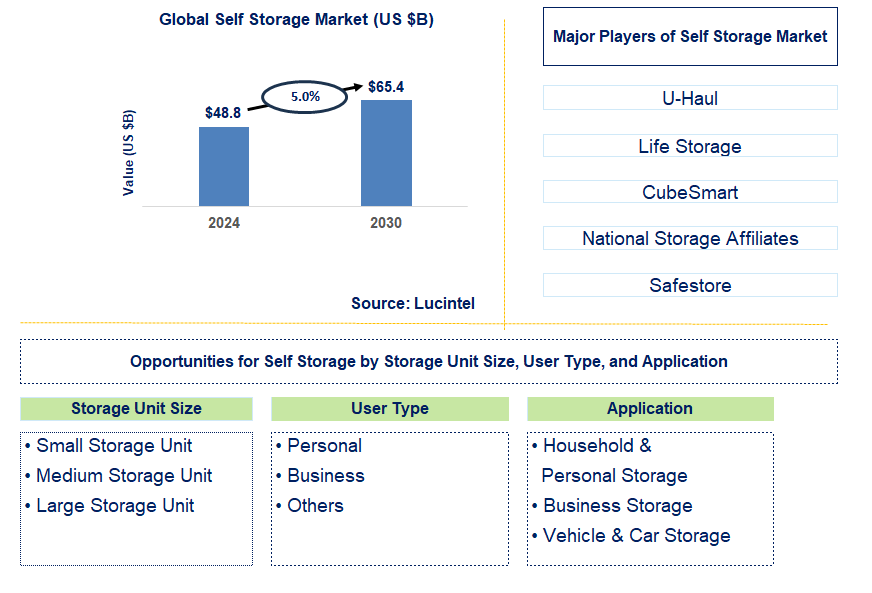
Key data points: The market size in 2030 = $65.4 billion, growth forecast = 5.0% annually for the next 6 years. Scroll below to get more insights. This market report covers trends, opportunities, and forecasts in the global self storage market to 2030 by storage unit size (small storage unit, medium storage unit, and large storage unit), user type (personal, business, and others), application (household & personal storage, business storage, and vehicle & car storage), and region (North America, Europe, Asia Pacific, and the Rest of the World)
We'll send your sample report shortly.
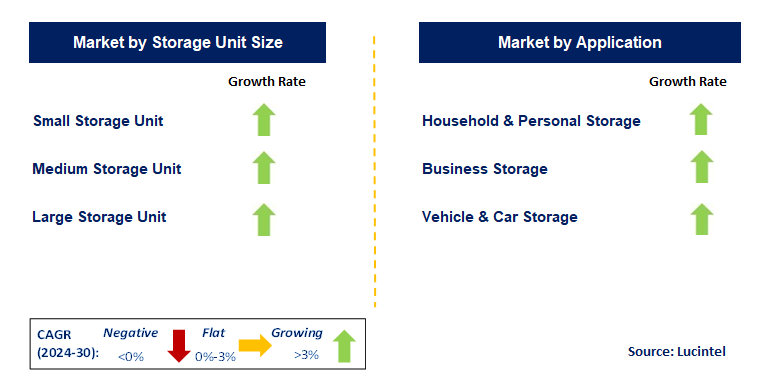
• Lucintel forecasts that medium storage unit is expected to witness highest growth over the forecast period due to its features like versatility and can be used to store a wide range of items, such as furniture, appliances, and boxes.
• Through this market, household & personal is expected to witness highest growth over the forecast period due to rising demand for self storage from travelers needing temporary storage and students who require storage during term breaks.
• North America is expected to witness highest growth over the forecast period due to rapid urbanization, rising population's disposable income, and increasing awareness of self-storage services among small and large enterprises in the region. A more than 150-page report is developed to help in your business decisions.
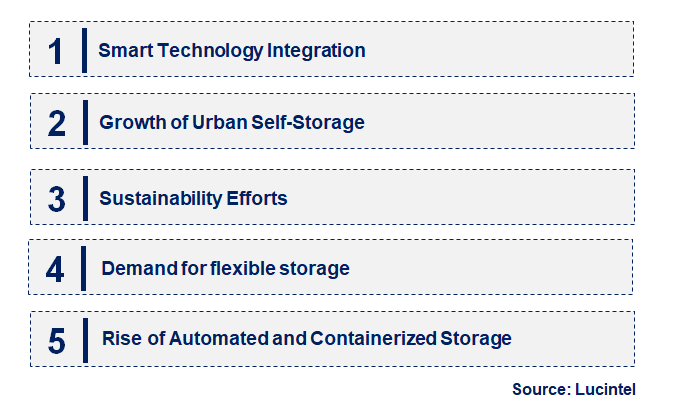
• Smart Technology Integration: The integration of smart technology into self-storage facilities is improving both security and operational efficiency. Features such as remote access control, climate monitoring, and automated lighting are gaining widespread acceptance, offering users greater convenience and control.
• Growth of Urban Self-Storage: Growing urban populations are driving increased demand for self-storage in city centers. Facilities are now primarily located in urban areas to meet the needs of inhabitants who require additional storage space.
• Sustainability Efforts: Self-storage is shifting toward sustainability initiatives. Companies are building structures with energy-efficient designs, utilizing renewable energy sources, and using sustainable materials.
• Demand for Flexible Storage: Facility renters are seeking storage options with flexible terms, such as month-to-month leases and adjustable storage sizes. This reflects the growing demand for flexible storage solutions that can adapt to the changing personal and business needs of each customer.
• Rise of Automated and Containerized Storage: Automated and containerized self-storage facilities are gaining widespread adoption. These systems ensure optimal space utilization with easy access, making them ideal for both residential and commercial users seeking hassle-free storage solutions. These trends are reshaping the self-storage market by making access more user-friendly, enhancing facility efficiency, and reducing environmental impact.
• Smart Technology Adoption: Self-storage facilities are increasingly adopting smart technology features such as remote monitoring, electronic gate access, and climate control systems to improve the security and convenience for users.
• Development of Urban Self-Storage Facilities: A growing number of self-storage facilities are being built within metropolitan areas to address the increasing demand for storage in city centers.
• Introduction of Eco-Friendly Operations: Owners of self-storage facilities are focusing on sustainability by adopting energy-efficient lighting and using environmentally friendly materials in their buildings. This trend reflects increasing environmental consciousness and pressure from regulatory frameworks.
• Growth of Automated Storage Facilities: Automated storage facilities are expanding with the use of robotic systems and containerized units. These systems optimize space and facilitate easy and quick access to inventory.
• Customer Experience: Improving customer service, enhancing digital platforms for user friendliness, and offering customized support are becoming more significant. As a result, companies are investing in technology to enrich customer experience and streamline operations. These trends will shape the future of the self-storage market by enhancing technology, improving convenience, and addressing environmental concerns.
• Urban Expansion: Urban expansion is expected to be a significant growth factor, as cities are typically densely populated. With this in mind, establishing self-storage facilities in areas with high demand can help meet the needs of city dwellers seeking additional space.
• Go Green Solutions: Investing in eco-friendly storage solutions can attract clients who are environmentally conscious. Additionally, applying sustainable practices and obtaining green building certifications will create a competitive advantage in the industry.
• Smart Technologies: Integrating smart technologies in self-storage facilities enhances both security and operational efficiency. Features such as remote access control and automated climate management improve customer service and attract technologically savvy customers.
• Flexible Storage Solutions: The self-storage industry can respond to changing consumer needs by offering flexible solutions, such as short-term leases with adjustable unit sizes. This flexibility will attract a broader range of customers and deepen market penetration.
• Expansion of Containerized Storage Solutions: The growth of containerized storage solutions offers efficient and scalable options for both residential and commercial users. This trend helps meet the increasing demand for versatile, easy-access storage options. These growth opportunities are driving the self-storage market to become more innovative, sustainable, and customer-centric.
• Urbanization and Population Growth: Increasing urbanization and population growth drive the demand for self-storage solutions in cities as living space shrinks.
• Advancement of Technology: The integration of smart technologies and automation enhances the functionality and attractiveness of self-storage facilities. Innovations in technology improve security, efficiency, and customer experience.
• Increased Consumer Demand for Flexibility: Consumers have long demanded storage units that offer flexibility, such as short-term leasing and customizable unit sizes. This creates opportunities to develop adaptable storage solutions.
• Rising Disposable Income: Growing disposable income encourages both consumers and businesses to invest in various storage solutions. Higher income levels facilitate the emergence and development of both residential and commercial self-storage markets.
• Sustainability Factor: An increasing focus on sustainability compels self-storage operators to accommodate environmental concerns. In this regard, environmental building designs and energy efficiency are becoming key drivers of the market. Challenges in the self-storage market include:
• High Initial Investment Costs: Most self-storage facilities require significant capital investment for establishment and maintenance. This acts as one of the largest entry barriers, restricting participation in the market and limiting growth.
• Competition and Market Saturation: The self-storage industry is highly competitive, with numerous players vying for market share. Increased competition and market saturation lead to downward pricing pressures and reduced profits.
• Issues of Regulation and Compliance: The complex regulatory environment can be burdensome to navigate. Adherence to local and national regulations is essential for avoiding legal issues and maintaining credibility in the marketplace. These drivers and challenges, together, shape the self-storage market and influence its growth trajectory and overall development.
• U-Haul
• Life Storage
• CubeSmart
• National Storage Affiliates
• Safestore
• Small Storage Unit
• Medium Storage Unit
• Large Storage Unit
• Personal
• Business
• Others
• Household & Personal Storage
• Business Storage
• Vehicle & Car Storage
• North America
• Europe
• Asia Pacific
• The Rest of the World
• United States: The self-storage market in the U.S. continues to grow with increasing demand for personal and business storage. Developments in the sector include advanced digital management systems, enhanced security features such as biometric access, and the growing popularity of containerized self-storage solutions. New self-storage facilities are also incorporating climate control and drive-up access in urban areas.
• China: The fast growth of self-storage in China is largely due to rapid urbanization and the ever-growing middle class. Companies are adopting an integrated approach to smart technology in space management while also focusing on value-added services related to increased security. In addition, the demands brought on by urban settings are addressed through high-tech storage facilities, including automated and mobile storage units.
• Germany: The self-storage market in Germany is increasingly focused on sustainability and efficiency. More eco-friendly storage solutions and energy-efficient facilities are emerging. Self-storage operators are also integrating more advanced IT systems to improve customer service and streamline operations.
• India: Self-storage is a rapidly growing industry in India, driven by urban migration and rising disposable incomes. There is significant growth in demand for both personal and business storage facilities. New facilities are being developed to offer modern features, such as enhanced security and climate control, to accommodate the growing urban population.
• Japan: The self-storage market in Japan is still developing, with a focus on compact and highly efficient storage solutions. These include the development of multi-story facilities and the use of smart technologies to optimize space. Additionally, there is an increasing demand for self-storage units in small living spaces and densely populated urban areas.


• U-Haul
• Life Storage
• CubeSmart
• National Storage Affiliates
• Safestore Q6. Which self storage market segment will be the largest in future? Answer: Lucintel forecasts that medium storage unit is expected to witness highest growth over the forecast period due to its features like versatility and can be used to store a wide range of items, such as furniture, appliances, and boxes. Q7. In self storage market, which region is expected to be the largest in next 6 years? Answer: North America is expected to witness highest growth over the forecast period due to rapid urbanization, rising population's disposable income, and increasing awareness of self-storage services among small and large enterprises in the region. Q.8 Do we receive customization in this report? Answer: Yes, Lucintel provides 10% customization without any additional cost.


Choose a license that fits your team. Instant PDF delivery.
Prices exclude taxes. Instant delivery. Custom licensing available on request.
Market Report · July 16, 2026
Market Report · May 18, 2026
Market Report · May 18, 2026
Trusted partner for strategic intelligence and business growth


Receive a complimentary market analysis tailored to your industry. Our analysts will identify key growth opportunities and competitive dynamics specific to your business.

Market size, growth rate, and key trend analysis for your specific sector.

Top competitor positioning and market share analysis.

Strategic recommendations backed by data-driven insights.
Get curated market intelligence and competitive moves straight to your inbox.
By subscribing, you agree to receive our monthly insights. Unsubscribe anytime.
Receive a complimentary market analysis tailored to your industry. Our analysts will identify key growth opportunities and competitive dynamics specific to your business.
Market size, growth rate, and key trend analysis for your specific sector.
Top competitor positioning and market share analysis.
Strategic recommendations backed by data-driven insights.
Get curated market intelligence, emerging trends, and competitive moves straight to your inbox each month.
By subscribing, you agree to receive our monthly insights. Unsubscribe anytime.
We'll send your sample report shortly.