Close Lucintel Chat
Didn't Find What You're Looking for?
Call us at +1972 636 5056 or write at helpdesk@Lucintel.com
Ask an Expert Provide Custom Requirements Download Sample Report Search Available Reports
  • helpdesk@Lucintel.com
  • |
  • Call Lucintel +1 972 636 5056
  • |
  • Login
  • |
  • Register
  • |
  • Search
  • |
'
...

The Impact of COVID-19 is included in Self-Propelled Modular Transporter Market Report. Buy it today to get an advantage.

Request the impact of COVID-19 on your product or industry


Self-Propelled Modular Transporter Market Trends and Forecast

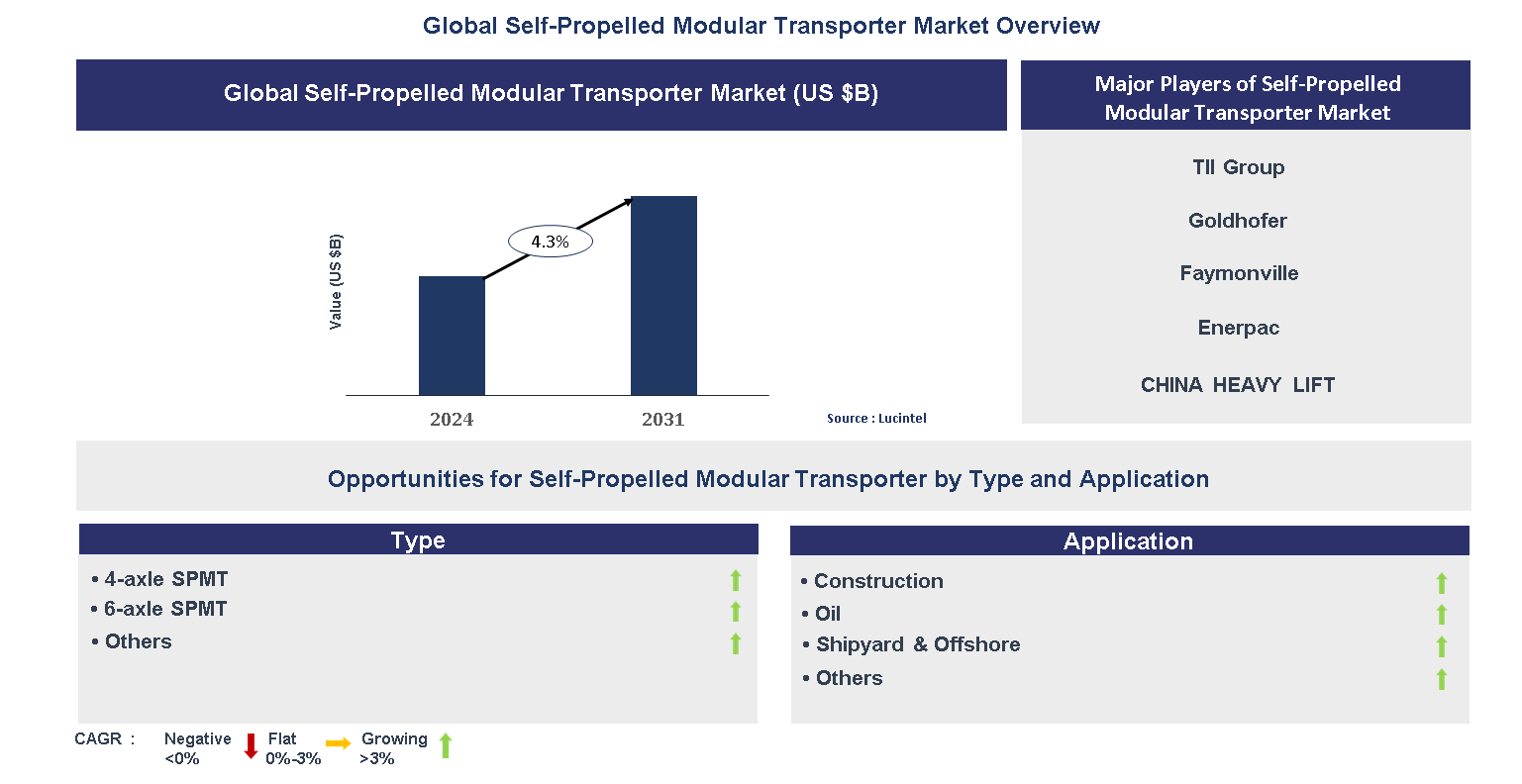
The future of the global self-propelled modular transporter market looks promising with opportunities in the construction, oil, and shipyard & offshore markets. The global self-propelled modular transporter market is expected to grow with a CAGR of 4.3% from 2025 to 2031. The major drivers for this market are the increasing demand for heavy equipment transportation, the rising need for efficient logistics solutions, and the growing adoption of modular transportation systems.

• Lucintel forecasts that, within the type category, 6-axle SPMT is expected to witness higher growth over the forecast period.
• Within the application category, oil is expected to witness the highest growth.
• In terms of region, APAC is expected to witness the highest growth over the forecast period.
Gain valuable insights for your business decisions with our comprehensive 150+ page report. Sample figures with some insights are shown below.
Self-Propelled Modular Transporter Market Trends and Forecast

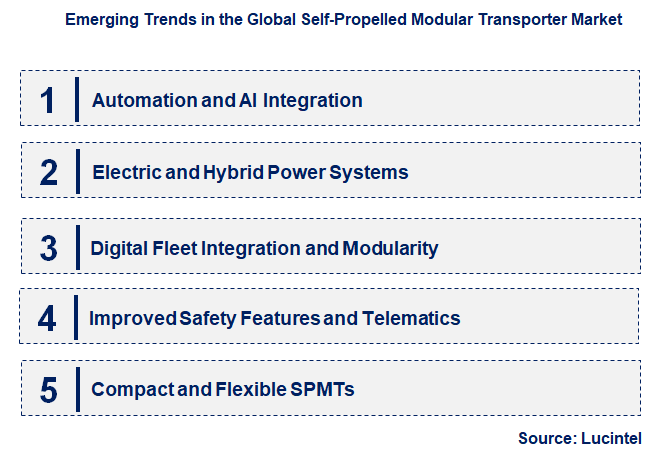
Emerging Trends in the Self-Propelled Modular Transporter Market

The new trends in the self-propelled modular transporter market are restructuring the business itself at its very core, propelling it towards a more technologically smart, efficient, and green model. These trends are shaped by the changing requirements of industries that move gigantic, intricate loads, ranging from construction and energy to manufacturing. The direction of the market towards automation and electrification mirrors a larger industry-wide effort for greater safety levels and lower environmental impact.
• Automation and AI Integration: One important trend is the integration of artificial intelligence (AI) and automation into SPMT systems. This encompasses autonomous navigation, automated load balancing, and real-time route optimization. AI calculations can compute the best path and transfer the load dynamically between the axles, minimizing the risk of tipping or structural failure. This direction adds safety to operations, makes extensive manual control unnecessary, and accelerates and stabilizes complicated movement, especially in tight or dangerous spaces.
• Electric and Hybrid Power Systems: There is an evident move toward electric and hybrid SPMT designs. These equipment substitute conventional diesel power packs with electric motors and batteries, which drastically minimize carbon footprints and noise pollution. Electric SPMTs are a reaction to increasing environmental laws and business sustainability initiatives, particularly in urban locations and sensitive environments. This movement also provides operational advantages, including reduced upkeep costs and the capability to execute operations indoors or in other settings in which diesel smoke is prohibited.
• Digital Fleet Integration and Modularity: Digital fleet integration is fueling the trend towards modular construction. New-generation SPMTs are not only mechanically connectable but also digitally connected, enabling smooth control and synchronization of the units. Operators can view the performance, load distribution, and maintenance requirements of a whole fleet from one control panel. This trend enhances the scalability and flexibility of SPMT operations to allow companies to rapidly reconfigure their equipment to transport a nearly unlimited variation of sizes and weights.
• Improved Safety Features and Telematics: One of the growing trends is the addition of state-of-the-art safety features and telematics. This comprises real-time axle load monitoring, stability control systems, and predictive maintenance notifications. Telematics systems can gather and send information to a centralized location, enabling operators to detect potential problems before they cause equipment breakdown or accidents. The trend is significant in safeguarding priceless cargo and staff, and it is increasingly becoming a standard for sophisticated, high-risk projects across industries.
• Compact and Flexible SPMTs: There is a growing trend towards more compact and flexible SPMT designs. Although conventional SPMTs are huge, more recent models are also being manufactured for urban building and industrial applications of smaller size. The smaller units have the same accuracy and load-carrying capacity as the large ones but are simpler to handle in confined areas. This trend is opening up the market for SPMTs to new applications and is catering to the demands of projects that do not need the huge size of an entire fleet of full-sized SPMTs.
These trends are essentially changing the self-propelled modular transporter industry fundamentally. The emphasis on digital integration, electrification, and automation is turning a niche specialization into a cutting-edge industry. The stress on safety and efficiency is increasing industry levels and making it possible to implement more sophisticated projects. By developing more compact and adaptable models, the industry is also extending its presence to new applications and sectors. All these trends are collectively making SPMT technology more available and potent, further establishing its position as an indispensable heavy haul logistics tool in the modern era.
Emerging Trends in the Self-Propelled Modular Transporter Market

Recent Development in the Self-Propelled Modular Transporter Market

The self-propelled modular transporter industry is going through a phase of heightened development led by innovation and changing world industrial requirements. These changes are not incremental, but they are actually changing the manner in which enormous, heavy loads are transported. The industry is being transformed from one based on brute force to one based on intelligent, accurate, and effective solutions. The next five critical developments indicate the most significant changes that are driving the SPMT market ahead, making way for more complicated and ambitious projects in different industries.
• Emergence of Electric and Hybrid SPMTs: One of the critical developments is the introduction and growing use of electric and hybrid SPMTs. Firms such as Mammate and Sarens are now marketing fleets powered by batteries or a hybrid system in place of conventional diesel motors. The move counters increased environmental pressures by cutting emissions and substantially lessening noise pollution on the job site.
• Integration of Sophisticated Control and Software Systems: There have been significant advancements in the control and software systems that operate SPMTs. These new systems have a precision level of millimeters, automatic synchronization, and predictive maintenance. These developments allow a single operator to move hundreds of axle lines at a time, thus achieving perfectly balanced loads and smooth movement.
• Modular and Prefabricated Construction Growth: The most significant change is the increased use of SPMTs to facilitate modular and prefabricated construction. Large structures are no longer constructed on-site; instead, pieces are manufactured in a contained factory setting and shipped as enormous modules. SPMTs are the sole machines that can transport these heavy, oversized units with the precision needed. This is fueling tremendous demand for SPMTs in the construction of power plants, industrial facilities, and bridges due to time savings and enhanced quality.
• Strategic Acquisitions and Partnerships: The market for SPMT is witnessing increased strategic acquisitions and partnerships between leading heavy-lift and transport firms. Mammut’s strategic partnerships for expanding its SPMT rental fleet in Asia and other parts of the world, for example, point to this trend. These actions are designed to increase global coverage, consolidate market position, and provide for the availability of a diversified fleet of equipment for large-scale international endeavors.
• Growth in the Renewable Energy Business: The substantial growth of the renewable energy business, specifically wind and offshore wind energy, has created a large expansion in SPMT applications. The large wind turbine blades, tower units, and offshore platform bases need the specialized features of SPMTs. This has produced a new, high-growth market segment for SPMT makers and service providers, since such components are too big for conventional transport. Demand from this segment is driving innovation and fleet growth significantly.
All these changes are significantly impacting the self-propelled modular transporter market. The trend toward electric power and sophisticated software is making SPMTs more efficient, eco-friendly, and safer. The rise in the application of modular construction and the expansion of the renewable energy market are giving rise to a consistent and increasing demand for these specialty vehicles. The development of the market, fueled by these major trends, is making SPMT an increasingly important facilitator of large-scale infrastructure and industrial development globally.

Strategic Growth Opportunities in the Self-Propelled Modular Transporter Market

The self-propelled modular transporter market provides substantial strategic development opportunities in a range of key applications. These are fueled by changing industry needs for the accurate, secure, and efficient transport of heavy, massive components. By concentrating on these particular areas of application, businesses can take advantage of the distinct strengths of SPMTs to get ahead and dominate the market. The next five growth opportunities demonstrate the most lucrative avenues for market growth and commercial achievement.
• Wind and Offshore Wind Energy: The renewable energy segment, particularly wind power, presents a high-growth opportunity for SPMT providers. The growing dimensions of wind turbine parts, such as gigantic blades, towers, and offshore monopiles, make their transport very difficult. SPMTs are the perfect answer for transporting such oversized pieces from manufacturing plants to ports or distant installation locations. The potential exists in offering specialized, high-capacity SPMT solutions and services to wind farm installation, as this market is predicted to continue to receive investment and growth worldwide.
• Bridge and Civil Infrastructure Construction: The upgrading of civil infrastructure, especially the replacement of obsolete bridges, presents a major growth potential. Off-site pre-fabrication of entire bridge sections, and subsequent delivery and installation, depends greatly on SPMTs. The opportunity lies in offering SPMT fleets for such mega projects, which demand millimeter-level accuracy to position bridge sections in the right place. This usage saves time in construction and reduces traffic disruption, and it is hence a favored approach for governments as well as engineering companies.
• Shipbuilding and Offshore Fabrication: The offshore fabrication and shipbuilding sectors use SPMTs extensively for the transfer of enormous ship blocks, offshore platforms, and other heavy modules between shipyards and fabrication facilities. The potential is to offer customized SPMT solutions capable of transferring extreme loads and surviving diverse adverse environments, such as uneven terrain and slopes. By providing tailored solutions, SPMT providers can become an integral part of the building process of new ships and offshore energy facilities, which are crucial to world trade and energy production.
• Oil and Gas Sector: In spite of a global movement towards renewables, the oil and gas sector remains a significant market for SPMTs. Refinery, pipeline, and liquefied natural gas (LNG) terminal construction and upkeep involve the movement of enormous, pre-fabricated modules. The potential lies in being able to deliver dependable SPMT solutions for such projects, which tend to be done in remote and difficult sites. Firms can have long-term contracts if they are able to show a record of safety, efficiency, and competency in moving complex, high-value components.
• Nuclear Power Plant Construction: The building of new nuclear power plants and the dismantling of old ones is a niche but high-value growth area. The transportation of reactor vessels, steam generators, and other large, heavy machinery demands the greatest precision and safety. SPMTs are imperative for such projects because they can position and handle very heavy loads with perfect accuracy. The potential is in offering highly specialized SPMT services that achieve very high safety and regulatory requirements, establishing a firm as a reliable partner for this high-stakes industry.
These strategic opportunities for growth are significantly influencing the self-propelled modular transporter market by broadening its base of applications and motivating innovation. By targeting these high-value markets, business is not only increasing the customer base but also driving innovation and R&D in more powerful, smarter, and more specialized SPMT systems. This strategic emphasis puts SPMT technology squarely at the forefront of heavy-haul logistics and continues to be a key driver of large-scale industrial projects globally.

Self-Propelled Modular Transporter Market Driver and Challenges

The market for self-propelled modular transporter is characterized by a dynamic interplay of strong drivers and great challenges. The key drivers, namely several technological, economic, and regulatory factors, are driving the market. The rising demand for effective heavy lifting, the readiness of automation technologies, and increased investment are building a strong ecosystem. Yet, such growth is confronted with issues like the high initial investment cost, technicality of operations, and necessity of highly skilled workers. Operating within such an environment necessitates a comprehensive grasp of such forces.
The factors responsible for driving the self-propelled modular transporter market include:
1. Growth in Mega Infrastructure Projects: The most important driving factor is the growing investment in mega infrastructure projects across the world, including bridges, roads, and seaports. All these mega projects involve the movement of enormous pre-fabricated units that cannot be transported with standard vehicles. SPMTs have the capacity, accuracy, and mobility to transport and position such huge loads and are hence the go-to for contemporary construction and engineering activities globally.
2. Expansion of the Renewable Energy Market: The expansive growth of the renewable energy market, specifically in wind power, is a key driver. The fabrication and deployment of new wind turbines entail the transport of highly heavy and massive components. SPMTs are necessary to move these pieces from fabrication facilities to distant installation locations. The industry is building an uninterrupted and expanding market for SPMTs, compelling manufacturers to design increased-capacity and more advanced models.
3. Automation Technology Advancements: Integration of next-generation automation, real-time monitoring, and remote-control technology is one such impetus. These technologies enable synchronized and accurate movement of several SPMT units, improving safety and operation efficiency. Automation negates the possibility of human failure, simplifies complicated maneuvers, and allows a single operator to handle a gigantic load, thus making SPMTs a cost- and reliable-solution offering.
4. Transition to Modular and Prefabricated Building: The international construction market is becoming more and more inclined toward modular and prefabricated building techniques to cut down on project duration and expense. This entails constructing significant portions of a building off-site and moving them for installation. SPMTs are the sole transporters that can carry these heavy, oversized modules, thus being a key driver of this development. This transformation is generating a consistent demand for SPMT services in urban and industrial projects.
5. Greater Emphasis on Safety and Efficiency: There is increasing focus on safety and efficiency in all heavy-lift and transportation operations. SPMTs are safer, by design, than other options because they have precise control, stable hydraulic suspension, and can handle uneven ground conditions. This emphasis on safety, combined with efficiency benefits of the use of SPMTs for minimizing project durations, is a powerful incentive for applying them to high-risk, high-value projects across industries.
Challenges in the self-propelled modular transporter market are:
1. Low Capital and Operating Costs: The most obvious challenge is that it takes a large amount of money to buy an SPMT fleet up front and the costs of operating it. SPMTs are technologically advanced, high-level vehicles that are an expensive purchase, which is prohibitive for small companies. Maintenance, qualified personnel, and specialized training costs add to an operating cost that discourages broad usage in specific markets.
2. Technical Sophistication and Skilled Manpower Requirement: It is technologically sophisticated and requires extremely skilled and experienced staff to operate an SPMT fleet. The sophistication of maneuvering several units, load distribution, and traversing difficult terrain calls for a high degree of expertise. Lack of skilled manpower in the heavy transport business is a major challenge as it can cause working delays, safety concerns, and increased manpower expenses.
3. Regulatory and Permitting Barriers: The movement of heavy and oversized shipments is subject to extensive regulations and special permits in all but a few countries. Reducing these regulatory barriers can be time-consuming and complicated. Varying regulations and permitting requirements by region can complicate international operations and add to logistics expenses, representing a major challenge for globally operating companies.
In summary, the self-propelled modular transporter industry is experiencing dynamic growth fueled by demand from mega-projects, growth in the renewable energy industry, and a tsunami of innovation. These forces are essentially transforming the industry and opening up new opportunities. Nevertheless, the market has to navigate huge challenges based on high costs, technical intensity, and regulatory barriers. The future success of the SPMT industry will ride on whether the industry can keep innovating, cutting costs, simplifying operations, and dealing with the intricate regulatory environment.

List of Self-Propelled Modular Transporter Companies

Companies in the market compete on the basis of product quality offered. Major players in this market focus on expanding their manufacturing facilities, R&D investments, infrastructural development, and leverage integration opportunities across the value chain. With these strategies self-propelled modular transporter companies cater increasing demand, ensure competitive effectiveness, develop innovative products & technologies, reduce production costs, and expand their customer base. Some of the self-propelled modular transporter companies profiled in this report include-
• TII Group
• Goldhofer
• Faymonville
• Enerpac
• CHINA HEAVY LIFT
• DaFang Special Vehicle
• Zhengzhou New Dafang Heavy Industry

Self-Propelled Modular Transporter Market by Segment

The study includes a forecast for the global self-propelled modular transporter market by type, application, and region.

Self-Propelled Modular Transporter Market by Type [Value from 2019 to 2031]:


• 4-axle SPMT
• 6-axle SPMT
• Others

Self-Propelled Modular Transporter Market by Application [Value from 2019 to 2031]:


• Construction
• Oil
• Shipyard & Offshore
• Others

Self-Propelled Modular Transporter Market by Region [Value from 2019 to 2031]:


• North America
• Europe
• Asia Pacific
• The Rest of the World

Country Wise Outlook for the Self-Propelled Modular Transporter Market

The self-propelled modular transporter market is rapidly growing and technologically advancing with a global surge in large-scale infrastructure, energy, and industrial development programs. SPMTs are multi-wheeled machines that can transport massive, heavy objects with millimeter-level accuracy, and they are indispensable for the complex operations. Recent innovations in main global markets involve an effort to increase automation, capacity, and efficiency. These developments are making SPMTs an essential piece in contemporary construction and logistics, especially with the trend towards modular and prefabricated construction practices to cut time and expenses.
• United States: The US SPMT market is strong due to massive infrastructure projects as well as a developing renewable energy industry. One of the primary developments is the growing usage of AI-driven and automated control systems to boost safety and efficiency in complex movements and lifts. There is also a noticeable trend toward electric and hybrid SPMTs to achieve sustainability objectives, lowering emissions and noise levels on sites.
• China: The Chinese SPMT market is dominated by fast domestic production and technological autonomy. One notable development is the emergence of local factories which are now able to mass-produce sophisticated SPMTs to match the level of international brands. China is prioritizing the development of its own electronic-hydraulic control technology to enhance steering accuracy and load synchronization, which are imperative in managing intricate, massive projects such as bridge and power plant building.
• Germany: Germany is still a world leader in SPMT technology and production, with industry leaders such as the TII Group and Goldhaber. In recent times, innovation in design and modularity are the focus. German manufacturers are designing SPMTs with higher load capacities and smart features, including remote control and real-time monitoring. It is about producing extremely flexible systems that are simple to combine for heavier loads and are transportable in common containers to minimize logistics expense.
• India: The Indian SPMT market is growing fast, led by huge government and private investment in infrastructure development. One of the developments is the growing use of SPMTs for modular construction of bridges and viaducts to accelerate project schedules. Indian heavy-lift and construction firms are buying sophisticated SPMTs from global and local manufacturers to transport pre-fabricated steel and concrete components. The market is also experiencing a transition to a rental and leasing strategy as an economically viable option for smaller companies, which is broadening market accessibility and speeding up utilization of advanced transport solutions.
• Japan: The SPMT market in Japan is concentrated in high-precision, specialty applications in its principal industries. One new development is the application of SPMTs to transport large equipment in semiconductor production and nuclear reactors. The market places a high value on extreme reliability and safety, and there is a strong bias toward trusted global original equipment manufacturers. As the infrastructure of Japan becomes older, SPMTs are also used for precision replacement of massive bridge segments and for the maneuvering of complex units in wind energy projects.

Lucintel Analytics Dashboard

Features of the Global Self-Propelled Modular Transporter Market

Market Size Estimates: Self-propelled modular transporter market size estimation in terms of value ($B).
Trend and Forecast Analysis: Market trends (2019 to 2024) and forecast (2025 to 2031) by various segments and regions.
Segmentation Analysis: Self-propelled modular transporter market size by type, application, and region in terms of value ($B).
Regional Analysis: Self-propelled modular transporter market breakdown by North America, Europe, Asia Pacific, and Rest of the World.
Growth Opportunities: Analysis of growth opportunities in different types, applications, and regions for the self-propelled modular transporter market.
Strategic Analysis: This includes M&A, new product development, and competitive landscape of the self-propelled modular transporter market.
Analysis of competitive intensity of the industry based on Porter’s Five Forces model.

Lucintel Consulting Services

FAQ

Q1. What is the growth forecast for self-propelled modular transporter market?
Answer: The global self-propelled modular transporter market is expected to grow with a CAGR of 4.3% from 2025 to 2031.
Q2. What are the major drivers influencing the growth of the self-propelled modular transporter market?
Answer: The major drivers for this market are the increasing demand for heavy equipment transportation, the rising need for efficient logistics solutions, and the growing adoption of modular transportation systems.
Q3. What are the major segments for self-propelled modular transporter market?
Answer: The future of the self-propelled modular transporter market looks promising with opportunities in the construction, oil, and shipyard & offshore markets.
Q4. Who are the key self-propelled modular transporter market companies?
Answer: Some of the key self-propelled modular transporter companies are as follows:
• TII Group
• Goldhofer
• Faymonville
• Enerpac
• CHINA HEAVY LIFT
• DaFang Special Vehicle
• Zhengzhou New Dafang Heavy Industry
Q5. Which self-propelled modular transporter market segment will be the largest in future?
Answer: Lucintel forecasts that, within the type category, 6-axle SPMT is expected to witness higher growth over the forecast period.
Q6. In self-propelled modular transporter market, which region is expected to be the largest in next 5 years?
Answer: In terms of region, APAC is expected to witness the highest growth over the forecast period.
Q7. Do we receive customization in this report?
Answer: Yes, Lucintel provides 10% customization without any additional cost.

This report answers following 11 key questions:

Q.1. What are some of the most promising, high-growth opportunities for the self-propelled modular transporter market by type (4-axle SPMT, 6-axle SPMT, and others), application (construction, oil, shipyard & offshore, and others), and region (North America, Europe, Asia Pacific, and the Rest of the World)?
Q.2. Which segments will grow at a faster pace and why?
Q.3. Which region will grow at a faster pace and why?
Q.4. What are the key factors affecting market dynamics? What are the key challenges and business risks in this market?
Q.5. What are the business risks and competitive threats in this market?
Q.6. What are the emerging trends in this market and the reasons behind them?
Q.7. What are some of the changing demands of customers in the market?
Q.8. What are the new developments in the market? Which companies are leading these developments?
Q.9. Who are the major players in this market? What strategic initiatives are key players pursuing for business growth?
Q.10. What are some of the competing products in this market and how big of a threat do they pose for loss of market share by material or product substitution?
Q.11. What M&A activity has occurred in the last 5 years and what has its impact been on the industry?

For any questions related to Self-Propelled Modular Transporter Market, Self-Propelled Modular Transporter Market Size, Self-Propelled Modular Transporter Market Growth, Self-Propelled Modular Transporter Market Analysis, Self-Propelled Modular Transporter Market Report, Self-Propelled Modular Transporter Market Share, Self-Propelled Modular Transporter Market Trends, Self-Propelled Modular Transporter Market Forecast, Self-Propelled Modular Transporter Companies, write Lucintel analyst at email: helpdesk@lucintel.com. We will be glad to get back to you soon.
                                           Table of Contents

            1. Executive Summary

            2. Market Overview

                        2.1 Background and Classifications
                        2.2 Supply Chain

            3. Market Trends & Forecast Analysis

                        3.1 Macroeconomic Trends and Forecasts
                        3.2 Industry Drivers and Challenges
                        3.3 PESTLE Analysis
                        3.4 Patent Analysis
                        3.5 Regulatory Environment
                        3.6 Global Self-Propelled Modular Transporter Market Trends and Forecast

            4. Global Self-Propelled Modular Transporter Market by Type

                        4.1 Overview
                        4.2 Attractiveness Analysis by Type
                        4.3 4-Axle Spmt : Trends and Forecast 2025 to 2031
                        4.4 6-Axle Spmt : Trends and Forecast 2025 to 2031
                        4.5 Others : Trends and Forecast 2025 to 2031

            5. Global Self-Propelled Modular Transporter Market by Application

                        5.1 Overview
                        5.2 Attractiveness Analysis by Application
                        5.3 Construction : Trends and Forecast 2025 to 2031
                        5.4 Oil : Trends and Forecast 2025 to 2031
                        5.5 Shipyard & Offshore : Trends and Forecast 2025 to 2031
                        5.6 Others : Trends and Forecast 2025 to 2031

            6. Regional Analysis

                        6.1 Overview
                        6.2 Global Self-Propelled Modular Transporter Market by Region

            7. North American Self-Propelled Modular Transporter Market

                        7.1 Overview
                        7.2 North American Self-Propelled Modular Transporter Market by Type
                        7.3 North American Self-Propelled Modular Transporter Market by Application
                        7.4 The United States Self-Propelled Modular Transporter Market
                        7.5 Canadian Self-Propelled Modular Transporter Market
                        7.6 Mexican Self-Propelled Modular Transporter Market

            8. European Self-Propelled Modular Transporter Market

                        8.1 Overview
                        8.2 European Self-Propelled Modular Transporter Market by Type
                        8.3 European Self-Propelled Modular Transporter Market by Application
                        8.4 German Self-Propelled Modular Transporter Market
                        8.5 French Self-Propelled Modular Transporter Market
                        8.6 Italian Self-Propelled Modular Transporter Market
                        8.7 Spanish Self-Propelled Modular Transporter Market
                        8.8 The United Kingdom Self-Propelled Modular Transporter Market

            9. APAC Self-Propelled Modular Transporter Market

                        9.1 Overview
                        9.2 APAC Self-Propelled Modular Transporter Market by Type
                        9.3 APAC Self-Propelled Modular Transporter Market by Application
                        9.4 Chinese Self-Propelled Modular Transporter Market
                        9.5 Indian Self-Propelled Modular Transporter Market
                        9.6 Japanese Self-Propelled Modular Transporter Market
                        9.7 South Korean Self-Propelled Modular Transporter Market
                        9.8 Indonesian Self-Propelled Modular Transporter Market

            10. ROW Self-Propelled Modular Transporter Market

                        10.1 Overview
                        10.2 ROW Self-Propelled Modular Transporter Market by Type
                        10.3 ROW Self-Propelled Modular Transporter Market by Application
                        10.4 Middle Eastern Self-Propelled Modular Transporter Market
                        10.5 South American Self-Propelled Modular Transporter Market
                        10.6 African Self-Propelled Modular Transporter Market

            11. Competitor Analysis

                        11.1 Product Portfolio Analysis
                        11.2 Operational Integration
                        11.3 Porter’s Five Forces Analysis
                                    • Competitive Rivalry
                                    • Bargaining Power of Buyers
                                    • Bargaining Power of Suppliers
                                    • Threat of Substitutes
                                    • Threat of New Entrants
                        11.4 Market Share Analysis

            12. Opportunities & Strategic Analysis

                        12.1 Value Chain Analysis
                        12.2 Growth Opportunity Analysis
                                    12.2.1 Growth Opportunity by Type
                                    12.2.2 Growth Opportunity by Application
                        12.3 Emerging Trends in the Global Self-Propelled Modular Transporter Market
                        12.4 Strategic Analysis
                                    12.4.1 New Product Development
                                    12.4.2 Certification and Licensing
                                    12.4.3 Mergers, Acquisitions, Agreements, Collaborations, and Joint Ventures

            13. Company Profiles of the Leading Players Across the Value Chain

                        13.1 Competitive Analysis
                        13.2 TII Group
                                    • Company Overview
                                    • Self-Propelled Modular Transporter Market Business Overview
                                    • New Product Development
                                    • Merger, Acquisition, and Collaboration
                                    • Certification and Licensing
                        13.3 Goldhofer
                                    • Company Overview
                                    • Self-Propelled Modular Transporter Market Business Overview
                                    • New Product Development
                                    • Merger, Acquisition, and Collaboration
                                    • Certification and Licensing
                        13.4 Faymonville
                                    • Company Overview
                                    • Self-Propelled Modular Transporter Market Business Overview
                                    • New Product Development
                                    • Merger, Acquisition, and Collaboration
                                    • Certification and Licensing
                        13.5 Enerpac
                                    • Company Overview
                                    • Self-Propelled Modular Transporter Market Business Overview
                                    • New Product Development
                                    • Merger, Acquisition, and Collaboration
                                    • Certification and Licensing
                        13.6 CHINA HEAVY LIFT
                                    • Company Overview
                                    • Self-Propelled Modular Transporter Market Business Overview
                                    • New Product Development
                                    • Merger, Acquisition, and Collaboration
                                    • Certification and Licensing
                        13.7 DaFang Special Vehicle
                                    • Company Overview
                                    • Self-Propelled Modular Transporter Market Business Overview
                                    • New Product Development
                                    • Merger, Acquisition, and Collaboration
                                    • Certification and Licensing
                        13.8 Zhengzhou New Dafang Heavy Industry
                                    • Company Overview
                                    • Self-Propelled Modular Transporter Market Business Overview
                                    • New Product Development
                                    • Merger, Acquisition, and Collaboration
                                    • Certification and Licensing

            14. Appendix

                        14.1 List of Figures
                        14.2 List of Tables
                        14.3 Research Methodology
                        14.4 Disclaimer
                        14.5 Copyright
                        14.6 Abbreviations and Technical Units
                        14.7 About Us
                        14.8 Contact Us

                                               List of Figures


            Chapter 1

                        Figure 1.1: Trends and Forecast for the Global Self-Propelled Modular Transporter Market

            Chapter 2

                        Figure 2.1: Usage of Self-Propelled Modular Transporter Market
                        Figure 2.2: Classification of the Global Self-Propelled Modular Transporter Market
                        Figure 2.3: Supply Chain of the Global Self-Propelled Modular Transporter Market

            Chapter 3

                        Figure 3.1: Trends of the Global GDP Growth Rate
                        Figure 3.2: Trends of the Global Population Growth Rate
                        Figure 3.3: Trends of the Global Inflation Rate
                        Figure 3.4: Trends of the Global Unemployment Rate
                        Figure 3.5: Trends of the Regional GDP Growth Rate
                        Figure 3.6: Trends of the Regional Population Growth Rate
                        Figure 3.7: Trends of the Regional Inflation Rate
                        Figure 3.8: Trends of the Regional Unemployment Rate
                        Figure 3.9: Trends of Regional Per Capita Income
                        Figure 3.10: Forecast for the Global GDP Growth Rate
                        Figure 3.11: Forecast for the Global Population Growth Rate
                        Figure 3.12: Forecast for the Global Inflation Rate
                        Figure 3.13: Forecast for the Global Unemployment Rate
                        Figure 3.14: Forecast for the Regional GDP Growth Rate
                        Figure 3.15: Forecast for the Regional Population Growth Rate
                        Figure 3.16: Forecast for the Regional Inflation Rate
                        Figure 3.17: Forecast for the Regional Unemployment Rate
                        Figure 3.18: Forecast for Regional Per Capita Income
                        Figure 3.19: Driver and Challenges of the Self-Propelled Modular Transporter Market

            Chapter 4

                        Figure 4.1: Global Self-Propelled Modular Transporter Market by Type in 2019, 2024, and 2031
                        Figure 4.2: Trends of the Global Self-Propelled Modular Transporter Market ($B) by Type
                        Figure 4.3: Forecast for the Global Self-Propelled Modular Transporter Market ($B) by Type
                        Figure 4.4: Trends and Forecast for 4-Axle Spmt in the Global Self-Propelled Modular Transporter Market (2019-2031)
                        Figure 4.5: Trends and Forecast for 6-Axle Spmt in the Global Self-Propelled Modular Transporter Market (2019-2031)
                        Figure 4.6: Trends and Forecast for Others in the Global Self-Propelled Modular Transporter Market (2019-2031)

            Chapter 5

                        Figure 5.1: Global Self-Propelled Modular Transporter Market by Application in 2019, 2024, and 2031
                        Figure 5.2: Trends of the Global Self-Propelled Modular Transporter Market ($B) by Application
                        Figure 5.3: Forecast for the Global Self-Propelled Modular Transporter Market ($B) by Application
                        Figure 5.4: Trends and Forecast for Construction in the Global Self-Propelled Modular Transporter Market (2019-2031)
                        Figure 5.5: Trends and Forecast for Oil in the Global Self-Propelled Modular Transporter Market (2019-2031)
                        Figure 5.6: Trends and Forecast for Shipyard & Offshore in the Global Self-Propelled Modular Transporter Market (2019-2031)
                        Figure 5.7: Trends and Forecast for Others in the Global Self-Propelled Modular Transporter Market (2019-2031)

            Chapter 6

                        Figure 6.1: Trends of the Global Self-Propelled Modular Transporter Market ($B) by Region (2019-2024)
                        Figure 6.2: Forecast for the Global Self-Propelled Modular Transporter Market ($B) by Region (2025-2031)

            Chapter 7

                        Figure 7.1: Trends and Forecast for the North American Self-Propelled Modular Transporter Market (2019-2031)
                        Figure 7.2: North American Self-Propelled Modular Transporter Market by Type in 2019, 2024, and 2031
                        Figure 7.3: Trends of the North American Self-Propelled Modular Transporter Market ($B) by Type (2019-2024)
                        Figure 7.4: Forecast for the North American Self-Propelled Modular Transporter Market ($B) by Type (2025-2031)
                        Figure 7.5: North American Self-Propelled Modular Transporter Market by Application in 2019, 2024, and 2031
                        Figure 7.6: Trends of the North American Self-Propelled Modular Transporter Market ($B) by Application (2019-2024)
                        Figure 7.7: Forecast for the North American Self-Propelled Modular Transporter Market ($B) by Application (2025-2031)
                        Figure 7.8: Trends and Forecast for the United States Self-Propelled Modular Transporter Market ($B) (2019-2031)
                        Figure 7.9: Trends and Forecast for the Mexican Self-Propelled Modular Transporter Market ($B) (2019-2031)
                        Figure 7.10: Trends and Forecast for the Canadian Self-Propelled Modular Transporter Market ($B) (2019-2031)

            Chapter 8

                        Figure 8.1: Trends and Forecast for the European Self-Propelled Modular Transporter Market (2019-2031)
                        Figure 8.2: European Self-Propelled Modular Transporter Market by Type in 2019, 2024, and 2031
                        Figure 8.3: Trends of the European Self-Propelled Modular Transporter Market ($B) by Type (2019-2024)
                        Figure 8.4: Forecast for the European Self-Propelled Modular Transporter Market ($B) by Type (2025-2031)
                        Figure 8.5: European Self-Propelled Modular Transporter Market by Application in 2019, 2024, and 2031
                        Figure 8.6: Trends of the European Self-Propelled Modular Transporter Market ($B) by Application (2019-2024)
                        Figure 8.7: Forecast for the European Self-Propelled Modular Transporter Market ($B) by Application (2025-2031)
                        Figure 8.8: Trends and Forecast for the German Self-Propelled Modular Transporter Market ($B) (2019-2031)
                        Figure 8.9: Trends and Forecast for the French Self-Propelled Modular Transporter Market ($B) (2019-2031)
                        Figure 8.10: Trends and Forecast for the Spanish Self-Propelled Modular Transporter Market ($B) (2019-2031)
                        Figure 8.11: Trends and Forecast for the Italian Self-Propelled Modular Transporter Market ($B) (2019-2031)
                        Figure 8.12: Trends and Forecast for the United Kingdom Self-Propelled Modular Transporter Market ($B) (2019-2031)

            Chapter 9

                        Figure 9.1: Trends and Forecast for the APAC Self-Propelled Modular Transporter Market (2019-2031)
                        Figure 9.2: APAC Self-Propelled Modular Transporter Market by Type in 2019, 2024, and 2031
                        Figure 9.3: Trends of the APAC Self-Propelled Modular Transporter Market ($B) by Type (2019-2024)
                        Figure 9.4: Forecast for the APAC Self-Propelled Modular Transporter Market ($B) by Type (2025-2031)
                        Figure 9.5: APAC Self-Propelled Modular Transporter Market by Application in 2019, 2024, and 2031
                        Figure 9.6: Trends of the APAC Self-Propelled Modular Transporter Market ($B) by Application (2019-2024)
                        Figure 9.7: Forecast for the APAC Self-Propelled Modular Transporter Market ($B) by Application (2025-2031)
                        Figure 9.8: Trends and Forecast for the Japanese Self-Propelled Modular Transporter Market ($B) (2019-2031)
                        Figure 9.9: Trends and Forecast for the Indian Self-Propelled Modular Transporter Market ($B) (2019-2031)
                        Figure 9.10: Trends and Forecast for the Chinese Self-Propelled Modular Transporter Market ($B) (2019-2031)
                        Figure 9.11: Trends and Forecast for the South Korean Self-Propelled Modular Transporter Market ($B) (2019-2031)
                        Figure 9.12: Trends and Forecast for the Indonesian Self-Propelled Modular Transporter Market ($B) (2019-2031)

            Chapter 10

                        Figure 10.1: Trends and Forecast for the ROW Self-Propelled Modular Transporter Market (2019-2031)
                        Figure 10.2: ROW Self-Propelled Modular Transporter Market by Type in 2019, 2024, and 2031
                        Figure 10.3: Trends of the ROW Self-Propelled Modular Transporter Market ($B) by Type (2019-2024)
                        Figure 10.4: Forecast for the ROW Self-Propelled Modular Transporter Market ($B) by Type (2025-2031)
                        Figure 10.5: ROW Self-Propelled Modular Transporter Market by Application in 2019, 2024, and 2031
                        Figure 10.6: Trends of the ROW Self-Propelled Modular Transporter Market ($B) by Application (2019-2024)
                        Figure 10.7: Forecast for the ROW Self-Propelled Modular Transporter Market ($B) by Application (2025-2031)
                        Figure 10.8: Trends and Forecast for the Middle Eastern Self-Propelled Modular Transporter Market ($B) (2019-2031)
                        Figure 10.9: Trends and Forecast for the South American Self-Propelled Modular Transporter Market ($B) (2019-2031)
                        Figure 10.10: Trends and Forecast for the African Self-Propelled Modular Transporter Market ($B) (2019-2031)

            Chapter 11

                        Figure 11.1: Porter’s Five Forces Analysis of the Global Self-Propelled Modular Transporter Market
                        Figure 11.2: Market Share (%) of Top Players in the Global Self-Propelled Modular Transporter Market (2024)

            Chapter 12

                        Figure 12.1: Growth Opportunities for the Global Self-Propelled Modular Transporter Market by Type
                        Figure 12.2: Growth Opportunities for the Global Self-Propelled Modular Transporter Market by Application
                        Figure 12.3: Growth Opportunities for the Global Self-Propelled Modular Transporter Market by Region
                        Figure 12.4: Emerging Trends in the Global Self-Propelled Modular Transporter Market

                                               List of Tables


            Chapter 1

                        Table 1.1: Growth Rate (%, 2023-2024) and CAGR (%, 2025-2031) of the Self-Propelled Modular Transporter Market by Type and Application
                        Table 1.2: Attractiveness Analysis for the Self-Propelled Modular Transporter Market by Region
                        Table 1.3: Global Self-Propelled Modular Transporter Market Parameters and Attributes

            Chapter 3

                        Table 3.1: Trends of the Global Self-Propelled Modular Transporter Market (2019-2024)
                        Table 3.2: Forecast for the Global Self-Propelled Modular Transporter Market (2025-2031)

            Chapter 4

                        Table 4.1: Attractiveness Analysis for the Global Self-Propelled Modular Transporter Market by Type
                        Table 4.2: Market Size and CAGR of Various Type in the Global Self-Propelled Modular Transporter Market (2019-2024)
                        Table 4.3: Market Size and CAGR of Various Type in the Global Self-Propelled Modular Transporter Market (2025-2031)
                        Table 4.4: Trends of 4-Axle Spmt in the Global Self-Propelled Modular Transporter Market (2019-2024)
                        Table 4.5: Forecast for 4-Axle Spmt in the Global Self-Propelled Modular Transporter Market (2025-2031)
                        Table 4.6: Trends of 6-Axle Spmt in the Global Self-Propelled Modular Transporter Market (2019-2024)
                        Table 4.7: Forecast for 6-Axle Spmt in the Global Self-Propelled Modular Transporter Market (2025-2031)
                        Table 4.8: Trends of Others in the Global Self-Propelled Modular Transporter Market (2019-2024)
                        Table 4.9: Forecast for Others in the Global Self-Propelled Modular Transporter Market (2025-2031)

            Chapter 5

                        Table 5.1: Attractiveness Analysis for the Global Self-Propelled Modular Transporter Market by Application
                        Table 5.2: Market Size and CAGR of Various Application in the Global Self-Propelled Modular Transporter Market (2019-2024)
                        Table 5.3: Market Size and CAGR of Various Application in the Global Self-Propelled Modular Transporter Market (2025-2031)
                        Table 5.4: Trends of Construction in the Global Self-Propelled Modular Transporter Market (2019-2024)
                        Table 5.5: Forecast for Construction in the Global Self-Propelled Modular Transporter Market (2025-2031)
                        Table 5.6: Trends of Oil in the Global Self-Propelled Modular Transporter Market (2019-2024)
                        Table 5.7: Forecast for Oil in the Global Self-Propelled Modular Transporter Market (2025-2031)
                        Table 5.8: Trends of Shipyard & Offshore in the Global Self-Propelled Modular Transporter Market (2019-2024)
                        Table 5.9: Forecast for Shipyard & Offshore in the Global Self-Propelled Modular Transporter Market (2025-2031)
                        Table 5.10: Trends of Others in the Global Self-Propelled Modular Transporter Market (2019-2024)
                        Table 5.11: Forecast for Others in the Global Self-Propelled Modular Transporter Market (2025-2031)

            Chapter 6

                        Table 6.1: Market Size and CAGR of Various Regions in the Global Self-Propelled Modular Transporter Market (2019-2024)
                        Table 6.2: Market Size and CAGR of Various Regions in the Global Self-Propelled Modular Transporter Market (2025-2031)

            Chapter 7

                        Table 7.1: Trends of the North American Self-Propelled Modular Transporter Market (2019-2024)
                        Table 7.2: Forecast for the North American Self-Propelled Modular Transporter Market (2025-2031)
                        Table 7.3: Market Size and CAGR of Various Type in the North American Self-Propelled Modular Transporter Market (2019-2024)
                        Table 7.4: Market Size and CAGR of Various Type in the North American Self-Propelled Modular Transporter Market (2025-2031)
                        Table 7.5: Market Size and CAGR of Various Application in the North American Self-Propelled Modular Transporter Market (2019-2024)
                        Table 7.6: Market Size and CAGR of Various Application in the North American Self-Propelled Modular Transporter Market (2025-2031)
                        Table 7.7: Trends and Forecast for the United States Self-Propelled Modular Transporter Market (2019-2031)
                        Table 7.8: Trends and Forecast for the Mexican Self-Propelled Modular Transporter Market (2019-2031)
                        Table 7.9: Trends and Forecast for the Canadian Self-Propelled Modular Transporter Market (2019-2031)

            Chapter 8

                        Table 8.1: Trends of the European Self-Propelled Modular Transporter Market (2019-2024)
                        Table 8.2: Forecast for the European Self-Propelled Modular Transporter Market (2025-2031)
                        Table 8.3: Market Size and CAGR of Various Type in the European Self-Propelled Modular Transporter Market (2019-2024)
                        Table 8.4: Market Size and CAGR of Various Type in the European Self-Propelled Modular Transporter Market (2025-2031)
                        Table 8.5: Market Size and CAGR of Various Application in the European Self-Propelled Modular Transporter Market (2019-2024)
                        Table 8.6: Market Size and CAGR of Various Application in the European Self-Propelled Modular Transporter Market (2025-2031)
                        Table 8.7: Trends and Forecast for the German Self-Propelled Modular Transporter Market (2019-2031)
                        Table 8.8: Trends and Forecast for the French Self-Propelled Modular Transporter Market (2019-2031)
                        Table 8.9: Trends and Forecast for the Spanish Self-Propelled Modular Transporter Market (2019-2031)
                        Table 8.10: Trends and Forecast for the Italian Self-Propelled Modular Transporter Market (2019-2031)
                        Table 8.11: Trends and Forecast for the United Kingdom Self-Propelled Modular Transporter Market (2019-2031)

            Chapter 9

                        Table 9.1: Trends of the APAC Self-Propelled Modular Transporter Market (2019-2024)
                        Table 9.2: Forecast for the APAC Self-Propelled Modular Transporter Market (2025-2031)
                        Table 9.3: Market Size and CAGR of Various Type in the APAC Self-Propelled Modular Transporter Market (2019-2024)
                        Table 9.4: Market Size and CAGR of Various Type in the APAC Self-Propelled Modular Transporter Market (2025-2031)
                        Table 9.5: Market Size and CAGR of Various Application in the APAC Self-Propelled Modular Transporter Market (2019-2024)
                        Table 9.6: Market Size and CAGR of Various Application in the APAC Self-Propelled Modular Transporter Market (2025-2031)
                        Table 9.7: Trends and Forecast for the Japanese Self-Propelled Modular Transporter Market (2019-2031)
                        Table 9.8: Trends and Forecast for the Indian Self-Propelled Modular Transporter Market (2019-2031)
                        Table 9.9: Trends and Forecast for the Chinese Self-Propelled Modular Transporter Market (2019-2031)
                        Table 9.10: Trends and Forecast for the South Korean Self-Propelled Modular Transporter Market (2019-2031)
                        Table 9.11: Trends and Forecast for the Indonesian Self-Propelled Modular Transporter Market (2019-2031)

            Chapter 10

                        Table 10.1: Trends of the ROW Self-Propelled Modular Transporter Market (2019-2024)
                        Table 10.2: Forecast for the ROW Self-Propelled Modular Transporter Market (2025-2031)
                        Table 10.3: Market Size and CAGR of Various Type in the ROW Self-Propelled Modular Transporter Market (2019-2024)
                        Table 10.4: Market Size and CAGR of Various Type in the ROW Self-Propelled Modular Transporter Market (2025-2031)
                        Table 10.5: Market Size and CAGR of Various Application in the ROW Self-Propelled Modular Transporter Market (2019-2024)
                        Table 10.6: Market Size and CAGR of Various Application in the ROW Self-Propelled Modular Transporter Market (2025-2031)
                        Table 10.7: Trends and Forecast for the Middle Eastern Self-Propelled Modular Transporter Market (2019-2031)
                        Table 10.8: Trends and Forecast for the South American Self-Propelled Modular Transporter Market (2019-2031)
                        Table 10.9: Trends and Forecast for the African Self-Propelled Modular Transporter Market (2019-2031)

            Chapter 11

                        Table 11.1: Product Mapping of Self-Propelled Modular Transporter Suppliers Based on Segments
                        Table 11.2: Operational Integration of Self-Propelled Modular Transporter Manufacturers
                        Table 11.3: Rankings of Suppliers Based on Self-Propelled Modular Transporter Revenue

            Chapter 12

                        Table 12.1: New Product Launches by Major Self-Propelled Modular Transporter Producers (2019-2024)
                        Table 12.2: Certification Acquired by Major Competitor in the Global Self-Propelled Modular Transporter Market

.

Buy full report or by chapter as follows

Limited Time Offer

Price by License Type:
[-] Hide Chapter Details
[Chapter Number] [Chapter Name] [Chapter Number Of Pages] [Chapter Price]
Title/Chapter Name Pages Price
Full Report: Self-Propelled Modular Transporter Market Report: Trends, Forecast and Competitive Analysis to 2031 Full Report $ 2,990
A 150 Page Report
Lucintel has been in the business of market research and management consulting since 2000 and has published over 1000 market intelligence reports in various markets / applications and served over 1,000 clients worldwide. This study is a culmination of four months of full-time effort performed by Lucintel's analyst team. The analysts used the following sources for the creation and completion of this valuable report:
  • In-depth interviews of the major players in this market
  • Detailed secondary research from competitors’ financial statements and published data 
  • Extensive searches of published works, market, and database information pertaining to industry news, company press releases, and customer intentions
  • A compilation of the experiences, judgments, and insights of Lucintel’s professionals, who have analyzed and tracked this market over the years.
Extensive research and interviews are conducted across the supply chain of this market to estimate market share, market size, trends, drivers, challenges, and forecasts. Below is a brief summary of the primary interviews that were conducted by job function for this report.
 
Thus, Lucintel compiles vast amounts of data from numerous sources, validates the integrity of that data, and performs a comprehensive analysis. Lucintel then organizes the data, its findings, and insights into a concise report designed to support the strategic decision-making process. The figure below is a graphical representation of Lucintel’s research process. 
 

Please sign in below to get report brochure - Self-Propelled Modular Transporter Market Report.

At Lucintel, we respect your privacy and maintain the confidentiality of information / data provided by you
(Please enter your corporate email. * These fields are mandatory )

Follow us on