
Report Feature
Self-Adhesive Labels Market Trends and Forecast
The future of the global self-adhesive labels market looks promising with opportunities in the food & beverage, consumer durable, pharmaceutical, home & personal care, retail label, and e-commerce markets. The global self-adhesive labels market is expected to reach an estimated $74556 million by 2035 with a CAGR of 4.2% from 2026 to 2035. The major drivers for this market are the rising demand for durable & high-quality labels, the increasing demand for packaged goods across industries, and the growing adoption in logistics & supply chain management.• Lucintel forecasts that, within the type category, release linear is expected to witness higher growth over the forecast period.
• Within the application category, food & beverage is expected to witness the highest growth.
• In terms of region, APAC is expected to witness the highest growth over the forecast period.
Gain valuable insights for your business decisions with our comprehensive 150+ page report. Sample figures with some insights are shown below.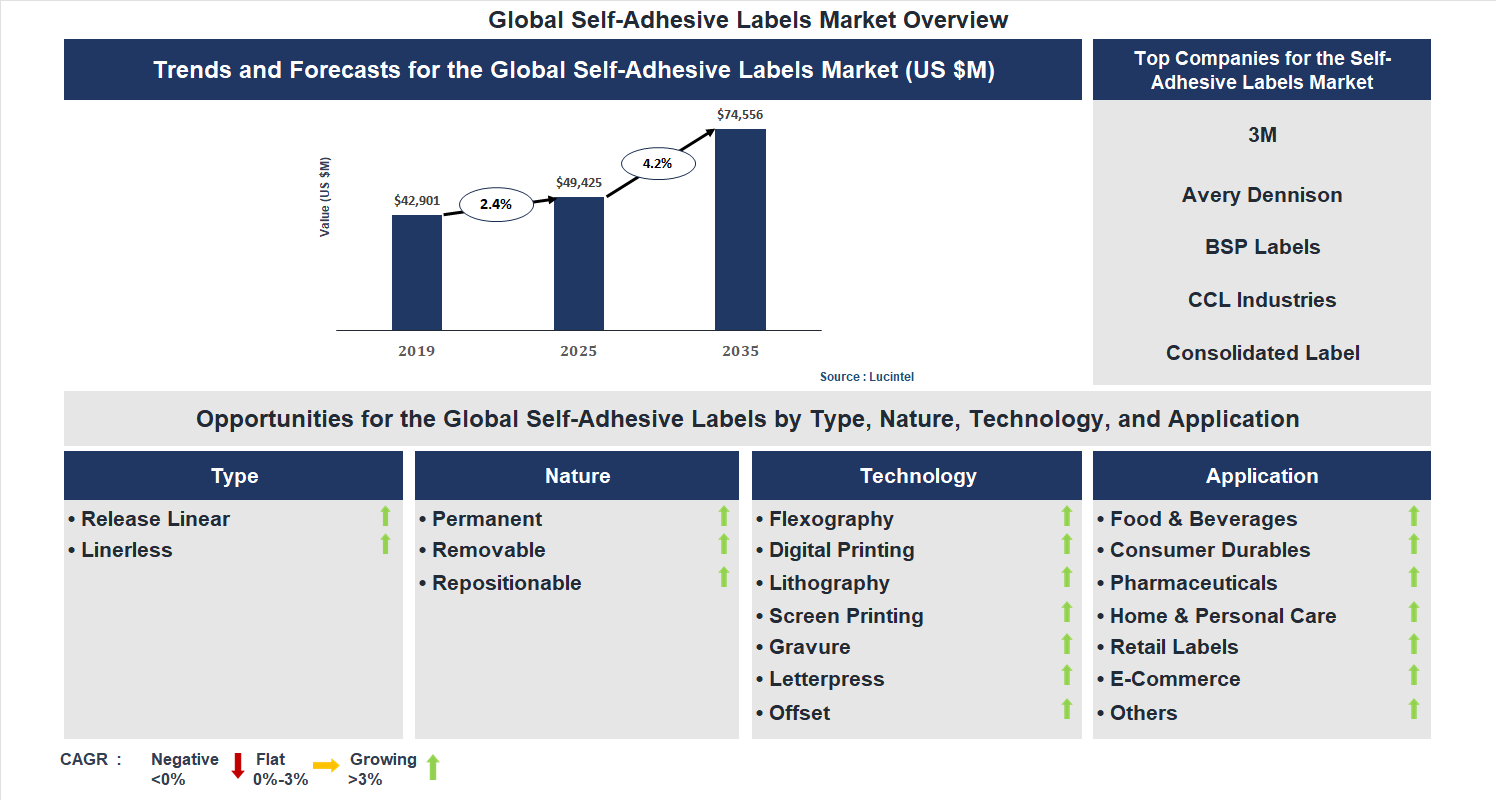
Emerging Trends in the Self-Adhesive Labels Market
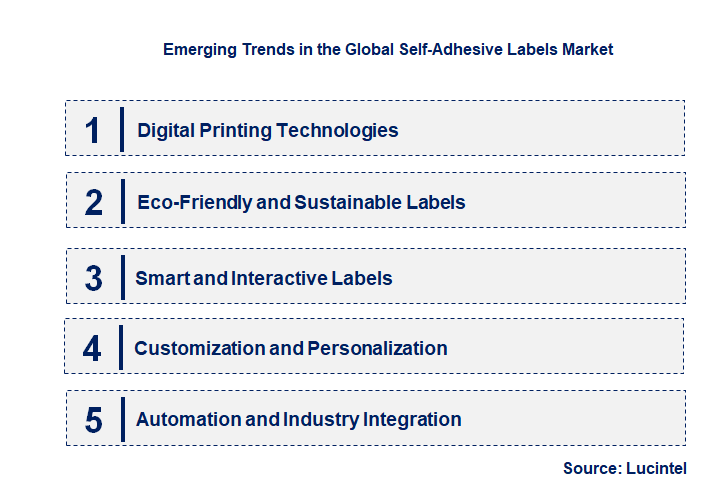
The self-adhesive labels market is experiencing rapid growth driven by technological advancements, evolving consumer preferences, and increasing demand across various industries such as retail, food and beverage, pharmaceuticals, and logistics. As businesses seek more efficient, customizable, and sustainable labeling solutions, the market is witnessing innovative trends that are transforming how products are branded, tracked, and managed. These developments are not only enhancing operational efficiency but also enabling brands to connect better with consumers through personalized and eco-friendly options. The following key trends highlight the dynamic nature of this market and its future trajectory.• Digital Printing Technologies: The adoption of digital printing in self-adhesive labels allows for high-quality, customizable, and short-run labels. This trend enables brands to quickly adapt to market changes, produce personalized labels, and reduce waste. Digital printing offers faster turnaround times and cost-effective solutions for small batches, making it ideal for promotional campaigns and limited editions. As technology advances, the quality and variety of digital labels continue to improve, providing greater flexibility and innovation in branding strategies.
• Eco-Friendly and Sustainable Labels: Increasing environmental awareness is driving demand for biodegradable, recyclable, and eco-friendly adhesives and materials. Manufacturers are developing labels using sustainable substrates like paper, plant-based adhesives, and water-based inks. This trend aligns with global efforts to reduce plastic waste and carbon footprints, appealing to environmentally conscious consumers. The shift towards sustainable labels not only enhances brand reputation but also complies with stricter regulations, fostering a greener supply chain and market growth.
• Smart and Interactive Labels: Integration of RFID, QR codes, NFC, and augmented reality (AR) into self-adhesive labels is creating smart, interactive packaging solutions. These labels enable real-time tracking, product authentication, and enhanced consumer engagement through digital content. The adoption of smart labels improves supply chain transparency, reduces counterfeiting, and offers personalized experiences to consumers. As IoT and digital technologies evolve, smart labels are becoming essential for brands aiming to innovate and differentiate in competitive markets.
• Customization and Personalization: The trend towards highly customized labels is driven by consumer demand for unique, personalized products. Advances in printing technology facilitate on-demand, tailored designs for individual customers or limited editions. This trend enhances brand loyalty and allows companies to target niche markets effectively. Personalization also extends to variable data printing, enabling the inclusion of unique serial numbers, expiry dates, or personalized messages, thereby increasing product value and consumer engagement.
• Automation and Industry Integration: The integration of automation, AI, and Industry 4.0 technologies in label manufacturing processes is increasing efficiency, reducing costs, and improving quality control. Automated systems streamline production, minimize errors, and enable rapid response to market demands. This trend supports mass customization and just-in-time production, making the market more agile and responsive. As digital transformation accelerates, automation is becoming a key driver for competitiveness and innovation within the self-adhesive labels industry.
These emerging trends are fundamentally reshaping the self-adhesive labels market by fostering innovation, sustainability, and efficiency. They enable companies to meet evolving consumer expectations, comply with environmental regulations, and leverage new digital technologies. As a result, the market is becoming more dynamic, competitive, and aligned with the broader trends of digital transformation and sustainability, paving the way for continued growth and diversification.
Recent Development in the Self-Adhesive Labels Market
The self-adhesive labels market is experiencing rapid growth driven by increasing demand across various industries such as retail, logistics, and food & beverage. Innovations in materials and printing technologies are enhancing label durability and customization options. E-commerce expansion and rising branding needs are further fueling market expansion. Companies are investing in sustainable solutions to meet environmental regulations. These developments are transforming the market landscape, creating new opportunities for manufacturers and end-users alike.• Growing Demand from Retail and Logistics Sectors: The retail and logistics industries are increasingly adopting self-adhesive labels for product identification, branding, and tracking. This demand is driven by the need for efficient inventory management and quick product turnaround. Enhanced label features like tamper-evidence and weather resistance are boosting adoption. As these sectors expand globally, the market benefits from higher volume sales and technological advancements, leading to increased competition and innovation.
• Technological Advancements in Printing and Materials: Innovations in printing techniques, such as digital and flexographic printing, are enabling high-quality, customizable labels at lower costs. New materials like biodegradable adhesives and eco-friendly substrates are gaining popularity, aligning with sustainability goals. These advancements improve label durability, adhesion, and visual appeal, meeting diverse industry requirements. Consequently, manufacturers can offer tailored solutions, expanding market reach and satisfying the growing demand for sustainable and high-performance labels.
• Rising Demand for Sustainable and Eco-Friendly Labels: Environmental concerns are prompting companies to adopt biodegradable, recyclable, and eco-friendly labels. This shift is driven by consumer preferences and stricter regulations. Sustainable labels reduce environmental impact and enhance brand image. The market is witnessing increased R&D investments to develop innovative eco-solutions. As sustainability becomes a key purchasing criterion, the market is expected to see significant growth in eco-friendly label segments, influencing supply chains and manufacturing practices.
• Expansion of E-commerce and Online Retail: The surge in e-commerce has increased the need for effective labeling solutions for packaging, shipping, and branding. Self-adhesive labels facilitate quick application, tamper-evidence, and branding consistency. The growth of online retail requires labels that withstand various environmental conditions during transit. This expansion is driving demand for innovative, durable, and cost-effective labeling options, creating new opportunities for market players to develop specialized products tailored for e-commerce logistics.
• Integration of Smart Labels and Digital Technologies: The adoption of smart labels with RFID, QR codes, and NFC technology is revolutionizing inventory management and consumer engagement. These labels enable real-time tracking, anti-counterfeiting, and interactive marketing. The integration of digital technologies enhances supply chain transparency and operational efficiency. As industries seek smarter solutions, the market is witnessing increased R&D investments and collaborations, positioning smart labels as a key growth driver in the evolving landscape.
The overall impact of these developments is a dynamic, innovative market characterized by increased customization, sustainability, and technological integration. These factors are expanding market size, improving product offerings, and meeting evolving customer demands, thereby fostering long-term growth and competitiveness in the self-adhesive labels industry.
Strategic Growth Opportunities in the Self-Adhesive Labels Market
The self-adhesive labels market is experiencing rapid expansion driven by increasing demand across various industries such as retail, logistics, food and beverage, and healthcare. Innovations in label materials, sustainability initiatives, and technological advancements are creating new growth avenues. Market players are focusing on product diversification, customization, and eco-friendly solutions to meet evolving consumer needs. The integration of digital printing and automation further enhances efficiency and quality, positioning the market for sustained growth and competitive advantage in the coming years.• Growing Demand for Sustainable and Eco-Friendly Labels: The shift towards environmentally conscious products is driving demand for biodegradable, recyclable, and eco-friendly self-adhesive labels. Companies are adopting sustainable materials like paper, plant-based adhesives, and water-based inks to reduce environmental impact. Regulatory pressures and consumer preferences are encouraging brands to switch to greener options, creating significant growth opportunities for manufacturers offering sustainable label solutions that meet quality and durability standards.
• Expansion of E-commerce Fueling Logistics and Shipping Labels: The rapid rise of e-commerce has increased the need for efficient packaging and tracking solutions, boosting demand for self-adhesive logistics and shipping labels. These labels require durability, weather resistance, and high-quality printing for tracking and branding. Innovations in barcode and RFID integration are enhancing supply chain management. As online shopping continues to grow globally, logistics labels are becoming essential, presenting substantial opportunities for market expansion and technological development.
• Technological Advancements in Digital Printing and Customization: The adoption of digital printing technologies allows for high-quality, short-run, and customized labels with quick turnaround times. This flexibility caters to brands seeking personalized packaging and promotional labels. The ability to produce variable data, such as QR codes and unique serial numbers, enhances marketing and traceability. As digital printing becomes more affordable and accessible, manufacturers can offer tailored solutions, opening new avenues for growth in niche markets and premium segments.
• Increasing Adoption of Smart Labels with IoT Integration: Smart self-adhesive labels embedded with RFID, NFC, or sensors are gaining traction across industries for enhanced tracking, authentication, and data collection. These labels enable real-time monitoring of products, temperature, and conditions, especially in pharmaceuticals, food safety, and logistics. The integration of IoT technology offers improved supply chain transparency and consumer engagement. Growing demand for smart labeling solutions presents significant opportunities for innovation and market penetration in high-value sectors.
• Rising Demand for Decorative and Premium Labels in Branding: Premium and decorative self-adhesive labels are increasingly used for branding, product differentiation, and packaging aesthetics. Features like embossing, holography, metallic finishes, and textured effects enhance visual appeal. Consumer goods, cosmetics, and luxury brands are investing in high-end labels to attract attention and convey quality. The trend towards attractive packaging design drives growth in the decorative label segment, encouraging manufacturers to develop innovative, eye-catching solutions that meet brand identity requirements.
The overall market outlook indicates that these growth opportunities will significantly influence the self-adhesive labels industry, fostering innovation, sustainability, and technological integration. Companies that capitalize on these trends are poised to strengthen their market position, meet evolving customer demands, and achieve sustained growth in a competitive landscape.
Self-Adhesive Labels Market Driver and Challenges
The self-adhesive labels market is influenced by a variety of technological, economic, and regulatory factors that shape its growth trajectory. Advances in printing technology and material science have enabled the production of more durable, customizable, and eco-friendly labels, fueling demand across industries. Economic factors such as rising consumer goods sales and expanding retail sectors contribute to market expansion, while regulatory standards regarding sustainability and labeling compliance impact product development and innovation. Additionally, the increasing adoption of automation and digital printing techniques enhances efficiency and customization capabilities. However, the market also faces challenges related to raw material costs, environmental regulations, and competition from alternative labeling solutions, which could hinder growth prospects.The factors responsible for driving the self-adhesive labels market include:
• Technological Innovation: The development of advanced printing techniques, such as digital and flexographic printing, allows for high-quality, customizable labels that meet diverse industry needs. Innovations in adhesive formulations improve label durability and removability, expanding application possibilities. These technological advancements enable manufacturers to offer eco-friendly options, such as biodegradable adhesives, aligning with sustainability trends. As a result, companies can cater to a broader customer base and enter new markets, fueling overall market growth.
• Growing Retail and Consumer Goods Sector: The expanding retail industry, including e-commerce, grocery, and personal care products, drives demand for attractive, informative, and tamper-evident labels. Consumer preferences for branded and personalized packaging increase the need for innovative labeling solutions. The rise in product launches and packaging innovations further boost demand for self-adhesive labels, which are cost-effective and easy to apply, thereby supporting the market’s expansion across various sectors.
• Increasing Focus on Sustainability: Environmental concerns and regulatory pressures are prompting manufacturers to develop eco-friendly labels using recyclable, biodegradable, or compostable materials. Governments and industry standards are encouraging sustainable practices, which influence product design and material selection. This shift not only helps companies meet compliance but also appeals to environmentally conscious consumers, creating new opportunities for market players to innovate and differentiate their offerings.
• Expansion of E-commerce and Logistics: The rapid growth of e-commerce has increased the need for efficient, high-quality labeling solutions for shipping, tracking, and branding. Self-adhesive labels facilitate quick application and are suitable for automated packaging lines, improving operational efficiency. The demand for tamper-evident and security labels in logistics further propels market growth. As online shopping continues to surge globally, the market benefits from increased adoption of self-adhesive labels in supply chain management.
• Rising Adoption of Digital Printing: Digital printing technology offers short-run, customized, and on-demand label production, reducing lead times and inventory costs. This flexibility is particularly attractive for small and medium-sized enterprises seeking personalized branding. The ability to quickly update designs and produce limited editions enhances market responsiveness. As digital printing becomes more affordable and widespread, it significantly contributes to the growth and diversification of the self-adhesive labels market.
The challenges facing this Market include:
• Fluctuating Raw Material Costs: The market heavily depends on raw materials such as adhesives, films, and inks, which are subject to price volatility due to supply chain disruptions, geopolitical tensions, and fluctuating oil prices. Rising costs can lead to increased product prices, affecting competitiveness and profit margins. Manufacturers may face difficulties in maintaining consistent quality and pricing strategies, which could hinder market growth and innovation.
• Stringent Environmental Regulations: Governments worldwide are implementing stricter regulations regarding the use of non-biodegradable materials and hazardous chemicals in adhesives and films. Compliance requires significant investment in research and development to develop sustainable alternatives, increasing operational costs. Non-compliance can result in penalties and damage to brand reputation, posing a substantial challenge for manufacturers to balance regulatory adherence with market demands.
• Intense Market Competition: The self-adhesive labels industry is highly competitive, with numerous local and international players vying for market share. Price wars, innovation race, and differentiation challenges pressure companies to continuously improve their offerings. Smaller firms may struggle to keep pace with technological advancements and regulatory requirements, leading to market consolidation. This competitive landscape can limit profit margins and slow down the pace of innovation.
The self-adhesive labels market is driven by technological advancements, expanding retail sectors, sustainability initiatives, e-commerce growth, and digital printing adoption. However, it faces challenges such as raw material cost fluctuations, strict environmental regulations, and intense competition. These factors collectively influence the market’s growth potential, requiring industry players to innovate and adapt strategically. Overall, the market’s future hinges on balancing innovation with regulatory compliance and cost management to capitalize on emerging opportunities.
List of Self-Adhesive Labels Companies
Companies in the market compete on the basis of product quality offered. Major players in this market focus on expanding their manufacturing facilities, R&D investments, infrastructural development, and leverage integration opportunities across the value chain. With these strategies self-adhesive labels companies cater increasing demand, ensure competitive effectiveness, develop innovative products & technologies, reduce production costs, and expand their customer base. Some of the self-adhesive labels companies profiled in this report include-• 3M
• Avery Dennison
• BSP Labels
• CCL Industries
• Consolidated Label
• Coveris Holdings
• CS Labels.
Self-Adhesive Labels Market by Segment
The study includes a forecast for the global self-adhesive labels market by type, nature, technology, application, and region.Self-Adhesive Labels Market by Type [Value from 2019 to 2035]:
• Release Linear
• Linerless
Self-Adhesive Labels Market by Nature [Value from 2019 to 2035]:
• Permanent
• Removable
• Repositionable
Self-Adhesive Labels Market by Technology [Value from 2019 to 2035]:
• Flexography
• Digital Printing
• Lithography
• Screen Printing
• Gravure
• Letterpress
• Offset
Self-Adhesive Labels Market by Application [Value from 2019 to 2035]:
• Food & Beverages
• Consumer Durables
• Pharmaceuticals
• Home & Personal Care
• Retail Labels
• E-Commerce
• Others
Self-Adhesive Labels Market by Region [Value from 2019 to 2035]:
• North America
• Europe
• Asia Pacific
• The Rest of the World
Country Wise Outlook for the Self-Adhesive Labels Market
The self-adhesive labels market has experienced significant growth driven by increasing demand across various industries such as retail, logistics, food and beverage, and pharmaceuticals. Technological advancements, sustainability initiatives, and evolving consumer preferences are shaping the market landscape. Countries are adopting innovative materials and eco-friendly solutions to meet regulatory standards and consumer expectations. The market‘s expansion is also fueled by the rise of e-commerce and automation, which require efficient labeling solutions. As the market continues to evolve, key players are focusing on product innovation, strategic partnerships, and expanding their geographic reach to capitalize on emerging opportunities.• United States: The U.S. market has seen rapid adoption of eco-friendly self-adhesive labels, driven by stringent environmental regulations and consumer demand for sustainable products. Technological innovations such as digital printing and smart labels are gaining popularity, enhancing customization and traceability. The growth of e-commerce and logistics sectors has further boosted demand, with companies investing in high-speed, cost-effective labeling solutions. Major players are expanding their product portfolios to include biodegradable and recyclable labels, aligning with sustainability goals. Additionally, automation and Industry 4.0 integration are improving production efficiency and quality control.
• China: China remains a dominant force in the self-adhesive labels market, fueled by its massive manufacturing sector and expanding retail industry. The country is witnessing increased adoption of digital printing technologies and innovative adhesive materials to meet diverse industry needs. Government initiatives promoting sustainable packaging are encouraging manufacturers to develop eco-friendly labels. The rapid growth of e-commerce platforms like Alibaba and JD.com has significantly increased demand for efficient, high-volume labeling solutions. Local companies are investing in R&D to develop smart labels with RFID and QR code functionalities, enhancing product tracking and consumer engagement.
• Germany: Germany‘s market is characterized by a strong focus on high-quality, durable, and environmentally friendly labels. The country is a leader in adopting sustainable materials and eco-design practices, driven by strict EU regulations. Technological advancements such as holographic and tamper-evident labels are gaining traction for security and branding purposes. The automotive, pharmaceutical, and food sectors are key consumers, demanding innovative labeling solutions. German manufacturers are also investing in automation and digital printing to improve efficiency and customization. The emphasis on circular economy principles is prompting the development of recyclable and biodegradable label options.
• India: The Indian self-adhesive labels market is experiencing rapid growth due to expanding manufacturing, retail, and FMCG sectors. Increasing urbanization and changing consumer preferences are driving demand for attractive, innovative labels. The adoption of digital printing and eco-friendly adhesives is rising, aligning with global sustainability trends. The government’s initiatives like Make in India and Digital India are boosting manufacturing capabilities and technological adoption. Small and medium enterprises are adopting cost-effective, high-quality labeling solutions to enhance product appeal. The growth of e-commerce and export markets is further fueling demand for versatile, durable labels suitable for diverse applications.
• Japan: Japan‘s market emphasizes high-quality, technologically advanced self-adhesive labels, with a focus on sustainability and innovation. The country is adopting eco-friendly materials and biodegradable adhesives to comply with strict environmental standards. Smart labels incorporating RFID and NFC technologies are increasingly used in logistics, retail, and pharmaceuticals for enhanced traceability and consumer interaction. Japan‘s industries, including electronics, automotive, and food, demand durable, tamper-evident, and security labels. Companies are investing in automation, digital printing, and R&D to develop cutting-edge solutions that meet both regulatory and consumer expectations. The market continues to evolve with a focus on sustainability and technological integration.

Features of the Global Self-Adhesive Labels Market
Market Size Estimates: Self-adhesive labels market size estimation in terms of value ($M).Trend and Forecast Analysis: Market trends (2019 to 2025) and forecast (2026 to 2035) by various segments and regions.
Segmentation Analysis: Self-adhesive labels market size by various segments, such as by type, nature, technology, application, and region in terms of value ($M).
Regional Analysis: Self-adhesive labels market breakdown by North America, Europe, Asia Pacific, and Rest of the World.
Growth Opportunities: Analysis of growth opportunities in different type, nature, technology, application, and regions for the self-adhesive labels market.
Strategic Analysis: This includes M&A, new product development, and competitive landscape of the self-adhesive labels market.
Analysis of competitive intensity of the industry based on Porter’s Five Forces model.

FAQ
Q1. What is the self-adhesive labels market size?Answer: The global self-adhesive labels market is expected to reach an estimated $74556 million by 2035.
Q2. What is the growth forecast for self-adhesive labels market?
Answer: The global self-adhesive labels market is expected to grow with a CAGR of 4.2% from 2026 to 2035.
Q3. What are the major drivers influencing the growth of the self-adhesive labels market?
Answer: The major drivers for this market are the rising demand for durable & high-quality labels, the increasing demand for packaged goods across industries, and the growing adoption in logistics & supply chain management.
Q4. What are the major segments for self-adhesive labels market?
Answer: The future of the self-adhesive labels market looks promising with opportunities in the food & beverage, consumer durable, pharmaceutical, home & personal care, retail label, and e-commerce markets.
Q5. Who are the key self-adhesive labels market companies?
Answer: Some of the key self-adhesive labels companies are as follows:
• 3M
• Avery Dennison
• BSP Labels
• CCL Industries
• Consolidated Label
• Coveris Holdings
• CS Labels.
Q6. Which self-adhesive labels market segment will be the largest in future?Answer: Lucintel forecasts that, within the type category, release linear is expected to witness higher growth over the forecast period.
Q7. In self-adhesive labels market, which region is expected to be the largest in next 8 years?
Answer: In terms of region, APAC is expected to witness the highest growth over the forecast period.
Q8. Do we receive customization in this report?
Answer: Yes, Lucintel provides 10% customization without any additional cost.
Table of Contents
List of Figures
List of Tables
Methodology
- In-depth interviews of the major players in this market
- Detailed secondary research from competitors’ financial statements and published data
- Extensive searches of published works, market, and database information pertaining to industry news, company press releases, and customer intentions
- A compilation of the experiences, judgments, and insights of Lucintel’s professionals, who have analyzed and tracked this market over the years.


Buy Now
Choose a license that fits your team. Instant PDF delivery.
Prices exclude taxes. Instant delivery. Custom licensing available on request.
Key Questions
- • What are some of the most promising, high-growth opportunities for the self-adhesive labels market by type (release linear and linerless), nature (permanent, removable, and repositionable), technology (flexography, digital printing, lithography, screen printing, gravure, letterpress, and offset), application (food & beverages, consumer durables, pharmaceuticals, home & personal care, retail labels, e-commerce, and others), and region (North America, Europe, Asia Pacific, and the Rest of the World)?
- • Which segments will grow at a faster pace and why?
- • Which region will grow at a faster pace and why?
- • What are the key factors affecting market dynamics? What are the key challenges and business risks in this market?
- • What are the business risks and competitive threats in this market?
- • What are the emerging trends in this market and the reasons behind them?
- • What are some of the changing demands of customers in the market?
- • What are the new developments in the market? Which companies are leading these developments?
- • Who are the major players in this market? What strategic initiatives are key players pursuing for business growth?
- • What are some of the competing products in this market and how big of a threat do they pose for loss of market share by material or product substitution?
- • What M&A activity has occurred in the last 7 years and what has its impact been on the industry? For any questions related to Self-Adhesive Labels Market, Self-Adhesive Labels Market Size, Self-Adhesive Labels Market Growth, Self-Adhesive Labels Market Analysis, Self-Adhesive Labels Market Report, Self-Adhesive Labels Market Share, Self-Adhesive Labels Market Trends, Self-Adhesive Labels Market Forecast, Self-Adhesive Labels Companies, write Lucintel analyst at email: helpdesk@lucintel.com. We will be glad to get back to you soon.


