
Report Feature
Selenium Market Trends and Forecast
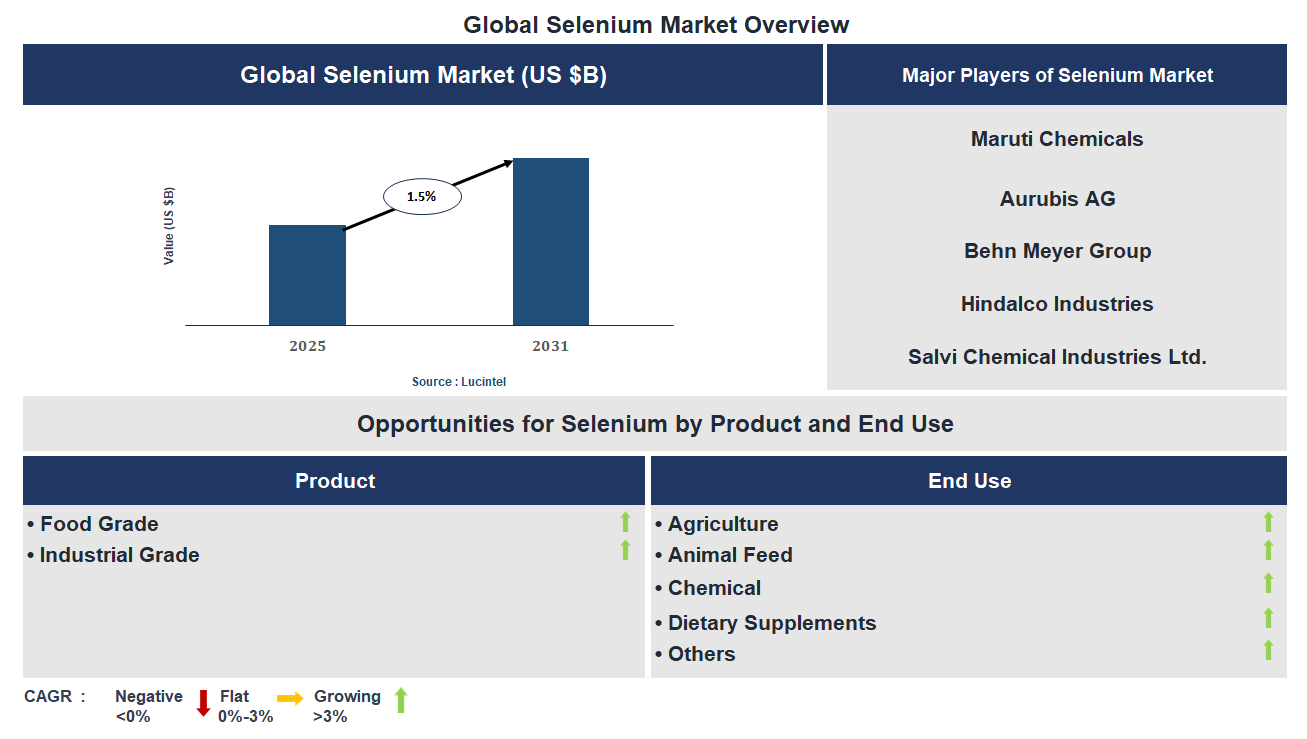
The future of the global selenium market looks promising with opportunities in the agriculture, animal feed, chemical, and dietary supplement markets. The global selenium market is expected to grow with a CAGR of 1.5% from 2025 to 2031. The major drivers for this market are the increasing demand for dietary supplements, the rising use of selenium in agriculture, and the growing applications in electronics & solar cells.• Lucintel forecasts that, within the product category, food grade is expected to witness higher growth over the forecast period.
• Within the end use category, dietary supplement is expected to witness the highest growth.
• In terms of region, APAC is expected to witness the highest growth over the forecast period. Gain valuable insights for your business decisions with our comprehensive 150+ page report. Sample figures with some insights are shown below.
Emerging Trends in the Selenium Market
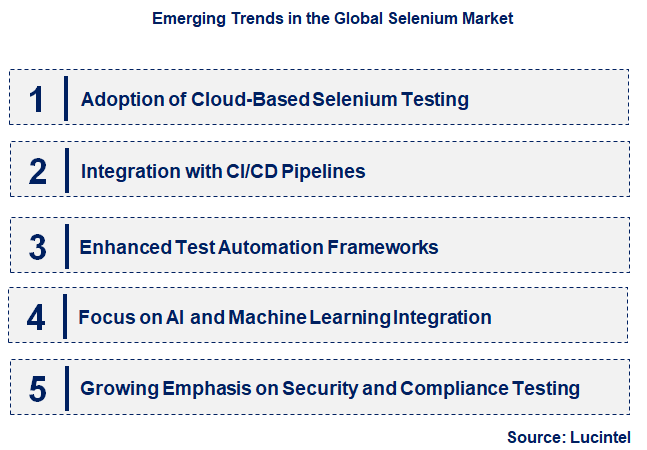
The selenium market is experiencing rapid evolution driven by technological advancements, increasing demand for automation testing, and a shift towards more integrated and efficient testing solutions. As businesses prioritize quality assurance and faster deployment cycles, the market is adapting to meet these needs through innovative tools, enhanced integrations, and a focus on user-friendly interfaces. These developments are not only expanding the scope of Selenium applications but also transforming how organizations approach software testing. The following key trends highlight the major shifts shaping the future of the selenium market, reflecting its growing importance in the broader automation landscape.• Adoption of Cloud-Based Selenium Testing: The shift to cloud platforms allows for scalable, flexible, and cost-effective testing environments. Cloud-based Selenium testing enables teams to run tests across multiple browsers and devices without the need for extensive infrastructure. This trend improves collaboration, accelerates testing cycles, and reduces costs, making automation more accessible to organizations of all sizes. As cloud services continue to evolve, expect more integrated solutions that streamline setup and management, further boosting Selenium’s reach and efficiency.
• Integration with CI/CD Pipelines: Continuous Integration and Continuous Deployment (CI/CD) pipelines are becoming standard in software development. Selenium tools are increasingly integrated into these pipelines, enabling automated testing at every stage of development. This integration ensures faster feedback loops, early detection of bugs, and higher quality releases. It also promotes a DevOps culture, where testing is seamlessly embedded into development workflows, reducing manual effort and increasing deployment speed. This trend is vital for organizations aiming for rapid, reliable software delivery.
• Enhanced Test Automation Frameworks: The development of more sophisticated and user-friendly automation frameworks is a significant trend. These frameworks offer better modularity, reusability, and reporting capabilities, making test creation and maintenance easier. Tools like Selenium Grid, WebDriverIO, and custom frameworks are evolving to support complex testing scenarios, including mobile and cross-browser testing. This trend improves test coverage, reduces time-to-market, and allows teams to adapt quickly to changing requirements, ultimately increasing the efficiency and effectiveness of automation efforts.
• Focus on AI and Machine Learning Integration: Incorporating AI and machine learning into Selenium testing is gaining momentum. These technologies help in test case generation, defect prediction, and intelligent test execution, reducing manual effort and increasing accuracy. AI-driven tools can identify flaky tests, optimize test suites, and provide insights into test results, enhancing overall quality. This integration is transforming Selenium from a simple automation tool into a smarter, more adaptive testing solution, capable of handling complex and dynamic applications more effectively.
• Growing Emphasis on Security and Compliance Testing: As cybersecurity concerns rise, Selenium is increasingly used for security testing and compliance validation. Automated scripts are employed to identify vulnerabilities, ensure adherence to standards, and validate security protocols across web applications. This trend is driven by regulatory requirements and the need for robust security measures. Enhanced security testing capabilities within Selenium frameworks help organizations mitigate risks, protect user data, and maintain trust, making security an integral part of the automation testing landscape. In summary, these trends are reshaping the selenium market by making automation more scalable, integrated, intelligent, and security-focused. They enable faster, more reliable software delivery while reducing costs and manual effort. As these developments continue, Selenium’s role in the broader automation ecosystem will expand, driving innovation and improving software quality across industries.
Recent Development in the Selenium Market
The selenium market has experienced significant growth driven by increasing demand for automation in testing, rising adoption across various industries, and technological advancements. As companies seek more efficient and reliable testing solutions, the market is evolving rapidly. Recent developments reflect a shift towards innovative products, strategic collaborations, and expanding applications, which are shaping the future landscape of Selenium-based testing tools. These changes are not only enhancing product capabilities but also broadening market reach and adoption, ultimately impacting the overall growth trajectory of the selenium market.• Expansion of Selenium Tool Ecosystem: The market has seen the launch of new Selenium frameworks and integrations, improving testing efficiency. These developments enable easier automation, better compatibility with various programming languages, and enhanced user experience, leading to wider adoption among developers and testers.
• Strategic Collaborations and Partnerships: Major tech companies and testing service providers are forming alliances to develop advanced testing solutions. These collaborations facilitate resource sharing, innovation, and market penetration, accelerating the deployment of Selenium-based tools across industries.
• Integration with AI and Machine Learning: Incorporating AI and ML into Selenium testing tools has improved test accuracy, reduced manual effort, and enabled predictive analytics. This integration enhances testing processes, making them more intelligent and adaptive to complex applications.
• Growing Adoption in Emerging Markets: Increasing awareness and digital transformation initiatives in emerging economies are driving Selenium adoption. Localized support, training programs, and affordable solutions are expanding the market footprint in these regions.
• Development of Cloud-Based Selenium Testing Platforms: The shift towards cloud computing has led to the emergence of cloud-based Selenium testing services. These platforms offer scalability, cost-efficiency, and remote access, making automated testing more accessible and flexible for organizations. In summary, these recent developments are significantly impacting the selenium market by fostering innovation, expanding application areas, and increasing accessibility. The integration of advanced technologies and strategic collaborations is propelling market growth, making Selenium a vital component in the automation testing landscape. As a result, the market is poised for continued expansion, driven by evolving industry needs and technological advancements.
Strategic Growth Opportunities in the Selenium Market
The selenium market is experiencing significant growth driven by increasing demand across various industries such as electronics, healthcare, agriculture, and manufacturing. As technological advancements and regulatory changes evolve, companies are exploring new applications and expanding existing ones to capitalize on emerging opportunities. This dynamic environment presents multiple avenues for strategic growth, enabling market players to enhance their competitive edge and meet rising global demand. Understanding these key growth opportunities by application is essential for stakeholders aiming to optimize their investments and innovate effectively in this expanding market landscape.• Enhanced Semiconductor Production: The rising demand for semiconductors in consumer electronics, automotive, and industrial applications is fueling seleniums use in photoelectric devices and rectifiers, boosting overall market growth.
• Diagnostic and Therapeutic Applications: Seleniums antioxidant properties are increasingly utilized in medical diagnostics and supplements, creating opportunities for pharmaceutical and healthcare companies to develop advanced selenium-based products.
• Fertilizer and Crop Protection: Selenium-enriched fertilizers are gaining popularity for improving crop yield and nutritional content, offering growth prospects for agricultural input manufacturers.
• Specialty Glass Production: Selenium compounds are essential in manufacturing colored glass and pigments, with expanding applications in art, architecture, and electronics, driving demand in the specialty glass segment.
• Environmental and Waste Management: Seleniums role in pollution control, especially in wastewater treatment and emission control systems, presents opportunities for environmental technology firms to develop sustainable solutions. In summary, these growth opportunities across key applications are significantly impacting the selenium market by expanding its scope and increasing demand. The diversification into electronics, healthcare, agriculture, specialty glass, and environmental sectors is fostering innovation and driving market expansion. As industries recognize seleniums versatile properties, strategic investments in these areas are expected to sustain long-term growth and competitiveness in the global market.
Selenium Market Driver and Challenges
The selenium market is influenced by a variety of technological, economic, and regulatory factors that shape its growth and development. Advances in automation and testing technologies drive demand for Selenium as a key tool for software quality assurance. Economic factors such as increasing digital transformation initiatives and the need for cost-effective testing solutions further propel market expansion. Regulatory standards emphasizing software reliability and security also impact adoption rates. Conversely, challenges such as evolving technology landscapes, skill shortages, and regulatory complexities pose hurdles. Understanding these drivers and challenges is essential for stakeholders to navigate the market effectively and capitalize on emerging opportunities. The factors responsible for driving the selenium market include:-• Technological Innovation: The rapid evolution of automation tools and frameworks enhances Seleniums capabilities, making it more attractive for developers seeking efficient testing solutions. Continuous improvements in browser compatibility, integration with CI/CD pipelines, and support for various programming languages expand Selenium’s usability. This technological progression reduces testing time and costs, encouraging widespread adoption across industries. As organizations prioritize faster release cycles and higher software quality, Selenium’s role becomes increasingly vital, fueling market growth.
• Increasing Adoption of Agile and DevOps: The shift towards Agile and DevOps methodologies emphasizes continuous testing and integration, requiring reliable automation tools. Selenium’s open-source nature and flexibility make it a preferred choice for integrating automated testing into development workflows. This trend accelerates the deployment of Selenium-based solutions, enabling faster feedback loops and improved product quality. As more organizations adopt these methodologies, the demand for Selenium in testing ecosystems continues to rise, driving market expansion.
• Growing Digital Transformation Initiatives: Businesses across sectors are investing heavily in digital transformation to enhance customer experience and operational efficiency. Automated testing tools like Selenium are crucial for supporting these initiatives by ensuring rapid and reliable software deployment. The increasing complexity of applications, including mobile and cloud-based solutions, further boosts the need for versatile testing tools. Selenium’s ability to adapt to diverse environments makes it indispensable, thereby expanding its market reach.
• Cost-Effectiveness and Open-Source Advantage: Selenium’s open-source model eliminates licensing costs, making it accessible to organizations of all sizes. This affordability, combined with a large community of developers contributing to its continuous improvement, makes Selenium a cost-effective solution for automated testing. Companies seeking to optimize testing budgets without compromising quality are increasingly adopting Selenium, which in turn fuels market growth. The availability of extensive resources and support further enhances its appeal. The challenges facing this selenium market include:-
• Rapid Technological Changes: The fast-paced evolution of testing tools and frameworks creates a dynamic environment where staying current is challenging. Compatibility issues with emerging browsers, platforms, and programming languages require continuous updates and adaptations. Organizations may face difficulties in maintaining and upgrading their Selenium-based testing environments, which can lead to increased costs and delays. This rapid change can also fragment the market, making it harder for users to select the most suitable tools and strategies.
• Skill Shortages and Training Gaps: The demand for skilled automation testers proficient in Selenium and related technologies exceeds supply. Organizations often struggle to find qualified personnel, leading to delays in implementation and suboptimal testing outcomes. Additionally, the need for ongoing training to keep pace with technological updates adds to operational costs. This skills gap hampers the widespread adoption of Selenium and limits its potential growth in certain regions or industries.
• Regulatory and Security Concerns: Increasing regulatory requirements around data security and privacy impact automation testing practices. Ensuring compliance while maintaining efficient testing processes can be complex, especially when dealing with sensitive data. Security vulnerabilities in automation tools or scripts pose risks that need careful management. Navigating these regulatory landscapes requires additional resources and expertise, which can slow down deployment and innovation within the selenium market. In summary, the selenium market is driven by technological advancements, methodological shifts, and the need for cost-effective solutions, all of which promote growth. However, rapid technological changes, skill shortages, and regulatory complexities present significant challenges that could hinder progress. Overall, the market’s future depends on how effectively stakeholders can leverage drivers while addressing these challenges. Strategic investments in training, technology updates, and compliance will be crucial for sustained growth and competitive advantage in this evolving landscape.
List of Selenium Companies
Companies in the market compete on the basis of product quality offered. Major players in this market focus on expanding their manufacturing facilities, R&D investments, infrastructural development, and leverage integration opportunities across the value chain. With these strategies selenium companies cater increasing demand, ensure competitive effectiveness, develop innovative products & technologies, reduce production costs, and expand their customer base. Some of the selenium companies profiled in this report include-• Maruti Chemicals
• Aurubis AG
• Behn Meyer Group
• Hindalco Industries
• Salvi Chemical Industries Ltd.
• Able Target Limited
• Shinko Chemical Co.
• Umicore
• JX Nippon Mining & Metals Corporation
• American Elements
Selenium Market by Segment
The study includes a forecast for the global selenium market by product, end use, and region.Selenium Market by Product [Value from 2019 to 2031]:
• Food Grade
• Industrial Grade
Selenium Market by End Use [Value from 2019 to 2031]:
• Agriculture
• Animal Feed
• Chemical
• Dietary Supplements
• Others
Selenium Market by Region [Value from 2019 to 2031]:
• North America
• Europe
• Asia Pacific
• The Rest of the World
Country Wise Outlook for the Selenium Market
The selenium market has experienced significant growth driven by increasing demand for automation testing in software development, expanding applications in healthcare, automotive, and electronics industries, and rising adoption of cloud-based testing solutions. Technological advancements and the integration of AI and machine learning are further propelling market expansion across key regions. Countries are investing in research and development to enhance Selenium tools and frameworks, aiming to improve testing efficiency and accuracy. The competitive landscape is evolving with new entrants offering innovative solutions, while established players focus on strategic partnerships and product upgrades to maintain their market position. These developments reflect a dynamic and rapidly evolving selenium market globally.• United States: The US market has seen rapid adoption of Selenium for automation testing, driven by the growth of the tech sector and increased focus on quality assurance. Major companies are investing in AI-powered testing tools, and cloud-based Selenium solutions are gaining popularity. The government and private sectors are also adopting Selenium for regulatory compliance and software validation, boosting market growth. Additionally, the US is witnessing a surge in startups offering innovative testing frameworks, contributing to a competitive landscape.
• China: Chinas selenium market is expanding due to the booming IT industry and increased digital transformation initiatives. Local companies are developing customized Selenium solutions tailored to regional needs, and there is a growing emphasis on automation in manufacturing and e-commerce sectors. Government policies supporting technological innovation and software development are further fueling market growth. The adoption of cloud testing platforms and integration with AI tools is also on the rise, enhancing testing efficiency.
• Germany: The German market is characterized by a focus on industrial automation and automotive software testing, where Selenium plays a crucial role. Companies are investing in advanced testing frameworks to ensure high-quality software for manufacturing and automotive applications. The emphasis on Industry 4.0 and smart manufacturing is driving demand for reliable automation testing tools. Additionally, Germanys strong emphasis on quality standards and compliance is encouraging the adoption of Selenium-based testing solutions.
• India: India’s selenium market is witnessing rapid growth due to the expanding IT and software services industry. The increasing adoption of agile and DevOps practices is boosting demand for automation testing tools. Local firms are developing cost-effective Selenium solutions to cater to small and medium enterprises. Government initiatives promoting digital literacy and software development are also contributing to market expansion. The rise of remote working and cloud-based testing platforms further accelerates adoption across various sectors.
• Japan: The Japanese selenium market is driven by the automotive, electronics, and manufacturing sectors, which require rigorous testing standards. Companies are integrating Selenium with AI and machine learning to enhance testing accuracy and speed. The focus on quality assurance and compliance with international standards is promoting Selenium adoption. Japan’s emphasis on innovation and automation in industrial processes is also fostering the development of advanced testing solutions, ensuring high reliability and efficiency in software testing practices.

Features of the Global Selenium Market
Market Size Estimates: Selenium market size estimation in terms of value ($B). Trend and Forecast Analysis: Market trends (2019 to 2024) and forecast (2025 to 2031) by various segments and regions. Segmentation Analysis: Selenium market size by product, end use, and region in terms of value ($B). Regional Analysis: Selenium market breakdown by North America, Europe, Asia Pacific, and Rest of the World. Growth Opportunities: Analysis of growth opportunities in different products, end uses, and regions for the selenium market. Strategic Analysis: This includes M&A, new product development, and competitive landscape of the selenium market. Analysis of competitive intensity of the industry based on Porter’s Five Forces model.
FAQ
Q1. What is the growth forecast for selenium market? Answer: The global selenium market is expected to grow with a CAGR of 1.5% from 2025 to 2031. Q2. What are the major drivers influencing the growth of the selenium market? Answer: The major drivers for this market are the increasing demand for dietary supplements, the rising use of selenium in agriculture, and the growing applications in electronics & solar cells. Q3. What are the major segments for selenium market? Answer: The future of the selenium market looks promising with opportunities in the agriculture, animal feed, chemical, and dietary supplement markets. Q4. Who are the key selenium market companies? Answer: Some of the key selenium companies are as follows:• Maruti Chemicals
• Aurubis AG
• Behn Meyer Group
• Hindalco Industries
• Salvi Chemical Industries Ltd.
• Able Target Limited
• Shinko Chemical Co.
• Umicore
• JX Nippon Mining & Metals Corporation
• American Elements Q5. Which selenium market segment will be the largest in future? Answer: Lucintel forecasts that, within the product category, food grade is expected to witness higher growth over the forecast period. Q6. In selenium market, which region is expected to be the largest in next 5 years? Answer: In terms of region, APAC is expected to witness the highest growth over the forecast period. Q7. Do we receive customization in this report? Answer: Yes, Lucintel provides 10% customization without any additional cost.
Table of Contents
List of Figures
List of Tables
Methodology
- In-depth interviews of the major players in this market
- Detailed secondary research from competitors’ financial statements and published data
- Extensive searches of published works, market, and database information pertaining to industry news, company press releases, and customer intentions
- A compilation of the experiences, judgments, and insights of Lucintel’s professionals, who have analyzed and tracked this market over the years.


Buy Now
Choose a license that fits your team. Instant PDF delivery.
Prices exclude taxes. Instant delivery. Custom licensing available on request.
Key Questions
- • What are some of the most promising, high-growth opportunities for the selenium market by product (food grade and industrial grade), end use (agriculture, animal feed, chemical, dietary supplements, and others), and region (North America, Europe, Asia Pacific, and the Rest of the World)?
- • Which segments will grow at a faster pace and why?
- • Which region will grow at a faster pace and why?
- • What are the key factors affecting market dynamics? What are the key challenges and business risks in this market?
- • What are the business risks and competitive threats in this market?
- • What are the emerging trends in this market and the reasons behind them?
- • What are some of the changing demands of customers in the market?
- • What are the new developments in the market? Which companies are leading these developments?
- • Who are the major players in this market? What strategic initiatives are key players pursuing for business growth?
- • What are some of the competing products in this market and how big of a threat do they pose for loss of market share by material or product substitution?
- • What M&A activity has occurred in the last 5 years and what has its impact been on the industry? For any questions related to Selenium Market, Selenium Market Size, Selenium Market Growth, Selenium Market Analysis, Selenium Market Report, Selenium Market Share, Selenium Market Trends, Selenium Market Forecast, Selenium Companies, write Lucintel analyst at email: helpdesk@lucintel.com. We will be glad to get back to you soon.


