
'
...

The Impact of COVID-19 is included in Seismic Service Market Report. Buy it today to get an advantage.

Request the impact of COVID-19 on your product or industry


Seismic Service Market Trends and Forecast

The future of the global seismic service market looks promising with opportunities in the oil & gas, mining, geothermal, and construction/engineering markets. The global seismic service market is expected to grow with a CAGR of 6.7% from 2025 to 2031. The major drivers for this market are the increasing exploration activities for oil reserves, the rising demand for advanced seismic imaging, and the growing investment in offshore energy projects.

• Lucintel forecasts that, within the service category, data acquisition is expected to witness the highest growth over the forecast period.
• Within the application category, oil & gas is expected to witness the highest growth.
• In terms of region, APAC is expected to witness the highest growth over the forecast period.
Gain valuable insights for your business decisions with our comprehensive 150+ page report. Sample figures with some insights are shown below.

Seismic Service Market Trends and Forecast

Emerging Trends in the Seismic Service Market

The seismic service industry is evolving beyond traditional hydrocarbon exploration, integrating advanced data analytics, renewable-energy applications and environmental monitoring. The following key trends illustrate how seismic services are being redefined across global markets.
• Advanced 4D/High-density Imaging: Seismic service providers are deploying high-density 3D and 4D seismic surveys to enhance subsurface resolution and reservoir characterization. This enables more accurate modelling of complex geology, supports enhanced oil recovery and facilitates monitoring of carbon-storage or geothermal reservoirs, thereby increasing value beyond standard 2D/3D surveys.
• Multi-Client Data Libraries & Digitalization: Firms are building multi-client seismic libraries and leveraging digitalization (cloud, AI/ML) to enable reuse of seismic data and faster interpretation. This lowers acquisition cost per project, accelerates decision-making and broadens service models into data-as-a-service rather than one-off surveys.
• Expansion into Renewable & Storage Applications: The seismic services market is branching into geothermal energy, carbon capture & storage (CCS) and wind-foundation assessments. For example, seismic campaigns in Germany for deep geothermal are indicative of this shift. This broadens the application base and aligns with energy-transition agendas.
• Land and Transition-Zone Growth Focus: While offshore has been dominant, there’s increased activity in land-based and transition-zone (onshore-to-offshore) seismic acquisition, especially in emerging markets. These segments allow access to previously under-surveyed areas like inland basins and rift zones, giving service firms new growth avenues.
• Regulatory & Environmental Compliance Integration: With increasing scrutiny of seismic operations (noise, disturbance, ecological impact), service firms are embedding regulatory and environmental compliance into their offerings. Community-engagement, low-impact acquisition methods and ESG reporting are becoming differentiators in proposal evaluations.
These trends are reshaping the seismic service market by transforming it from a narrowly hydrocarbon-focused sector into a diversified subsurface-imaging industry supporting multiple energy and infrastructure domains. Service firms with broad digital capabilities, multi-application offerings and environmental-compliant operations are likely to lead in this new paradigm.
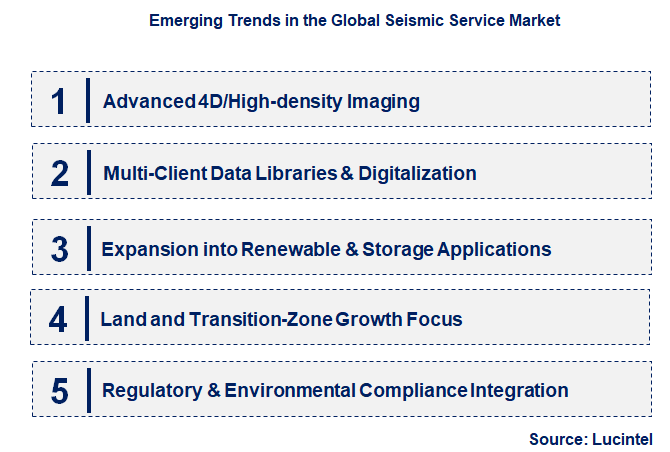
Emerging Trends in the Seismic Service Market

Recent Development in the Seismic Service Market

Recent years have witnessed several consequential developments in the seismic services domain. These are driven by evolving technology, new applications and changing market needs, raising the competitive bar for service providers.
• Major Offshore Contract Awards: Large seismic acquisition contracts, such as a 3D streamer contract for Oil and Natural Gas Corporation (ONGC) offshore India in the Mahanadi basin, signal renewed investment in frontier E&P zones and expansion of seismic service scope.
• Geothermal-Driven Seismic Campaigns: Germany’s large-scale 3D seismic campaign near Münster to assess deep geothermal reservoirs shows the seismic service industry is aligning with heat-transition strategies beyond oil & gas.
• Shift to Multi-Client & Re-use Models: Seismic service companies are increasingly offering multi-client data libraries and subscription-style models, reducing cost barriers and speeding up exploration phases for clients.
• Technology Upgrade to High-Density / Real-Time Imaging: The adoption of high-density sensor arrays, real-time data streaming and advanced processing techniques is enabling higher-quality subsurface imaging and shorter turnaround times.
• Regulation & ESG-Driven Market Adjustments: The need to align seismic operations with environmental regulations, social acceptance and ESG frameworks is driving changes in acquisition practices, stakeholder engagement and risk-mitigation strategies.
Collectively, these developments are elevating the seismic services sector from commodity survey work to strategic subsurface-information services. Companies able to harness advanced technology, diversify their application base and navigate regulatory complexity will define the next phase of market leadership.

Strategic Growth Opportunities in the Seismic Service Market

The seismic service market is positioned for growth across several application segments, each with distinct strategic opportunity. The following five application-based opportunities offer high potential for seismic service providers to expand and differentiate.
• Oil & Gas Exploration – Mature-Field Optimization: In mature basins, seismic services can support enhanced oil-recovery, well-placement optimization and reservoir monitoring. Providers who offer 4D imaging and real-time interpretation add value to operators seeking cost-effective gains from existing assets.
• Geothermal & Heat Supply Systems: As governments pursue decarbonization, seismic services can support geothermal resource characterization, drilling planning and subsurface risk mitigation. This opens non-traditional revenue paths for seismic companies focused on energy-transition markets.
• Carbon Capture, Utilization & Storage: Seismic imaging plays a key role in CO₂-storage site selection, monitoring leakage and ensuring integrity of storage reservoirs. Seismic service firms that build expertise in such subsurface-monitoring solutions can tap growing CCS demand.
• Mining, Minerals & Critical-Metal Exploration: The push for critical-metal and rare-earth exploration (for batteries, renewables) creates a demand for seismic and geophysical surveys beyond hydrocarbons. Seismic providers who reposition into this space gain access to expanding mining investment.
• Infrastructure & Geohazard Assessment: Urban infrastructure, civil projects and dam safety programmers increasingly call for seismic-survey services for subsurface risk assessment. Service firms that adapt to these smaller-volume, high-margin engagements can diversify client portfolios and reduce cyclicality.
By pursuing these application-based opportunities, seismic service companies can transition from a narrow hydrocarbon-centric model to a diversified subsurface-solutions business. This shift enables revenue growth across multiple sectors, greater resilience to commodity cycles and alignment with broader energy-transition and infrastructure-spending trends.

Seismic Service Market Driver and Challenges

The seismic service market is shaped by a combination of technological, economic and regulatory drivers and obstacles. Understanding these main forces is key to navigating the sector’s future.
The factors responsible for driving the seismic service market include:
1. Technological Innovation in Imaging: Advances in high-density 3D/4D acquisition, sensor technology and AI-powered data processing drive more accurate subsurface models and create demand for premium seismic services.
2. Energy Transition & Diversification of Applications: Growth in geothermal, CCUS, offshore wind foundation surveys and mining invites seismic service firms into new non-oil markets, broadening the addressable market and creating fresh service lines.
3. Rising Upstream Exploration in Emerging Markets: Countries such as India and China are ramping up exploration and seismic surveys in under-explored basins, which drives regional service market growth and global spread of seismic operations.
4. Infrastructure & Urban-Resilience Needs: Increased investment in infrastructure, dam safety and geohazard mitigation requires subsurface imaging and seismic services beyond resource sectors, adding stable non-cyclic demand.
5. Regulatory & Environmental Pressure on Survey Methods: As governments strengthen environmental regulation and ESG frameworks, operators require low-impact seismic acquisition, monitoring and compliance-focused services, raising market entry barriers but creating differentiation.
Challenges in the seismic service market are:
1. High Up-Front Capital Costs & Operational Complexity: Seismic acquisition (especially offshore or deep-water) demands significant investment in vessels, equipment and logistics, raising project risk and limiting entry for smaller firms.
2. Commodity-Price Volatility Impacting E&P Investment: The seismic service market remains somewhat tied to oil & gas capital expenditure, which fluctuates with cycles; downturns reduce demand for large seismic campaigns.
3. Regulatory & Social Acceptance Risks: Seismic operations (especially onshore, transition-zones or sensitive environments) face permitting delays, community resistance and evolving environmental rules, which can hinder execution and increase costs.
The seismic service market is being propelled by strong technological and application-driven forces while simultaneously constrained by cost, funding and regulatory risks. Successfully navigating these drivers and challenges will determine which service providers thrive as the industry pivots into a broader subsurface-solutions era.

List of Seismic Service Companies

Companies in the market compete on the basis of product quality offered. Major players in this market focus on expanding their manufacturing facilities, R&D investments, infrastructural development, and leverage integration opportunities across the value chain. With these strategies seismic service companies cater increasing demand, ensure competitive effectiveness, develop innovative products & technologies, reduce production costs, and expand their customer base. Some of the seismic service companies profiled in this report include-
• Viridien
• TGS
• Petroleum Geo-Services
• Halliburton
• Fugro
• BGP
• Seitel

Seismic Service Market by Segment

The study includes a forecast for the global seismic service market by service, location, application, and region.

Seismic Service Market by Service [Value from 2019 to 2031]:


• Data Acquisition
• Data Processing & Interpretation
• Data Sales

Seismic Service Market by Location [Value from 2019 to 2031]:


• Onshore
• Offshore

Seismic Service Market by Application [Value from 2019 to 2031]:


• Oil & Gas
• Mining
• Geothermal
• Construction/Engineering
• Others

Seismic Service Market by Region [Value from 2019 to 2031]:


• North America
• Europe
• Asia Pacific
• The Rest of the World

Country Wise Outlook for the Seismic Service Market

The seismic service market is undergoing significant transformation driven by technological advances, decarbonization mandates and diversified applications beyond oil and gas. Across major economies such as the United States, China, Germany, India and Japan, seismic service providers are adapting to new demands in energy exploration, geothermal, carbon storage and infrastructure monitoring. The following summaries reflect recent developments in each key country.
• United States: The US seismic services market has seen increased offshore and deep-water survey activity, especially in the Gulf of Mexico, tied to revived oil & gas exploration and the growing geothermal sector. Land and marine seismic data acquisition, processing and interpretation continue to be a strong growth segment, driven by infrastructure spend and energy transition projects.
• China: China’s seismic services market is expanding rapidly with a strong focus on advanced imaging technologies and offshore basin surveys. The surge is being supported by China’s push to explore unconventional hydrocarbons and integrate seismic data into renewable and subsurface storage projects.
• Germany: In Germany seismic services are increasingly applied in geothermal energy and subsurface storage, not just hydrocarbon exploration. The market is thus shifting towards energy transition and heat-supply mandates, offering new non-oil-based opportunities for seismic service firms.
• India: India’s seismic services sector is experiencing a resurgence with major offshore contracts and expansion of data-library offerings for key sedimentary basins. Government initiatives for exploration, mining and infrastructure are also driving demand for seismic acquisition, interpretation and integrated services.
• Japan: Japan’s seismic services market remains focused on hazard monitoring, infrastructure resilience and advanced seismic imaging, given its tectonic setting. Additionally, seismic service firms are engaging in subsurface imaging linked to geothermal and carbon-storage projects, reflecting broader energy transition trends in Japan.

Lucintel Analytics Dashboard

Features of the Global Seismic Service Market

Market Size Estimates: Seismic service market size estimation in terms of value ($B).
Trend and Forecast Analysis: Market trends (2019 to 2024) and forecast (2025 to 2031) by various segments and regions.
Segmentation Analysis: Seismic service market size by service, location, application, and region in terms of value ($B).
Regional Analysis: Seismic service market breakdown by North America, Europe, Asia Pacific, and Rest of the World.
Growth Opportunities: Analysis of growth opportunities in different services, locations, applications, and regions for the seismic service market.
Strategic Analysis: This includes M&A, new product development, and competitive landscape of the seismic service market.
Analysis of competitive intensity of the industry based on Porter’s Five Forces model.

Lucintel Consulting Services

FAQ

Q1. What is the growth forecast for seismic service market?
Answer: The global seismic service market is expected to grow with a CAGR of 6.7% from 2025 to 2031.
Q2. What are the major drivers influencing the growth of the seismic service market?
Answer: The major drivers for this market are the increasing exploration activities for oil reserves, the rising demand for advanced seismic imaging, and the growing investment in offshore energy projects.
Q3. What are the major segments for seismic service market?
Answer: The future of the seismic service market looks promising with opportunities in the oil & gas, mining, geothermal, and construction/engineering markets.
Q4. Who are the key seismic service market companies?
Answer: Some of the key seismic service companies are as follows:
• Viridien
• TGS
• Petroleum Geo-Services
• Halliburton
• Fugro
• BGP
• Seitel
Q5. Which seismic service market segment will be the largest in future?
Answer: Lucintel forecasts that, within the service category, data acquisition is expected to witness the highest growth over the forecast period.
Q6. In seismic service market, which region is expected to be the largest in next 5 years?
Answer: In terms of region, APAC is expected to witness the highest growth over the forecast period.
Q7. Do we receive customization in this report?
Answer: Yes, Lucintel provides 10% customization without any additional cost.

This report answers following 11 key questions:

Q.1. What are some of the most promising, high-growth opportunities for the seismic service market by service (data acquisition, data processing & interpretation, and data sales), location (onshore and offshore), application (oil & gas, mining, geothermal, construction/engineering, and others), and region (North America, Europe, Asia Pacific, and the Rest of the World)?
Q.2. Which segments will grow at a faster pace and why?
Q.3. Which region will grow at a faster pace and why?
Q.4. What are the key factors affecting market dynamics? What are the key challenges and business risks in this market?
Q.5. What are the business risks and competitive threats in this market?
Q.6. What are the emerging trends in this market and the reasons behind them?
Q.7. What are some of the changing demands of customers in the market?
Q.8. What are the new developments in the market? Which companies are leading these developments?
Q.9. Who are the major players in this market? What strategic initiatives are key players pursuing for business growth?
Q.10. What are some of the competing products in this market and how big of a threat do they pose for loss of market share by material or product substitution?
Q.11. What M&A activity has occurred in the last 5 years and what has its impact been on the industry?

For any questions related to Seismic Service Market, Seismic Service Market Size, Seismic Service Market Growth, Seismic Service Market Analysis, Seismic Service Market Report, Seismic Service Market Share, Seismic Service Market Trends, Seismic Service Market Forecast, Seismic Service Companies, write Lucintel analyst at email: helpdesk@lucintel.com. We will be glad to get back to you soon.
                                           Table of Contents

            1. Executive Summary

            2. Market Overview

                        2.1 Background and Classifications
                        2.2 Supply Chain

            3. Market Trends & Forecast Analysis

                        3.1 Macroeconomic Trends and Forecasts
                        3.2 Industry Drivers and Challenges
                        3.3 PESTLE Analysis
                        3.4 Patent Analysis
                        3.5 Regulatory Environment
                        3.6 Global Seismic Service Market Trends and Forecast

            4. Global Seismic Service Market by Service

                        4.1 Overview
                        4.2 Attractiveness Analysis by Service
                        4.3 Data Acquisition : Trends and Forecast 2025 to 2031
                        4.4 Data Processing & Interpretation : Trends and Forecast 2025 to 2031
                        4.5 Data Sales : Trends and Forecast 2025 to 2031

            5. Global Seismic Service Market by Location

                        5.1 Overview
                        5.2 Attractiveness Analysis by Location
                        5.3 Onshore : Trends and Forecast 2025 to 2031
                        5.4 Offshore : Trends and Forecast 2025 to 2031

            6. Global Seismic Service Market by Application

                        6.1 Overview
                        6.2 Attractiveness Analysis by Application
                        6.3 Oil & Gas : Trends and Forecast 2025 to 2031
                        6.4 Mining : Trends and Forecast 2025 to 2031
                        6.5 Geothermal : Trends and Forecast 2025 to 2031
                        6.6 Construction/Engineering : Trends and Forecast 2025 to 2031
                        6.7 Others : Trends and Forecast 2025 to 2031

            7. Regional Analysis

                        7.1 Overview
                        7.2 Global Seismic Service Market by Region

            8. North American Seismic Service Market

                        8.1 Overview
                        8.2 North American Seismic Service Market by Service
                        8.3 North American Seismic Service Market by Application
                        8.4 The United States Seismic Service Market
                        8.5 Canadian Seismic Service Market
                        8.6 Mexican Seismic Service Market

            9. European Seismic Service Market

                        9.1 Overview
                        9.2 European Seismic Service Market by Service
                        9.3 European Seismic Service Market by Application
                        9.4 German Seismic Service Market
                        9.5 French Seismic Service Market
                        9.6 Italian Seismic Service Market
                        9.7 Spanish Seismic Service Market
                        9.8 The United Kingdom Seismic Service Market

            10. APAC Seismic Service Market

                        10.1 Overview
                        10.2 APAC Seismic Service Market by Service
                        10.3 APAC Seismic Service Market by Application
                        10.4 Chinese Seismic Service Market
                        10.5 Indian Seismic Service Market
                        10.6 Japanese Seismic Service Market
                        10.7 South Korean Seismic Service Market
                        10.8 Indonesian Seismic Service Market

            11. ROW Seismic Service Market

                        11.1 Overview
                        11.2 ROW Seismic Service Market by Service
                        11.3 ROW Seismic Service Market by Application
                        11.4 Middle Eastern Seismic Service Market
                        11.5 South American Seismic Service Market
                        11.6 African Seismic Service Market

            12. Competitor Analysis

                        12.1 Product Portfolio Analysis
                        12.2 Operational Integration
                        12.3 Porter’s Five Forces Analysis
                                    • Competitive Rivalry
                                    • Bargaining Power of Buyers
                                    • Bargaining Power of Suppliers
                                    • Threat of Substitutes
                                    • Threat of New Entrants
                        12.4 Market Share Analysis

            13. Opportunities & Strategic Analysis

                        13.1 Value Chain Analysis
                        13.2 Growth Opportunity Analysis
                                    13.2.1 Growth Opportunity by Service
                                    13.2.2 Growth Opportunity by Location
                                    13.2.3 Growth Opportunity by Application
                        13.3 Emerging Trends in the Global Seismic Service Market
                        13.4 Strategic Analysis
                                    13.4.1 New Product Development
                                    13.4.2 Certification and Licensing
                                    13.4.3 Mergers, Acquisitions, Agreements, Collaborations, and Joint Ventures

            14. Company Profiles of the Leading Players Across the Value Chain

                        14.1 Competitive Analysis Overview
                        14.2 Viridien
                                    • Company Overview
                                    • Seismic Service Market Business Overview
                                    • New Product Development
                                    • Merger, Acquisition, and Collaboration
                                    • Certification and Licensing
                        14.3 TGS
                                    • Company Overview
                                    • Seismic Service Market Business Overview
                                    • New Product Development
                                    • Merger, Acquisition, and Collaboration
                                    • Certification and Licensing
                        14.4 Petroleum Geo-Services
                                    • Company Overview
                                    • Seismic Service Market Business Overview
                                    • New Product Development
                                    • Merger, Acquisition, and Collaboration
                                    • Certification and Licensing
                        14.5 Halliburton
                                    • Company Overview
                                    • Seismic Service Market Business Overview
                                    • New Product Development
                                    • Merger, Acquisition, and Collaboration
                                    • Certification and Licensing
                        14.6 Fugro
                                    • Company Overview
                                    • Seismic Service Market Business Overview
                                    • New Product Development
                                    • Merger, Acquisition, and Collaboration
                                    • Certification and Licensing
                        14.7 BGP
                                    • Company Overview
                                    • Seismic Service Market Business Overview
                                    • New Product Development
                                    • Merger, Acquisition, and Collaboration
                                    • Certification and Licensing
                        14.8 Seitel
                                    • Company Overview
                                    • Seismic Service Market Business Overview
                                    • New Product Development
                                    • Merger, Acquisition, and Collaboration
                                    • Certification and Licensing

            15. Appendix

                        15.1 List of Figures
                        15.2 List of Tables
                        15.3 Research Methodology
                        15.4 Disclaimer
                        15.5 Copyright
                        15.6 Abbreviations and Technical Units
                        15.7 About Us
                        15.8 Contact Us

                                               List of Figures


            Chapter 1

                        Figure 1.1: Trends and Forecast for the Global Seismic Service Market

            Chapter 2

                        Figure 2.1: Usage of Seismic Service Market
                        Figure 2.2: Classification of the Global Seismic Service Market
                        Figure 2.3: Supply Chain of the Global Seismic Service Market

            Chapter 3

                        Figure 3.1: Trends of the Global GDP Growth Rate
                        Figure 3.2: Trends of the Global Population Growth Rate
                        Figure 3.3: Trends of the Global Inflation Rate
                        Figure 3.4: Trends of the Global Unemployment Rate
                        Figure 3.5: Trends of the Regional GDP Growth Rate
                        Figure 3.6: Trends of the Regional Population Growth Rate
                        Figure 3.7: Trends of the Regional Inflation Rate
                        Figure 3.8: Trends of the Regional Unemployment Rate
                        Figure 3.9: Trends of Regional Per Capita Income
                        Figure 3.10: Forecast for the Global GDP Growth Rate
                        Figure 3.11: Forecast for the Global Population Growth Rate
                        Figure 3.12: Forecast for the Global Inflation Rate
                        Figure 3.13: Forecast for the Global Unemployment Rate
                        Figure 3.14: Forecast for the Regional GDP Growth Rate
                        Figure 3.15: Forecast for the Regional Population Growth Rate
                        Figure 3.16: Forecast for the Regional Inflation Rate
                        Figure 3.17: Forecast for the Regional Unemployment Rate
                        Figure 3.18: Forecast for Regional Per Capita Income
                        Figure 3.19: Driver and Challenges of the Seismic Service Market

            Chapter 4

                        Figure 4.1: Global Seismic Service Market by Service in 2019, 2024, and 2031
                        Figure 4.2: Trends of the Global Seismic Service Market ($B) by Service
                        Figure 4.3: Forecast for the Global Seismic Service Market ($B) by Service
                        Figure 4.4: Trends and Forecast for Data Acquisition in the Global Seismic Service Market (2019-2031)
                        Figure 4.5: Trends and Forecast for Data Processing & Interpretation in the Global Seismic Service Market (2019-2031)
                        Figure 4.6: Trends and Forecast for Data Sales in the Global Seismic Service Market (2019-2031)

            Chapter 5

                        Figure 5.1: Global Seismic Service Market by Location in 2019, 2024, and 2031
                        Figure 5.2: Trends of the Global Seismic Service Market ($B) by Location
                        Figure 5.3: Forecast for the Global Seismic Service Market ($B) by Location
                        Figure 5.4: Trends and Forecast for Onshore in the Global Seismic Service Market (2019-2031)
                        Figure 5.5: Trends and Forecast for Offshore in the Global Seismic Service Market (2019-2031)

            Chapter 6

                        Figure 6.1: Global Seismic Service Market by Application in 2019, 2024, and 2031
                        Figure 6.2: Trends of the Global Seismic Service Market ($B) by Application
                        Figure 6.3: Forecast for the Global Seismic Service Market ($B) by Application
                        Figure 6.4: Trends and Forecast for Oil & Gas in the Global Seismic Service Market (2019-2031)
                        Figure 6.5: Trends and Forecast for Mining in the Global Seismic Service Market (2019-2031)
                        Figure 6.6: Trends and Forecast for Geothermal in the Global Seismic Service Market (2019-2031)
                        Figure 6.7: Trends and Forecast for Construction/Engineering in the Global Seismic Service Market (2019-2031)
                        Figure 6.8: Trends and Forecast for Others in the Global Seismic Service Market (2019-2031)

            Chapter 7

                        Figure 7.1: Trends of the Global Seismic Service Market ($B) by Region (2019-2024)
                        Figure 7.2: Forecast for the Global Seismic Service Market ($B) by Region (2025-2031)

            Chapter 8

                        Figure 8.1: Trends and Forecast for the North American Seismic Service Market (2019-2031)
                        Figure 8.2: North American Seismic Service Market by Service in 2019, 2024, and 2031
                        Figure 8.3: Trends of the North American Seismic Service Market ($B) by Service (2019-2024)
                        Figure 8.4: Forecast for the North American Seismic Service Market ($B) by Service (2025-2031)
                        Figure 8.5: North American Seismic Service Market by Location in 2019, 2024, and 2031
                        Figure 8.6: Trends of the North American Seismic Service Market ($B) by Location (2019-2024)
                        Figure 8.7: Forecast for the North American Seismic Service Market ($B) by Location (2025-2031)
                        Figure 8.8: North American Seismic Service Market by Application in 2019, 2024, and 2031
                        Figure 8.9: Trends of the North American Seismic Service Market ($B) by Application (2019-2024)
                        Figure 8.10: Forecast for the North American Seismic Service Market ($B) by Application (2025-2031)
                        Figure 8.11: Trends and Forecast for the United States Seismic Service Market ($B) (2019-2031)
                        Figure 8.12: Trends and Forecast for the Mexican Seismic Service Market ($B) (2019-2031)
                        Figure 8.13: Trends and Forecast for the Canadian Seismic Service Market ($B) (2019-2031)

            Chapter 9

                        Figure 9.1: Trends and Forecast for the European Seismic Service Market (2019-2031)
                        Figure 9.2: European Seismic Service Market by Service in 2019, 2024, and 2031
                        Figure 9.3: Trends of the European Seismic Service Market ($B) by Service (2019-2024)
                        Figure 9.4: Forecast for the European Seismic Service Market ($B) by Service (2025-2031)
                        Figure 9.5: European Seismic Service Market by Location in 2019, 2024, and 2031
                        Figure 9.6: Trends of the European Seismic Service Market ($B) by Location (2019-2024)
                        Figure 9.7: Forecast for the European Seismic Service Market ($B) by Location (2025-2031)
                        Figure 9.8: European Seismic Service Market by Application in 2019, 2024, and 2031
                        Figure 9.9: Trends of the European Seismic Service Market ($B) by Application (2019-2024)
                        Figure 9.10: Forecast for the European Seismic Service Market ($B) by Application (2025-2031)
                        Figure 9.11: Trends and Forecast for the German Seismic Service Market ($B) (2019-2031)
                        Figure 9.12: Trends and Forecast for the French Seismic Service Market ($B) (2019-2031)
                        Figure 9.13: Trends and Forecast for the Spanish Seismic Service Market ($B) (2019-2031)
                        Figure 9.14: Trends and Forecast for the Italian Seismic Service Market ($B) (2019-2031)
                        Figure 9.15: Trends and Forecast for the United Kingdom Seismic Service Market ($B) (2019-2031)

            Chapter 10

                        Figure 10.1: Trends and Forecast for the APAC Seismic Service Market (2019-2031)
                        Figure 10.2: APAC Seismic Service Market by Service in 2019, 2024, and 2031
                        Figure 10.3: Trends of the APAC Seismic Service Market ($B) by Service (2019-2024)
                        Figure 10.4: Forecast for the APAC Seismic Service Market ($B) by Service (2025-2031)
                        Figure 10.5: APAC Seismic Service Market by Location in 2019, 2024, and 2031
                        Figure 10.6: Trends of the APAC Seismic Service Market ($B) by Location (2019-2024)
                        Figure 10.7: Forecast for the APAC Seismic Service Market ($B) by Location (2025-2031)
                        Figure 10.8: APAC Seismic Service Market by Application in 2019, 2024, and 2031
                        Figure 10.9: Trends of the APAC Seismic Service Market ($B) by Application (2019-2024)
                        Figure 10.10: Forecast for the APAC Seismic Service Market ($B) by Application (2025-2031)
                        Figure 10.11: Trends and Forecast for the Japanese Seismic Service Market ($B) (2019-2031)
                        Figure 10.12: Trends and Forecast for the Indian Seismic Service Market ($B) (2019-2031)
                        Figure 10.13: Trends and Forecast for the Chinese Seismic Service Market ($B) (2019-2031)
                        Figure 10.14: Trends and Forecast for the South Korean Seismic Service Market ($B) (2019-2031)
                        Figure 10.15: Trends and Forecast for the Indonesian Seismic Service Market ($B) (2019-2031)

            Chapter 11

                        Figure 11.1: Trends and Forecast for the ROW Seismic Service Market (2019-2031)
                        Figure 11.2: ROW Seismic Service Market by Service in 2019, 2024, and 2031
                        Figure 11.3: Trends of the ROW Seismic Service Market ($B) by Service (2019-2024)
                        Figure 11.4: Forecast for the ROW Seismic Service Market ($B) by Service (2025-2031)
                        Figure 11.5: ROW Seismic Service Market by Location in 2019, 2024, and 2031
                        Figure 11.6: Trends of the ROW Seismic Service Market ($B) by Location (2019-2024)
                        Figure 11.7: Forecast for the ROW Seismic Service Market ($B) by Location (2025-2031)
                        Figure 11.8: ROW Seismic Service Market by Application in 2019, 2024, and 2031
                        Figure 11.9: Trends of the ROW Seismic Service Market ($B) by Application (2019-2024)
                        Figure 11.10: Forecast for the ROW Seismic Service Market ($B) by Application (2025-2031)
                        Figure 11.11: Trends and Forecast for the Middle Eastern Seismic Service Market ($B) (2019-2031)
                        Figure 11.12: Trends and Forecast for the South American Seismic Service Market ($B) (2019-2031)
                        Figure 11.13: Trends and Forecast for the African Seismic Service Market ($B) (2019-2031)

            Chapter 12

                        Figure 12.1: Porter’s Five Forces Analysis of the Global Seismic Service Market
                        Figure 12.2: Market Share (%) of Top Players in the Global Seismic Service Market (2024)

            Chapter 13

                        Figure 13.1: Growth Opportunities for the Global Seismic Service Market by Service
                        Figure 13.2: Growth Opportunities for the Global Seismic Service Market by Location
                        Figure 13.3: Growth Opportunities for the Global Seismic Service Market by Application
                        Figure 13.4: Growth Opportunities for the Global Seismic Service Market by Region
                        Figure 13.5: Emerging Trends in the Global Seismic Service Market

                                               List of Tables


            Chapter 1

                        Table 1.1: Growth Rate (%, 2023-2024) and CAGR (%, 2025-2031) of the Seismic Service Market by Service, Location, and Application
                        Table 1.2: Attractiveness Analysis for the Seismic Service Market by Region
                        Table 1.3: Global Seismic Service Market Parameters and Attributes

            Chapter 3

                        Table 3.1: Trends of the Global Seismic Service Market (2019-2024)
                        Table 3.2: Forecast for the Global Seismic Service Market (2025-2031)

            Chapter 4

                        Table 4.1: Attractiveness Analysis for the Global Seismic Service Market by Service
                        Table 4.2: Market Size and CAGR of Various Service in the Global Seismic Service Market (2019-2024)
                        Table 4.3: Market Size and CAGR of Various Service in the Global Seismic Service Market (2025-2031)
                        Table 4.4: Trends of Data Acquisition in the Global Seismic Service Market (2019-2024)
                        Table 4.5: Forecast for Data Acquisition in the Global Seismic Service Market (2025-2031)
                        Table 4.6: Trends of Data Processing & Interpretation in the Global Seismic Service Market (2019-2024)
                        Table 4.7: Forecast for Data Processing & Interpretation in the Global Seismic Service Market (2025-2031)
                        Table 4.8: Trends of Data Sales in the Global Seismic Service Market (2019-2024)
                        Table 4.9: Forecast for Data Sales in the Global Seismic Service Market (2025-2031)

            Chapter 5

                        Table 5.1: Attractiveness Analysis for the Global Seismic Service Market by Location
                        Table 5.2: Market Size and CAGR of Various Location in the Global Seismic Service Market (2019-2024)
                        Table 5.3: Market Size and CAGR of Various Location in the Global Seismic Service Market (2025-2031)
                        Table 5.4: Trends of Onshore in the Global Seismic Service Market (2019-2024)
                        Table 5.5: Forecast for Onshore in the Global Seismic Service Market (2025-2031)
                        Table 5.6: Trends of Offshore in the Global Seismic Service Market (2019-2024)
                        Table 5.7: Forecast for Offshore in the Global Seismic Service Market (2025-2031)

            Chapter 6

                        Table 6.1: Attractiveness Analysis for the Global Seismic Service Market by Application
                        Table 6.2: Market Size and CAGR of Various Application in the Global Seismic Service Market (2019-2024)
                        Table 6.3: Market Size and CAGR of Various Application in the Global Seismic Service Market (2025-2031)
                        Table 6.4: Trends of Oil & Gas in the Global Seismic Service Market (2019-2024)
                        Table 6.5: Forecast for Oil & Gas in the Global Seismic Service Market (2025-2031)
                        Table 6.6: Trends of Mining in the Global Seismic Service Market (2019-2024)
                        Table 6.7: Forecast for Mining in the Global Seismic Service Market (2025-2031)
                        Table 6.8: Trends of Geothermal in the Global Seismic Service Market (2019-2024)
                        Table 6.9: Forecast for Geothermal in the Global Seismic Service Market (2025-2031)
                        Table 6.10: Trends of Construction/Engineering in the Global Seismic Service Market (2019-2024)
                        Table 6.11: Forecast for Construction/Engineering in the Global Seismic Service Market (2025-2031)
                        Table 6.12: Trends of Others in the Global Seismic Service Market (2019-2024)
                        Table 6.13: Forecast for Others in the Global Seismic Service Market (2025-2031)

            Chapter 7

                        Table 7.1: Market Size and CAGR of Various Regions in the Global Seismic Service Market (2019-2024)
                        Table 7.2: Market Size and CAGR of Various Regions in the Global Seismic Service Market (2025-2031)

            Chapter 8

                        Table 8.1: Trends of the North American Seismic Service Market (2019-2024)
                        Table 8.2: Forecast for the North American Seismic Service Market (2025-2031)
                        Table 8.3: Market Size and CAGR of Various Service in the North American Seismic Service Market (2019-2024)
                        Table 8.4: Market Size and CAGR of Various Service in the North American Seismic Service Market (2025-2031)
                        Table 8.5: Market Size and CAGR of Various Location in the North American Seismic Service Market (2019-2024)
                        Table 8.6: Market Size and CAGR of Various Location in the North American Seismic Service Market (2025-2031)
                        Table 8.7: Market Size and CAGR of Various Application in the North American Seismic Service Market (2019-2024)
                        Table 8.8: Market Size and CAGR of Various Application in the North American Seismic Service Market (2025-2031)
                        Table 8.9: Trends and Forecast for the United States Seismic Service Market (2019-2031)
                        Table 8.10: Trends and Forecast for the Mexican Seismic Service Market (2019-2031)
                        Table 8.11: Trends and Forecast for the Canadian Seismic Service Market (2019-2031)

            Chapter 9

                        Table 9.1: Trends of the European Seismic Service Market (2019-2024)
                        Table 9.2: Forecast for the European Seismic Service Market (2025-2031)
                        Table 9.3: Market Size and CAGR of Various Service in the European Seismic Service Market (2019-2024)
                        Table 9.4: Market Size and CAGR of Various Service in the European Seismic Service Market (2025-2031)
                        Table 9.5: Market Size and CAGR of Various Location in the European Seismic Service Market (2019-2024)
                        Table 9.6: Market Size and CAGR of Various Location in the European Seismic Service Market (2025-2031)
                        Table 9.7: Market Size and CAGR of Various Application in the European Seismic Service Market (2019-2024)
                        Table 9.8: Market Size and CAGR of Various Application in the European Seismic Service Market (2025-2031)
                        Table 9.9: Trends and Forecast for the German Seismic Service Market (2019-2031)
                        Table 9.10: Trends and Forecast for the French Seismic Service Market (2019-2031)
                        Table 9.11: Trends and Forecast for the Spanish Seismic Service Market (2019-2031)
                        Table 9.12: Trends and Forecast for the Italian Seismic Service Market (2019-2031)
                        Table 9.13: Trends and Forecast for the United Kingdom Seismic Service Market (2019-2031)

            Chapter 10

                        Table 10.1: Trends of the APAC Seismic Service Market (2019-2024)
                        Table 10.2: Forecast for the APAC Seismic Service Market (2025-2031)
                        Table 10.3: Market Size and CAGR of Various Service in the APAC Seismic Service Market (2019-2024)
                        Table 10.4: Market Size and CAGR of Various Service in the APAC Seismic Service Market (2025-2031)
                        Table 10.5: Market Size and CAGR of Various Location in the APAC Seismic Service Market (2019-2024)
                        Table 10.6: Market Size and CAGR of Various Location in the APAC Seismic Service Market (2025-2031)
                        Table 10.7: Market Size and CAGR of Various Application in the APAC Seismic Service Market (2019-2024)
                        Table 10.8: Market Size and CAGR of Various Application in the APAC Seismic Service Market (2025-2031)
                        Table 10.9: Trends and Forecast for the Japanese Seismic Service Market (2019-2031)
                        Table 10.10: Trends and Forecast for the Indian Seismic Service Market (2019-2031)
                        Table 10.11: Trends and Forecast for the Chinese Seismic Service Market (2019-2031)
                        Table 10.12: Trends and Forecast for the South Korean Seismic Service Market (2019-2031)
                        Table 10.13: Trends and Forecast for the Indonesian Seismic Service Market (2019-2031)

            Chapter 11

                        Table 11.1: Trends of the ROW Seismic Service Market (2019-2024)
                        Table 11.2: Forecast for the ROW Seismic Service Market (2025-2031)
                        Table 11.3: Market Size and CAGR of Various Service in the ROW Seismic Service Market (2019-2024)
                        Table 11.4: Market Size and CAGR of Various Service in the ROW Seismic Service Market (2025-2031)
                        Table 11.5: Market Size and CAGR of Various Location in the ROW Seismic Service Market (2019-2024)
                        Table 11.6: Market Size and CAGR of Various Location in the ROW Seismic Service Market (2025-2031)
                        Table 11.7: Market Size and CAGR of Various Application in the ROW Seismic Service Market (2019-2024)
                        Table 11.8: Market Size and CAGR of Various Application in the ROW Seismic Service Market (2025-2031)
                        Table 11.9: Trends and Forecast for the Middle Eastern Seismic Service Market (2019-2031)
                        Table 11.10: Trends and Forecast for the South American Seismic Service Market (2019-2031)
                        Table 11.11: Trends and Forecast for the African Seismic Service Market (2019-2031)

            Chapter 12

                        Table 12.1: Product Mapping of Seismic Service Suppliers Based on Segments
                        Table 12.2: Operational Integration of Seismic Service Manufacturers
                        Table 12.3: Rankings of Suppliers Based on Seismic Service Revenue

            Chapter 13

                        Table 13.1: New Product Launches by Major Seismic Service Producers (2019-2024)
                        Table 13.2: Certification Acquired by Major Competitor in the Global Seismic Service Market

.

Buy full report or by chapter as follows

Limited Time Offer

Price by License Type:
[-] Hide Chapter Details
[Chapter Number] [Chapter Name] [Chapter Number Of Pages] [Chapter Price]
Title/Chapter Name Pages Price
Full Report: Seismic Service Market Report: Trends, Forecast and Competitive Analysis to 2031 Full Report $ 2,990
A 150 Page Report
Lucintel has been in the business of market research and management consulting since 2000 and has published over 1000 market intelligence reports in various markets / applications and served over 1,000 clients worldwide. This study is a culmination of four months of full-time effort performed by Lucintel's analyst team. The analysts used the following sources for the creation and completion of this valuable report:
  • In-depth interviews of the major players in this market
  • Detailed secondary research from competitors’ financial statements and published data 
  • Extensive searches of published works, market, and database information pertaining to industry news, company press releases, and customer intentions
  • A compilation of the experiences, judgments, and insights of Lucintel’s professionals, who have analyzed and tracked this market over the years.
Extensive research and interviews are conducted across the supply chain of this market to estimate market share, market size, trends, drivers, challenges, and forecasts. Below is a brief summary of the primary interviews that were conducted by job function for this report.
 
Thus, Lucintel compiles vast amounts of data from numerous sources, validates the integrity of that data, and performs a comprehensive analysis. Lucintel then organizes the data, its findings, and insights into a concise report designed to support the strategic decision-making process. The figure below is a graphical representation of Lucintel’s research process. 
 

Please sign in below to get report brochure - Seismic Service Market Report.

At Lucintel, we respect your privacy and maintain the confidentiality of information / data provided by you
(Please enter your corporate email. * These fields are mandatory )

Follow us on