
Market Report · July 22, 2026

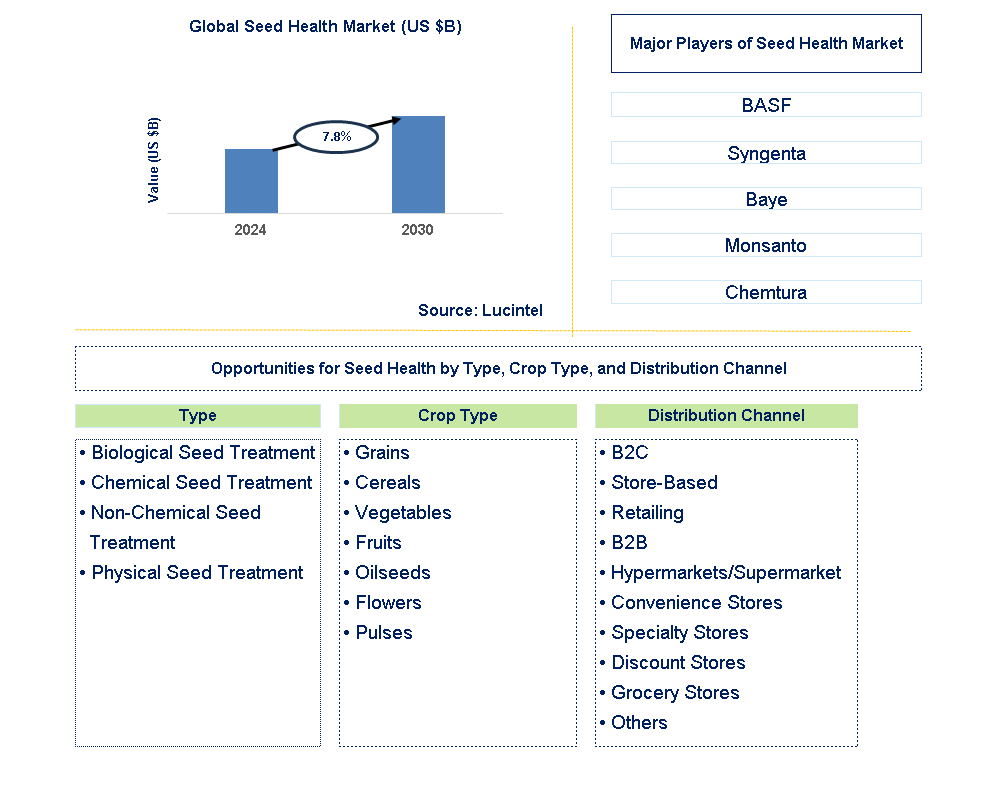
Key data points: The growth forecast = 7.8% annually for the next 6 years. Scroll below to get more insights. This market report covers trends, opportunities, and forecasts in the global seed health market to 2030 by type (biological seed treatment, chemical seed treatment, non-chemical seed treatment, and physical seed treatment), crop type (grains, cereals, vegetables, fruits, oilseeds, flowers, and pulses), distribution channel (B2C, store-based, retailing, B2B, hypermarkets/supermarket, convenience stores, specialty stores, discount stores, grocery stores, and others), and region (North America, Europe, Asia Pacific, and the Rest of the World)
We'll send your sample report shortly.
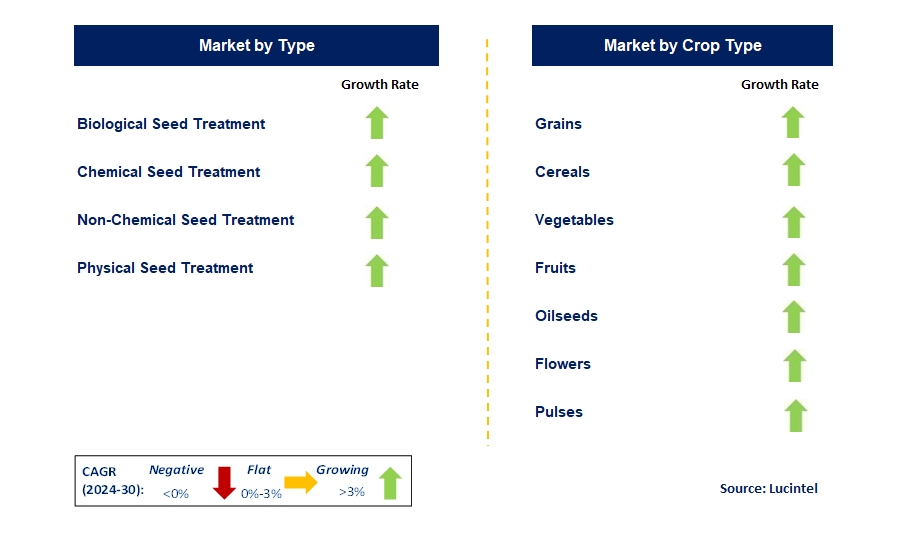
• Lucintel forecasts that, within the type category, the grain is expected to witness the highest growth over the forecast period.
• Within the crop type category, the chemical seed treatment is expected to witness the highest growth.
• In terms of region, APAC is expected to witness the highest growth over the forecast period. A more than 150-page report is developed to help in your business decisions.
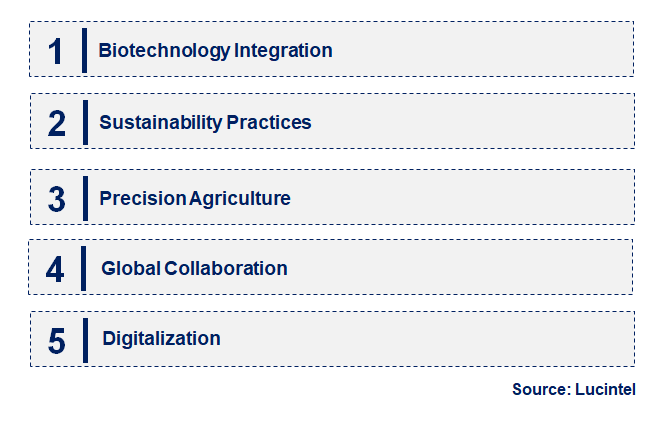
• Biotechnology Integration: The incorporation of biotechnology in seed health is on the rise as gene therapies promote disease resistance and increase yield, leading to a reduction in chemical use due to advancements in changing policies.
• Sustainability Practices: The transition to eco-friendly farming methods is noteworthy, as consumer preferences have led farmers to use organic seeds and biopesticides, increasing crop resilience and fortifying food security.
• Precision Agriculture: The use of precision agriculture technologies in seed health management has greatly improved through the use of real-time data for targeted applications, thereby increasing crop yields and minimizing inputs.
• Global Collaboration: One of the new waves in seed health research and development is emerging practices such as clinical research compliance that encourage countries and institutions to forge progress and achieve exponential growth in best practices.
• Digitalization: IT-enabled tools and platforms are increasingly used in the seed health market for data collection, interpretation, monitoring, and management, attributes that advance decision-making processes and improve agricultural efficiency. The seed health market is rapidly evolving through the integration of biotechnology, sustainability practices, precision agriculture, global collaboration, and digitalization. Biotechnology advancements, such as gene editing, are improving disease resistance and yield while promoting eco-friendly practices. The growing shift toward sustainable agriculture is driven by consumer demand for organic solutions, enhancing crop resilience and food security. Precision agriculture technologies allow for data-driven interventions, optimizing resources and minimizing waste. Furthermore, global collaborations in research are fostering innovation and knowledge sharing, while digital tools enhance decision-making and operational efficiency. Together, these trends signify a transformative phase in seed health, aligning agricultural practices with the demands of a sustainable future.
• Development in Biopesticides: There is wider acceptance of biopesticides as better alternatives for pest control compared to chemical pesticides, offering healthy growing conditions for crops and reducing pesticide residue in alignment with sustainability.
• More Efficient Seed Treatments: The trend in seed treatments is gradually shifting towards the use of advanced technologies like pathogen-protective and germination-enhancement coatings on seeds that increase seed health and early growth of crops.
• Regulatory Changes: Emerging regulations are fast-tracking the approval of new varieties of seeds, especially biotechnological seeds, allowing for faster uptake by farmers.
• Focus on Crop Diversity: An increasing focus on crop diversity informs seed health interventions while promoting the conservation of heirloom and landrace varieties to withstand climatic stresses and enhance crop diversity.
• Rise of Smart Technologies: The use of smart technologies such as AI and IoT in monitoring seed health supports more data-driven decisions, increasing efficiency and improving resource use in agriculture. The seed health landscape is transforming through key advancements such as biopesticides, enhanced seed treatments, evolving regulatory frameworks, a focus on crop diversity, and the rise of smart technologies. Biopesticides are emerging as effective, environmentally friendly alternatives to chemical pesticides, promoting healthier crop ecosystems and aligning with sustainability goals. Innovations in seed treatments are boosting germination and pathogen resistance, while regulatory changes are accelerating the approval of biotechnologically enhanced seeds, facilitating their adoption by farmers. Moreover, an emphasis on crop diversity is fostering the use of heirloom and indigenous varieties to enhance resilience against climate challenges. Lastly, the integration of smart technologies, including AI and IoT, is revolutionizing monitoring and decision-making, optimizing resource use and improving overall agricultural efficiency. Together, these trends are driving a more sustainable and resilient future for seed health and agriculture.
• Organic Seed Development: The popularity of organic seeds is on the rise, creating opportunities for producers to satisfy health-conscious consumers while promoting favorable societal benefits.
• Disease Resistance Traits: There is potential for developing seeds with superior disease resistance qualities due to the growing need to protect crops from pests and diseases in changing climate and pest situations.
• Biocontrol Solutions: An increase in the consumption of biocontrol solutions presents opportunities for companies to develop and promote pest control products that minimize the use of chemicals in pest management.
• Smart Farming Solutions: The increasing adoption of smart farming technologies provides seed health companies with opportunities to incorporate digital solutions that improve monitoring and management of farm practices.
• Global Seed Trade: With increasing international cooperation in seed trade, new opportunities are emerging in the global seed health market, inviting new technologies and best practices. The seed health market is witnessing a dynamic shift fueled by several emerging opportunities, including the rising demand for organic seeds, the development of disease-resistant traits, and the increasing popularity of biocontrol solutions. As health-conscious consumers seek organic options, producers are encouraged to promote sustainable practices. Furthermore, enhancing seeds with disease resistance addresses the pressing challenges posed by climate change and evolving pest pressures. The demand for biocontrol solutions allows companies to innovate in pest management while reducing reliance on chemicals. Additionally, the adoption of smart farming technologies offers avenues for seed health companies to implement digital monitoring and management solutions, enhancing efficiency for farmers. Finally, the expanding global seed trade, supported by international collaborations, is fostering new markets and the sharing of innovations, collectively positioning the seed health sector for significant growth and sustainability in the coming years.
• Technological Advancements: Rapid changes in biotechnology and digital device technology are enabling innovations in seed health, leading to better crop productivity and practices.
• Growing Demand for Food Security: The quest for food due to an increasing population is boosting insights into the need for seed health investments to increase food production.
• Regulatory Support: Favorable policy measures for biotechnology and quality seeds have made it easier for countries to develop and commercialize seed health technologies across different markets.
• Environmental Awareness: Growing concern for the environment is encouraging the adoption of organic farming practices among farmers, thereby increasing the need for disease-resistant and eco-friendly seeds.
• Climate Change Adaptation: The ongoing threat of climate change to food systems has made it increasingly necessary to develop crops with enhanced seed health and endurance. Challenges in the seed health market include:
• Regulatory Hurdles: Despite progress, new regulatory requirements can pose obstacles to introducing fresh ideas or seed technologies, leading to under exploitation of the market and a slower pace of reforms.
• Management of Resistance: The emergence of resistant pests and diseases is a critical challenge that compromises seed health, necessitating continuous and effective measures to counteract these problems.
• Market Access: Difficulties and inadequate market access for smallholder farmers serve as disincentives for desired changes toward improvements in seed health, threatening food production and the sustainable growth of agriculture. These drivers and challenges often interact to shape the general seed health market scenario at any given time, influencing its expansion and position concerning the various actors involved.
• BASF
• Syngenta
• Baye
• Monsanto
• Chemtura
• DuPont
• CropScience
• Sumitomo Chemical Company
• Valent
• Novozymes
• Biological Seed Treatment
• Chemical Seed Treatment
• Non-Chemical Seed Treatment
• Physical Seed Treatment
• Grains
• Cereals
• Vegetables
• Fruits
• Oilseeds
• Flowers
• Pulses
• B2C
• Store-Based
• Retailing
• B2B
• Hypermarkets/Supermarket
• Convenience Stores
• Specialty Stores
• Discount Stores
• Grocery Stores
• Others
• North America
• Europe
• Asia Pacific
• The Rest of the World
• United States: The seed health market in the U.S. has seen increased investments in biotechnology for seed health, including CRISPR techniques and supportive regulations aimed at improving seed disease immunity.
• China: China has made significant progress in seed health, with government policies encouraging research towards higher crop yields and disease-resistant varieties, as well as the cultivation of high-quality seed varieties.
• Germany: Germany is currently the most innovative country in Europe regarding seed health treatments, enhancing environmentally friendly farming through improved organic seed coatings and integrated pest management systems due to regulatory pressure.
• India: The seed health market in India is expanding with a trend toward hybrid seeds and biopesticides for higher crop yields, supported by government-promoted sustainable food security farming practices.
• Japan: Advancements in seed health in Japan are closely linked to technology and precision agriculture, with a focus on biotechnology to develop new varieties that address diseases and improve food production efficiency.


• BASF
• Syngenta
• Baye
• Monsanto
• Chemtura
• DuPont
• CropScience
• Sumitomo Chemical Company
• Valent
• Novozymes Q5. Which seed health market segment will be the largest in the future? Answer: Lucintel forecasts that grain is expected to witness the highest growth over the forecast period. Q6. In the seed health market, which region is expected to be the largest in the next 5 years? Answer: APAC is expected to witness the highest growth over the forecast period. Q.7 Do we receive customization in this report? Answer: Yes, Lucintel provides 10% customization without any additional cost.


Choose a license that fits your team. Instant PDF delivery.
Prices exclude taxes. Instant delivery. Custom licensing available on request.
Market Report · July 22, 2026
Market Report · July 22, 2026
Market Report · July 22, 2026
Trusted partner for strategic intelligence and business growth


Receive a complimentary market analysis tailored to your industry. Our analysts will identify key growth opportunities and competitive dynamics specific to your business.

Market size, growth rate, and key trend analysis for your specific sector.

Top competitor positioning and market share analysis.

Strategic recommendations backed by data-driven insights.
Get curated market intelligence and competitive moves straight to your inbox.
By subscribing, you agree to receive our monthly insights. Unsubscribe anytime.
Receive a complimentary market analysis tailored to your industry. Our analysts will identify key growth opportunities and competitive dynamics specific to your business.
Market size, growth rate, and key trend analysis for your specific sector.
Top competitor positioning and market share analysis.
Strategic recommendations backed by data-driven insights.
Get curated market intelligence, emerging trends, and competitive moves straight to your inbox each month.
By subscribing, you agree to receive our monthly insights. Unsubscribe anytime.
We'll send your sample report shortly.