
Market Report · July 16, 2026

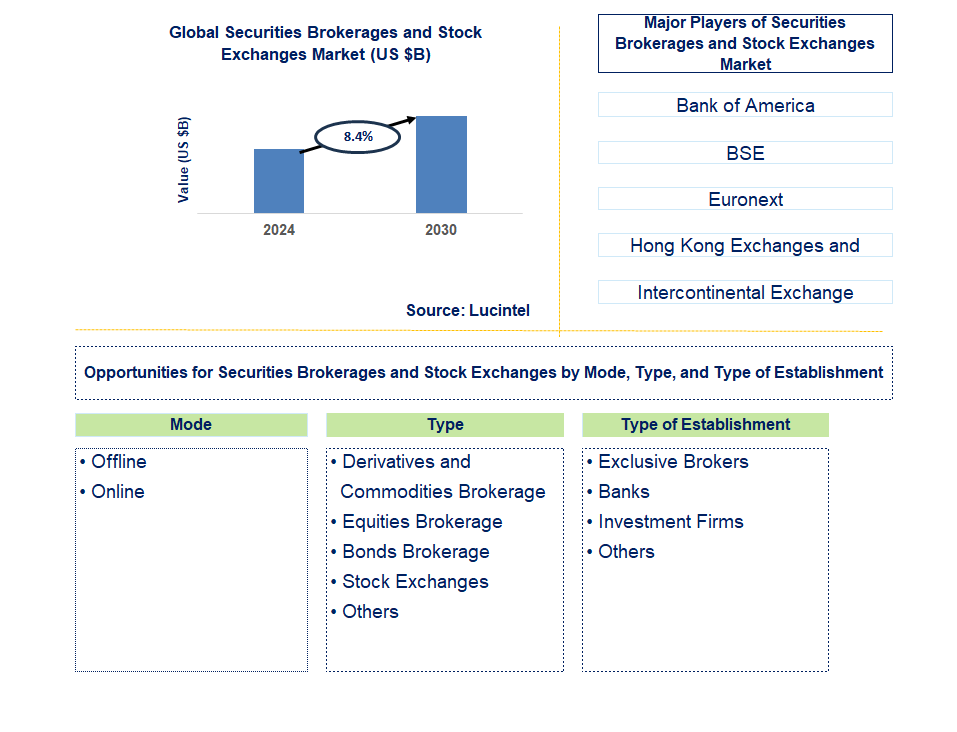
Key data points: The growth forecast = 8.4% annually next 6 years. Scroll below to get more insights. This market report covers trends, opportunities, and forecast in the global securities brokerages and stock exchanges market to 2030 by mode (offline and online), type (derivatives and commodities brokerage, equities brokerage, bonds brokerage, stock exchanges, and others), type of establishment (exclusive brokers, banks, investment firms, and others), and region (North America, Europe, Asia Pacific, and the Rest of the World)
We'll send your sample report shortly.
• United States: U.S. securities brokerages and stock exchanges embrace numerous technological advancements and regulatory reforms for more efficient and transparent markets. High-frequency trading and algorithmic trading platforms revolutionize market operations while blockchain technology is being studied for clearing and settlement processes. The SEC's tighter regulations aim to curb market manipulation and enhance investor protection. Advances in AI and machine learning technologies enable sophisticated market analysis and improved risk management strategies, driving innovation in the financial industry.
• China: Chinese securities market is rapidly modernizing through initiatives like the Shanghai-London Stock Connect and the STAR Market. These initiatives aim to enhance market accessibility and liquidity for overseas and local investors. The CSRC is restructuring to increase market transparency and promote investor protection. Innovations in fintech influence brokerage practices, increasingly focusing on mobile trading platforms and digital asset management solutions, aligning with China's commitment to modernizing financial markets.
• Germany: The Frankfurt Stock Exchange in Germany invests in advanced trading technologies to handle increasing trading volumes and complexities. Market infrastructure is improving due to MiFID II, enhancing market transparency and reducing conflicts of interest. Trends point toward green finance, with a strong focus on incorporating environmental, social, and governance criteria into investment decisions. These developments support improved market infrastructure, ensuring better transparency and sustainable investment practices, further establishing Germany as a leader in innovative and responsible financial markets.
• India: The securities market in India is witnessing landmark reforms aimed at greater access and enhanced transparency. The Securities and Exchange Board of India (SEBI) intends to introduce new rules to simplify trading processes and consolidate market integrity. Fintech companies are driving innovation in brokerage services, increasingly utilizing mobile and digital solutions. The National Stock Exchange and Bombay Stock Exchange are expanding their platforms and introducing new products for a fast-growing diverse investor base, also improving market efficiency.
• Japan: The securities market in Japan is modernizing through advancements in trading technologies and regulatory reforms. The Tokyo Stock Exchange is implementing new technologies to increase trade efficiency and visibility. The FSA actively promotes reforms to strengthen corporate governance and protect investors. ESG factors are becoming increasingly prominent in investment decisions, part of the global move toward sustainable finance. These developments are enhancing market operations in Japan and aligning them with best practices for financial markets worldwide.
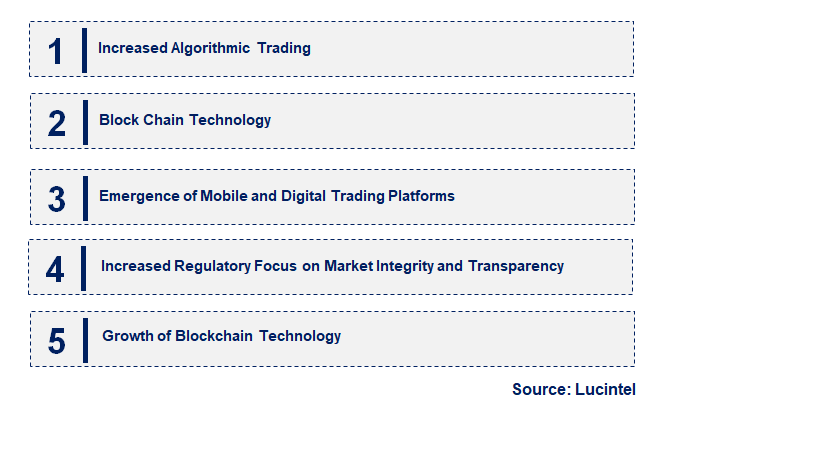
• Change in Patterns and Trends: The securities brokerage and stock exchange market is influenced by various emerging trends due to technological changes, updates in regulations, and shifts in investor preferences. These trends alter the market structures, affecting how securities are traded, managed, and regulated, and they create new challenges and opportunities among market participants.
• Increased Algorithmic Trading: Algorithmic trading has dramatically increased with the shift to upgrade algorithms from brokerages and exchanges that settle trades quickly, thereby enhancing trading strategies. These algorithms analyze vast amounts of market data in real time, helping create efficient execution of trades. Although algorithmic trading improves market liquidity and reduces transaction costs, it has also raised concerns about market volatility and systemic risk. Regulators are now addressing these issues to ensure that algorithmic trading contributes positively to market stability and efficiency.
• Blockchain Technology: Blockchain emerges as a new securitization concept, improving transparency, security, and efficiency in trading and settlement processes, safeguarded through active online management. With a decentralized and immutable ledger, blockchain helps reduce the risks of fraud or error, streamlines operations in clearing and settlement, and enables various digital asset management possibilities. By adopting blockchain, financial transactions can transform and lower their costs while enhancing the integrity of market processes overall.
• Emergence of Mobile and Digital Trading Platforms: Advances in mobile and digital trading platforms are changing how investors access and manage investments. Real-time access to market data, trading tools, and investment services through mobile devices and tablets makes investing easier and more user-friendly. The trend towards mobile trading apps and digital brokerage services attracts a new generation of investors, increasing overall market participation and driving innovation in the financial services industry.
• Increased Regulatory Focus on Market Integrity and Transparency: Regulatory focus has intensified to ensure market integrity and transparency through new regulations aimed at eliminating market manipulation, conflicts of interest, and data privacy concerns. Enhanced oversight and enforcement are necessary to protect investors and ensure fairness and orderly markets. This trend of increased compliance requirements and a commitment to improving transparency and accountability influences how brokerages and exchange organizations operate. This focus on regulatory compliance shapes the market environment while enhancing investor protection.
• Growth of Blockchain Technology: Blockchain technology is emerging as a key innovation in the securities market, offering enhanced transparency, security, and efficiency in trading and settlement processes. By providing a decentralized and immutable ledger, blockchain can reduce the risks of fraud and errors, streamline operations in areas such as clearing and settlement, and facilitate digital asset management. The adoption of blockchain technology is expected to transform financial transactions, reduce costs, and improve the overall integrity of market processes. Trends such as algorithmic trading, blockchain technology, ESG investing, mobile and digital platforms, and regulation could transform the securities brokerage and stock exchange markets concerning innovation, market efficiency, and catering to changing investor needs and regulatory demands. All these developments will continue to shape the future of trading and investment in a more dynamic, transparent, and inclusive financial market that will benefit from the real evolution of the market.
• Development in Trading Technologies: Enhanced trading technologies and systems in the context of high-frequency trading and advanced algorithmic trading systems have transformed the securities market. These technologies enable trades to execute faster with increased liquidity in the markets, thereby boosting market efficiency. All of this requires exchanges and brokerage groups to invest in state-of-the-art trading platforms to support these advances. The resulting gains are significant, but they are also associated with risks related to market volatility and systemic failures. Regulators are working to address these concerns, ensuring that technological developments positively impact market stability and integrity.
• Growth of Digital Platforms and Fintech Solutions: The introduction of fintech solutions and the expansion of digital trading platforms are transforming the securities market. Digital platforms make trading services, real-time market data, and investment management tools accessible through mobile devices and web-based portals. Innovations such as robo-advisors and automated trading systems enhance the quality of brokerage services and make investing easier and more user-friendly. This encourages greater market participation, drives competition, and facilitates a better financial services industry.
• Regulatory Reforms and Compliance Enhancements: Regulatory reforms involve new regulations in the securities market that aim to achieve transparency, eliminate conflicts of interest, and provide investor protection. Key regulatory initiatives in Europe include MiFID II and newer versions from the Securities and Exchange Commission of the United States that increase compliance requirements for brokerages and exchanges. These reforms aim to make markets more secure and enhance market integrity, addressing emerging risks and supporting fair and transparent trading practices. Greater regulatory compliance is transforming how financial entities operate, contributing to enhanced market stability and investor protection.
• Increasing Sustainable and ESG Investing: Sustainable and ESG investing has gained attention in the securities market as investors increasingly prioritize environmental, social, and governance criteria. ESG-focused financial products and indices are becoming more prevalent, promoting sustainable investment decision models. Brokerages and exchanges are adapting to this trend by including ESG criteria in their offerings and increasing transparency and reporting of ESG factors. This push into sustainable investing alters market dynamics and promotes responsible financial practices.
• Market Infrastructure Modernization: Market infrastructure modernization is a crucial development in the securities market, where exchanges are upgrading their technology to cope with continuously growing and more complex trading volumes. Investments in modern clearing and settlement systems improve market efficiency and reduce transaction costs. Efforts to modernize infrastructure promise to enhance overall financial market functions and enable faster, more reliable transactions. This trend is critical in meeting expanded global financial market demands for operational resilience. The development of brokerages and stock exchanges in the securities market should reflect recent advancements in trading technology, digital growth, regulatory reforms, ESG investing, and modernization of market infrastructures, while responding to emerging investor needs and regulatory demands. All these trends are moving towards innovation, emphasizing market efficiency and responsiveness to changing investor requirements. These changes in the markets will be key to their evolution into a brighter future for trading and investment, providing a more dynamic, transparent, and resilient financial ecosystem.
• Digital Trading Platforms: The rapid boom in digital trading platforms creates an enormous opportunity for securities brokerages and stock exchanges. Such platforms deliver users real-time market data, advanced trading tools, and seamless transaction capabilities through mobile and web applications. The greater the demand for convenient and easy-to-access trading solutions, the more customers a company investing in modern digital platforms can attract and engage. Areas where genuine differentiation can be realized and sustained in this market include improvements to the user interface of sites, enhanced security features, and integration into other financial services. On the other hand, increased digital trading platforms lead to higher market participation and more liquidity, which spur market growth.
• Fintech Solutions: Fintech innovations transform the modern securities market through robo-advisors, automated trading systems, and blockchain technology to make securities markets more efficient, lower investment costs, and improve access to investments for investors. Robo-advisors, for instance, utilize algorithms to provide personalized investment advice and portfolio management at a lower cost, making financial planning more affordable and accessible. Blockchain technology promises securities users greater transparency and security in transactions, perhaps even in clearing and settlement, marking a significant step forward for the business. A security firm embracing fintech solutions would be able to leave competitors behind, attracting tech-savvy investors while optimizing back-office processes. Fintech is expected to significantly fuel growth and innovation in the industry.
• ESG Investing: The emphasis on ESG criteria represents a potential growth opportunity for securities brokerages and stock exchanges. Investors increasingly want to connect their investments with ethical and sustainable practices, thus opening up avenues for more ESG-related financial products and services. Firms that develop and promote ESG investment options—perhaps as green bonds or sustainability-oriented funds—will attract a new, socially conscious segment of investors. Moreover, the integration of ESG factors into investment analysis and reporting will boost transparency, aiming to attract more institutional investors. Adopting ESG investing is, in essence, in line with global trends toward sustainability and responsibility in this increasingly fluid market.
• Market Data Analytics: Advanced market data analytics tools are among the most important growth opportunities available for securities brokerages and stock exchanges. Data analytics can characterize short-term market trends as well as investor and trading patterns. Using big data through advanced machine learning algorithms can aid firms in decision-making, trade strategies, and making services to clients more targeted. Advanced analytics enhance risk management and fraud detection, boosting market stability. Sophisticated data analytics capabilities would form a viable investment for firms to stay ahead of the competition, deliver superior service, and seize emerging market opportunities.
• Compliance Technologies: The changing regulatory landscape is opening up growth avenues for compliance technologies. Organizations must comply with complex regulations and report on various activities, which impacts the application of these compliance technologies. Regulatory reporting systems, anti-money laundering tools, and cybersecurity measures are some of the solutions implemented by firms to achieve these objectives. Advanced compliance technologies ensure adherence to regulations while boosting operational efficiency and reducing the incidence of potential fines and legal issues. As regulatory requirements become more stringent, firms that invest in robust compliance technologies will better manage the regulatory environment and maintain market trust. The strategic growth opportunities in digital trading platforms, fintech solutions, ESG investing, market data analytics, and regulatory compliance technologies are redefining the securities brokerages and stock exchanges market. By capitalizing on these opportunities, businesses will improve their offerings, attract fresh investor capital, and ignite innovation. As the marketplace changes, these applications will define the future of financial trading and investment, leading to prosperity, effectiveness, and sustainability in financial services.
• Bank of America
• BSE
• Euronext
• Hong Kong Exchanges and Clearing
• Intercontinental Exchange
• JPMorgan Chase
• Morgan Stanley
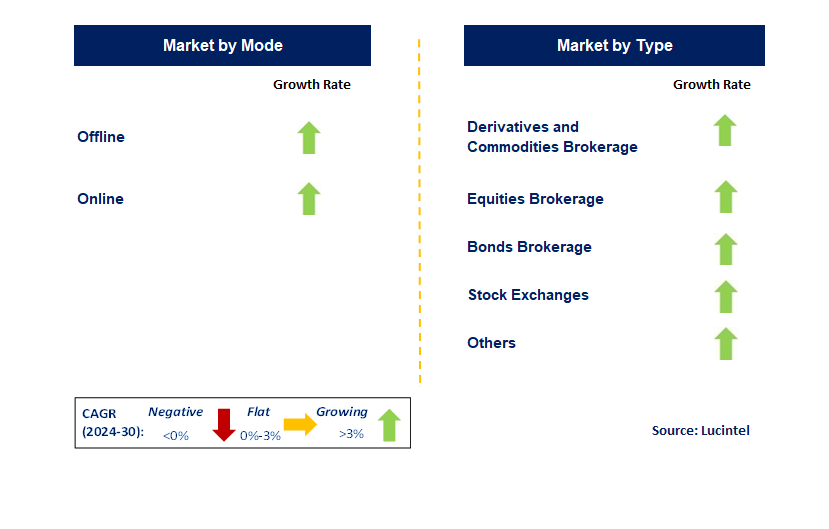
• Offline
• Online
• Derivatives and Commodities Brokerage
• Equities Brokerage
• Bonds Brokerage
• Stock Exchanges
• Others
• Exclusive Brokers
• Banks
• Investment Firms
• Others
• North America
• Europe
• Asia Pacific
• The Rest of the World
• Lucintel forecasts that, within the mode category, online will remain the larger segment over the forecast period due to increasing internet penetration, mobile trading platforms, and growing investor awareness of online opportunities.
• Within the type of establishment category, investment firms are expected to witness the largest growth due to expertise in investment-related services.
• In terms of regions, North America is expected to witness the highest growth over the forecast period due to the growing number of stock traders in the region.


• Bank of America
• BSE
• Euronext
• Hong Kong Exchanges and Clearing
• Intercontinental Exchange
• JPMorgan Chase
• Morgan Stanley Q5. Which securities brokerages and stock exchanges market segment will be the largest in the future? Answer: Lucintel forecasts that online will remain the larger segment over the forecast period due to increasing internet penetration, mobile trading platforms, and growing investor awareness of online opportunities. Q6. In securities brokerages and stock exchanges market, which region is expected to be the largest in the next 5 years? Answer: North America is expected to witness the highest growth over the forecast period due to the growing number of stock traders in the region. Q.7 Do we receive customization in this report? Answer: Yes, Lucintel provides 10% customization without any additional cost.


Choose a license that fits your team. Instant PDF delivery.
Prices exclude taxes. Instant delivery. Custom licensing available on request.
Market Report · July 16, 2026
Market Report · May 18, 2026
Market Report · May 18, 2026
Trusted partner for strategic intelligence and business growth


Receive a complimentary market analysis tailored to your industry. Our analysts will identify key growth opportunities and competitive dynamics specific to your business.

Market size, growth rate, and key trend analysis for your specific sector.

Top competitor positioning and market share analysis.

Strategic recommendations backed by data-driven insights.
Get curated market intelligence and competitive moves straight to your inbox.
By subscribing, you agree to receive our monthly insights. Unsubscribe anytime.
Receive a complimentary market analysis tailored to your industry. Our analysts will identify key growth opportunities and competitive dynamics specific to your business.
Market size, growth rate, and key trend analysis for your specific sector.
Top competitor positioning and market share analysis.
Strategic recommendations backed by data-driven insights.
Get curated market intelligence, emerging trends, and competitive moves straight to your inbox each month.
By subscribing, you agree to receive our monthly insights. Unsubscribe anytime.
We'll send your sample report shortly.