
'
...

The Impact of COVID-19 is included in Seafood Market Report. Buy it today to get an advantage.

Request the impact of COVID-19 on your product or industry


Seafood Market Trends and Forecast

The future of the global seafood market looks promising with opportunities in the fish and shrimp markets. The global seafood market is expected to reach an estimated $517.7 billion by 2035 with a CAGR of 3.5% from 2026 to 2035. The major drivers for this market are the increasing demand for healthy protein sources, the rising popularity of sustainable seafood choices, and the growing preference for diverse seafood varieties.

• Lucintel forecasts that, within the form category, fresh/chilled is expected to witness the highest growth over the forecast period.
• Within the type category, fish is expected to witness higher growth.
• In terms of region, APAC is expected to witness the highest growth over the forecast period.
Gain valuable insights for your business decisions with our comprehensive 150+ page report. Sample figures with some insights are shown below.
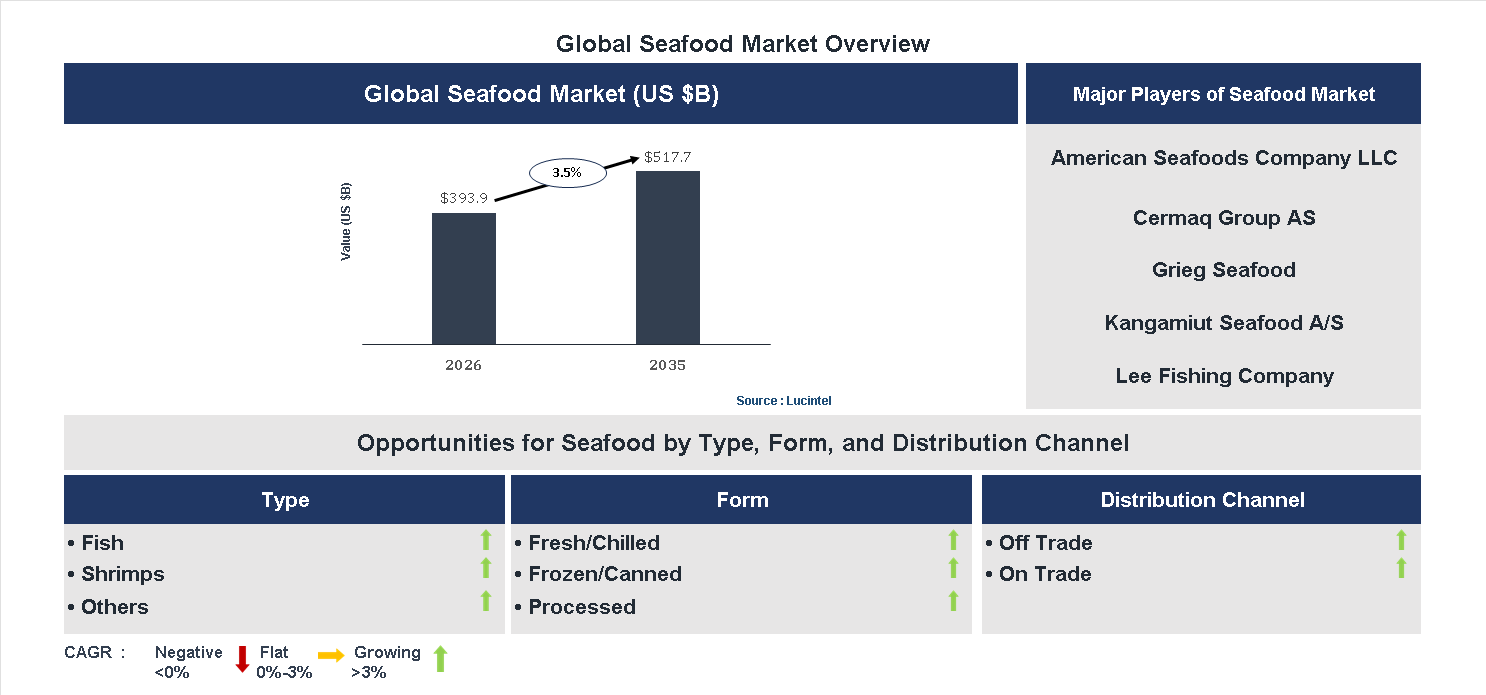
Seafood Market Trends and Forecast

Emerging Trends in the Seafood Market

The seafood market is experiencing rapid transformation driven by technological advancements, changing consumer preferences, and sustainability concerns. As global demand for seafood increases, stakeholders are adopting innovative practices to meet these needs while addressing environmental challenges. These emerging trends are reshaping the industry landscape, influencing supply chains, product offerings, and market strategies. Companies are focusing on sustainability, digitalization, and health-conscious products to stay competitive. Understanding these key trends is essential for market participants to capitalize on opportunities and navigate potential risks in this dynamic environment.

• Sustainability and Eco-Friendly Practices: The seafood industry is increasingly prioritizing sustainable sourcing and eco-friendly practices. Consumers are more aware of overfishing and environmental impacts, prompting companies to adopt responsible fishing methods and certifications like MSC. This trend enhances brand reputation and meets regulatory requirements, ensuring long-term resource availability. Sustainable practices also attract environmentally conscious consumers, boosting sales and market loyalty. As regulations tighten, sustainability is becoming a critical factor influencing procurement, processing, and marketing strategies across the seafood supply chain.
• Digitalization and E-Commerce Growth: The integration of digital technologies is revolutionizing seafood distribution and sales channels. Online platforms and e-commerce are enabling direct-to-consumer sales, expanding market reach beyond traditional retail outlets. Digital traceability tools improve transparency, allowing consumers to verify product origins and quality. Additionally, data analytics optimize supply chain efficiency, reduce waste, and forecast demand more accurately. This trend enhances consumer engagement, streamlines operations, and provides competitive advantages in a rapidly evolving market landscape, especially post-pandemic.
• Health and Wellness Focus: Consumers are increasingly seeking seafood products that promote health and wellness. There is a rising demand for organic, low-mercury, and omega-3-rich options. Functional seafood products, such as fortified or enhanced items, are gaining popularity. This trend influences product development, marketing strategies, and sourcing practices, encouraging companies to innovate with healthier offerings. The focus on health also drives interest in sustainable and ethically sourced seafood, aligning consumer values with product choices and expanding market segments focused on wellness.
• Innovation in Processing and Packaging: Advances in processing technologies and packaging are enhancing product shelf life, safety, and convenience. Modified atmosphere packaging, vacuum sealing, and biodegradable materials are becoming standard, reducing waste and environmental impact. Innovative processing methods improve product quality and enable new formats like ready-to-eat or minimally processed seafood. These developments meet consumer demand for convenience and freshness while supporting sustainability goals. Enhanced packaging also facilitates better branding and product differentiation, giving companies a competitive edge in a crowded market.
• Regulatory Changes and Trade Dynamics: Evolving regulations and international trade policies significantly impact the seafood market. Stricter safety standards, labeling requirements, and tariffs influence sourcing, pricing, and market access. Countries are implementing measures to combat illegal, unreported, and unregulated fishing, affecting supply chains. Trade tensions and agreements shape export-import dynamics, requiring companies to adapt quickly. Staying compliant and agile in response to regulatory shifts is crucial for market players to maintain competitiveness and avoid disruptions, making regulatory awareness a key strategic focus.

In summary, these trends are collectively reshaping the seafood market by emphasizing sustainability, technological integration, health-conscious products, innovative processing, and adaptive regulatory strategies. They are driving industry growth, improving transparency, and aligning market offerings with evolving consumer values, ultimately creating a more sustainable and competitive landscape.
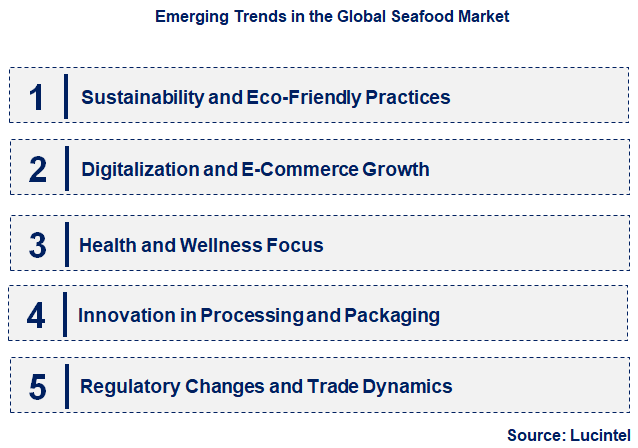
Emerging Trends in the Seafood Market

Recent Development in the Seafood Market

The seafood market is experiencing rapid transformation driven by technological advancements, changing consumer preferences, and sustainability initiatives. These developments are shaping the future landscape, creating new opportunities for growth and innovation. Stakeholders are focusing on sustainable sourcing, digital marketing, and product diversification to meet evolving demands. As the industry adapts, these key areas are expected to significantly influence market dynamics, competitiveness, and consumer engagement, ultimately fostering a more resilient and sustainable seafood sector.

• Growing Demand for Sustainable Seafood: Consumers increasingly prioritize eco-friendly options, prompting suppliers to adopt sustainable fishing practices and certifications. This shift enhances brand reputation, attracts environmentally conscious buyers, and encourages responsible harvesting, which ensures long-term resource availability. The market benefits from increased transparency and trust, leading to higher sales and market share for sustainable products. This trend also drives regulatory changes, fostering industry-wide sustainability commitments and innovations.
• Adoption of Digital Platforms for Market Expansion: Digital marketing and e-commerce platforms are revolutionizing seafood sales by enabling direct-to-consumer channels and global reach. Businesses leverage online platforms for branding, customer engagement, and streamlined logistics, reducing intermediaries. This digital shift enhances market accessibility, provides real-time data insights, and caters to tech-savvy consumers seeking convenience. As a result, companies can expand their customer base, improve sales efficiency, and adapt quickly to market trends, fostering growth in both local and international markets.
• Innovation in Product Offerings and Processing: The industry is focusing on diversifying products through value-added processing, such as ready-to-eat meals, frozen options, and specialty items. These innovations meet consumer demand for convenience, health, and variety. Advanced processing technologies improve product quality, shelf life, and safety, boosting consumer confidence. This diversification opens new revenue streams, attracts different customer segments, and enhances competitiveness. It also encourages investment in R&D, leading to more innovative and sustainable seafood solutions.
• Emphasis on Traceability and Quality Assurance: Enhanced traceability systems are being implemented to ensure transparency from catch to consumer. Technologies like blockchain and RFID enable real-time tracking, boosting trust and compliance with regulations. Improved quality assurance reduces waste, recalls, and fraud, safeguarding brand integrity. Consumers increasingly demand transparency about product origins and safety, influencing purchasing decisions. This focus on traceability strengthens market confidence, encourages sustainable practices, and aligns with global standards, ultimately elevating industry credibility and consumer loyalty.
• Expansion of Aquaculture and Alternative Seafood Sources: Aquaculture is rapidly growing to meet rising seafood demand, reducing pressure on wild stocks. Innovations in sustainable farming techniques improve yield, quality, and environmental impact. Alternative sources like plant-based seafood and lab-grown options are gaining popularity among health-conscious and environmentally aware consumers. These developments diversify supply chains, stabilize prices, and reduce overfishing risks. They also open new markets and investment opportunities, positioning the industry for resilient growth amid environmental and resource challenges.

The overall impact of these developments is a more sustainable, innovative, and consumer-centric seafood market. They foster growth, improve supply chain transparency, and enhance competitiveness, ensuring long-term industry resilience and meeting evolving global demands.

Strategic Growth Opportunities in the Seafood Market

The seafood market is experiencing significant growth driven by increasing consumer awareness of health benefits, rising demand for sustainable products, and expanding global trade. Innovations in aquaculture and processing technologies are enhancing product quality and availability. Additionally, changing dietary preferences and urbanization are fueling market expansion across regions. Companies are exploring new applications and markets to capitalize on these trends, creating diverse opportunities for growth. Strategic investments and sustainable practices are essential for capturing market share and ensuring long-term success in this dynamic industry.

• Expanding Demand for Premium and Organic Seafood Products: Growing health consciousness and preference for organic, sustainably sourced seafood are driving premium product sales. Consumers are willing to pay higher prices for quality, traceability, and eco-friendly options, prompting suppliers to innovate and diversify offerings. This trend opens new revenue streams and encourages sustainable practices, strengthening brand loyalty and market positioning.
• Increasing Adoption of Aquaculture for Sustainable Supply: Aquaculture is becoming a vital component to meet rising seafood demand while reducing pressure on wild stocks. Advances in farming techniques, disease management, and feed efficiency are improving yields and sustainability. Governments and private sectors are investing heavily in aquaculture infrastructure, creating opportunities for market players to expand production, improve product consistency, and address supply chain challenges.
• Growing Market for Processed and Ready-to-Eat Seafood: Convenience-driven consumer lifestyles are boosting demand for processed and ready-to-eat seafood products. Innovations in packaging, preservation, and flavoring are enhancing product appeal and shelf life. This segment offers significant growth potential, especially in urban areas and emerging markets, by catering to busy consumers seeking quick, nutritious meal options, thereby expanding market reach and consumer base.
• Rising Focus on Sustainability and Ethical Sourcing: Consumers and regulators are increasingly emphasizing sustainable fishing practices and ethical sourcing. Companies adopting eco-labeling, transparent supply chains, and responsible harvesting methods are gaining a competitive advantage. This focus encourages industry-wide improvements, reduces environmental impact, and aligns with consumer values, fostering trust and loyalty while opening access to environmentally conscious markets.
• Technological Innovations in Seafood Processing and Packaging: Advanced processing, freezing, and packaging technologies are improving product quality, safety, and shelf life. Automation and smart packaging solutions enable better traceability and reduce waste. These innovations facilitate global distribution, reduce costs, and meet stringent safety standards, providing opportunities for market expansion, especially in regions with strict import regulations, and supporting the development of new seafood products and applications.

These strategic growth opportunities collectively enhance the seafood market’s resilience, sustainability, and innovation capacity. By capitalizing on premium products, sustainable practices, technological advancements, and consumer preferences, industry players can expand their market share and ensure long-term profitability. Embracing these opportunities will drive market evolution, meet global demand, and promote responsible growth in the seafood industry.

Seafood Market Driver and Challenges

The seafood market is influenced by a variety of technological, economic, and regulatory factors that shape its growth and sustainability. Advances in fishing and aquaculture technologies have improved yield and quality, while economic shifts such as changing consumer preferences and global trade dynamics impact demand. Regulatory frameworks aimed at conservation and sustainable practices also play a crucial role in market operations. Additionally, environmental concerns and climate change pose both challenges and opportunities for seafood producers. Understanding these drivers and challenges is essential for stakeholders to navigate the evolving landscape, optimize supply chains, and ensure sustainable growth in this competitive industry.

The factors responsible for driving the seafood market include:
• Technological Innovations: The adoption of advanced fishing equipment, aquaculture techniques, and processing technologies enhances efficiency and product quality. Innovations such as automated sorting, sustainable harvesting methods, and improved cold chain logistics reduce waste and extend shelf life, meeting consumer demands for fresh and high-quality seafood. These technological advancements also enable producers to access previously unreachable markets, increase yield, and reduce environmental impact, thereby fueling market growth.
• Rising Consumer Demand for Healthy Food: Increasing awareness of the health benefits associated with seafood consumption, such as high protein content and omega-3 fatty acids, drives demand globally. Consumers are seeking fresh, organic, and sustainably sourced seafood, which encourages retailers and producers to expand their offerings. This trend is particularly prominent in developed countries, where health consciousness influences purchasing decisions, leading to increased market penetration and diversification of seafood products.
• Expansion of Aquaculture: The growth of aquaculture as a sustainable alternative to wild fishing is a significant driver. It allows for controlled production, consistent supply, and reduced pressure on wild fish populations. Technological improvements in aquaculture practices, along with supportive government policies, have facilitated industry expansion. This not only stabilizes prices but also enables the industry to meet rising global demand, especially in regions with limited wild fish resources.
• Global Trade and Market Accessibility: The liberalization of trade policies and development of international logistics networks have expanded market access for seafood products. Countries can now export and import seafood more efficiently, leading to increased competition and diversification of available products. This global connectivity supports economies of scale, reduces costs, and opens new markets, thereby boosting overall market growth and providing opportunities for producers worldwide.
• Sustainability and Certification Initiatives: Growing consumer awareness about environmental impacts has led to increased demand for sustainably sourced seafood. Certification programs like MSC and ASC ensure responsible harvesting and aquaculture practices, adding value to products. These initiatives influence purchasing decisions, encourage industry compliance, and open access to premium markets. They also promote conservation efforts, ensuring long-term resource availability and market stability.

The challenges facing the seafood market include:
• Overfishing and Resource Depletion: Unsustainable fishing practices threaten fish populations and marine ecosystems, leading to resource depletion. This not only jeopardizes biodiversity but also risks regulatory restrictions and market access issues for producers. Managing fish stocks sustainably requires strict enforcement of quotas and adoption of responsible harvesting techniques, which can be challenging due to illegal fishing activities and a lack of compliance.
• Environmental and Climate Change Impacts: Rising sea temperatures, ocean acidification, and extreme weather events adversely affect marine life and aquaculture productivity. These environmental changes can lead to reduced yields, increased disease outbreaks, and habitat destruction. Adapting to these impacts necessitates significant investment in resilient infrastructure and sustainable practices, posing financial and operational challenges for industry stakeholders.
• Regulatory and Trade Barriers: Stringent regulations aimed at conservation and food safety, along with trade restrictions and tariffs, can hinder market access and increase compliance costs. Navigating complex legal frameworks across different countries requires substantial resources and expertise. Non-compliance risks, penalties, and market bans, which can disrupt supply chains and impact profitability.

In summary, the seafood market is driven by technological advancements, health-conscious consumer preferences, aquaculture expansion, global trade facilitation, and sustainability initiatives. However, it faces significant challenges such as overfishing, environmental impacts, and regulatory complexities. These factors collectively influence the markets growth trajectory, requiring stakeholders to adopt sustainable practices, innovate, and navigate regulatory landscapes carefully. The balance between leveraging growth drivers and mitigating challenges will determine the long-term sustainability and profitability of the seafood industry.

List of Seafood Companies

Companies in the market compete on the basis of product quality offered. Major players in this market focus on expanding their manufacturing facilities, R&D investments, infrastructural development, and leverage integration opportunities across the value chain. With these strategies seafood companies cater increasing demand, ensure competitive effectiveness, develop innovative products & technologies, reduce production costs, and expand their customer base. Some of the seafood companies profiled in this report include-
• American Seafoods Company LLC
• Cermaq Group AS
• Grieg Seafood
• Kangamiut Seafood A/S
• Lee Fishing Company
• Maruha Nichiro Corporation
• Mowi ASA
• Pacific Seafood
• Phillips Foods Inc.
• Royal Greenland A/S

Seafood Market by Segment

The study includes a forecast for the global seafood market by type, form, distribution channel, and region.

Seafood Market by Type [Value from 2019 to 2035]:


• Fish
• Shrimps
• Others

Seafood Market by Form [Value from 2019 to 2035]:


• Fresh/Chilled
• Frozen/Canned
• Processed

Seafood Market by Distribution Channel [Value from 2019 to 2035]:


• Off Trade
• On Trade

Seafood Market by Region [Value from 2019 to 2035]:


• North America
• Europe
• Asia Pacific
• The Rest of the World

Country Wise Outlook for the Seafood Market

The seafood market has experienced significant shifts driven by technological innovations, changing consumer preferences, and environmental concerns. Countries are adopting sustainable practices, expanding aquaculture, and leveraging new technologies to meet rising demand. Trade policies and climate change impacts also influence market dynamics, prompting countries to adapt their strategies. As the seafood industry evolves, each nation plays a crucial role in shaping the future landscape through advancements in production, sustainability, and market access.

• United States: The U.S. seafood market has seen increased investment in sustainable fishing practices and aquaculture. Innovations in technology, such as remote sensing and data analytics, improve stock management. Consumer demand for organic and locally sourced seafood continues to grow, prompting retailers to expand offerings. Regulatory frameworks are tightening to ensure sustainability, and exports to Asia are rising, especially for shellfish and salmon. The industry is also exploring alternative protein sources like plant-based seafood substitutes.
• China: China remains the worlds largest seafood producer and consumer, with rapid growth in aquaculture, particularly in shrimp and fish farming. The government emphasizes sustainable practices and environmental protection, leading to stricter regulations. Technological advancements include automation in processing and breeding. Domestic consumption is increasing, driven by urbanization and rising incomes. China is also expanding its seafood exports, especially to Southeast Asia and Europe, while investing in innovative breeding techniques and disease control measures.
• Germany: Germanys seafood market is characterized by a focus on sustainability and quality. The country imports a significant portion of its seafood, mainly from the EU and international sources. Recent developments include increased certification efforts for sustainable products and a shift towards organic and eco-labeled seafood. Consumer preferences favor traceability and ethical sourcing, prompting retailers to enhance transparency. The industry is also exploring new aquaculture methods and investing in cold-water fish species to diversify offerings amid climate challenges.
• India: India’s seafood industry is rapidly expanding, driven by increased exports and domestic consumption. The government promotes aquaculture development, especially in shrimp and fish farming, with subsidies and infrastructure support. Technological adoption includes improved hatchery techniques and disease management. The market is witnessing a rise in value-added products and processing facilities. Sustainable practices are gaining importance, with initiatives to reduce overfishing and promote eco-friendly aquaculture. India is also exploring new markets in Africa and the Middle East to diversify export destinations.
• Japan: Japan maintains a strong seafood tradition, with a focus on high-quality, sustainable products. Recent developments include advancements in aquaculture technology, such as recirculating systems for fish farming. The country emphasizes sustainable fishing practices and strict regulations to protect marine resources. Innovation in seafood processing and preservation extends shelf life and enhances product quality. Japan is also investing in research for alternative seafood sources, including lab-grown fish, to address declining wild stocks. The domestic market remains robust, with a growing interest in health-conscious and organic seafood options.

Lucintel Analytics Dashboard

Features of the Global Seafood Market

Market Size Estimates: Seafood market size estimation in terms of value ($B).
Trend and Forecast Analysis: Market trends (2019 to 2025) and forecast (2026 to 2035) by various segments and regions.
Segmentation Analysis: Seafood market size by type, form, distribution channel, and region in terms of value ($B).
Regional Analysis: Seafood market breakdown by North America, Europe, Asia Pacific, and Rest of the World.
Growth Opportunities: Analysis of growth opportunities in different types, forms, distribution channels, and regions for the seafood market.
Strategic Analysis: This includes M&A, new product development, and competitive landscape of the seafood market.
Analysis of competitive intensity of the industry based on Porter’s Five Forces model.

Lucintel Consulting Services

FAQ

Q1. What is the seafood market size?
Answer: The global seafood market is expected to reach an estimated $517.7 billion by 2035.
Q2. What is the growth forecast for seafood market?
Answer: The global seafood market is expected to grow with a CAGR of 3.5% from 2026 to 2035.
Q3. What are the major drivers influencing the growth of the seafood market?
Answer: The major drivers for this market are the increasing demand for healthy protein sources, the rising popularity of sustainable seafood choices, and the growing preference for diverse seafood varieties.
Q4. What are the major segments for seafood market?
Answer: The future of the seafood market looks promising with opportunities in the fish and shrimp markets.
Q5. Who are the key seafood market companies?
Answer: Some of the key seafood companies are as follows:
• American Seafoods Company LLC
• Cermaq Group AS
• Grieg Seafood
• Kangamiut Seafood A/S
• Lee Fishing Company
• Maruha Nichiro Corporation
• Mowi ASA
• Pacific Seafood
• Phillips Foods Inc.
• Royal Greenland A/S
Q6. Which seafood market segment will be the largest in future?
Answer: Lucintel forecasts that, within the form category, fresh/chilled is expected to witness the highest growth over the forecast period.
Q7. In seafood market, which region is expected to be the largest in next 5 years?
Answer: In terms of region, APAC is expected to witness the highest growth over the forecast period.
Q8. Do we receive customization in this report?
Answer: Yes, Lucintel provides 10% customization without any additional cost.

This report answers following 11 key questions:

Q.1. What are some of the most promising, high-growth opportunities for the seafood market by type (fish, shrimps, and others), form (fresh/chilled, frozen/canned, and processed), distribution channel (off trade and on trade), and region (North America, Europe, Asia Pacific, and the Rest of the World)?
Q.2. Which segments will grow at a faster pace and why?
Q.3. Which region will grow at a faster pace and why?
Q.4. What are the key factors affecting market dynamics? What are the key challenges and business risks in this market?
Q.5. What are the business risks and competitive threats in this market?
Q.6. What are the emerging trends in this market and the reasons behind them?
Q.7. What are some of the changing demands of customers in the market?
Q.8. What are the new developments in the market? Which companies are leading these developments?
Q.9. Who are the major players in this market? What strategic initiatives are key players pursuing for business growth?
Q.10. What are some of the competing products in this market and how big of a threat do they pose for loss of market share by material or product substitution?
Q.11. What M&A activity has occurred in the last 7 years and what has its impact been on the industry?

For any questions related to Seafood Market, Seafood Market Size, Seafood Market Growth, Seafood Market Analysis, Seafood Market Report, Seafood Market Share, Seafood Market Trends, Seafood Market Forecast, Seafood Companies, write Lucintel analyst at email: helpdesk@lucintel.com. We will be glad to get back to you soon.
                                           Table of Contents

            1. Executive Summary

            2. Market Overview

                        2.1 Background and Classifications
                        2.2 Supply Chain

            3. Market Trends & Forecast Analysis

                        3.1 Macroeconomic Trends and Forecasts
                        3.2 Industry Drivers and Challenges
                        3.3 PESTLE Analysis
                        3.4 Patent Analysis
                        3.5 Regulatory Environment
                        3.6 Global Seafood Market Trends and Forecast

            4. Global Seafood Market by Type

                        4.1 Overview
                        4.2 Attractiveness Analysis by Type
                        4.3 Fish : Trends and Forecast 2019 to 2035
                        4.4 Shrimps : Trends and Forecast 2019 to 2035
                        4.5 Others : Trends and Forecast 2019 to 2035

            5. Global Seafood Market by Form

                        5.1 Overview
                        5.2 Attractiveness Analysis by Form
                        5.3 Fresh/Chilled : Trends and Forecast 2019 to 2035
                        5.4 Frozen/Canned : Trends and Forecast 2019 to 2035
                        5.5 Processed : Trends and Forecast 2019 to 2035

            6. Global Seafood Market by Distribution Channel

                        6.1 Overview
                        6.2 Attractiveness Analysis by Distribution Channel
                        6.3 Off Trade : Trends and Forecast 2019 to 2035
                        6.4 On Trade : Trends and Forecast 2019 to 2035

            7. Regional Analysis

                        7.1 Overview
                        7.2 Global Seafood Market by Region

            8. North American Seafood Market

                        8.1 Overview
                        8.2 North American Seafood Market by Form
                        8.3 North American Seafood Market by Type
                        8.4 The United States Seafood Market
                        8.5 Canadian Seafood Market
                        8.6 Mexican Seafood Market

            9. European Seafood Market

                        9.1 Overview
                        9.2 European Seafood Market by Form
                        9.3 European Seafood Market by Type
                        9.4 German Seafood Market
                        9.5 French Seafood Market
                        9.6 Italian Seafood Market
                        9.7 Spanish Seafood Market
                        9.8 The United Kingdom Seafood Market

            10. APAC Seafood Market

                        10.1 Overview
                        10.2 APAC Seafood Market by Form
                        10.3 APAC Seafood Market by Type
                        10.4 Chinese Seafood Market
                        10.5 Indian Seafood Market
                        10.6 Japanese Seafood Market
                        10.7 South Korean Seafood Market
                        10.8 Indonesian Seafood Market

            11. ROW Seafood Market

                        11.1 Overview
                        11.2 ROW Seafood Market by Form
                        11.3 ROW Seafood Market by Type
                        11.4 Middle Eastern Seafood Market
                        11.5 South American Seafood Market
                        11.6 African Seafood Market

            12. Competitor Analysis

                        12.1 Product Portfolio Analysis
                        12.2 Operational Integration
                        12.3 Porter’s Five Forces Analysis
                                    • Competitive Rivalry
                                    • Bargaining Power of Buyers
                                    • Bargaining Power of Suppliers
                                    • Threat of Substitutes
                                    • Threat of New Entrants
                        12.4 Market Share Analysis

            13. Opportunities & Strategic Analysis

                        13.1 Value Chain Analysis
                        13.2 Growth Opportunity Analysis
                                    13.2.1 Growth Opportunity by Type
                                    13.2.2 Growth Opportunity by Form
                                    13.2.3 Growth Opportunity by Distribution Channel
                                    13.2.4 Growth Opportunity by Region
                        13.3 Emerging Trends in the Global Seafood Market
                        13.4 Strategic Analysis
                                    13.4.1 New Product Development
                                    13.4.2 Certification and Licensing
                                    13.4.3 Mergers, Acquisitions, Agreements, Collaborations, and Joint Ventures

            14. Company Profiles of the Leading Players Across the Value Chain

                        14.1 Competitive Analysis Overview
                        14.2 American Seafoods Company LLC
                                    • Company Overview
                                    • Seafood Market Business Overview
                                    • New Product Development
                                    • Merger, Acquisition, and Collaboration
                                    • Certification and Licensing
                        14.3 Cermaq Group AS
                                    • Company Overview
                                    • Seafood Market Business Overview
                                    • New Product Development
                                    • Merger, Acquisition, and Collaboration
                                    • Certification and Licensing
                        14.4 Grieg Seafood
                                    • Company Overview
                                    • Seafood Market Business Overview
                                    • New Product Development
                                    • Merger, Acquisition, and Collaboration
                                    • Certification and Licensing
                        14.5 Kangamiut Seafood A/S
                                    • Company Overview
                                    • Seafood Market Business Overview
                                    • New Product Development
                                    • Merger, Acquisition, and Collaboration
                                    • Certification and Licensing
                        14.6 Lee Fishing Company
                                    • Company Overview
                                    • Seafood Market Business Overview
                                    • New Product Development
                                    • Merger, Acquisition, and Collaboration
                                    • Certification and Licensing
                        14.7 Maruha Nichiro Corporation
                                    • Company Overview
                                    • Seafood Market Business Overview
                                    • New Product Development
                                    • Merger, Acquisition, and Collaboration
                                    • Certification and Licensing
                        14.8 Mowi ASA
                                    • Company Overview
                                    • Seafood Market Business Overview
                                    • New Product Development
                                    • Merger, Acquisition, and Collaboration
                                    • Certification and Licensing
                        14.9 Pacific Seafood
                                    • Company Overview
                                    • Seafood Market Business Overview
                                    • New Product Development
                                    • Merger, Acquisition, and Collaboration
                                    • Certification and Licensing
                        14.10 Phillips Foods Inc.
                                    • Company Overview
                                    • Seafood Market Business Overview
                                    • New Product Development
                                    • Merger, Acquisition, and Collaboration
                                    • Certification and Licensing
                        14.11 Royal Greenland A/S
                                    • Company Overview
                                    • Seafood Market Business Overview
                                    • New Product Development
                                    • Merger, Acquisition, and Collaboration
                                    • Certification and Licensing

            15. Appendix

                        15.1 List of Figures
                        15.2 List of Tables
                        15.3 Research Methodology
                        15.4 Disclaimer
                        15.5 Copyright
                        15.6 Abbreviations and Technical Units
                        15.7 About Us
                        15.8 Contact Us

                                               List of Figures


            Chapter 1

                        Figure 1.1: Trends and Forecast for the Global Seafood Market

            Chapter 2

                        Figure 2.1: Usage of Seafood Market
                        Figure 2.2: Classification of the Global Seafood Market
                        Figure 2.3: Supply Chain of the Global Seafood Market

            Chapter 3

                        Figure 3.1: Trends of the Global GDP Growth Rate
                        Figure 3.2: Trends of the Global Population Growth Rate
                        Figure 3.3: Trends of the Global Inflation Rate
                        Figure 3.4: Trends of the Global Unemployment Rate
                        Figure 3.5: Trends of the Regional GDP Growth Rate
                        Figure 3.6: Trends of the Regional Population Growth Rate
                        Figure 3.7: Trends of the Regional Inflation Rate
                        Figure 3.8: Trends of the Regional Unemployment Rate
                        Figure 3.9: Trends of Regional Per Capita Income
                        Figure 3.10: Forecast for the Global GDP Growth Rate
                        Figure 3.11: Forecast for the Global Population Growth Rate
                        Figure 3.12: Forecast for the Global Inflation Rate
                        Figure 3.13: Forecast for the Global Unemployment Rate
                        Figure 3.14: Forecast for the Regional GDP Growth Rate
                        Figure 3.15: Forecast for the Regional Population Growth Rate
                        Figure 3.16: Forecast for the Regional Inflation Rate
                        Figure 3.17: Forecast for the Regional Unemployment Rate
                        Figure 3.18: Forecast for Regional Per Capita Income
                        Figure 3.19: Driver and Challenges of the Seafood Market

            Chapter 4

                        Figure 4.1: Global Seafood Market by Type in 2019, 2025, and 2035
                        Figure 4.2: Trends of the Global Seafood Market ($B) by Type
                        Figure 4.3: Forecast for the Global Seafood Market ($B) by Type
                        Figure 4.4: Trends and Forecast for Fish in the Global Seafood Market (2019-2035)
                        Figure 4.5: Trends and Forecast for Shrimps in the Global Seafood Market (2019-2035)
                        Figure 4.6: Trends and Forecast for Others in the Global Seafood Market (2019-2035)

            Chapter 5

                        Figure 5.1: Global Seafood Market by Form in 2019, 2025, and 2035
                        Figure 5.2: Trends of the Global Seafood Market ($B) by Form
                        Figure 5.3: Forecast for the Global Seafood Market ($B) by Form
                        Figure 5.4: Trends and Forecast for Fresh/Chilled in the Global Seafood Market (2019-2035)
                        Figure 5.5: Trends and Forecast for Frozen/Canned in the Global Seafood Market (2019-2035)
                        Figure 5.6: Trends and Forecast for Processed in the Global Seafood Market (2019-2035)

            Chapter 6

                        Figure 6.1: Global Seafood Market by Distribution Channel in 2019, 2025, and 2035
                        Figure 6.2: Trends of the Global Seafood Market ($B) by Distribution Channel
                        Figure 6.3: Forecast for the Global Seafood Market ($B) by Distribution Channel
                        Figure 6.4: Trends and Forecast for Off Trade in the Global Seafood Market (2019-2035)
                        Figure 6.5: Trends and Forecast for On Trade in the Global Seafood Market (2019-2035)

            Chapter 7

                        Figure 7.1: Trends of the Global Seafood Market ($B) by Region (2019-2025)
                        Figure 7.2: Forecast for the Global Seafood Market ($B) by Region (2026-2035)

            Chapter 8

                        Figure 8.1: Trends and Forecast for the North American Seafood Market (2019-2035)
                        Figure 8.2: North American Seafood Market by Type in 2019, 2025, and 2035
                        Figure 8.3: Trends of the North American Seafood Market ($B) by Type (2019-2025)
                        Figure 8.4: Forecast for the North American Seafood Market ($B) by Type (2026-2035)
                        Figure 8.5: North American Seafood Market by Form in 2019, 2025, and 2035
                        Figure 8.6: Trends of the North American Seafood Market ($B) by Form (2019-2025)
                        Figure 8.7: Forecast for the North American Seafood Market ($B) by Form (2026-2035)
                        Figure 8.8: North American Seafood Market by Distribution Channel in 2019, 2025, and 2035
                        Figure 8.9: Trends of the North American Seafood Market ($B) by Distribution Channel (2019-2025)
                        Figure 8.10: Forecast for the North American Seafood Market ($B) by Distribution Channel (2026-2035)
                        Figure 8.11: Trends and Forecast for the United States Seafood Market ($B) (2019-2035)
                        Figure 8.12: Trends and Forecast for the Mexican Seafood Market ($B) (2019-2035)
                        Figure 8.13: Trends and Forecast for the Canadian Seafood Market ($B) (2019-2035)

            Chapter 9

                        Figure 9.1: Trends and Forecast for the European Seafood Market (2019-2035)
                        Figure 9.2: European Seafood Market by Type in 2019, 2025, and 2035
                        Figure 9.3: Trends of the European Seafood Market ($B) by Type (2019-2025)
                        Figure 9.4: Forecast for the European Seafood Market ($B) by Type (2026-2035)
                        Figure 9.5: European Seafood Market by Form in 2019, 2025, and 2035
                        Figure 9.6: Trends of the European Seafood Market ($B) by Form (2019-2025)
                        Figure 9.7: Forecast for the European Seafood Market ($B) by Form (2026-2035)
                        Figure 9.8: European Seafood Market by Distribution Channel in 2019, 2025, and 2035
                        Figure 9.9: Trends of the European Seafood Market ($B) by Distribution Channel (2019-2025)
                        Figure 9.10: Forecast for the European Seafood Market ($B) by Distribution Channel (2026-2035)
                        Figure 9.11: Trends and Forecast for the German Seafood Market ($B) (2019-2035)
                        Figure 9.12: Trends and Forecast for the French Seafood Market ($B) (2019-2035)
                        Figure 9.13: Trends and Forecast for the Spanish Seafood Market ($B) (2019-2035)
                        Figure 9.14: Trends and Forecast for the Italian Seafood Market ($B) (2019-2035)
                        Figure 9.15: Trends and Forecast for the United Kingdom Seafood Market ($B) (2019-2035)

            Chapter 10

                        Figure 10.1: Trends and Forecast for the APAC Seafood Market (2019-2035)
                        Figure 10.2: APAC Seafood Market by Type in 2019, 2025, and 2035
                        Figure 10.3: Trends of the APAC Seafood Market ($B) by Type (2019-2025)
                        Figure 10.4: Forecast for the APAC Seafood Market ($B) by Type (2026-2035)
                        Figure 10.5: APAC Seafood Market by Form in 2019, 2025, and 2035
                        Figure 10.6: Trends of the APAC Seafood Market ($B) by Form (2019-2025)
                        Figure 10.7: Forecast for the APAC Seafood Market ($B) by Form (2026-2035)
                        Figure 10.8: APAC Seafood Market by Distribution Channel in 2019, 2025, and 2035
                        Figure 10.9: Trends of the APAC Seafood Market ($B) by Distribution Channel (2019-2025)
                        Figure 10.10: Forecast for the APAC Seafood Market ($B) by Distribution Channel (2026-2035)
                        Figure 10.11: Trends and Forecast for the Japanese Seafood Market ($B) (2019-2035)
                        Figure 10.12: Trends and Forecast for the Indian Seafood Market ($B) (2019-2035)
                        Figure 10.13: Trends and Forecast for the Chinese Seafood Market ($B) (2019-2035)
                        Figure 10.14: Trends and Forecast for the South Korean Seafood Market ($B) (2019-2035)
                        Figure 10.15: Trends and Forecast for the Indonesian Seafood Market ($B) (2019-2035)

            Chapter 11

                        Figure 11.1: Trends and Forecast for the ROW Seafood Market (2019-2035)
                        Figure 11.2: ROW Seafood Market by Type in 2019, 2025, and 2035
                        Figure 11.3: Trends of the ROW Seafood Market ($B) by Type (2019-2025)
                        Figure 11.4: Forecast for the ROW Seafood Market ($B) by Type (2026-2035)
                        Figure 11.5: ROW Seafood Market by Form in 2019, 2025, and 2035
                        Figure 11.6: Trends of the ROW Seafood Market ($B) by Form (2019-2025)
                        Figure 11.7: Forecast for the ROW Seafood Market ($B) by Form (2026-2035)
                        Figure 11.8: ROW Seafood Market by Distribution Channel in 2019, 2025, and 2035
                        Figure 11.9: Trends of the ROW Seafood Market ($B) by Distribution Channel (2019-2025)
                        Figure 11.10: Forecast for the ROW Seafood Market ($B) by Distribution Channel (2026-2035)
                        Figure 11.11: Trends and Forecast for the Middle Eastern Seafood Market ($B) (2019-2035)
                        Figure 11.12: Trends and Forecast for the South American Seafood Market ($B) (2019-2035)
                        Figure 11.13: Trends and Forecast for the African Seafood Market ($B) (2019-2035)

            Chapter 12

                        Figure 12.1: Porter’s Five Forces Analysis of the Global Seafood Market
                        Figure 12.2: Market Share (%) of Top Players in the Global Seafood Market (2025)

            Chapter 13

                        Figure 13.1: Growth Opportunities for the Global Seafood Market by Type
                        Figure 13.2: Growth Opportunities for the Global Seafood Market by Form
                        Figure 13.3: Growth Opportunities for the Global Seafood Market by Distribution Channel
                        Figure 13.4: Growth Opportunities for the Global Seafood Market by Region
                        Figure 13.5: Emerging Trends in the Global Seafood Market

                                               List of Tables


            Chapter 1

                        Table 1.1: Growth Rate (%, 2024-2025) and CAGR (%, 2026-2035) of the Seafood Market by Type, Form, and Distribution Channel
                        Table 1.2: Attractiveness Analysis for the Seafood Market by Region
                        Table 1.3: Global Seafood Market Parameters and Attributes

            Chapter 3

                        Table 3.1: Trends of the Global Seafood Market (2019-2025)
                        Table 3.2: Forecast for the Global Seafood Market (2026-2035)

            Chapter 4

                        Table 4.1: Attractiveness Analysis for the Global Seafood Market by Type
                        Table 4.2: Market Size and CAGR of Various Type in the Global Seafood Market (2019-2025)
                        Table 4.3: Market Size and CAGR of Various Type in the Global Seafood Market (2026-2035)
                        Table 4.4: Trends of Fish in the Global Seafood Market (2019-2025)
                        Table 4.5: Forecast for Fish in the Global Seafood Market (2026-2035)
                        Table 4.6: Trends of Shrimps in the Global Seafood Market (2019-2025)
                        Table 4.7: Forecast for Shrimps in the Global Seafood Market (2026-2035)
                        Table 4.8: Trends of Others in the Global Seafood Market (2019-2025)
                        Table 4.9: Forecast for Others in the Global Seafood Market (2026-2035)

            Chapter 5

                        Table 5.1: Attractiveness Analysis for the Global Seafood Market by Form
                        Table 5.2: Market Size and CAGR of Various Form in the Global Seafood Market (2019-2025)
                        Table 5.3: Market Size and CAGR of Various Form in the Global Seafood Market (2026-2035)
                        Table 5.4: Trends of Fresh/Chilled in the Global Seafood Market (2019-2025)
                        Table 5.5: Forecast for Fresh/Chilled in the Global Seafood Market (2026-2035)
                        Table 5.6: Trends of Frozen/Canned in the Global Seafood Market (2019-2025)
                        Table 5.7: Forecast for Frozen/Canned in the Global Seafood Market (2026-2035)
                        Table 5.8: Trends of Processed in the Global Seafood Market (2019-2025)
                        Table 5.9: Forecast for Processed in the Global Seafood Market (2026-2035)

            Chapter 6

                        Table 6.1: Attractiveness Analysis for the Global Seafood Market by Distribution Channel
                        Table 6.2: Market Size and CAGR of Various Distribution Channel in the Global Seafood Market (2019-2025)
                        Table 6.3: Market Size and CAGR of Various Distribution Channel in the Global Seafood Market (2026-2035)
                        Table 6.4: Trends of Off Trade in the Global Seafood Market (2019-2025)
                        Table 6.5: Forecast for Off Trade in the Global Seafood Market (2026-2035)
                        Table 6.6: Trends of On Trade in the Global Seafood Market (2019-2025)
                        Table 6.7: Forecast for On Trade in the Global Seafood Market (2026-2035)

            Chapter 7

                        Table 7.1: Market Size and CAGR of Various Regions in the Global Seafood Market (2019-2025)
                        Table 7.2: Market Size and CAGR of Various Regions in the Global Seafood Market (2026-2035)

            Chapter 8

                        Table 8.1: Trends of the North American Seafood Market (2019-2025)
                        Table 8.2: Forecast for the North American Seafood Market (2026-2035)
                        Table 8.3: Market Size and CAGR of Various Type in the North American Seafood Market (2019-2025)
                        Table 8.4: Market Size and CAGR of Various Type in the North American Seafood Market (2026-2035)
                        Table 8.5: Market Size and CAGR of Various Form in the North American Seafood Market (2019-2025)
                        Table 8.6: Market Size and CAGR of Various Form in the North American Seafood Market (2026-2035)
                        Table 8.7: Market Size and CAGR of Various Distribution Channel in the North American Seafood Market (2019-2025)
                        Table 8.8: Market Size and CAGR of Various Distribution Channel in the North American Seafood Market (2026-2035)
                        Table 8.9: Trends and Forecast for the United States Seafood Market (2019-2035)
                        Table 8.10: Trends and Forecast for the Mexican Seafood Market (2019-2035)
                        Table 8.11: Trends and Forecast for the Canadian Seafood Market (2019-2035)

            Chapter 9

                        Table 9.1: Trends of the European Seafood Market (2019-2025)
                        Table 9.2: Forecast for the European Seafood Market (2026-2035)
                        Table 9.3: Market Size and CAGR of Various Type in the European Seafood Market (2019-2025)
                        Table 9.4: Market Size and CAGR of Various Type in the European Seafood Market (2026-2035)
                        Table 9.5: Market Size and CAGR of Various Form in the European Seafood Market (2019-2025)
                        Table 9.6: Market Size and CAGR of Various Form in the European Seafood Market (2026-2035)
                        Table 9.7: Market Size and CAGR of Various Distribution Channel in the European Seafood Market (2019-2025)
                        Table 9.8: Market Size and CAGR of Various Distribution Channel in the European Seafood Market (2026-2035)
                        Table 9.9: Trends and Forecast for the German Seafood Market (2019-2035)
                        Table 9.10: Trends and Forecast for the French Seafood Market (2019-2035)
                        Table 9.11: Trends and Forecast for the Spanish Seafood Market (2019-2035)
                        Table 9.12: Trends and Forecast for the Italian Seafood Market (2019-2035)
                        Table 9.13: Trends and Forecast for the United Kingdom Seafood Market (2019-2035)

            Chapter 10

                        Table 10.1: Trends of the APAC Seafood Market (2019-2025)
                        Table 10.2: Forecast for the APAC Seafood Market (2026-2035)
                        Table 10.3: Market Size and CAGR of Various Type in the APAC Seafood Market (2019-2025)
                        Table 10.4: Market Size and CAGR of Various Type in the APAC Seafood Market (2026-2035)
                        Table 10.5: Market Size and CAGR of Various Form in the APAC Seafood Market (2019-2025)
                        Table 10.6: Market Size and CAGR of Various Form in the APAC Seafood Market (2026-2035)
                        Table 10.7: Market Size and CAGR of Various Distribution Channel in the APAC Seafood Market (2019-2025)
                        Table 10.8: Market Size and CAGR of Various Distribution Channel in the APAC Seafood Market (2026-2035)
                        Table 10.9: Trends and Forecast for the Japanese Seafood Market (2019-2035)
                        Table 10.10: Trends and Forecast for the Indian Seafood Market (2019-2035)
                        Table 10.11: Trends and Forecast for the Chinese Seafood Market (2019-2035)
                        Table 10.12: Trends and Forecast for the South Korean Seafood Market (2019-2035)
                        Table 10.13: Trends and Forecast for the Indonesian Seafood Market (2019-2035)

            Chapter 11

                        Table 11.1: Trends of the ROW Seafood Market (2019-2025)
                        Table 11.2: Forecast for the ROW Seafood Market (2026-2035)
                        Table 11.3: Market Size and CAGR of Various Type in the ROW Seafood Market (2019-2025)
                        Table 11.4: Market Size and CAGR of Various Type in the ROW Seafood Market (2026-2035)
                        Table 11.5: Market Size and CAGR of Various Form in the ROW Seafood Market (2019-2025)
                        Table 11.6: Market Size and CAGR of Various Form in the ROW Seafood Market (2026-2035)
                        Table 11.7: Market Size and CAGR of Various Distribution Channel in the ROW Seafood Market (2019-2025)
                        Table 11.8: Market Size and CAGR of Various Distribution Channel in the ROW Seafood Market (2026-2035)
                        Table 11.9: Trends and Forecast for the Middle Eastern Seafood Market (2019-2035)
                        Table 11.10: Trends and Forecast for the South American Seafood Market (2019-2035)
                        Table 11.11: Trends and Forecast for the African Seafood Market (2019-2035)

            Chapter 12

                        Table 12.1: Product Mapping of Seafood Suppliers Based on Segments
                        Table 12.2: Operational Integration of Seafood Manufacturers
                        Table 12.3: Rankings of Suppliers Based on Seafood Revenue

            Chapter 13

                        Table 13.1: New Product Launches by Major Seafood Producers (2019-2025)
                        Table 13.2: Certification Acquired by Major Competitor in the Global Seafood Market

.

Buy full report or by chapter as follows

Price by License Type:
[-] Hide Chapter Details
[Chapter Number] [Chapter Name] [Chapter Number Of Pages] [Chapter Price]
Title/Chapter Name Pages Price
Full Report: Seafood Market Report: Trends, Forecast and Competitive Analysis to 2035 Full Report $ 4,850
A 150 Page Report
Lucintel has been in the business of market research and management consulting since 2000 and has published over 1000 market intelligence reports in various markets / applications and served over 1,000 clients worldwide. This study is a culmination of four months of full-time effort performed by Lucintel's analyst team. The analysts used the following sources for the creation and completion of this valuable report:
  • In-depth interviews of the major players in this market
  • Detailed secondary research from competitors’ financial statements and published data 
  • Extensive searches of published works, market, and database information pertaining to industry news, company press releases, and customer intentions
  • A compilation of the experiences, judgments, and insights of Lucintel’s professionals, who have analyzed and tracked this market over the years.
Extensive research and interviews are conducted across the supply chain of this market to estimate market share, market size, trends, drivers, challenges, and forecasts. Below is a brief summary of the primary interviews that were conducted by job function for this report.
 
Thus, Lucintel compiles vast amounts of data from numerous sources, validates the integrity of that data, and performs a comprehensive analysis. Lucintel then organizes the data, its findings, and insights into a concise report designed to support the strategic decision-making process. The figure below is a graphical representation of Lucintel’s research process. 
 

Please sign in below to get report brochure - Seafood Market Report.

At Lucintel, we respect your privacy and maintain the confidentiality of information / data provided by you
(Please enter your corporate email. * These fields are mandatory )

Follow us on

