
Market Report · July 31, 2026

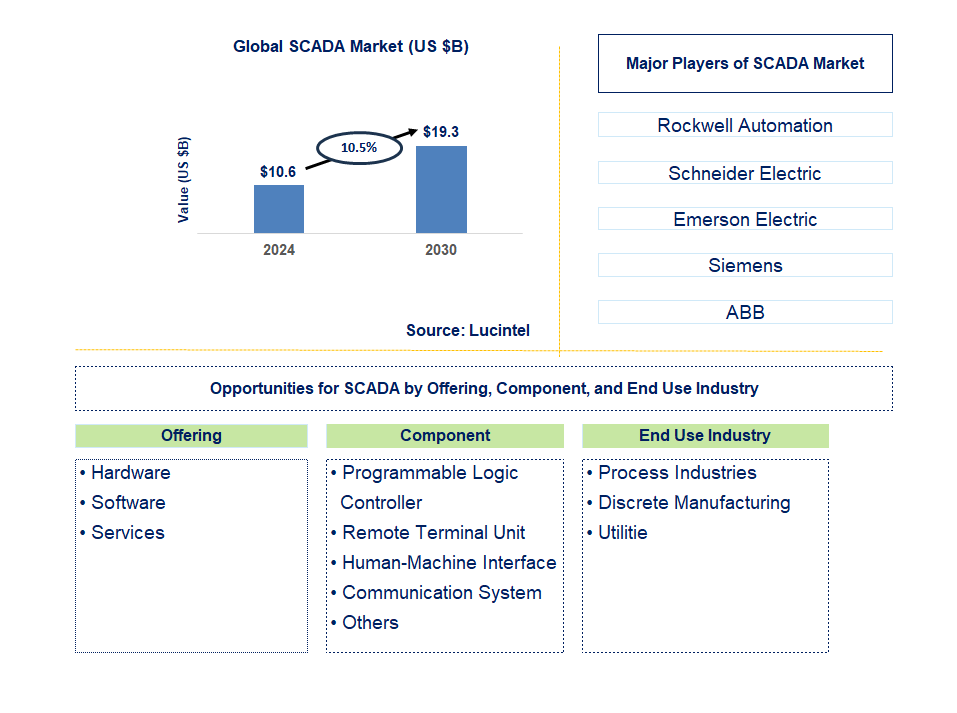
Key data points: The market size in 2030 = $19.3 billion, growth forecast = 10.5% annually for the next 6 years. Scroll below to get more insights. This market report covers trends, opportunities, and forecasts in the global scada market to 2030 by offering (hardware, software, and services), component (programmable logic controller, remote terminal unit, human-machine interface, communication system, and others), end use industry (process industries, discrete manufacturing, and utilitie), and region (North America, Europe, Asia Pacific, and the Rest of the World)
We'll send your sample report shortly.
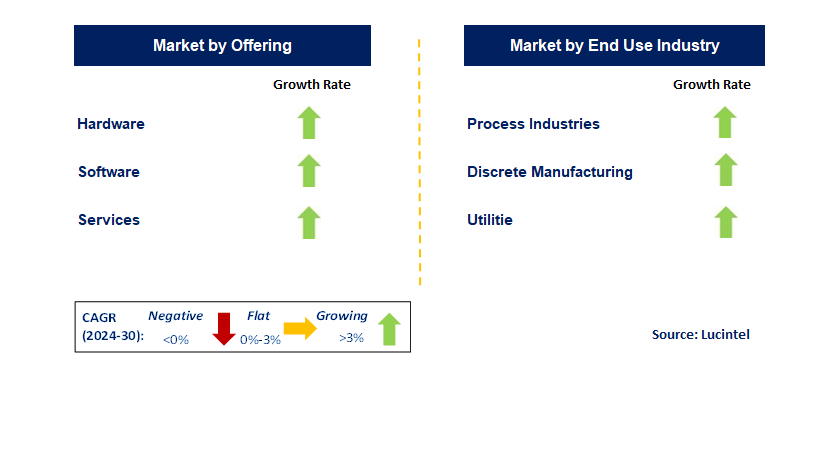
• Lucintel forecasts, within offering category, services is expected to witness highest growth over the forecast period.
• Within end-use industry category market, process industries will remain the largest segment.
• In terms of region, Europe is expected to witness highest growth over the forecast period due to growth of the manufacturing sector in the area and increased investments in smart grid projects. A more than 150-page report is developed to help in your business decisions.
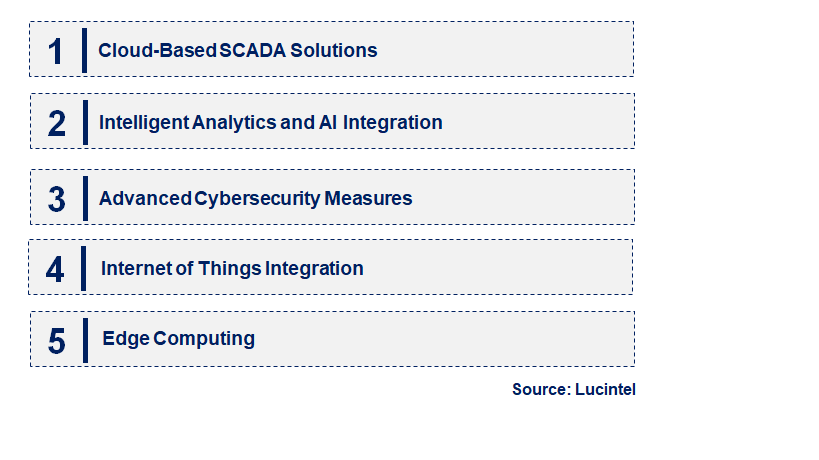
• Cloud-Based SCADA Solutions: Scalability, cost-effectiveness, and remote accessibility make cloud-based SCADA systems increasingly popular. They allow real-time access and control of data from any location, improving decision-making and operational efficiency while minimizing on-site infrastructure and maintenance.
• Intelligent Analytics and AI Integration: AI-powered advanced analytics are rapidly transforming SCADA systems, facilitating predictive maintenance and operational efficiencies. AI algorithms analyze large volumes of data to identify patterns, forecast equipment failures, and optimize processes, enhancing overall system performance and reducing downtime.
• Advanced Cybersecurity Measures: The emergence of cyber threats has led to a greater focus on strengthening SCADA cybersecurity. Implementing advanced encryption, multifactor authentication, and periodic security audits are high priorities to protect critical infrastructure from potential breaches affecting data integrity.
• Internet of Things Integration: Integrating IoT into SCADA systems enhances visibility and control over industrial processes. IoT sensors provide real-time data on equipment status and ambient conditions, allowing for accurate monitoring and management. This connectivity enables quicker responses to issues, improving overall system efficiency.
• Edge Computing: Edge computing, which enables data processing closer to the source, is a key trend. It reduces latency and bandwidth use, enhances real-time decision-making, and improves system responsiveness. These benefits allow edge computing to complement SCADA systems by providing faster and more reliable data processing. These trends will continue to shape the SCADA market, enhancing system capabilities, boosting efficiency, and addressing pressing challenges. Cloud solutions, AI integration, and IoT provide flexibility and advanced analytics, while enhanced cybersecurity and edge computing meet critical operational needs and address security concerns.
• Adoption of AI and Machine Learning: SCADA systems are increasingly adopting AI and machine learning to enhance predictive maintenance and operational efficiency. These technologies analyze historical and real-time data to predict impending equipment failures and optimize processes, thereby reducing downtimes and costs.
• Integration of Cloud Technologies: The shift to cloud-based SCADA solutions is accelerating due to advantages such as remote access, scalability, and reduced infrastructure costs. Cloud-based SCADA enables flexible deployment and the ability to handle complex industrial processes from anywhere in the world.
• Advanced Cybersecurity: Due to rising cyber threats, the demand for security in SCADA systems is increasing. This includes implementing robust encryption protocols, sophisticated authentication techniques, and regular security updates to fend off cyberattacks while ensuring data integrity.
• Edge Computing Development: Edge computing is being adopted to make SCADA systems more efficient and responsive. By processing data closer to its source, it reduces latency and bandwidth usage, allowing for quicker and more accurate decision-making on the factory floor.
• Increased Focus on Integration with IoT: Integrating IoT devices with SCADA enhances monitoring and control capabilities. IoT sensors provide real-time data on various parameters, improving oversight of industrial processes and enabling quick management of equipment and operations. These developments are fostering growth in the SCADA market by upgrading system capabilities, efficiency, and security. AI, cloud technologies, and IoT, along with enhanced cybersecurity and edge computing, drive the evolution of SCADA systems to meet the demands of modern industries.
• Smart Grid Applications: SCADA systems are used in smart grid applications for effective management and monitoring of electrical grids. This includes real-time data acquisition, automated control, and advanced analytics that optimize energy distribution by reducing outages. The growth of renewable energy sources and smart grids presents significant opportunities for SCADA solutions.
• Water and Wastewater Management: The adoption of SCADA systems in water and wastewater management is increasing due to the need for efficient resource management and regulatory compliance. Real-time monitoring and control of processes in water treatment can be supported by SCADA systems, enhancing water quality and operational efficiency.
• Industrial Automation: SCADA systems play a crucial role in industrial automation, providing control and monitoring in manufacturing processes. Future integration of SCADA with advanced robotics and AI opens avenues for streamlining operations, enhancing product quality, and reducing production costs.
• Oil and Gas Industry: SCADA applications involve monitoring and controlling exploration, production, and distribution processes within the oil and gas industry. Safety features in SCADA solutions include analysis of real-time data, which is increasingly in demand in remote and hazardous areas.
• Building Management Systems: An emerging application of SCADA systems is in building management, controlling HVAC, lighting, and security systems. SCADA solutions that integrate management and optimization of building operations are crucial, given the growing focus on energy efficiency and smart building technologies. These growth opportunities indicate increased usage of SCADA systems across various applications. Stakeholders can ensure better outcomes in this evolving market by embracing technological advancements and addressing industry needs.
• Technological Advancement: Innovations in AI, IoT, and cloud computing are major contributors to the growth of the SCADA market by improving system functionality and efficiency. These technologies enable sophisticated monitoring, predictive maintenance, and data analysis, enhancing operational performance and reducing costs.
• Growing Demand for Automation: The increasing demand for industrial automation across various industries propels the market for SCADA systems. Automation improves productivity, reduces labor costs, and enhances process control, leading to higher demand from manufacturing, energy, and utilities sectors.
• Increasing Cybersecurity Awareness: The awareness of cybersecurity threats is driving investments in secure SCADA systems. Advanced security measures, including enhanced encryption and multifactor authentication, are necessary to protect an organization's critical infrastructure from cyber threats.
• Smart Infrastructure Growth: The growth of smart grids and smart cities provides numerous opportunities for SCADA systems. SCADA systems are vital for managing and optimizing complex infrastructure networks, thereby increasing market demand.
• Regulatory Compliance: Stricter regulations regarding data security and operational efficiency compel industry players to adopt more advanced SCADA solutions. Compliance with these regulations creates a need for robust and secure SCADA systems, driving market growth. Challenges in the SCADA market include:
• Higher Implementation Costs: The initial deployment costs of SCADA systems are significant, making them unaffordable for small organizations. The need for advanced hardware, software, and their integration and maintenance can be prohibitively expensive for some organizations.
• Integration with Legacy Systems: Adapting new SCADA systems to existing large-scale management infrastructures can be challenging and costly. Compatibility issues and the need for extensive customization can hinder a smooth transition to new SCADA solutions.
• Data Privacy Concerns: Data privacy and protection remain major challenges for SCADA systems. Evolving laws and diverse cyber threats necessitate rigorous security measures that organizations must implement to safeguard sensitive data and comply with privacy standards. Key drivers for the SCADA market include technological advancements, the demand for automation, cybersecurity concerns, and regulatory policies. Effectively leveraging these drivers will create a strong platform for growth while addressing market challenges.
• Rockwell Automation
• Schneider Electric
• Emerson Electric
• Siemens
• ABB
• Hardware
• Software
• Services
• Programmable Logic Controller
• Remote Terminal Unit
• Human-Machine Interface
• Communication System
• Others
• Process Industries
• Discrete Manufacturing
• Utilitie
• North America
• Europe
• Asia Pacific
• The Rest of the World
• U.S.A: The SCADA market in the U.S. is experiencing relatively high growth due to increased spending on smart grid technologies and industrial automation. Key developments include the integration of AI and ML to improve predictive maintenance and operational efficiency. Additionally, regulatory pressures are compelling better cybersecurity measures for the development of secure SCADA systems.
• China: China's SCADA market has grown remarkably due to governmental policies and programs aimed at smarter infrastructure and modernization of industries. Major trends include the deployment of SCADA systems in smart cities and real-time data processing developments. There is a strong emphasis on integrating SCADA systems with AI to ensure effective resource management and operational efficiency.
• Germany: Germany represents a strong market for SCADA due to the influence of industrial automation and Industry 4.0. Recent developments include the integration of SCADA with advanced robotics and IoT devices. Germany also leads in cybersecurity for SCADA systems due to stringent data protection regulations and resilient industrial control systems.
• India: Rapid urbanization and infrastructure development are increasing the SCADA market in India. Key developments include the adoption of SCADA systems by power generation and distribution sectors, along with value-added data analytics through predictive maintenance. Solutions must be scalable and designed to meet the diverse demands of this fast-growing industry and urban sector in India.
• Japan: The Japanese market for SCADA reflects advanced smart manufacturing and disaster management capabilities. This includes SCADA integration with IoT and AI for improved operational efficiency and resilience. Japan is also modernizing aging infrastructure with new SCADA systems to enhance reliability and safety.


• Rockwell Automation
• Schneider Electric
• Emerson Electric
• Siemens
• ABB Q6. Which SCADA market segment will be the largest in future? Answer: Lucintel forecasts that services is expected to witness highest growth over the forecast period. Q7. In SCADA market, which region is expected to be the largest in next 5 years? Answer:Europe is expected to witness highest growth over the forecast period due to growth of the manufacturing sector in the area and increased investments in smart grid projects. Q.8 Do we receive customization in this report? Answer: Yes, Lucintel provides 10% customization without any additional cost.


Choose a license that fits your team. Instant PDF delivery.
Prices exclude taxes. Instant delivery. Custom licensing available on request.
Market Report · July 31, 2026
Market Report · July 31, 2026
Market Report · July 31, 2026
Trusted partner for strategic intelligence and business growth


Receive a complimentary market analysis tailored to your industry. Our analysts will identify key growth opportunities and competitive dynamics specific to your business.

Market size, growth rate, and key trend analysis for your specific sector.

Top competitor positioning and market share analysis.

Strategic recommendations backed by data-driven insights.
Get curated market intelligence and competitive moves straight to your inbox.
By subscribing, you agree to receive our monthly insights. Unsubscribe anytime.
Receive a complimentary market analysis tailored to your industry. Our analysts will identify key growth opportunities and competitive dynamics specific to your business.
Market size, growth rate, and key trend analysis for your specific sector.
Top competitor positioning and market share analysis.
Strategic recommendations backed by data-driven insights.
Get curated market intelligence, emerging trends, and competitive moves straight to your inbox each month.
By subscribing, you agree to receive our monthly insights. Unsubscribe anytime.
We'll send your sample report shortly.