
Market Report · July 31, 2026

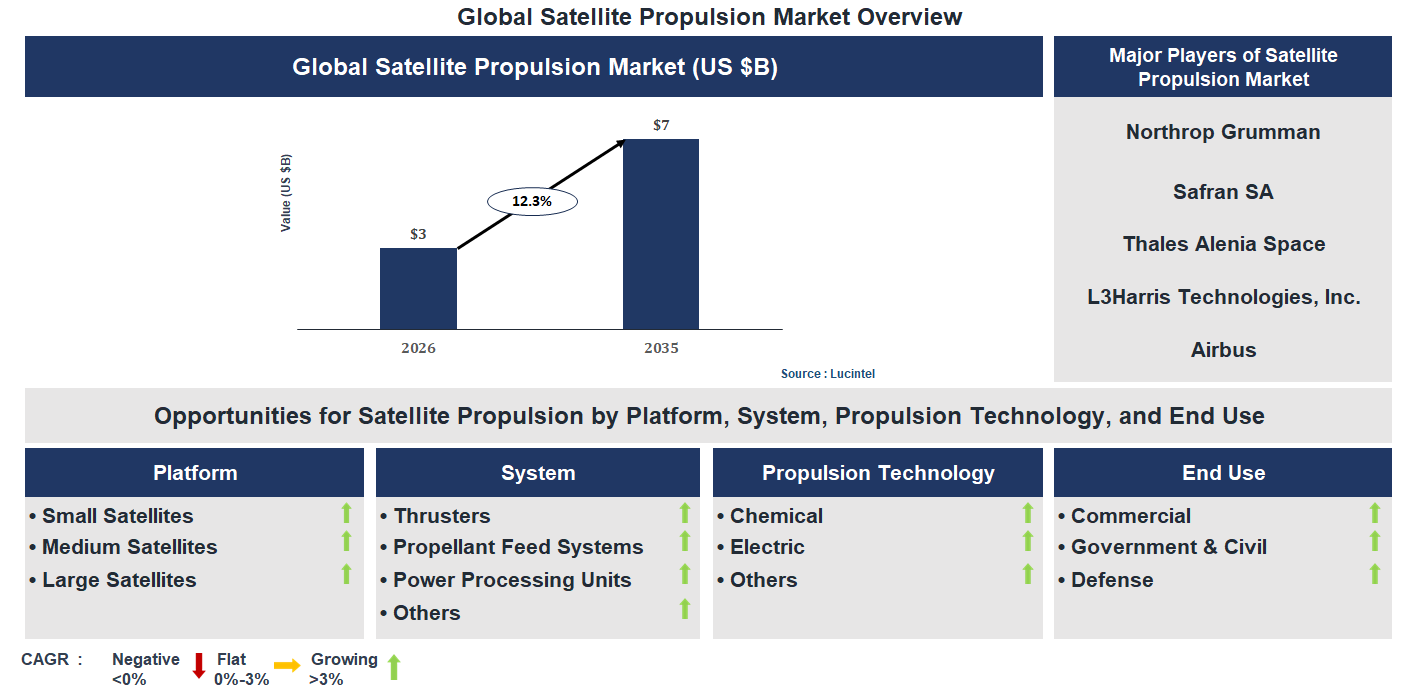
Key data points: The market size in 2035 = $7 billion, growth forecast = 12.3% annually for the next 8 years. Scroll below to get more insights. This market report covers trends, opportunities and forecasts in satellite propulsion market to 2035 by platform (small satellites, medium satellites, and large satellites), system (thrusters, propellant feed systems, power processing units, and others), propulsion technology (chemical, electric, and others), end use (commercial, government & civil, and defense), and region (North America, Europe, Asia Pacific, and the Rest of the World)
We'll send your sample report shortly.
• Lucintel forecasts that, within the system category, thruster is expected to witness the highest growth over the forecast period.
• Within the end use category, commercial is expected to witness the highest growth.
• In terms of region, Europe is expected to witness the highest growth over the forecast period. Gain valuable insights for your business decisions with our comprehensive 150+ page report. Sample figures with some insights are shown below.
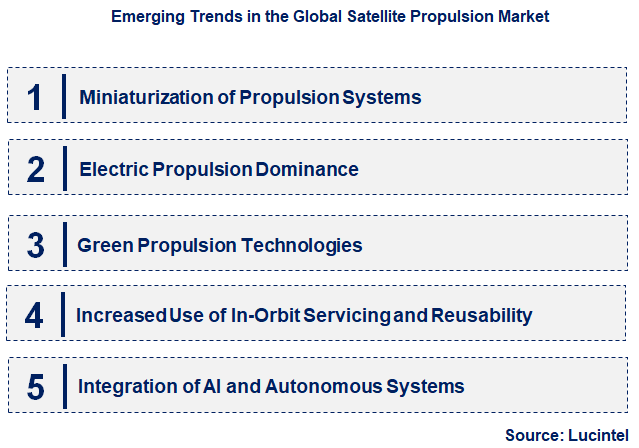
• Miniaturization of Propulsion Systems: The trend toward smaller, lightweight propulsion units is driven by the need for miniaturized satellites like CubeSats and small sats. These compact systems reduce launch costs and enable more flexible satellite designs. Advances in materials and microfabrication techniques allow for high-performance propulsion in limited spaces, expanding the potential for innovative satellite configurations. This miniaturization trend is making space more accessible and cost-effective, fostering a broader range of applications and increasing the overall satellite deployment rate.
• Electric Propulsion Dominance: Electric propulsion systems, such as Hall-effect thrusters and ion engines, are gaining popularity due to their high efficiency and low fuel consumption. They enable longer mission durations and greater payload capacities, especially for deep-space and geostationary satellites. The shift toward electric propulsion is driven by technological improvements and the need for sustainable space operations. This trend is transforming satellite design, allowing for more ambitious missions and reducing launch and operational costs, ultimately making space exploration and communication more feasible and economical.
• Green Propulsion Technologies: Environmental concerns are prompting the development of eco-friendly propulsion options, such as green propellants and solar-thermal systems. These technologies aim to minimize toxic emissions and reduce space debris. The adoption of green propulsion aligns with global sustainability goals and regulatory pressures, encouraging innovation in environmentally responsible space operations. This trend is fostering a new era of sustainable satellite missions, reducing the ecological footprint of space activities, and appealing to environmentally conscious stakeholders.
• Increased Use of In-Orbit Servicing and Reusability: The market is witnessing a rise in propulsion systems designed for satellite servicing, refueling, and deorbiting. Reusable propulsion modules extend satellite lifespans and enable on-demand mission adjustments. This trend reduces costs and enhances mission flexibility, supporting the growing demand for satellite longevity and adaptability. It also promotes sustainable space practices by decreasing the need for launching new satellites, thus conserving resources and reducing space debris.
• Integration of AI and Autonomous Systems: The incorporation of artificial intelligence and autonomous control in propulsion systems is enhancing precision, safety, and operational efficiency. AI-driven systems can optimize fuel usage, predict maintenance needs, and enable autonomous maneuvering. This technological integration is crucial for complex missions and congested orbital environments. It is transforming satellite operations by increasing reliability and reducing human intervention, ultimately leading to smarter, more resilient satellite fleets capable of adapting to dynamic space conditions. These emerging trends are fundamentally reshaping the satellite propulsion market by making satellite systems more efficient, sustainable, and adaptable. They are enabling new mission capabilities, reducing costs, and promoting environmentally responsible practices. As these trends continue to evolve, they will drive innovation, expand market opportunities, and redefine the future landscape of space exploration and satellite deployment.
• Growing Demand for Satellite Longevity: The need for longer-lasting satellites is driving innovations in propulsion systems, enabling extended mission durations and reducing replacement costs. Enhanced propulsion solutions improve orbit maintenance, station-keeping, and end-of-life deorbiting, which are critical for operational efficiency. This trend is encouraging manufacturers to develop more durable, fuel-efficient, and reliable propulsion technologies, ultimately increasing satellite lifespan and reducing overall mission costs. The market benefits from increased satellite operational time and improved service continuity.
• Advancements in Electric Propulsion Technologies: Electric propulsion systems, such as Hall-effect thrusters and ion engines, are gaining prominence due to their high efficiency and low fuel consumption. These technologies enable satellites to perform complex maneuvers with less propellant, extending mission capabilities and lifespan. The adoption of electric propulsion is particularly impactful for deep-space missions and large satellite constellations. As technology matures, costs decrease, making electric propulsion more accessible, which accelerates market growth and broadens application scope.
• Rising Investment in Space Exploration Missions: Governments and private companies are investing heavily in space exploration, requiring advanced propulsion systems for interplanetary travel and deep-space probes. These investments are fostering innovation in propulsion technologies capable of supporting long-duration, high-energy missions. The development of new propulsion solutions enhances mission feasibility, safety, and efficiency, attracting more funding and partnerships. This trend is expanding the market beyond traditional satellite applications into new frontiers of space exploration.
• Increasing Focus on Environmentally Friendly Propulsion: Environmental concerns are prompting the industry to develop eco-friendly propulsion options that reduce space debris and minimize chemical emissions. Green propulsion technologies, such as solar-electric and hybrid systems, are gaining traction for their sustainability benefits. These innovations help meet regulatory standards and corporate social responsibility goals. The shift towards environmentally conscious propulsion solutions is shaping a more sustainable market, encouraging adoption across commercial, governmental, and scientific satellite missions.
• Integration of AI and Automation in Propulsion Systems: The incorporation of artificial intelligence and automation is revolutionizing satellite propulsion management. AI-driven systems optimize fuel usage, predict maintenance needs, and enhance maneuver precision, leading to increased operational efficiency. Automation reduces human intervention, minimizes errors, and enables real-time decision-making. This technological integration is critical for complex satellite constellations and deep-space missions, significantly impacting market dynamics by improving reliability, reducing costs, and enabling more sophisticated mission profiles. These developments are transforming the satellite propulsion market by enhancing satellite performance, extending mission durations, and supporting sustainable practices. Increased technological innovation and investment are driving growth, creating new opportunities for industry players. As the market evolves, these advancements will lead to more efficient, reliable, and environmentally friendly satellite propulsion solutions, ultimately expanding the scope and capabilities of satellite applications worldwide.
• Growing Demand for Satellite Constellations Drives Propulsion Innovation: The rise of large satellite constellations for global internet coverage and Earth monitoring necessitates advanced propulsion systems for precise positioning, collision avoidance, and orbit maintenance. This demand encourages development of scalable, efficient propulsion solutions that can support the deployment and operation of numerous satellites simultaneously, fostering market growth and technological advancements.
• Advancements in Electric Propulsion Technologies Enhance Satellite Efficiency: Electric propulsion systems, such as Hall-effect thrusters and ion engines, offer higher efficiency and lower fuel consumption compared to traditional chemical thrusters. These innovations enable longer mission durations, increased payload capacity, and reduced launch costs. As research progresses, electric propulsion is becoming the preferred choice for commercial and government satellites, opening new avenues for market expansion.
• Increasing Focus on Space Debris Management Promotes Propulsion Solutions: The growing concern over space debris necessitates active debris removal and collision avoidance strategies. Propulsion systems capable of precise maneuvering and deorbiting are critical for sustainable space operations. This focus drives demand for innovative propulsion technologies that can safely and efficiently manage space debris, creating opportunities for specialized propulsion solutions in the market.
• Rising Investments in Space Exploration and Lunar Missions Expand Market Scope: Government agencies and private companies are investing heavily in space exploration, lunar, and Mars missions. These missions require robust propulsion systems capable of long-distance travel, deep-space maneuvering, and payload delivery. The development of high-thrust, reliable propulsion solutions for these applications is expected to significantly boost market growth and technological development.
• Integration of Green Propulsion Systems Promotes Sustainable Space Operations: Environmental concerns and regulatory pressures are pushing the industry toward eco-friendly propulsion options that reduce space debris and emissions. Green propulsion technologies, such as green monopropellants and environmentally safe electric thrusters, are gaining traction. Their adoption supports sustainable space activities, aligns with regulatory standards, and opens new market segments focused on environmentally responsible satellite operations. The satellite propulsion market is poised for substantial growth through technological innovation, expanding applications, and sustainability initiatives. These opportunities will drive industry competitiveness, enhance satellite capabilities, and support the sustainable expansion of space activities, ultimately shaping the future landscape of satellite missions and space exploration.
• Technological Innovation: The continuous development of more efficient, reliable, and cost-effective propulsion systems, such as electric and hybrid propulsion, is expanding satellite capabilities. These innovations enable longer mission durations, increased payload capacity, and reduced launch costs, making satellite deployment more feasible and attractive for various applications including communications, Earth observation, and navigation.
• Growing Satellite Demand: The rising need for satellite-based services across sectors like telecommunications, defense, and weather forecasting is fueling market growth. The proliferation of small satellites and mega-constellations requires advanced propulsion systems for orbit insertion, station-keeping, and end-of-life deorbiting, thereby boosting demand.
• Regulatory and Policy Support: Governments and international agencies are implementing policies that encourage satellite deployment and space exploration. Regulatory frameworks aimed at space traffic management and debris mitigation are fostering a safer environment, which in turn promotes investment in reliable propulsion solutions.
• Economic Factors: The decreasing costs of satellite manufacturing and launch services, coupled with increased private sector investment, are making satellite missions more economically viable. This financial environment encourages innovation and expansion within the satellite propulsion sector, supporting market growth. The challenges in the satellite propulsion market are:
• High Development and Manufacturing Costs: Developing advanced propulsion systems involves significant R&D investment, complex manufacturing processes, and rigorous testing. These high costs can limit entry for smaller players and slow down innovation, impacting overall market growth.
• Regulatory and Space Debris Concerns: Stringent regulations related to space traffic management and debris mitigation pose operational challenges. Compliance requirements can delay deployment and increase costs, while the growing space debris complicates satellite operations and end-of-life disposal.
• Technological Complexity and Reliability: The harsh space environment demands highly reliable propulsion systems. Developing technology that can withstand extreme conditions and operate flawlessly over long durations is challenging, and failures can lead to costly mission losses and increased insurance premiums. The satellite propulsion market is driven by technological advancements, increasing satellite demand, supportive policies, and favorable economic conditions. However, high costs, regulatory hurdles, and technological complexities present significant challenges. These factors collectively influence the pace and direction of market growth, requiring stakeholders to innovate continuously and navigate regulatory landscapes carefully. Overall, the markets future depends on balancing these drivers and challenges to foster sustainable growth and technological progress.
• Northrop Grumman
• Safran SA
• Thales Alenia Space
• L3Harris Technologies, Inc.
• Airbus
• Small Satellites
• Medium Satellites
• Large Satellites
• Thrusters
• Propellant Feed Systems
• Power Processing Units
• Others
• Chemical
• Electric
• Others
• Commercial
• Government & Civil
• Defense
• North America
• Europe
• Asia Pacific
• The Rest of the World
• United States: The US market has seen significant advancements with major players like SpaceX and Northrop Grumman developing next-generation propulsion systems. Innovations include electric and chemical propulsion for small satellites and deep space missions. The government agencies, including NASA, are investing in reusable propulsion technologies to reduce costs and enhance mission capabilities. Collaborations between private companies and government agencies are accelerating the deployment of advanced propulsion solutions, supporting both commercial and scientific missions.
• China: China has made notable progress in satellite propulsion, focusing on indigenous technology development. The China Academy of Space Technology (CAST) has launched new electric propulsion systems for communication satellites, improving efficiency and lifespan. The country’s space agency, CNSA, is also working on deep space propulsion technologies to support lunar and Mars exploration missions. China’s expanding satellite constellation and ambitious space exploration plans are driving demand for innovative propulsion solutions.
• Germany: Germany’s aerospace industry is emphasizing the development of environmentally friendly propulsion systems, including green propulsion technologies that reduce emissions. Companies like Airbus Defense and Space are advancing electric propulsion for small and medium-sized satellites. Germany is also involved in European collaborative projects aimed at standardizing and improving satellite propulsion systems, contributing to the broader European space strategy. Research institutions are exploring hybrid propulsion options to enhance mission flexibility and sustainability.
• India: India’s space agency ISRO has focused on cost-effective propulsion solutions to support its growing satellite fleet and interplanetary missions. Recent developments include the successful deployment of electric propulsion systems for communication satellites and the development of new cryogenic engines for launch vehicles. India is also exploring reusable propulsion technologies to reduce mission costs and increase launch frequency, aligning with its goal of becoming a major space power.
• Japan: Japan has advanced its satellite propulsion capabilities through innovations in ion and Hall-effect thrusters, primarily used in scientific and communication satellites. The Japan Aerospace Exploration Agency (JAXA) is investing in deep space propulsion research to support future lunar and asteroid missions. Japanese companies are also collaborating with international partners to develop hybrid propulsion systems, emphasizing reliability and efficiency for long-duration missions. These efforts position Japan as a key player in the evolving satellite propulsion landscape.


• Northrop Grumman
• Safran SA
• Thales Alenia Space
• L3Harris Technologies, Inc.
• Airbus Q6. Which satellite propulsion market segment will be the largest in future? Answer: Lucintel forecasts that, within the system category, thruster is expected to witness the highest growth over the forecast period. Q7. In satellite propulsion market, which region is expected to be the largest in next 8 years? Answer: In terms of region, Europe is expected to witness the highest growth over the forecast period. Q8. Do we receive customization in this report? Answer: Yes, Lucintel provides 10% customization without any additional cost.


Choose a license that fits your team. Instant PDF delivery.
Prices exclude taxes. Instant delivery. Custom licensing available on request.
Market Report · July 31, 2026
Market Report · July 31, 2026
Market Report · July 31, 2026
Trusted partner for strategic intelligence and business growth


Receive a complimentary market analysis tailored to your industry. Our analysts will identify key growth opportunities and competitive dynamics specific to your business.

Market size, growth rate, and key trend analysis for your specific sector.

Top competitor positioning and market share analysis.

Strategic recommendations backed by data-driven insights.
Get curated market intelligence and competitive moves straight to your inbox.
By subscribing, you agree to receive our monthly insights. Unsubscribe anytime.
Receive a complimentary market analysis tailored to your industry. Our analysts will identify key growth opportunities and competitive dynamics specific to your business.
Market size, growth rate, and key trend analysis for your specific sector.
Top competitor positioning and market share analysis.
Strategic recommendations backed by data-driven insights.
Get curated market intelligence, emerging trends, and competitive moves straight to your inbox each month.
By subscribing, you agree to receive our monthly insights. Unsubscribe anytime.
We'll send your sample report shortly.