
Market Report · July 29, 2026

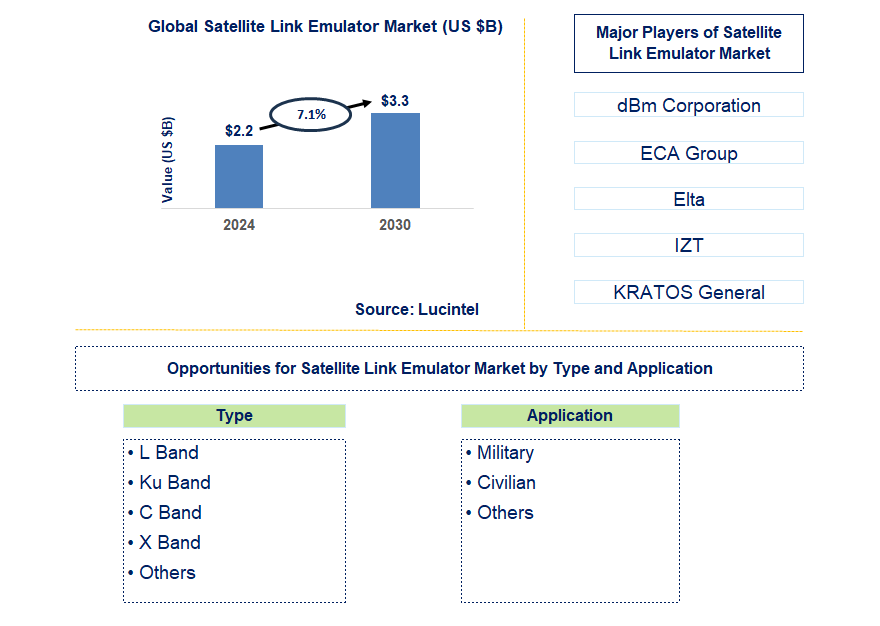
Key data points: The market size in 2030 = $3.3 billion, growth forecast = 7.1% annually for the next 6 years. Scroll below to get more insights. This market report covers trends, opportunities, and forecasts in the global satellite link emulator report: trends, forecast and competitive analysis to 2030market to 2030 by type (L band, Ku band, C band, X band, and others), application (military, civilian, and others), and region (North America, Europe, Asia Pacific, and the Rest of the World)
We'll send your sample report shortly.
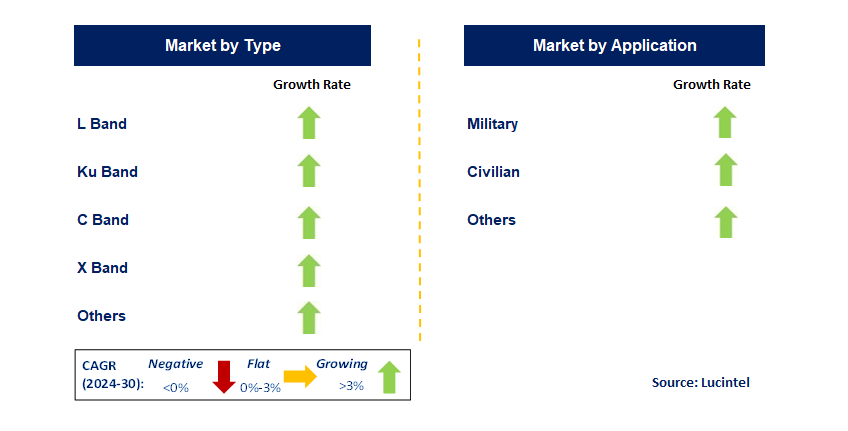
• Lucintel forecasts that, within the type category, the L band is expected to witness the highest growth over the forecast period.
• In terms of region, APAC is expected to witness the highest growth over the forecast period. A more than 150-page report is developed to help in your business decisions.
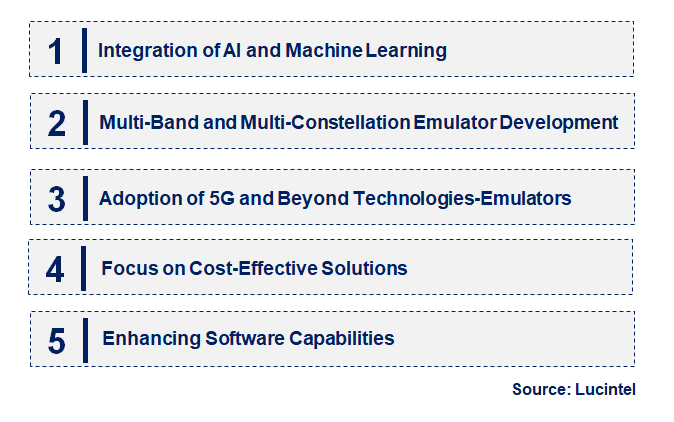
• Integration of AI and Machine Learning: AI and machine learning are increasingly being included in the satellite link emulators with a purpose to enhance the accuracy of the simulation as well as predictive capacity. It allows modeling complex scenarios, which eventually improves the dependability of satellite communications.
• Multi-Band and Multi-Constellation Emulator Development: The trend is now towards the development of such emulators that support multiple frequency bands as well as satellite constellations. It answers the challenge to a highly complex testing environment for which the modern satellite systems have been oriented.
• Adoption of 5G and Beyond Technologies-Emulators Update: The latest 5G standards and future communication technologies are implemented in the emulators. In this regard, simulation of satellite links is most certainly not obsolete, to say nothing of new standards and technologies popping up now and then.
• Focus on Cost-Effective Solutions: The increasing demand for low-cost satellite link emulators which do not compromise in performance is the current trend; this is because advanced simulation technologies need to be made available in a very wide user base.
• Enhancing Software Capabilities: Improved software algorithms can make enhancements in the performance and multiplicity of satellite link emulators. This, in turn, enables better, more accurate simulations and support of complex scenarios of satellite communications. The trends that drive the satellite link emulator industry towards AI integration, multi-band supporting capabilities, adoption of 5G, cost-effectiveness, and enhanced software capabilities. All these above factors are driving innovations and accuracy and affordability in satellite link simulation.
• Advancements in Simulation Technology: With the development of higher accuracy and robust simulation technologies, precise and real simulation of satellite links is now being introduced. New simulation technologies will improve modeling capabilities of complex satellite scenarios and thus allow performance assessment of the system under different conditions.
• Integration with 5G Networks: Satellite link emulators are upgraded for integration with the latest 5G networks. Thus, the latest communication standards are ensured, and satellite systems can be tested in unison with the infrastructures of 5G.
• Portable Solutions Emerging: Portable and compact satellite link emulators are fast becoming favorites today. Portability and mobility provide much convenience and ease for field testing and flexible deployment options across various locations.
• Advanced Software Algorithms Focus: Advanced software algorithms are developed to make the satellite link emulators much more accurate and efficient. It supports more accurate simulation of link conditions as well as performance metrics.
• Rising Demand in Defense and Aerospace: Satellite link emulators find rising applications in defense and aerospace industries. Recently, there are special emulators that allow complex military or space missions. the satellite link emulator market is impacted mainly by the growth in simulation technology, integration of 5G, the availability of portable solutions, improved software algorithms, and also an increase in applications in defense services thus pushing innovation and expanding applications.
• Growth Opportunity in Defense Sector: Defense segment forms an opportunity area for satellite link emulators, where the demand for advanced test of communication systems used in military operations are increasing. There is good demand for emulators developed to test a secure as well as a resilient link.
• Growth in Aerospace Industry: Expand the satellite link emulators for space missions, and satellite deployable into the aerospace industry. Advanced emulators are essential in complex satellite communication and support space exploration.
• Adoption in Telecommunications: With advancement in telecommunications networks, the demand to produce space and earth orientations as well as integration-ready satellites with emerging technologies such as 5G arises. This creates opportunities for developing advanced emulators compatible with new communication standards.
• Portable Testing Solutions Development-portable testing solutions are in much demand. Portable satellite link emulators usable for many environments including field testing-great growth opportunity.
• Greater Interest in Cost-Effective Solutions: The interest is with cost-effective satellite link emulators that have high performance without a high price tag. This opportunity involves addressing the needs of smaller organizations and expanding markets with a budget. The growth opportunity in the defense sector, the aerospace industry, telecommunications, portable solutions, and cost-effective products drives the satellite link emulator market. The opportunities are multiplying the market and inspiring innovation in satcom link simulation technologies.
• dBm Corporation
• ECA Group
• Elta
• IZT
• KRATOS General Microwave
• L Band
• Ku Band
• C Band
• X Band
• Others
• Military
• Civilian
• Others
• North America
• Europe
• Asia Pacific
• The Rest of the World
• United States: Developments in the U.S. related to satellite link emulators have recently included significant investments in high-end simulation technologies for reliability and performative networks. Innovations have centered around developing an AI-machine learning-enabled emulator with accuracy for better prediction. These advanced solutions find increasing demand by Defense and telecommunications sectors.
• China: China has been consistently upgrading its satellite link emulator facilities with zero focus on high-frequency and high-capacity simulation technologies. The latest developments of the same relate to the setting up of more complex emulators that could work with complex satellite constellations and multi-band operations. The driver behind the growth is China's aggressiveness in further strengthening the country's space program and enhancing the satellite communication infrastructure.
• Germany: Antenna and satellite link emulators in Germany are now being improved in terms of high-precision, cost-effective tools. Improved software algorithms support better link performance simulation and integration with the 5G technology epoch. Emphasis is on supporting the aerospace sector and compliant with stiff regulations by Europe.
• India: In the case of India, though its market is still developing with affordable and scalable simulation solutions, recent developments have actually been focused on enhancing emulator capabilities to cover various satellite missions and applications. These recent developments are primarily triggered by the country's increasing space program and the escalating demand for trusted satellite communications.
• Japan: Compact and high performance system: In Japan, the innovation in satellite link emulators is made with regards to compact systems as well as highly performing systems. The key development includes emulator technology that will be capable of providing testing possibilities for both commercial and defense satellites. The market demand is fueled by the interest of Japan in space research and a need for better communication solutions.


• dBm Corporation
• ECA Group
• Elta
• IZT
• KRATOS General Microwave Q6. Which satellite link emulator market segment will be the largest in the future? Answer: Lucintel forecasts that the L band is expected to witness the highest growth over the forecast period. Q7. In the satellite link emulator market, which region is expected to be the largest in the next 5 years? Answer: APAC is expected to witness the highest growth over the forecast period. Q.8 Do we receive customization in this report? Answer: Yes, Lucintel provides 10% customization without any additional cost.


Choose a license that fits your team. Instant PDF delivery.
Prices exclude taxes. Instant delivery. Custom licensing available on request.
Market Report · July 29, 2026
Market Report · July 20, 2026
Market Report · July 20, 2026
Trusted partner for strategic intelligence and business growth


Receive a complimentary market analysis tailored to your industry. Our analysts will identify key growth opportunities and competitive dynamics specific to your business.

Market size, growth rate, and key trend analysis for your specific sector.

Top competitor positioning and market share analysis.

Strategic recommendations backed by data-driven insights.
Get curated market intelligence and competitive moves straight to your inbox.
By subscribing, you agree to receive our monthly insights. Unsubscribe anytime.
Receive a complimentary market analysis tailored to your industry. Our analysts will identify key growth opportunities and competitive dynamics specific to your business.
Market size, growth rate, and key trend analysis for your specific sector.
Top competitor positioning and market share analysis.
Strategic recommendations backed by data-driven insights.
Get curated market intelligence, emerging trends, and competitive moves straight to your inbox each month.
By subscribing, you agree to receive our monthly insights. Unsubscribe anytime.
We'll send your sample report shortly.