
Market Report · July 31, 2026

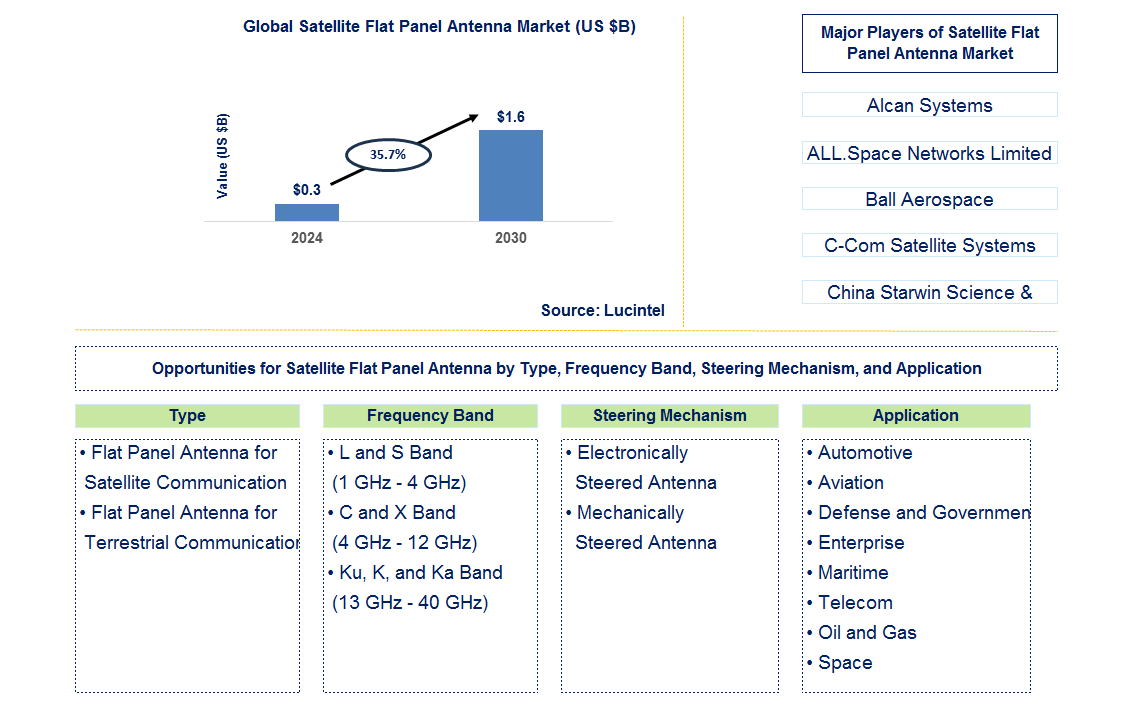
Key data points: The market size in 2030 = $1.6 billion, growth forecast = 35.7% annually for the next 6 years. Scroll below to get more insights. This market report covers trends, opportunities, and forecasts in the global satellite flat panel antenna market to 2030 by type (flat panel antenna for satellite communication (satcom) and flat panel antenna for terrestrial communication), frequency band (L and S Band (1 GHz - 4 GHz), C and X Band (4 GHz - 12 GHz), and Ku, K, and Ka Band (13 GHz - 40 GHz)), steering mechanism (electronically steered antenna, mechanically steered antenna, and hybrid), application (automotive, aviation, defense and government, enterprise, maritime, telecom, oil and gas, and space), and region (North America, Europe, Asia Pacific, and the Rest of the World)
We'll send your sample report shortly.
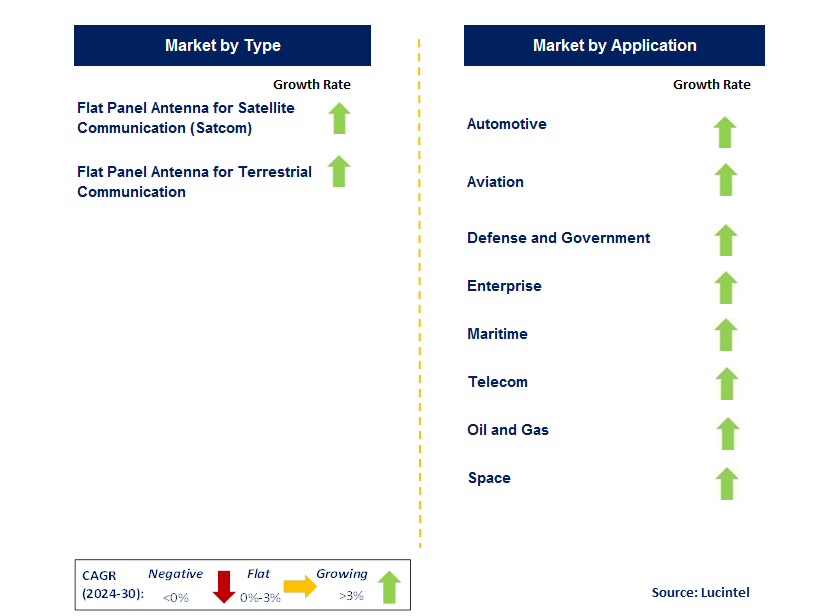
• Lucintel forecasts that, within the type category, flat panel antenna for satellite communication (satcom) is expected to witness the highest growth over the forecast period.
• Within the application category, defense and government will remain the largest segment.
• In terms of region,North America is expected to witness the highest growth over the forecast period. Gain valuable insights for your business decisions with our comprehensive 150+ page report.
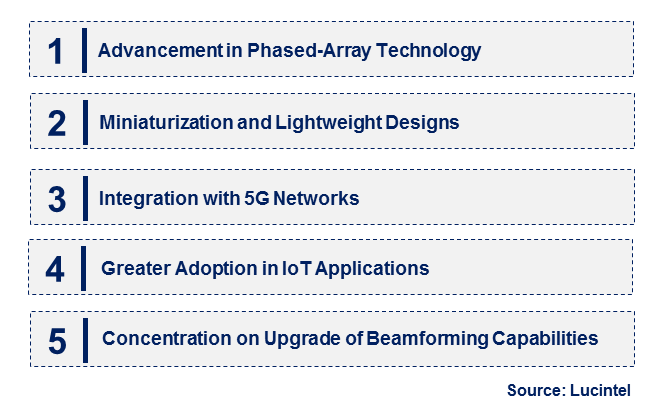
• Advancement in Phased-Array Technology: Phased-array technology has facilitated significant improvements in the performance of satellite flat panel antennas. In this technique, more than one antenna steers electronic beams, eliminating the need for physically pointing the antennas. This enhancement improves the capability of the antenna to track signals from satellites and maintain their connection, resulting in greater reliability.
• Miniaturization and Lightweight Designs: This trend is also growing in satellite flat panel antennas, as they are being designed to be smaller and lighter. These demands arise from the need for compact and transformable antennas for use in portable systems, airplanes, and cars.
• Integration with 5G Networks: Several flat panel antennas are being integrated with 5G systems for improved communication and connectivity. Satellite antennas are designed to aid in high data transfer rates and increase data coverage in both urban and rural areas.
• Greater Adoption in IoT Applications: The application of satellite flat panel antennas in IoT (Internet of Things) applications is increasing. These antennas are vital in ensuring connectivity coverage for new and underserved regions through IoT devices and sensors.
• Concentration on Upgrading Beamforming Capabilities: Upgrading beamforming capabilities has become a crucial aspect of recent satellite flat panel antennas. This technology enhances deep penetration, improves communication quality, and increases bandwidth efficiency.
• Emergence of Low-Cost Solutions: Focusing on low-cost satellite flat panel antennas and making this technology affordable is gaining importance. It is essential to lower manufacturing costs without sacrificing quality in order to effectively penetrate the market and promote global interconnectivity.
• Collaborations and Partnerships: Innovation in satellite flat panel antennas is being fostered by partnerships between technology firms and space agencies. These collaborations enable the development of advanced technology and the incorporation of new satellite systems and networks. Such trends will continue to transform the Satellite Flat Panel Antenna market through technological innovation and improved performance across various applications. The emphasis on miniaturization, 5G integration, and low cost is set to enhance market penetration and creativity.
• Advanced Phased-Array Technology: Recent improvements in phased-array technology have had significant impacts on flat panel satellite antennas, enhancing the accuracy and efficiency of satellite tracking. This technology improves the performance of the flat panel antenna in terms of signal stability, making it suitable for use in moving objects.
• Miniaturization of Antenna Designs: With advancements in technology, antenna engineers are now focused on creating smaller and lighter satellite flat panel antennas. Such designs are more often found in applications where size and weight are crucial, for instance, in aviation and handheld satellite communication devices.
• Integration with New Satellite Networks: Active efforts are being made to integrate flat panel antennas with new satellite networks, including LEO constellations. This integration enhances communication and supports business connectivity by providing services in remote and underserved areas.
• Improved Material Technologies: Developments in material technologies allow for the design of various flat panel antennas for satellite communications that are more rugged and efficient. New materials increase the performance and reliability of antennas, enabling them to withstand harsher and more diverse conditions while extending operational periods.
• Enhanced Beamforming and Signal Processing: There have been performance improvements in satellite flat panel antennas due to innovations in beamforming and signal processing techniques. Such advancements result in high-quality signals, low levels of interference, and better utilization of existing bandwidth.
• Expansion into IoT and Automotive Markets: Satellite flat panel antennas are increasingly being used in IoT and automotive applications. The requirements for data transfer and communication in these areas are addressed by advances in antenna designs.
• Cost Reduction Initiatives: As cost-effective production strategies are employed, the use of satellite flat panel antennas is gaining popularity. The reduction of prices through better technologies and the effects of large-scale production are helping to promote and penetrate the market. These trends, among many others, are encouraging considerable progress within the Satellite Flat Panel Antenna market. The development of advanced technologies and processes, minimization of device sizes, and reduction of costs enhance applications and performance, resulting in growth and innovation.
• Consumer Connectivity: Undoubtedly, the focus will be on implementing satellite flat panel antennas into consumer connectivity solutions, such as home satellite internet services, which will help penetrate new markets. Intel is particularly focused on meeting the high-speed internet connectivity needs of underserved markets by utilizing technology that enables new antenna systems to be deployed.
• Mobile and Automotive Applications: There has been increased usage of satellite flat panel antennas in mobile and automotive applications, such as during flights and vehicle transportation telematics, not limited to vehicle web connections. The constant need for high connectivity in transportation has led to many advanced antenna technologies.
• Remote and Rural Areas: There is great potential in extending the coverage of satellite flat panel antennas for use in remote and rural areas. Piloting internet and communication services in areas where such services have not been easily available presents business opportunities that strengthen the global communication network.
• IoT Deployment: There lies an opportunity for growth with the use of satellite flat panel antennas in IoT deployment. These antennas can facilitate the internal communications of the sensors and other devices used within the framework of IoT, including those operating in some of the most remote sites devoid of communications infrastructure.
• Defense and Military Applications: Sectors where high-performance satellite flat panel antennas are applicable include defense and military. Examples of use include communicating data over secured internal non-spatial air modes, hotspot detection, and intelligence gathering. The market for satellite flat panel antennas is growing due to user connectivity requirements, mobile usage, coverage for people in remote areas, IoT growth, and defense purposes. These opportunities are shaping the market and leading to technological transformation.
• Technological Advancements: The advancement of antenna technology, such as phased-array systems and miniaturization, is pushing the market. These advances enhance the performance, efficiency, and versatility of the systems, making satellite flat panel antennas broadly marketable in various operations.
• Increased Demand for Connectivity: There is an increasing requirement for reliable high-speed networks, especially in remote and underdeveloped regions, which is in turn increasing the demand for satellite flat panel antennas. This demand stretches from households to mobile and industrial applications.
• Growth and Development of Satellite Networks: The commencement of new satellite networking systems, particularly LEO constellations, creates a platform for flat panel antennas. Such networks require next-generation antennas for applications ranging from pole to pole and ocean floor to space.
• Cost Reduction Initiatives: Efforts to reduce the production costs of satellite flat panel antennas are making the technology accessible to many. The reduction of costs enables wider acceptance and facilitates market development.
• Focus on Mobile and IoT Applications: This market is driven by increasing demand for satellite flat panel antennas in mobile and IoT applications. These applications involve long-distance communication, which demands the use of more reliable and efficient antennas. Challenges in the satellite flat panel antenna market include:
• High Development and Production Costs: The invention and manufacture of advanced satellite flat panel antennas come at a price. High initial investment and production costs can be critical to market penetration and affect profit margins.
• Regulatory and Compliance Issues: Seeking regulatory approvals and compliance with relevant standards can be a significant effort. Regulatory barriers and discrepancies in requirements within regions can hamper market establishment and expansion.
• Technological Complexity: Integrating advanced satellite flat panel antenna technology is complicated. Addressing technical problems and compatibility issues with previously established systems is crucial for successful deployment. The Satellite Flat Panel Antenna market has been dynamic in terms of technological development, increasing connectivity needs, and cost reduction. It is important to find solutions to the challenges of costs, regulation, and technology from the perspective of business development and innovation.
• Alcan Systems
• ALL.Space Networks Limited
• Ball Aerospace
• C-Com Satellite Systems
• China Starwin Science & Technology
• Gilat Satellite Networks
• Hanwha Phasor
• Kymeta Corporation
• L3Harris Technologies
• The MTI Corporation
• Flat Panel Antenna for Satellite Communication (Satcom)
• Flat Panel Antenna for Terrestrial Communication
• L and S Band (1 GHz - 4 GHz)
• C and X Band (4 GHz - 12 GHz)
• Ku, K, and Ka Band (13 GHz - 40 GHz)
• Electronically Steered Antenna
• Mechanically Steered Antenna
• Hybrid
• Automotive
• Aviation
• Defense and Government
• Enterprise
• Maritime
• Telecom
• Oil and Gas
• Space
• North America
• Europe
• Asia Pacific
• The Rest of the World
• United States: The U.S. market is making headway to the next level of performance regarding flat panel satellite antennas with the emergence of more sophisticated phased array technology. Companies are therefore focused on enhancing antenna functionality, particularly in moving or fixed locations, including vehicle and aviation connectivity enhancements. Thus, the development of beamforming and antenna size reduction makes this class of antennas effective and multifunctional in both civil and military applications.
• Chinese: China is moving quickly on the development of its satellite flat panel antenna offerings, driven by significant investments in space and related technology. The deployment focus is on developing cost-efficient options for adoption in rural and underserved regions. Chinese developers are also engaged in deploying antennas into upcoming satellite networks and 5G integrations for improved communication throughout the country.
• Germany: Germany is leveraging its strengths in engineering and satellite technology to promote satellite flat panel antennas. Recent developments include the addition of high-frequency features and new antenna designs to improve efficiency and extend service life. However, common trends across these countries show German companies working under European Space Agency projects to boost their industries and assist the evolution of satellite communications as a whole.
• Indian: Due to the expansion of India's space program and the growing need for communication infrastructure, growth in satellite flat panel antenna technology is being noted. Recent trends include innovative designs that are lightweight and small enough for satellite internet services and remote sensing. In search of market opportunities, Indian companies are targeting the development of low-cost applications to support the Indian government's rural connectivity programs.
• Japan: Japan remains dominant in the development of satellite flat panel antenna technology, featuring the latest designs of super-thin, very high-gain antennas. The Japanese industry is also working on interconnecting and integrating these antennas with next-generation satellite systems and space missions for exploring planets. Materials engineering and electronic apparatus are reforming incorporated antenna efficiency and reliability.


• ALCAN Systems
• All Space Networks Limited
• Ball Aerospace
• C-COM Satellite Systems
• China Starwin Science & Technology
• Gilat Satellite Networks
• Hanwha Phasor
• Kymeta Corporation
• L3Harris Technologies
• The MTI CORPORATION Q6. Which satellite flat panel antenna market segment will be the largest in future? Answer: Lucintel forecasts that flat panel antenna for satellite communication (satcom) is expected to witness highest growth over the forecast period. Q7. In satellite flat panel antenna market, which region is expected to be the largest in next 5 years? Answer: North America is expected to witness highest growth over the forecast period. Q.8 Do we receive customization in this report? Answer: Yes, Lucintel provides 10% customization without any additional cost.


Choose a license that fits your team. Instant PDF delivery.
Prices exclude taxes. Instant delivery. Custom licensing available on request.
Market Report · July 31, 2026
Market Report · July 31, 2026
Market Report · July 31, 2026
Trusted partner for strategic intelligence and business growth


Receive a complimentary market analysis tailored to your industry. Our analysts will identify key growth opportunities and competitive dynamics specific to your business.

Market size, growth rate, and key trend analysis for your specific sector.

Top competitor positioning and market share analysis.

Strategic recommendations backed by data-driven insights.
Get curated market intelligence and competitive moves straight to your inbox.
By subscribing, you agree to receive our monthly insights. Unsubscribe anytime.
Receive a complimentary market analysis tailored to your industry. Our analysts will identify key growth opportunities and competitive dynamics specific to your business.
Market size, growth rate, and key trend analysis for your specific sector.
Top competitor positioning and market share analysis.
Strategic recommendations backed by data-driven insights.
Get curated market intelligence, emerging trends, and competitive moves straight to your inbox each month.
By subscribing, you agree to receive our monthly insights. Unsubscribe anytime.
We'll send your sample report shortly.