
Market Report · July 31, 2026

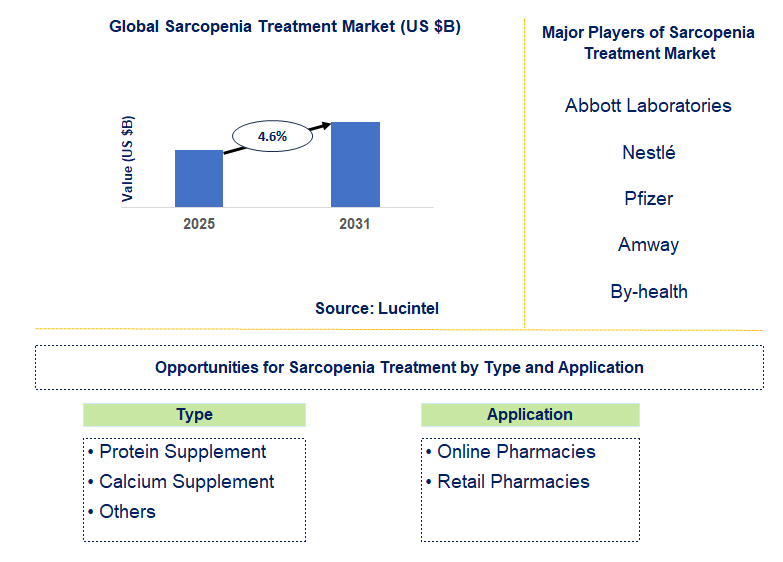
Key data points: The growth forecast = 4.6% annually for the next 7 years. Scroll below to get more insights. This market report covers trends, opportunities and forecasts in sarcopenia treatment market to 2031 by type (protein supplement, calcium supplement, and others), application (online pharmacies and retail pharmacies), and region (North America, Europe, Asia Pacific, and the Rest of the World)
We'll send your sample report shortly.
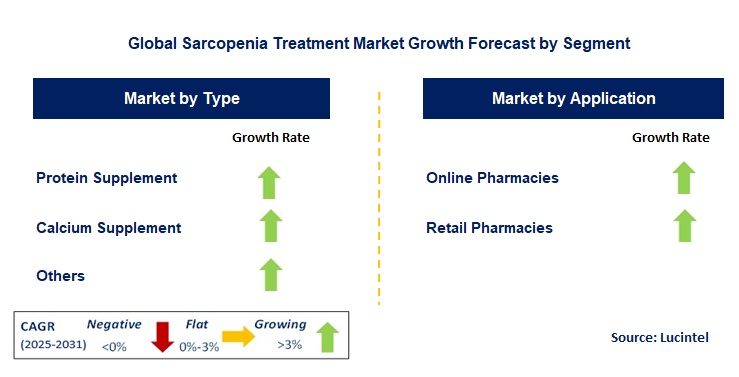
• Lucintel forecasts that, within the type category, protein supplement is expected to witness higher growth over the forecast period.
• Within the application category, online pharmacy is expected to witness higher growth.
• In terms of region, APAC is expected to witness the highest growth over the forecast period. Gain valuable insights for your business decisions with our comprehensive 150+ page report. Sample figures with some insights are shown below.
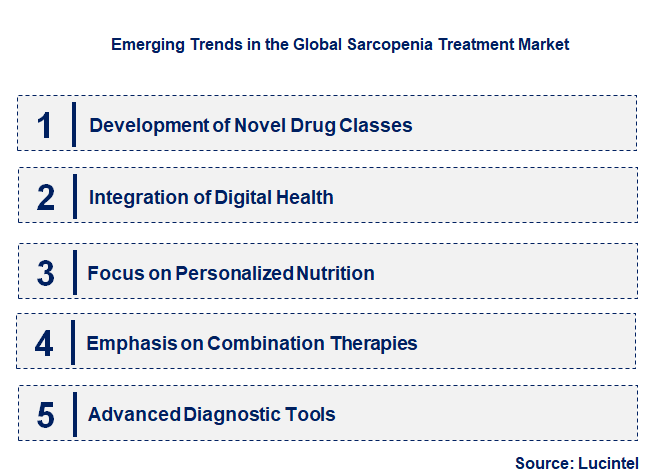
• Development of Novel Drug Classes: The market is seeing a significant trend in the development of investigational drugs, such as myostatin inhibitors and activin receptor type IIB antagonists. These drugs aim to directly target the molecular pathways responsible for muscle wasting. If successful, these therapies could provide the first-ever pharmacological treatment for sarcopenia.
• Integration of Digital Health: Digital health platforms, including mobile apps and telemedicine, are an emerging trend. These technologies enable remote monitoring of patients, providing real-time data on physical activity, nutritional intake, and muscle strength. This integration facilitates personalized treatment plans, improves patient engagement, and enhances communication between patients and healthcare providers.
• Focus on Personalized Nutrition: The market is moving toward tailored nutritional interventions. Companies are developing specialized protein supplements, amino acid blends, and functional foods based on individual patient needs. This approach recognizes that a "one-size-fits-all" model is ineffective and that personalized nutrition is key to optimizing muscle synthesis and mitigating muscle loss.
• Emphasis on Combination Therapies: A significant trend is the shift toward a combination therapy model. Instead of relying on a single intervention, the market is focusing on combining pharmacological treatments, nutritional supplementation, and physical therapy. This synergistic approach targets multiple aspects of sarcopenia, leading to more comprehensive and effective treatment outcomes.
• Advanced Diagnostic Tools: The development of more accessible and accurate diagnostic tools is a key trend. This includes portable devices for measuring muscle mass and strength, and biomarkers for early detection. These tools are crucial for widespread screening and early intervention, which can significantly improve patient prognosis and slow disease progression. These emerging trends are fundamentally reshaping the sarcopenia market by introducing more targeted and integrated solutions. The move toward novel drugs, personalized nutrition, and digital health is creating a more sophisticated and effective treatment paradigm, which is essential for managing a complex condition that affects a growing global population.
• Progress in Drug Pipeline: A significant development is the progression of several drug candidates into advanced clinical trials. These include myostatin inhibitors, such as bimagrumab, and selective androgen receptor modulators (SARMs). The success of these trials could lead to the first regulatory approvals for sarcopenia-specific drugs, transforming the market from primarily supplements to pharmaceutical-based treatments.
• Launch of Specialized Supplements: The market has seen a rise in the development and launch of specialized nutritional supplements. These products are formulated with key ingredients like whey protein, leucine, creatine, and vitamin D to specifically address muscle loss. This development caters to a health-conscious consumer base and is expanding the market for non-prescription interventions.
• Increased Focus on Diagnostics: There is a growing focus on developing and standardizing diagnostic tools for sarcopenia. Recent developments include the use of advanced imaging techniques like DEXA scans and bioelectrical impedance analysis (BIA) for accurate muscle mass measurement. This is crucial for early detection and for establishing standardized diagnostic criteria, which is a major barrier.
• Growth of Telerehabilitation: The rise of telerehabilitation and digital platforms is a key development, particularly in the wake of the COVID-19 pandemic. These platforms offer remote physical therapy, virtual consultations, and exercise guidance. This makes treatment more accessible to the elderly and those with mobility issues, enhancing patient adherence and continuity of care.
• Partnerships in Research and Development: Recent developments include an increase in strategic partnerships between pharmaceutical companies, research institutions, and academic centers. These collaborations aim to accelerate the discovery of new therapeutic targets, develop biomarkers for disease progression, and streamline clinical trials, all of which are vital for bringing new treatments to market. The recent developments in the sarcopenia market are creating a more comprehensive and accessible treatment landscape. The combination of a promising drug pipeline, innovative nutritional products, and digital health tools is empowering patients and healthcare providers with better options, thereby shifting the paradigm from simple management to proactive and effective treatment.
• Nutritional Supplementation Market: A key growth opportunity exists in the nutritional supplements segment. Developing and marketing specialized protein powders, amino acid blends, and functional foods tailored for sarcopenia patients can capture a large, consumer-driven market. This application is highly accessible and addresses a core component of sarcopenia management.
• Pharmaceutical Drug Development: The most impactful opportunity is the development and commercialization of the first-in-class pharmacological treatments. Companies that can successfully navigate clinical trials and secure regulatory approval for drugs targeting sarcopenia's pathophysiology will gain a significant competitive advantage and address a major unmet medical need in the market.
• Geriatric Care and Rehabilitation: There is a strategic opportunity to integrate sarcopenia treatment within geriatric care settings. Partnering with nursing homes, hospitals, and rehabilitation centers to provide a bundled offering of nutritional products, physical therapy services, and advanced diagnostics can improve patient outcomes and create a robust business model.
• Personalized Medicine and Diagnostics: A significant opportunity lies in the intersection of personalized medicine and diagnostics. Developing diagnostic tools that can identify patients at high risk of sarcopenia and then offering a personalized treatment plan, including a specific combination of nutrition, exercise, and drug therapy, can lead to more effective and marketable solutions.
• Digital Health and Tele-Rehabilitation: The application of digital health is a key growth area. Creating platforms that offer remote monitoring, virtual consultations, and personalized exercise programs offers a scalable solution. This application not only improves patient access and adherence but also provides a continuous revenue stream through subscription-based services. Strategic growth opportunities in the sarcopenia market are diverse, spanning from nutritional supplements to novel drugs and digital health. By focusing on these applications, companies can not only achieve commercial success but also contribute to a better quality of life for the elderly by addressing the underlying causes of muscle decline.
• Abbott Laboratories
• Nestlé
• Pfizer
• Amway
• By-health
• Usana
• A&Z Pharmaceutical
• GlaxoSmithKline
• Bayer
• H&H
• Protein Supplement
• Calcium Supplement
• Others
• Online Pharmacies
• Retail Pharmacies
• North America
• Europe
• Asia Pacific
• The Rest of the World
• United States: The U.S. market is a leader in research and development, with several pharmaceutical companies actively pursuing drug candidates, including myostatin inhibitors and selective androgen receptor modulators (SARMs). These investigational therapies are poised to be the first-in-class pharmacological treatments for sarcopenia, which currently has no FDA-approved drugs.
• China: China's sarcopenia market is expanding rapidly due to its large and aging population. Recent developments focus on increasing awareness and improving diagnostic capabilities. While nutritional supplements remain the primary treatment, there is growing investment in clinical trials and research to develop and introduce new drugs and therapies, often with a focus on traditional Chinese medicine.
• Germany: In Germany, the sarcopenia market is characterized by a strong emphasis on a multidisciplinary approach, combining physical therapy, nutritional counseling, and supplements. Recent developments include integrating these treatments within geriatric care centers and nursing homes to improve patient outcomes. Research collaborations are also a focus, aiming to identify effective pharmacological agents.
• India: India's market for sarcopenia treatment is still emerging but holds significant potential. The primary focus is on nutritional supplements, particularly protein and vitamin D. The rising prevalence of sarcopenia and malnutrition is driving this market. As healthcare infrastructure improves, there is a growing need for more advanced diagnostic tools and therapeutic options.
• Japan: Japan's market is highly developed due to its large aging population. Recent developments include government-led initiatives to address sarcopenia as a public health concern. The market is seeing a focus on early diagnosis and preventive care. Research is also active, with a push to develop a holistic approach combining exercise, nutrition, and pharmacological interventions.


• Abbott Laboratories
• Nestlé
• Pfizer
• Amway
• By-health
• Usana
• A&Z Pharmaceutical
• GlaxoSmithKline
• Bayer
• H&H Q5. Which sarcopenia treatment market segment will be the largest in future? Answer: Lucintel forecasts that, within the type category, protein supplement is expected to witness higher growth over the forecast period. Q6. In sarcopenia treatment market, which region is expected to be the largest in next 5 years? Answer: In terms of region, APAC is expected to witness the highest growth over the forecast period. Q7. Do we receive customization in this report? Answer: Yes, Lucintel provides 10% customization without any additional cost.


Choose a license that fits your team. Instant PDF delivery.
Prices exclude taxes. Instant delivery. Custom licensing available on request.
Market Report · July 31, 2026
Market Report · July 31, 2026
Market Report · July 31, 2026
Trusted partner for strategic intelligence and business growth


Receive a complimentary market analysis tailored to your industry. Our analysts will identify key growth opportunities and competitive dynamics specific to your business.

Market size, growth rate, and key trend analysis for your specific sector.

Top competitor positioning and market share analysis.

Strategic recommendations backed by data-driven insights.
Get curated market intelligence and competitive moves straight to your inbox.
By subscribing, you agree to receive our monthly insights. Unsubscribe anytime.
Receive a complimentary market analysis tailored to your industry. Our analysts will identify key growth opportunities and competitive dynamics specific to your business.
Market size, growth rate, and key trend analysis for your specific sector.
Top competitor positioning and market share analysis.
Strategic recommendations backed by data-driven insights.
Get curated market intelligence, emerging trends, and competitive moves straight to your inbox each month.
By subscribing, you agree to receive our monthly insights. Unsubscribe anytime.
We'll send your sample report shortly.