
Market Report · July 15, 2026

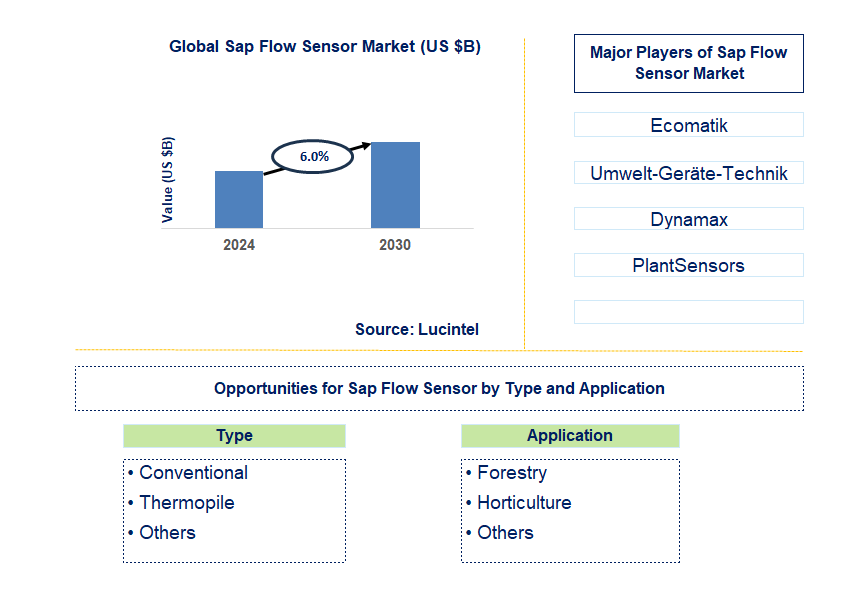
Key data points: The growth forecast = 6.0% annually next 6 years. Scroll below to get more insights. This market report covers trends, opportunities, and forecast in the global sap flow sensor market to 2030 by type (conventional, thermopile, and others), application (forestry, horticulture, and others), and region (North America, Europe, Asia Pacific, and the Rest of the World)
We'll send your sample report shortly.
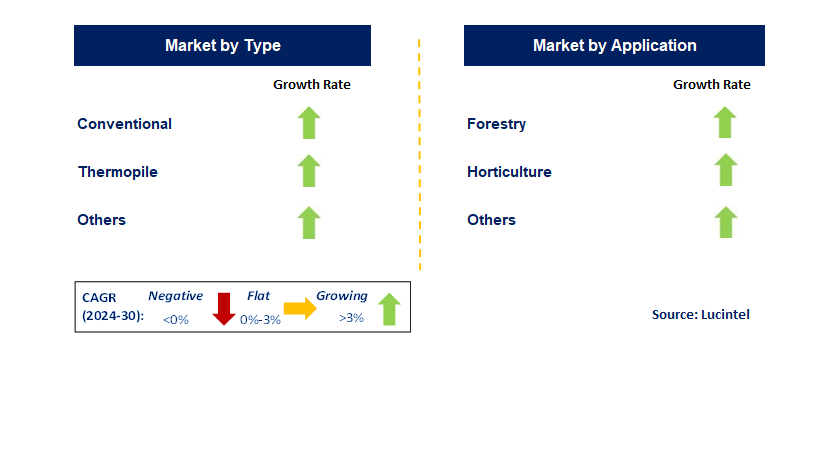
• Lucintel forecasts that, within the type category, conventional is expected to witness higher growth over the forecast period.
• Within the application category, forestry is expected to witness higher growth over the forecast period.
• In terms of regions, Europe is expected to witness highest growth over the forecast period. Gain valuable insights for your business decissions with our comprehensive 150+ page report.
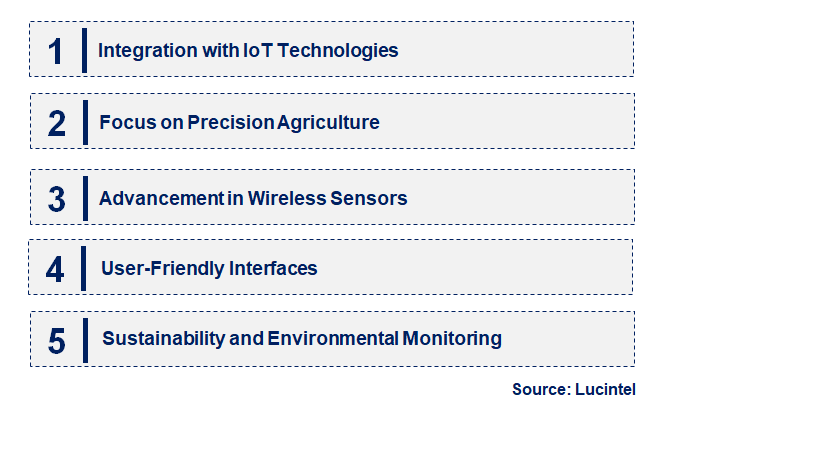
• Integration with IoT Technologies: The incorporation of IoT technologies in sap flow sensors is transforming data collection and analysis. Sensors equipped with IoT capabilities enable real-time monitoring and remote access to data, enhancing decision-making processes in agriculture and forestry.
• Focus on Precision Agriculture: The growing emphasis on precision agriculture is driving demand for accurate sap flow measurement. Farmers are increasingly adopting advanced sensors to optimize irrigation and resource allocation, leading to improved crop yield and sustainability.
• Advancement in Wireless Sensors: Wireless sap flow sensors are on the rise. Since there is no requirement for bulky wiring, it makes installation easier and with more versatility in where the sensor can be placed makes the product very useful in the field.
• User-Friendly Interfaces: Manufacturers have incorporated user-friendly designs into sap flow sensors. Improved interfaces and mobile applications make the operation and interpretation of the sensor by non-experts possible and widen the user base.
• Sustainability and Environmental Monitoring: For environmental monitoring, the need for sap flow sensors is increased mainly through its applications. As sustainability has become a prime focus area, there is the implementation of such sensors in forest management and climate research with various water-saving practices. Therefore, such changes in trends challenge the sap flow sensor market, thus promoting the development of newer and commercially viable versions and raising the scope of practical use in many diversified areas.
• Advanced Wireless Sensors: Recently introduced in the market, wireless sap flow sensors enable a live transmission of data to smartphones and computers without interrupting data transmission. This increases access and real-time observation, making correct resource management decisions possible at the right time.
• Integration of AI for Data Analysis: Artificial intelligence in sap flow sensors is integrating more effectively for better data interpretation. Advanced models adopt AI algorithms to analyze the patterns of sap flow and give actionable information, helpful in making better predictions about yield generation and resource management.
• Introduction of Robust Sensor Designs: Recent models are being designed to withstand harsh environmental conditions, enhancing durability and reliability. These robust sensors are particularly beneficial in agricultural settings, ensuring accurate measurements despite varying weather conditions.
• Better Calibration: The latest sap flow sensors are designed with robust calibration features. The specified accuracy and constant output reading are quite suitable for scientific studies and precision agriculture applications, because these are highly demanding of any quality measurement.
• Technology development partnerships: The technology firms and research institutes involved in agricultural research are collaborating and partnering to develop the next generation of sap flow sensors, with an integration of cutting-edge technologies that would aid in the innovation of the market. These types of innovations are highly impactful in the sap flow sensor market as it fosters newness in terms of innovative solutions that ultimately improve their quality of measurement solutions delivered to the users.
• Precision Agriculture: The trend of precision agriculture is very strongly underlined and thus accounts for the biggest opportunities for growth. The adoption of sap flow sensors by farmers ensures optimized irrigation practices, increased productivity, and sustainability in the use of water.
• Environmental Research: Today, the requirement of sap flow sensors is growing in the area of environment research. Sap flow sensors are used in the investigation of plant physiology, water use of the ecosystem, and health status of the trees, which makes these sensors tools valuable for scientists and conservationists.
• Forestry Management: The application of sap flow sensors is highly demanding in the forestry sector. These sensors can be used to monitor tree health, estimate water usage, and ensure sustained forest management.
• Irrigation Management Systems: These sap flow sensors can be integrated into irrigation management systems to improve water efficiency. Real-time sap flow data can thus determine the schedule for irrigation, reducing waste and promoting a more sustainable farming environment.
• Urban Agriculture: The emerging urban agriculture sets a growing demand for portable sap flow sensors. This device can help urban farmers effectively control water resources to support the growing trend of food production in the urban setting. Such areas are fueling growth opportunities that are driving innovation and expanding the market for sap flow sensors, thereby making the application more valuable in various industrial sectors.
• Ecomatik
• Umwelt-Geräte-Technik
• Dynamax
• PlantSensors
• Conventional
• Thermopile
• Others
• Forestry
• Horticulture
• Others
• North America
• Europe
• Asia Pacific
• The Rest of the World
• United States: New Trends in the U.S. adopt high technology sap flow sensors that incorporate wireless means to provide real time data in this regard. This makes it easier for researchers and also farmers to access the data to make effective decisions in management of the resources. Some firms focus on interfaces that are very friendly to a point where people that are not at a level of expertise can use the device in the field.
• China: The sap flow sensor market is growing rapidly in China mainly due to higher agricultural automation. This year's Compo saw the use of AI with algorithms that more adequately interpreted data to generate more accurate yield predictions. Low-cost sensors are also being produced by Chinese manufacturers; these means advanced technology are becoming available to smallholder farmers, who thus encourage sustainable farming practices throughout the region.
• Germany: Environmental monitoring and sustainability are specifically well-focused aspects of the German market. In this regards, recent innovations in the German market include upgraded sensors with enhanced calibration features, ensuring accuracy in a myriad of environmental conditions. The demand for sensors is growing in research and conservation projects, which helps monitor forest resources better and in water application in agricultural usage.
• India: The Indian market for sap flow sensors is also experiencing growth from the need to manage water effectively in agriculture. New models with the capacity to withstand harsh climatic conditions are being developed and provide accurate real-time readings. Moreover, it is the government's push toward smart agriculture that has further facilitated these sensors' adoption by farmers, enhancing productivity while ensuring sustainability.
• Japan: Japan is the technological world leader in the use of sensors and advanced smart farming in high-tech sap flow measurement. Recent development has involved compact, portable devices that can be utilized with ease for various agricultural situations. Advances in data analytics and connectivity features have enabled farmers to make appropriate decisions based on information available, thereby improving crop management and yield.


• Ecomatik
• Umwelt-Geräte-Technik
• Dynamax
• PlantSensors Q5. Which sap flow sensor market segment will be the largest in future? Answer: Lucintel forecasts that conventional is expected to witness higher growth over the forecast period. Q6. In sap flow sensor market, which region is expected to be the largest in next 5 years? Answer: Europe is expected to witness highest growth over the forecast period. Q.7 Do we receive customization in this report? Answer: Yes, Lucintel provides 10% customization without any additional cost.


Choose a license that fits your team. Instant PDF delivery.
Prices exclude taxes. Instant delivery. Custom licensing available on request.
Market Report · July 15, 2026
Market Report · July 13, 2026
Market Report · July 13, 2026
Trusted partner for strategic intelligence and business growth


Receive a complimentary market analysis tailored to your industry. Our analysts will identify key growth opportunities and competitive dynamics specific to your business.

Market size, growth rate, and key trend analysis for your specific sector.

Top competitor positioning and market share analysis.

Strategic recommendations backed by data-driven insights.
Get curated market intelligence and competitive moves straight to your inbox.
By subscribing, you agree to receive our monthly insights. Unsubscribe anytime.
Receive a complimentary market analysis tailored to your industry. Our analysts will identify key growth opportunities and competitive dynamics specific to your business.
Market size, growth rate, and key trend analysis for your specific sector.
Top competitor positioning and market share analysis.
Strategic recommendations backed by data-driven insights.
Get curated market intelligence, emerging trends, and competitive moves straight to your inbox each month.
By subscribing, you agree to receive our monthly insights. Unsubscribe anytime.
We'll send your sample report shortly.