
Market Report · July 20, 2026

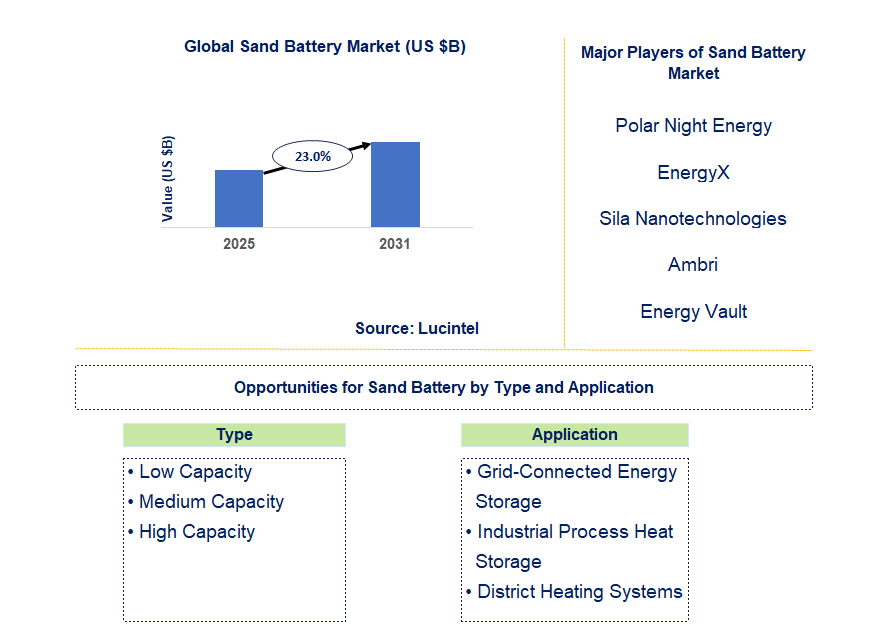
Key data points: The growth forecast = 23% annually for the next 7 years. Scroll below to get more insights. This market report covers Trends, opportunities and forecasts in sand battery market to 2031 by type (low capacity, medium capacity, and high capacity), application (grid-connected energy storage, industrial process heat storage, and district heating systems), and region (North America, Europe, Asia Pacific, and the Rest of the World)
We'll send your sample report shortly.
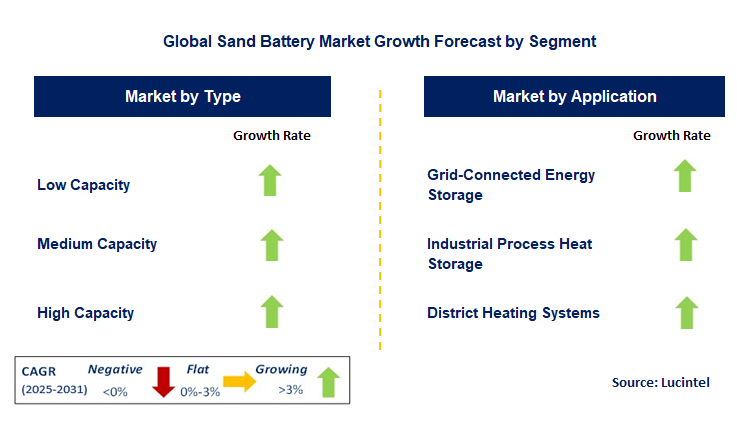
• Lucintel forecasts that, within the type category, high capacity is expected to witness the highest growth over the forecast period.
• Within the application category, grid-connected energy storage is expected to witness the highest growth.
• In terms of region, APAC is expected to witness the highest growth over the forecast period.
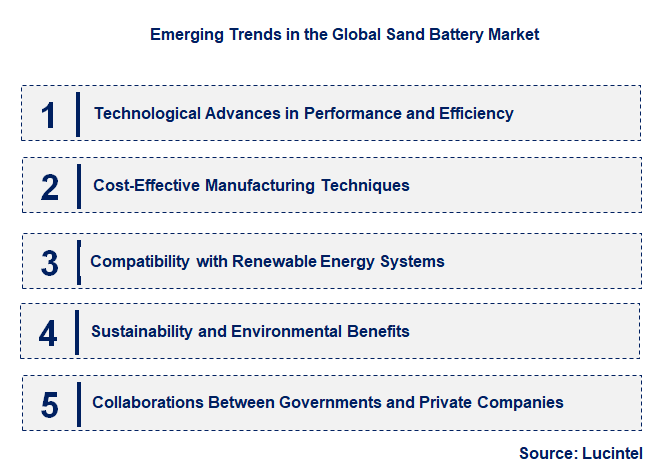
• Technological Advances in Performance and Efficiency: Technological improvements on sand battery technology are directed at boosting the efficiency, energy density, and rate of charging of sand batteries. Scientists are working to increase the performance of the materials and processes that go into sand-based batteries so that they can hold more energy and provide quicker discharge times. These advancements are essential in order to make sand batteries viable competitors to standard energy storage technologies, like lithium-ion batteries, especially in large-scale applications such as grid storage.
• Cost-Effective Manufacturing Techniques: One of the primary benefits of sand batteries is their potential for low-cost production. With improvements in manufacturing methods, the cost of sand-based battery production is likely to come down radically. This reduction in cost makes sand batteries more viable for diverse applications from massive grid storage to household usage. With high raw materials and reduced production costs, sand batteries can revolutionize the existing energy storage market by providing a cost-effective and sustainable option.
• Compatibility with Renewable Energy Systems: Sand batteries are being increasingly combined with renewable energy systems like solar and wind power to store excess energy for future use. The capacity to store renewable energy in an efficient manner is important in order to solve the problem of intermittency of these sources of energy. Sand batteries are a promising option for grid-scale energy storage, enabling the reliable integration of renewable energy into power grids. This is assisting in promoting the use of sand batteries as an essential part of clean energy infrastructure.
• Sustainability and Environmental Benefits: The increasing focus on sustainability is pushing the adoption of sand batteries, which are composed of common, non-toxic, and eco-friendly materials. In contrast to lithium-ion batteries that utilize rare and at times toxic materials, sand batteries present a cleaner alternative for energy storage. This green benefit makes sand batteries a preferable choice for nations and businesses that want to lower their carbon impact and ensure sustainable energy storage practices.
• Collaborations Between Governments and Private Companies: Governments and private companies are partnering more frequently on the development and commercialization of sand batteries. Public-private partnerships are important in order to spur research, finance pilot projects, and scale-up manufacturing. Governments are funding and financing sand battery research and policy efforts, while private enterprises provide the skills and facilities required to manufacture end masse and implement on the market. This partnership is driving sand battery technology forward and making the successful integration of sand batteries into global energy infrastructures possible. These trends are redefining the sand battery industry, placing it at the forefront of the world's move towards clean, sustainable energy. With technology improvement and investment, sand batteries will be playing an ever-growing part in solving the energy storage and integration of renewable energy challenges.
• Sand Battery Material Breakthroughs: Recent advances in materials technology have seen improved sand battery performance. Scientists have found means of improving the energy storage and conductivity of sand-based materials, making them more efficient and suitable for high-capacity energy storage. These innovations have seen sand batteries poised for commercialization, with chances of competing with conventional energy storage technology in terms of efficiency and cost.
• Pilot Projects and Real-World Applications: A number of pilot projects are already being implemented to pilot test sand batteries in live applications, more so in connection with renewable energy systems. Pilot projects are working to prove the feasibility of using sand batteries as grid storage devices, solar systems, and even off-grid connections. The effectiveness of pilot projects will be highly instrumental in ascertaining the performance of sand batteries and also their scalability into large-scale storage solutions.
• More Investment and Financing: Investment in sand battery technology is growing rapidly, with both private investors and governments committing funds to support research and development. This influx of funding is accelerating the commercialization of sand batteries, enabling companies to scale up production and bring their technologies to market. As the demand for sustainable energy storage solutions increases, sand batteries are receiving more attention from investors looking to capitalize on the potential for clean, low-cost energy storage.
• International Partnerships and Collaborations: International partnerships among research institutions, governments, and private firms are facilitating the development of sand battery technology. These collaborations are aimed at enhancing the performance, scalability, and cost-effectiveness of sand batteries. Through sharing resources and knowledge, these collaborations are speeding up the development of sand battery technologies and enhancing their potential for adoption in the global market.
• Government Incentives for Sustainable Energy Solutions: Governments worldwide are identifying the potential of sand batteries as part of their renewable energy strategies. In countries like the United States, China, and Germany, policymakers are investing funds and offering incentives to advance the sustainable energy storage technologies such as sand batteries. Such support is encouraging innovation and minimizing the commercialization barriers, with sand batteries poised to become an indispensable component of the global energy transition. These major advances are making sand batteries a true and sustainable energy storage option, enabling the increasing need for the integration of renewable energy and grid stability.
• Grid-Scale Energy Storage: One of the highest growth potentials for sand batteries is in grid-scale energy storage. Sand batteries have the capacity to store great volumes of energy harnessed by renewable sources such as solar and wind energy, smoothing supply and demand. Their capacity to offer cost-efficient long-term storage solutions makes them a principal technology for improving grid stability and allowing the mass integration of renewable energy.
• Solar Energy Storage: Sand batteries present a promising prospect for the storage of solar energy, especially in off-grid scenarios and areas with high solar potential. By accumulating excess energy during the day, sand batteries can serve as a stable source of power at night or on overcast days. This capability of efficient storage of solar energy is vital for widespread adoption of solar power, particularly in remote locations that lack connection to the central grid.
• Off-Grid and Remote Applications: Sand batteries are best suited for off-grid and remote power applications, where the availability of conventional energy storage systems is less. In regions where there is no reliable grid infrastructure, sand batteries can offer a low-cost and renewable energy storage option, enabling the adoption of renewable energy systems in those regions. This use case is especially valid in developing nations and remote regions dependent on solar or wind energy for electricity supply.
• Electric Vehicle Charging Points: As electric vehicle (EV) uptake increases, EV charging infrastructure demand increases. Sand batteries can be used to contribute to energy storage for EV charging points, especially in cases where the grid is unreliable or renewable energy sources are being used in the charging network. By buffering energy during off-peak times, sand batteries are able to optimize renewable energy usage and minimize load on the grid during peak charging periods.
• Residential Energy Storage Solutions: The increasing market demand for home solar power systems presents a strong opportunity for sand batteries in domestic energy storage. Sand batteries provide the capability to store extra energy generated from residential solar panels, enabling homeowners to better utilize renewable energy. Increasing demand for energy independence and sustainability will drive the residential energy storage market based on sand batteries into a top market segment within the next few years. These expansion prospects reveal the adaptability of sand batteries and their promise of transforming the energy storage sector. With continuing development and cost of production lowering, sand batteries will be an ever-more essential means of satisfying the world's demand for energy storage.
• Polar Night Energy
• EnergyX
• Sila Nanotechnologies
• Ambri
• Energy Vault
• ESS
• Heliogen
• Low Capacity
• Medium Capacity
• High Capacity
• Grid-Connected Energy Storage
• Industrial Process Heat Storage
• District Heating Systems
• North America
• Europe
• Asia Pacific
• The Rest of the World
• United States: Sand battery technology is also making waves in the United States with its prospects of scalable energy storage. Sand battery technologies are being developed and commercialized by research institutions and start-ups. Sand batteries are also receiving funding and policy support from the U.S. government in the area of clean energy technology. New innovations in sand batteries are working to enhance energy density, charging times, and overall efficiency. Firms are also investigating the use of sand in grid-scale storage projects and are keen to tap the expertise of universities and partner with industry players to commercialize this technology. More of this is likely to follow as the demand for green energy solutions increases.
• China: China has made significant investment in new energy storage technologies, and the sand battery is one of the areas that have recently caught attention. With its extensive manufacturing capacity and emphasis on renewable power, China has been investigating sand battery systems as one of the ways of diversifying energy storage. Research is underway in China to improve sand-based battery performance to enable large-scale energy storage, especially to facilitate solar and wind power integration. The efforts of the Chinese government to wean itself from dependence on foreign minerals like cobalt and lithium have seen considerable investments in sand battery technologies, thus establishing China as a dominant player in the sector.
• Germany: Germany is making concerted efforts in adopting sand battery technology in its shift to renewable energy. Germany's energy transition plan, called the Evergreened, emphasizes a high priority on sustainable energy storage technologies. German researchers are currently developing sand-based battery efficiency, cost, and scalability for applications in both residential and grid levels. Germany's efforts to decrease carbon emissions have driven investment in alternative energy storage technologies, and sand batteries have been identified as a potential answer. The industry is likely to expand as Germany aims to diversify its energy storage systems in order to assist its renewable energy ambitions.
• India: India is rapidly shifting attention to the development of renewable energy, and sand batteries are finding their way as a potential energy storage technology. India's rich solar energy potential can be served significantly by effective and affordable storage means such as sand batteries. The nation is spending on research and development efforts to enhance sand battery performance, with the target of making sand batteries suitable for mass-scale energy storage. As India vows to reach net-zero emissions by 2070, technologies for energy storage such as sand batteries will become an important element in the country's quest to satisfy increasing energy needs while decreasing its carbon footprint.
• Japan: Sand battery technology is gaining lots of attention in Japan as the country seeks to shift towards renewable energy and enhance energy security. Japan is experimenting and testing sand-based batteries for large-scale energy storage to supplement its increasing renewable energy equipment, especially solar and wind power. Japan's scarcity of natural resources and high reliance on imported energy prompted it to make the technologies of energy storage essential. Sand batteries, as they are less dependent on hard-to-find resources and are available in plenty, are viewed as a green solution compared to conventional means of storage, and Japan is investing in these technologies to enhance its energy independence.


• Polar Night Energy
• EnergyX
• Sila Nanotechnologies
• Ambri
• Energy Vault
• ESS
• Heliogen Q5. Which sand battery market segment will be the largest in future? Answer: Lucintel forecasts that, within the type category, high capacity is expected to witness the highest growth over the forecast period. Q6. In sand battery market, which region is expected to be the largest in next 5 years? Answer: In terms of region, APAC is expected to witness the highest growth over the forecast period. Q7. Do we receive customization in this report? Answer: Yes, Lucintel provides 10% customization without any additional cost.


Choose a license that fits your team. Instant PDF delivery.
Prices exclude taxes. Instant delivery. Custom licensing available on request.
Market Report · July 20, 2026
Market Report · July 20, 2026
Market Report · July 20, 2026
Trusted partner for strategic intelligence and business growth


Receive a complimentary market analysis tailored to your industry. Our analysts will identify key growth opportunities and competitive dynamics specific to your business.

Market size, growth rate, and key trend analysis for your specific sector.

Top competitor positioning and market share analysis.

Strategic recommendations backed by data-driven insights.
Get curated market intelligence and competitive moves straight to your inbox.
By subscribing, you agree to receive our monthly insights. Unsubscribe anytime.
Receive a complimentary market analysis tailored to your industry. Our analysts will identify key growth opportunities and competitive dynamics specific to your business.
Market size, growth rate, and key trend analysis for your specific sector.
Top competitor positioning and market share analysis.
Strategic recommendations backed by data-driven insights.
Get curated market intelligence, emerging trends, and competitive moves straight to your inbox each month.
By subscribing, you agree to receive our monthly insights. Unsubscribe anytime.
We'll send your sample report shortly.