
Market Report · July 31, 2026

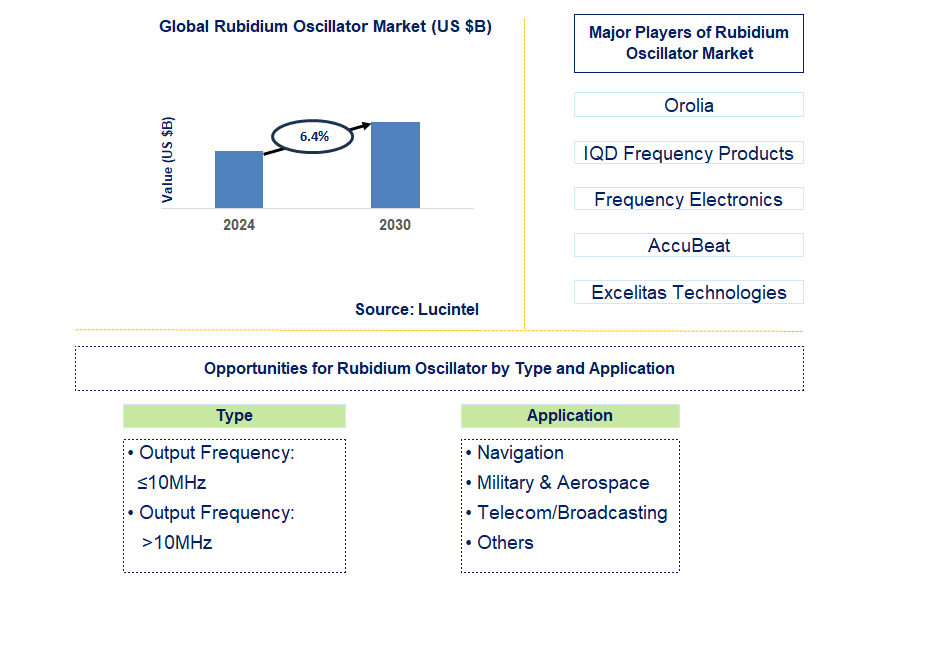
Key data points: The growth forecast = 6.4% annually for the next 6 years. Scroll below to get more insights. This market report covers trends, opportunities, and forecasts in the global rubidium oscillator market to 2030 by type (output frequency: ≤10MHz and output frequency: >10MHz), application (navigation, military & aerospace, telecom/broadcasting, and others), and region (North America, Europe, Asia Pacific, and the Rest of the World)
We'll send your sample report shortly.
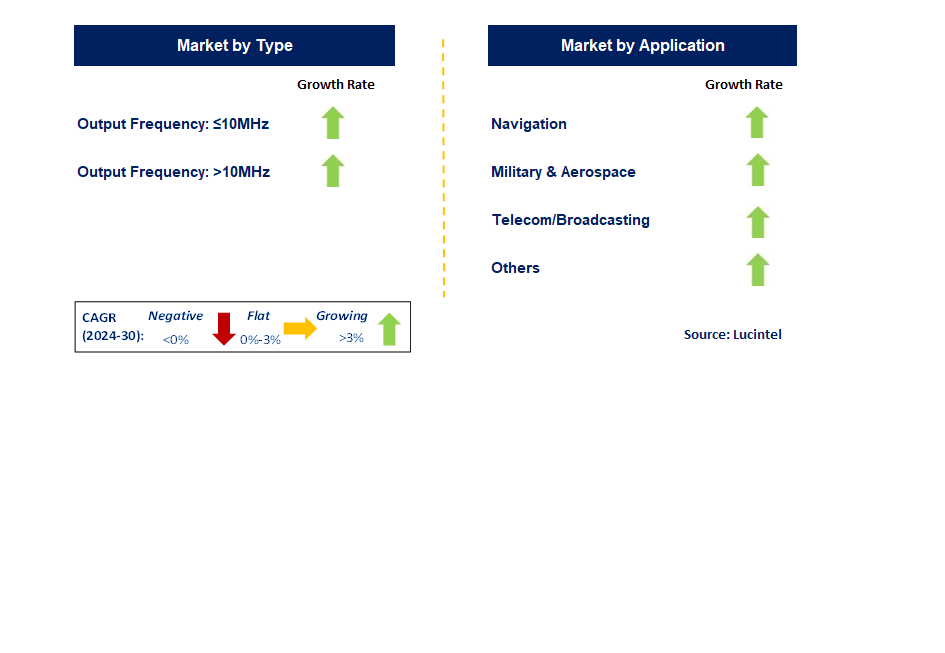
• Lucintel forecasts that, within type category, output frequency: ≤10MHz is expected to witness a higher growth over the forecast period.
• Within the application category, navigation is expected to witness the highest growth.
• In terms of regions, APAC is expected to witness highest growth over the forecast period. Gain valuable insight for your business decisions with our comprehensive 150+ page report. Advancements in technology and growth in demand for rubidium oscillators across several applications, including telecommunications, aerospace, and defense, are changing the rubidium oscillators market. With these oscillators being considered to have high stability and precision, they are becoming more integrated into systems that need reliable timing sources. This overview captures the rubidium oscillators market trends in the United States, China, Germany, India, and Japan.
• United States: In the U.S., the rubidium oscillator market is growing due to improvements in the telecommunications sector and the defense markets. Rubidium oscillator manufacturer Symmetrical, now part of Microsemi, added rubidium optimized for GNSS and 5G performance to its product portfolio. The drive for the creation of small-sized oscillators with high performance helps the U.S. retain its geopolitical engineering edge in precision timing systems.
• China: China has been focusing on increasing its domestic production capacity of rubidium oscillators in order to satisfy internal market needs and reduce reliance on other countries’ technologies. Enterprises such as Beijing Huayuan Technology enhance rubidium oscillator stability through research and development. The expansion of the telecommunications industry and programs aimed at improving satellite communication systems have led to the increasing use of rubidium oscillators in the region, making China a potential threat in the global market.
• Germany: The rubidium oscillator market in Germany enjoys the presence of well-established industries and a focus on precision mechanics. Rubidium oscillators, for communication networks and the manufacturing industry, are offered by companies such as Oscilloquartz, which explores advanced ideas. The promotion of Industry 4.0 by the German government is increasing the demand for rubidium oscillators as essential parts for automation and data processing systems.
• India: India is positioned as part of the expanding rubidium oscillator market, with a special emphasis on the policy of digital transformation and smart city development. Partnerships allow local producers to join forces with international corporations to improve their technologies and manufacturing practices. India encourages market penetration strategies such as accurate time standards for promotional applications in telecommunications and outer space, which rubidium oscillator manufacturers can capitalize on.
• Japan: With companies like Seiko Instruments taking the forefront as an active participant in the rubidium oscillator market, Japan plays a significant role in this market. The Japanese regional market is known for high investment in research and development, particularly for high-frequency oscillators in advanced telecommunications and precision applications. It is believed that the incorporation of rubidium oscillators in emerging technologies will help maintain the growth rate of this segment. A more than 150-page report is developed to help in your business decisions.
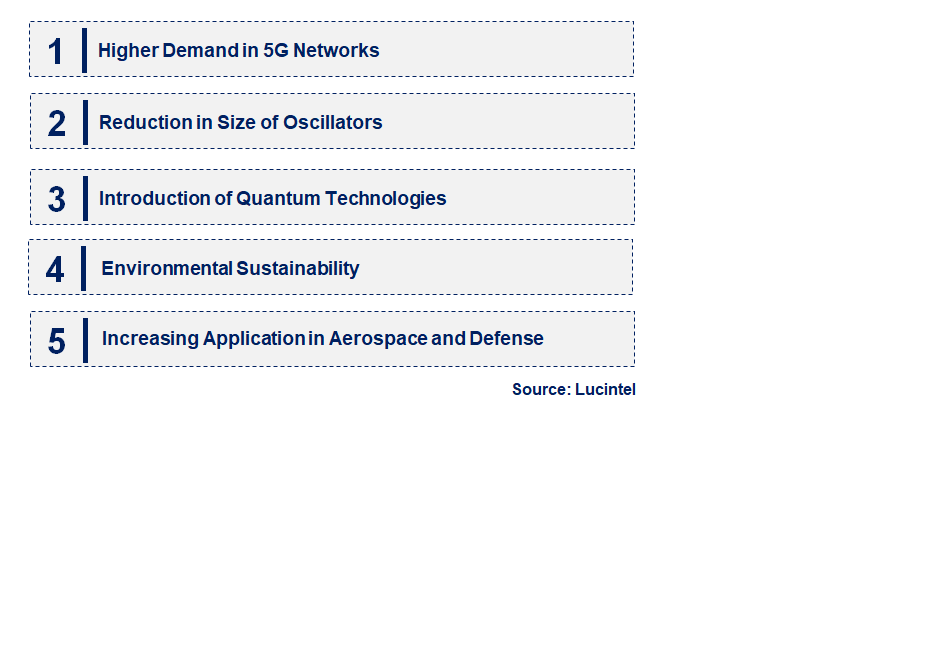
• Higher demand in 5G networks: The rollout of 5G networks has created the need for services that have good accuracy in time, thus there is a need for rubidium oscillators in base stations and communication systems. Their stability and accuracy provide the requisite infrastructure for high data-speed transmission, improving the network.
• Reduction in size of oscillators: Companies are targeting rubidium oscillators to shrink due to market requirements for smaller yet highly efficient electrical devices. This allows for encapsulation in virtually all consumer and telecommunications devices and upscales performance without taking up too much space.
• Introduction of quantum technologies: With advancements in quantum technologies, rubidium oscillators are being used in quantum systems more frequently for controlling and timing. Due to their outstanding stability, rubidium oscillators can be used in quantum computing and secure communication, fostering the development of new concepts in these domains.
• Environmental sustainability: Rising regulatory and societal pressures are pushing manufacturers to produce rubidium oscillators that incorporate energy-saving features. These oscillators are made to require lower power consumption without compromising quality, enhancing cost-efficiency in various operational applications.
• Increasing application in aerospace and defense: Great attention is being given to their uses in aerospace and defense, which is anticipated to grow owing to the rubidium oscillators' demand for precise timing in navigation and communication systems. They are critical for mission-oriented functions and therefore present opportunities for growth in this sector. These trends follow a dynamic change in the rubidium oscillators market, showing the need to have a strategy to cope with the changes posed by the industry.
• Technology advancements: Progress in rubidium oscillator design has been followed by improved frequency stability and phase noise. Such innovations increase the precision of oscillators for mission-critical applications, making them very useful in telecommunications and aerospace industries.
• Enhanced capacity areas: Rubidium oscillator manufacturers are increasing their production capacities to satisfy the intake of rubidium oscillators. This expansion further includes investing in efficient period reduction devices to create larger windows for new orders.
• New developments: New models of rubidium oscillators are being unveiled in the market for specific applications, such as rubidium oscillators intended to work in 5G networks and space. These products have superior performance that meets the requirements of the changing market.
• R&D investments: Research and development on new materials and technologies, as well as advances in the production of rubidium oscillators, are getting substantial funding. These investments are meant to enhance functionality and bring about new concepts for the emerging markets and technologies.
• Collaborations and partnerships: There have been reported cases of growing partnerships between manufacturers and research organizations in the rubidium oscillator market. Such partnerships enable the realization of new ideas faster and more efficiently to meet the market's evolving needs. These advances illustrate that the growth of the rubidium oscillators market is supported by continuous developments necessary for upholding modern technology.
• Telecommunications infrastructure: Augmentation of telecommunications networks, especially with an emphasis on 5G initiation, signifies promising opportunities for the use of rubidium oscillator devices. Manufacturers can provide high-performance solutions in response to growing demands for high accuracy in timing and synchronization.
• Aerospace applications: In the aerospace sector, rubidium oscillators are used for several applications, including navigation and communication systems. The increasing demand for high-quality timing devices in this sector will present opportunities for rubidium technology manufacturers.
• Defense and military systems: The need for accurate time stamping for navigation and secure communications within defense systems provides a market for rubidium oscillators. There is also potential in advancing these devices further and focusing on developing ruggedized products for military applications.
• Industrial automation: As many industrial processes are now being automated, there is a growing requirement for accurate timing solutions. In an industry where increased precision and efficiency are sought after through rubidium oscillators, this presents growth opportunities in this application.
• Consumer electronics: The consumer electronics submarket trends toward miniaturization, providing new opportunities for rubidium oscillators. Suppliers can provide rhythm and miniaturized oscillators for inclusion in smartphones and wearables, which promises success within this segment of the market. These growth opportunities portray a favorable situation for the rubidium oscillators market, encouraging persistent innovation.
• Increasing requirement of accurate timing: There is a growing requirement for rubidium oscillators because of the increasing need for precise timing in the telecommunications, aerospace, and defense industries. As more industries seek to achieve accurate time and frequency, the use of these oscillators will rise.
• Technological advancements: Considerable research, development, and improvement of rubidium oscillators are ongoing with the aim of improving performance parameters such as frequency stability and phase noise. These developments make rubidium oscillators more preferred for more applications.
• Investment in telecommunications infrastructure: The demand for rubidium oscillators is increasing due to high capital expenditure on telecommunications infrastructure, especially now that 5G technology is coming into the picture. This capital injection is necessary for efficient delivery of high-speed data transmission as well as the reliability of the network.
• Heightened demand from aerospace and defense sectors: The growing use of rubidium oscillators in the aerospace and defense sectors is due to advanced navigation and communication systems. They are essential for mission-critical operations, thus the demand and growth of this industry.
• Increased R&D investments: Research and development activities have made innovations in rubidium oscillator technology more advanced. Manufacturers are actively searching for new materials and designs to remain competitive. Challenges in the rubidium oscillator market are:
• High manufacturing costs: The process of manufacturing rubidium oscillators is so sophisticated that it results in high manufacturing costs, which may affect the selling prices in the market and the returns for manufacturers.
• Intense market competition: The rubidium oscillator market is very competitive, with several stakeholders making efforts to capture the market. This can cause price cuts and reduced profit margins among competitors.
• Regulatory compliance: Regulatory compliance in some areas can be a barrier for manufacturers. Adhering to particular practices within the industry is important but may bring about more processes and costs to the development process. These drivers and challenges have implications for the rubidium oscillators market from all angles, as they determine the development of the market and the strategies of stakeholders in response to its changes.
• Orolia
• IQD Frequency Products
• Frequency Electronics
• AccuBeat
• Excelitas Technologies
• Stanford Research Systems (SRS)
• Quartzlock
• Output Frequency: ≤10MHz
• Output Frequency: >10MHz
• Navigation
• Military & Aerospace
• Telecom/Broadcasting
• Others
• North America
• Europe
• Asia Pacific
• The Rest of the World


• Orolia
• IQD Frequency Products
• Frequency Electronics
• AccuBeat
• Excelitas Technologies
• Stanford Research Systems (SRS)
• Quartzlock Q5. Which rubidium oscillator market segment will be the largest in future? Answer: Lucintel forecasts that output frequency: ≤10MHz is expected to witness the higher growth over the forecast period. Q6. In rubidium oscillator market, which region is expected to be the largest in next 5 years? Answer: APAC is expected to witness highest growth over the forecast period. Q.7 Do we receive customization in this report? Answer: Yes, Lucintel provides 10% customization without any additional cost.


Choose a license that fits your team. Instant PDF delivery.
Prices exclude taxes. Instant delivery. Custom licensing available on request.
Market Report · July 31, 2026
Market Report · July 31, 2026
Market Report · July 31, 2026
Trusted partner for strategic intelligence and business growth


Receive a complimentary market analysis tailored to your industry. Our analysts will identify key growth opportunities and competitive dynamics specific to your business.

Market size, growth rate, and key trend analysis for your specific sector.

Top competitor positioning and market share analysis.

Strategic recommendations backed by data-driven insights.
Get curated market intelligence and competitive moves straight to your inbox.
By subscribing, you agree to receive our monthly insights. Unsubscribe anytime.
Receive a complimentary market analysis tailored to your industry. Our analysts will identify key growth opportunities and competitive dynamics specific to your business.
Market size, growth rate, and key trend analysis for your specific sector.
Top competitor positioning and market share analysis.
Strategic recommendations backed by data-driven insights.
Get curated market intelligence, emerging trends, and competitive moves straight to your inbox each month.
By subscribing, you agree to receive our monthly insights. Unsubscribe anytime.
We'll send your sample report shortly.