
Market Report · July 29, 2026

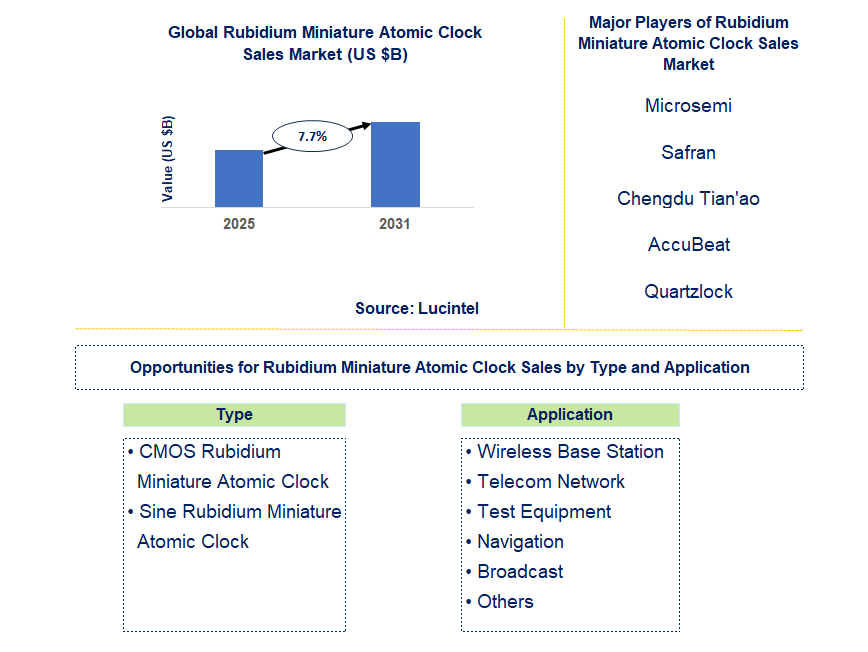
Key data points: The growth forecast = 7.7% annually for the next 7 years. Scroll below to get more insights. This market report covers Trends, opportunities and forecasts in rubidium miniature atomic clock sales market to 2031 by type (CMOS rubidium miniature atomic clock and sine rubidium miniature atomic clock), application (wireless base station, telecom network, test equipment, navigation, broadcast, and others), and region (North America, Europe, Asia Pacific, and the Rest of the World)
We'll send your sample report shortly.
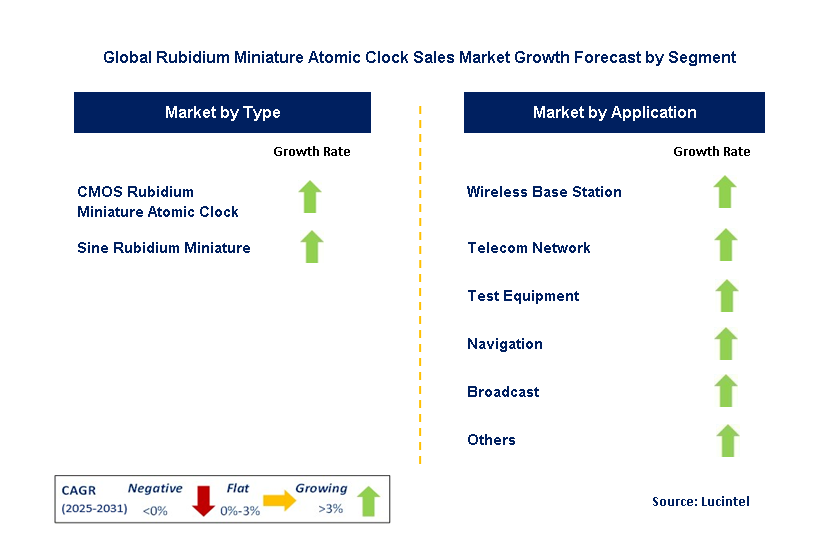
• Lucintel forecasts that, within the type category, CMOS rubidium miniature atomic clock is expected to witness higher growth over the forecast period due to the growing demand for cost-effective and low-power atomic clock.
• Within the application category, telecom network is expected to witness the highest growth due to the rising deployment of 5G network.
• In terms of region, APAC is expected to witness the highest growth over the forecast period due to the increasing demand for advanced optical solutions in industry.
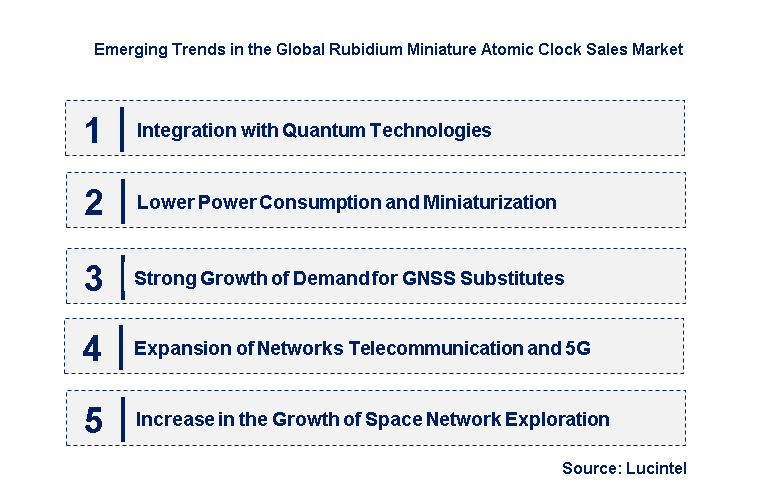
• Integration with Quantum Technologies: At present, quantum technologies are penetrating many fields that are using Rubidium Miniature Atomic Clocks, particularly quantum communication and quantum computation. Such integrative approaches lead to the development of new secure communication clocks, which also potentially benefit advanced scientific research. The growing interest in quantum networks has raised the demand for RMACs because such devices are needed in order to ensure the correct synchronization of different quantum systems. As quantum technologies advance, it is expected that RMACs will serve as regarded components in the ultra-precise timekeeping applications of next generation systems.
• Lower Power Consumption and Miniaturization: Energy-efficient timing systems and compact devices continue to advance in the RMAC industry, which is often referred to as “miniaturization". Rubidium-based clocks are rapidly becoming smaller and more power-efficient, making them ideal for integration into portable devices, mobile systems, and even satellites. Smaller and low-power RMACs is helping to push the boundaries of precision in modern consumer electronics and wearable technology, which has a greater need for precise timing with reduced energy expenditure. In aerospace and defense industries, where space and power are limited, this trend takes on a particular significance.
• Strong Growth of Demand for GNSS Substitutes: In the global market of autonomous systems and Global Navigation Satellite Systems (GNSS), there is an ever-increasing demand for backup and alternative navigation systems, which is resulting in increased interest towards the Rubidium Miniature Atomic Clock market. Disruptions to traditional GNSS solutions has pushed relocation to alternative navigation and positioning systems integrated with RMACs. The unique ability to provide highly accurate timings with zero reliance on satellite signals makes RMACs invaluable for areas where GNSS signals are weak, like urban canyons or underground environments. This trend is contributing to considerable growth in the defense, automotive, and robotics industries.
• Expansion of Networks Telecommunication and 5G: Expansion of 5G networks across the globe is creating demand for modern timing systems, which is beneficial for the growth of the RMAC market. Rubidium Miniature Atomic Clocks help time and synchronize base stations and other critical infrastructures in telecommunication networks. Moreover, RMACs also improve performance, lower latency, and better reliability in high-speed 5G communication system. The expected increase in the coverage of 5G networks will, together with the precision timekeeping requirements in telecommunications, sustains the demand for Rubidium Miniature Atomic Clocks in developed and even developing economies.
• Increase in the Growth of Space Network Exploration: Development of space exploration and satellite based systems is one of the most important aspects in the driving of the market for Rubidium Miniature Atomic Clocks. RMACs are critical for accurate and stable timing of the clock in satellite communication, remote sensing, and global positioning systems. With the continuous expansion of satellite communication, navigation, and earth observation by space agencies and various private companies, the RMACs are very likely to become one of the vital components. Their size, precision, and power efficiency makes them ideal for space applications, fueling growth in the exploration of space. Rubidium Miniature Atomic Clock market trends integration with quantum technologies, space exploration, and telecom expansion are miniaturizing, energy saving, compacting, and improving accuracy of timing technologies. The trends more demand alternative GNSS and the growth of space exploratiodn. These trends will increase the amount of innovation and advancement possibilities in the field of timing solutions for many sectors.
• Improvements in Device Size and Capability Integration: The most notable change in the Rubidium Miniature Atomic Clock industry is the shrinking of these devices and their ability to be part of a compact system. There has already been substantial progress in the dimensional reductions of Rubidium clocks with no or little sacrifice of its precision. This improvement has broadened the scope of applications that these devices can be used in, including handheld and aerospace gadgets. The more precise and compact devices are progressively less expensive, so now industries other than traditional aerospace and defense, such as consumer electronics and industrial automation, can afford them.
• Greater Precision and Consistency Over Time: New developments have made Miniature Rubidium Atomic Clocks even more precise and consistent over time, allowing their use in more sophisticated devices. The advancement in atomic physics and engineering has given rise to better performance in terms of precision of time measurements and the immunity to environmental variables such as temperature and magnetism. These refinements are most crucial in satellite navigation and telecommunication where minute discrepancies in timing can cause grave interruptions to service. Enhanced accuracy RMACs are readily gaining popularity in a myriad of industries with the insatiable need for proficient time measuring devices.
• Adoption in 5G Infrastructure: The Rubidium Miniature Atomic Clocks used in telecommunications are in high demand due to the increased scope of 5G networks. These clocks are essential to enhance the 5G base stations as well as to synchronize them with the existing infrastructure. The extreme requirement of data transmission in 5G networks has made it vital to incorporate RMACs in the infrastructure to achieve the needed synchronization. With telecom carriers advancing the rollout of 5G networks in various regions, the use of RMACs is bound to boom, facilitating the growth of the telecommunications industry.
• Government Investments in Quantum Technologies: The introduction of quantum technologies is in high demand due to nations investing heavily on them, which is creating new opportunities for Rubidium Miniature Atomic Clocks. Their application is needed in quantum communication systems where data is prone to being corrupted and for this to not happen, timing has to be dead on. Countries such as the USA, China and Germany are working towards building quantum networks, which means RMACs will be in great demand to support these projects. The government is bound to hasten the progress and usage of RMACs in particular scientific and defense projects due to the anticipated spending.
• New Uses in Autonomous Technology: With autonomous solutions like self-driving cars and drones gaining popularity, there is a growing need for Rubidium Miniature Atomic Clocks. These devices enable accurate timing for navigation and sensor synchronization, which is critical for safe and reliable operation. Incorporation of RMACs into autonomous systems enables performance optimization and allows for real-time modifications. It is anticipated that the burgeoning sectors of autonomous vehicles and drones will further increase the use of Rubidium Miniature Atomic Clocks. The Rubidium Miniature Atomic Clock Sales market is experiencing a profound transformation in scope, precision, andUse, which supersedes anything seen even a few years ago. This growth will be accompanied by increased proliferation of Rubidium Miniature Atomic Clocks RMACs in other industries, such as telecommunications, quantum technology, and autonomous systems. With increased sophistication suitable for emerging new industries, the proliferation of their use will escalate and result in growth in the coming years.
• Telecommunications and 5G Networks: For the global rollout of 5G networks, there is a significant growth opportunity for Rubidium Miniature Atomic Clocks. These clocks are essential for synchronizing base stations and improving the performance and reliability of the telecom network. Further, RMACs will become more paramount for the operation of the 5G infrastructure as the demand for better and reliable services increase. Telecom companies that are investing in 5G technology will increasingly require RMACs, which is a significant opportunity for the manufacturers.
• Progress of Space Exploration and Satellite Networks: Due to the advancements in international space centers, satellite communication, and SWOT _facilities navigation_ systems, there is a positive opportunity profitability gap for Rubidium Miniature Atomic Clocks. RMACs perform the crucial task of keeping the time accurate in satellite communication, remote sensing, and Global Positioning System (GPS) and as more satellites are to coming to provide global communication, Earth observation, and navigation systems satellites, the greater need for RMACs is predicted. This funding gap is promising for producers who wish to satisfy the needs of space agencies and private sector space corporations.
• The Emergence of Quantum Technologies: Implementation of new technologies such as quantum technologies and advanced quantum communication and quantum systems has greatly increased utilization of Rubidium Miniature Atomic Clocks. RMACs are used for maintaining accuracy in synchronization and time-sensitive data transmission of quantum systems, which enables these devices to achieve the desired level of performance. The acceleration of quantum technologies will result in a higher need for precise timing instruments, which will constitute considerable profit opportunities for the manufacturers of RMACs. Additionally, government investments and funding from the private sector in quantum projects will aid in magnifying this market potential.
• Autonomous Systems and Robotics: Rubidium Miniature Atomic Clocks are becoming more and more useful for autonomous sytems like self driving cars, drones, and robotics. These systems need precise operational timing for navigation, synchronisation of multiple sensors, and performance maximisation. As automotive, robotics, and other industries develop, so will the demand for RMACs, which presents a great opportunities for growth. Markets can be served by offering compact and dependable timing solutions to autonomous systems.
• Defense and Military Applications: The defesne segment is still the biggest consumer for Rubidium Miniature Atomic Clocks as military applications need the best combination of timing accuracy and reliability. RMACs are widely utilized in advanced military navigation systems, communication devices, and surveillance equipment. As more attention is paid to military and modernisation, the demand for RMACs systems will increase. Those serving the defese sector would greatly benefit from the growing need for low power precise timing systems. In the fields of telecommunications, space exploration, quantum/guided systems, and defense applications, there are lucrative opportunities that can be best utilized by Rubidium Miniature Atomic Clocks. If industries are looking for more precise, compact, and reliable timing systems, then RMACs will meet these needs effortlessly. Any manufacturers that are willing to grow, will have a more than available chance to be successful in the shifting RMAC market.
• Microsemi
• Safran
• Chengdu Tian'ao Electronics
• AccuBeat
• Quartzlock
• CMOS Rubidium Miniature Atomic Clock
• Sine Rubidium Miniature Atomic Clock
• Wireless Base Station
• Telecom Network
• Test Equipment
• Navigation
• Broadcast
• Others
• North America
• Europe
• Asia Pacific
• The Rest of the World
• United States: The RMAB market as well as the US military and aerospace sectors are in constant competition with each other. Major telecommunication developments have been achieved in the US with regards to the integration of the atom clock systems miniaturization. Telecommunications, military, and aerospace industries have been the big three sectors driving its demand. These industries need high-precision compact systems for satellite communication and navigation. The US has pioneered the development of quantum technologies and hybrid atomic clock systems, achieving new precision levels in Rubidium solutions and enabling new innovation in the efficiency for these systems. This converge of interest has accelerated the investment dollars to R&D initiatives establishing the US as the leader in RMAC capabilities.
• China: China has developed a competitive position in the market Rubidium Miniature Atomic Clocks (RMAC) within the aerospace and defense industries. China's investment into satellite navigation and space activities are enhancing the country’s satellite-based timing services accuracy and reliability. The Chinese government is sponsoring advanced research in clock technology with the aim of increasing domestic production and self-sufficiency. The rising interest toward quantum technologies and space infrastructure development in China is stimulating the demand for RMACs, especially in telecom and GPS.
• Germany: Germany maintains a superior position in the RMAC market due to its engineering and production capabilities. The focus is on industrial uses such as automotive and high precision navigation, which require accurate timing. German firms are adopting RMACs for new automated vehicles, industrial robotics, and military systems. In addition, the strong aviation industry in Germany is a continuing source of RMAC for use in satellite communications and navigation, which increase the need for miniature atomic clocks. Germany is well-known for having stringent requirements for precision engineering and quality control, making the country very competitive in the European market.
• India: The requriements for Rubidium Miniature Atomic Clocks are expected to grow along with the expansion of Indian space and defense industries. The Indian government’s satellite system, such as the Indian National Satellite System (INSAT) and the Indian Regional Navigation Satellite System (IRNSS), is a great portion of their satellite RMACs. Besides, growing fields of telecommunication and defense industries are needing more dependable accurate time gauges. With the growing intiatives towards research in quantum technologies, India is anticipated to be a growing market for RMACs in the Asia-Pacific region.
• Japan: Japan already has a foot in the door in the Rubidium Miniature Atomic Clock market due to the evolution of the precision timing systems technology for defese and telecommunication purposes. Communication and navigation satellite systems, along with other emerging fields such as quantum technology, are resulting in increased spending for RMACs development and research. Furthermore, there are reports of other Japanese firms utilizing the miniature atomic clocks in the autonomous systems and advanced telecommunication systems. Japan is anticipated to further develop its capabilities in space, and along with that, the need for reliable and precise timing devices will only increase.


• Microsemi
• Safran
• Chengdu Tian'ao Electronics
• AccuBeat
• Quartzlock Q5. Which rubidium miniature atomic clock sales market segment will be the largest in future? Answer: Lucintel forecasts that, within the type category, CMOS rubidium miniature atomic clock is expected to witness higher growth over the forecast period due to the growing demand for cost-effective and low-power atomic clock. Q6. In rubidium miniature atomic clock sales market, which region is expected to be the largest in next 5 years? Answer: In terms of region, APAC is expected to witness the highest growth over the forecast period due to the increasing demand for advanced optical solutions in industry. Q7. Do we receive customization in this report? Answer: Yes, Lucintel provides 10% customization without any additional cost.


Choose a license that fits your team. Instant PDF delivery.
Prices exclude taxes. Instant delivery. Custom licensing available on request.
Market Report · July 29, 2026
Market Report · July 20, 2026
Market Report · July 20, 2026
Trusted partner for strategic intelligence and business growth


Receive a complimentary market analysis tailored to your industry. Our analysts will identify key growth opportunities and competitive dynamics specific to your business.

Market size, growth rate, and key trend analysis for your specific sector.

Top competitor positioning and market share analysis.

Strategic recommendations backed by data-driven insights.
Get curated market intelligence and competitive moves straight to your inbox.
By subscribing, you agree to receive our monthly insights. Unsubscribe anytime.
Receive a complimentary market analysis tailored to your industry. Our analysts will identify key growth opportunities and competitive dynamics specific to your business.
Market size, growth rate, and key trend analysis for your specific sector.
Top competitor positioning and market share analysis.
Strategic recommendations backed by data-driven insights.
Get curated market intelligence, emerging trends, and competitive moves straight to your inbox each month.
By subscribing, you agree to receive our monthly insights. Unsubscribe anytime.
We'll send your sample report shortly.