
Market Report · July 31, 2026

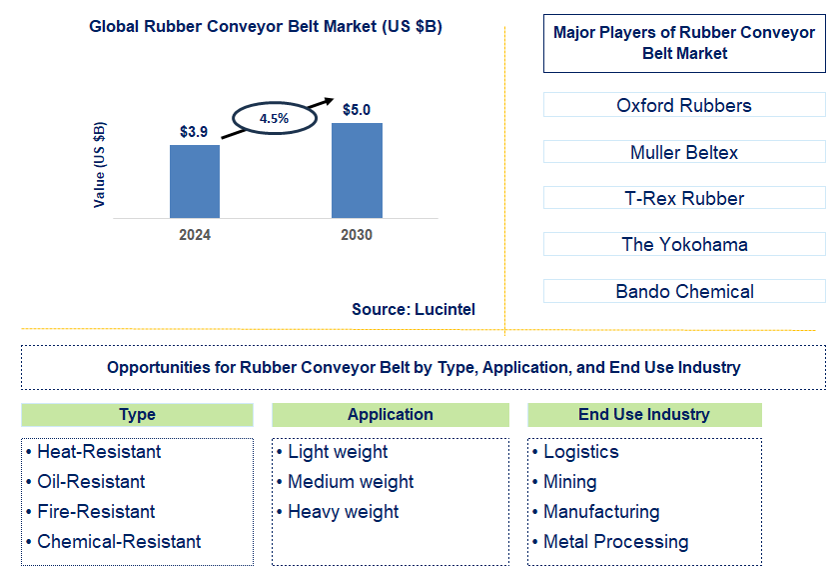
Key data points: The market size in 2030 = $5.04 billion, growth forecast = 4.5% annually for the next 6 years. Scroll below to get more insights. This market report covers trends, opportunities, and forecasts in the global rubber conveyor belt market to 2030 by type (heat-resistant, oil-resistant, fire-resistant, and chemical-resistant), application (light weight, medium weight, and heavy weight), end use industry (logistics, mining, manufacturing, and metal processing), and region (North America, Europe, Asia Pacific, and the Rest of the World)
We'll send your sample report shortly.
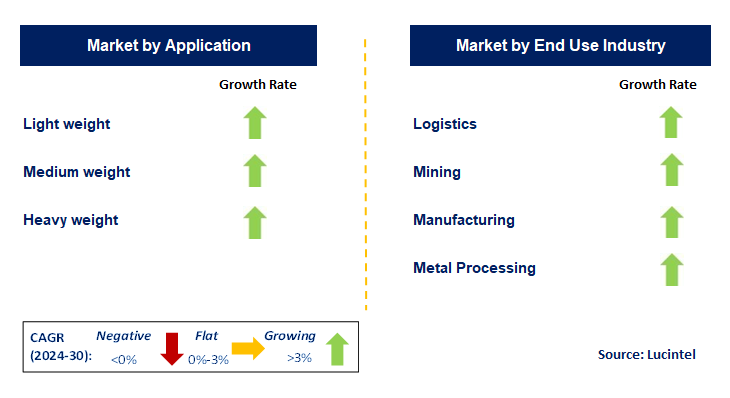
• Lucintel forecasts that, within the application category, medium weight is expected to witness the highest growth over the forecast period due to increasing adoption of rubber conveyor belts in small & medium enterprises and rising demand from small-scale manufacturing units across the globe.
• Within the end-use category, mining will remain the largest segment.
• In terms of regions, APAC is expected to witness the highest growth over the forecast period. Gain valuable insights for your business decisions with our comprehensive 150+ page report.
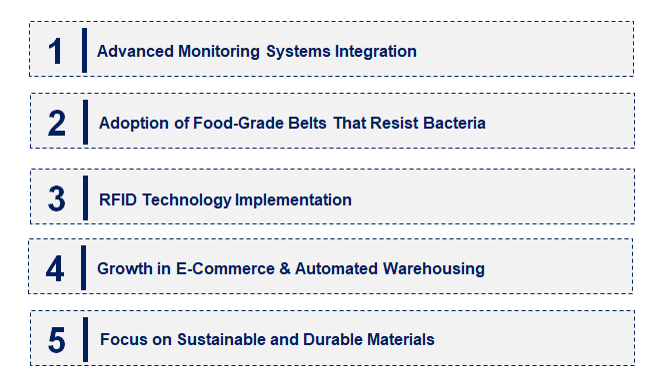
• Advanced Monitoring Systems Integration: Monitoring solutions for conveyor belt systems have become more common in recent years. For example, Continental is introducing technologies that combine visual and auditory assessments to identify weak spots in belts before they burst. By taking this approach, unplanned downtime is minimized while operational efficiency gains are made across sectors by reducing costs associated with maintenance.
• Adoption of Food-Grade Belts That Resist Bacteria: There is now a focus on manufacturing food-grade conveyor belts that resist bacteria as well as detect contaminants because of strict regulations surrounding food safety. These innovations are particularly important for industries such as food and beverage where sanitization is key. FDA standards compliance can be guaranteed through these specific belts while at the same time improving product safety and quality.
• RFID Technology Implementation: Incorporation of RFID technology into conveyor systems has revolutionized logistics and supply chain management. Real-time tracking from order to delivery enhances business operations allowing customers better experiences. Such an automated system allows controlling many processes simultaneously thus promoting efficient performance while eliminating mistakes in managing materials.
• Growth in E-Commerce & Automated Warehousing: The growth of e-commerce necessitates efficient warehousing with lines of conveyors being among must-haves during order fulfillment in warehouses and distribution centers. Automating product flow using rubber conveyors enhances work speed dramatically ameliorating precision levels. It is anticipated that reliance on sophisticated conveyor systems will rise along with the scale-up efforts of online retailers’ logistics thereby giving traction to the developing market.
• Focus on Sustainable and Durable Materials: Rubber conveyor belts made from sustainable materials that offer improved durability and superior performance are increasingly being developed. To withstand harsh conditions and have minimal environmental footprints, manufacturers have invested in the development of these belts. This trend not only meets the growing demand for environmentally friendly products among consumers but also enhances the longevity and reliability of conveyor systems. Technological improvements, changing regulatory requirements, and evolving consumer preferences are transforming the rubber conveyor belt market. These trends are creating a more efficient, safer industry with an emphasis on sustainability. Market demand for innovative solutions will drive its growth as industries look to remain competitive in their material handling & logistics strategies through adopting modern technology such as this advanced roller system.
• Technologically Advanced Materials: The development of ruggedized materials with high strength and abrasion resistance has enhanced the life span of rubber conveyor belts. They include polyester fabric and aramid cord which make for excellent tensile strength and flexibility so that they can endure heavy loads as well as harsh conditions during their use.
• Conveyor Belt Systems That Are Smart: Conveyor belts equipped with sensors that can be integrated into them have enabled real-time monitoring and predictive maintenance. Such smart systems can identify potential problems like misalignment or belt wear allowing for timely interventions thereby reducing downtime.
• Energy Efficient Conveyor Belts: There is a growing emphasis on sustainability leading to the development of energy-efficient conveyor belts that minimize power consumption. These kinds of belts reduce power losses during operation through low friction coatings as well as optimized designs thus saving costs while cutting down on environmental impact.
• Custom-made Conveyor Belt Solutions: With an increased number of diverse applications in industries, there has been a need for personalized conveyor belt solutions. Manufacturers now produce numerous types of belts with specific parameters including surface texture, weight, and thickness among others such as width according to different industry requirements.
• Three-Dimensional Printing Of Conveyor Belts: Customized conveyor belts can be produced using three-dimensional (3D) printing technology. This implies that complicated patterns with intricate structures could be created using this method hence improving performance or enhancing flexibility, especially in specialized applications. These ongoing changes in the rubber conveyor belt market are making a big difference in the entire industry. Manufacturers now have access to conveyor belt solutions that are more sustainable, resilient, and energy-efficient. This will help them improve their efficiency, reduce costs, and increase productivity. Further innovative developments are expected as technology progresses.
• Enhanced Durability and Performance in the Mining Industry: Due to the need for durable and high-performance belts that can withstand harsh working environments, the mining industry offers significant growth potential for the rubber conveyor belt business. The trend towards advanced materials and manufacturing processes has led to a situation where belts are available with greater wear, abrasion, and impact resistance resulting in reduced downtime due to longer life spans. As such, this opportunity if capitalized upon will drive efficient productivity in the mining sector and therefore lead to a sustained demand.
• Automation and Customization in the Manufacturing Sector: The transition of manufacturing from a manual state has necessitated the existence of customized rubber conveyor belts which easily blend with the complex machinery used currently. These belts help improve production lines by reducing manual labor hence raising overall efficiency levels. Customization improves the functionality of application-specific design while lowering maintenance costs over time. Automation is one of the major growth drivers in manufacturing concerning the development of conveyor belt markets thus boosting its prospects in the future.
• Compliance and Hygiene in Food & Beverage Industry: In the food & beverage industry, there is an increasing need for regulatory-compliant rubber conveyor belts that can be easily washed or sterilized according to strict hygiene standards. They are necessary to prevent contamination as well as ensure product safety all through their journey from raw material suppliers to consumers’ hands or mouths respectively. Consequently, antimicrobial food-grade materials are being used more often than ever before because they enhance cleanliness during processing or packaging processes. This opportunity aligns with consumer safety requirements alongside industrial regulations thus it’s quite important.
• Efficiency and Flexibility in Logistics and Warehousing: E-commerce’s rise has brought about increased demand for flexible rubber conveyor belts that are capable of handling large volumes of goods and services quickly. These belts are crucial in handling diverse products quickly and efficiently, supporting the high throughput required in modern logistics centers. For this reason, rubber conveyor belts have found a place within various sectors making them indispensable due to their ability to handle varied commodities at low downtimes thus promoting market expansion as well as efficient operations.
• Heavy-Duty Applications in the Construction Industry: Within the construction industry, there is a need for rubber conveyor belts that can withstand heavy loads and demanding conditions such as abrasive materials or extreme temperatures. By responding to these needs through the development of reinforced heavy-duty belts, there is now higher demand during construction activities. Construction has seen over 20% productivity hike when it comes to building materials handling with reduced downtime from using these belt types. This opportunity therefore means much in terms of equipment reliability demands by the industry. These five growth opportunities in mining, manufacturing, food & beverage, logistics, and construction industries collectively increase the size of the rubber conveyor belt market. Taken together, these opportunities reflect specific concerns like durability, personalization, hygiene standards compliance, adaptability to varying situations, and working under strenuous conditions which shape the adoption rate of such items thereby making them integral components across different industrial verticals.
• Oxford Rubbers
• Muller Beltex
• T-Rex Rubber
• The Yokohama
• Bando Chemical
• Bridgestone
• Oriental Rubber
• Fenner
• Mitsuboshi Belting
• Wuxi Boton Belt
• Heat-Resistant
• Oil-Resistant
• Fire-Resistant
• Chemical-Resistant
• Light weight
• Medium weight
• Heavy weight
• Logistics
• Mining
• Manufacturing
• Metal Processing
• North America
• Europe
• Asia Pacific
• The Rest of the World
• United States: Mining and manufacturing sectors in U.S.A are driving demand for a variety of rubber conveyor belts. Companies have been looking to improve belt durability using advanced materials and cut back on maintenance costs. Also there is an increasing focus on green energy saving belts that conform to strict environmental laws.
• China: The Chinese rubber conveyor belt market has experienced remarkable expansion due to the country’s booming industrial sector. Technological advancements are targeting enhanced resistance to severe conditions including wear and tear which are critical for heavy industries like mining or steel production. The market has also seen increased capacity of domestic producers cutting reliance on imports thereby boosting local manufacturing.
• Germany: Germany leads in terms of innovation with regard to high-quality durable belts used in automotive as well as manufacturing industries. Additionally it is among the pioneers introducing smart conveyor belts incorporating sensors capable of real-time monitoring and predictive maintenance resulting in improved efficiency of operations.
• India: With urbanization taking place at a fast rate in India construction projects have increased leading to the growth of infrastructure projects hence an increase in the market size. Consequently, the shift has been towards lightweight, high-strength belting solutions more suited for various applications ranging from mining to food processing. Local manufacturers are now embracing advanced technology so that they can produce strong quality items cheaply.
• Japan: Japanese companies concentrate on precision production systems that offer highest performances. The development process takes into consideration improvements in material science resulting into flexible, heat tolerant conveyor belts. Japanese corporations too explore cost-effective techniques with reduced environmental effect by minimizing their ecological footprints during production processes.


• Oxford Rubbers
• Muller Beltex
• T-Rex Rubber
• The Yokohama
• Bando Chemical
• Bridgestone
• Oriental Rubber
• Fenner
• Mitsuboshi Belting
• Wuxi Boton Belt Q6. Which rubber conveyor belt market segment will be the largest in future? Answer: Lucintel forecast that medium weight is expected to witness the highest growth over the forecast period due to increasing adoption of rubber conveyor belts in small & medium enterprises and rising demand from small scale manufacturing units across the globe. Q7. In rubber conveyor belt market, which region is expected to be the largest in next 5 years? Answer: APAC is expected to witness the highest growth over the forecast period. Q.8 Do we receive customization in this report? Answer: Yes, Lucintel provides 10% customization without any additional cost.


Choose a license that fits your team. Instant PDF delivery.
Prices exclude taxes. Instant delivery. Custom licensing available on request.
Market Report · July 31, 2026
Market Report · July 22, 2026
Market Report · July 20, 2026
Trusted partner for strategic intelligence and business growth


Receive a complimentary market analysis tailored to your industry. Our analysts will identify key growth opportunities and competitive dynamics specific to your business.

Market size, growth rate, and key trend analysis for your specific sector.

Top competitor positioning and market share analysis.

Strategic recommendations backed by data-driven insights.
Get curated market intelligence and competitive moves straight to your inbox.
By subscribing, you agree to receive our monthly insights. Unsubscribe anytime.
Receive a complimentary market analysis tailored to your industry. Our analysts will identify key growth opportunities and competitive dynamics specific to your business.
Market size, growth rate, and key trend analysis for your specific sector.
Top competitor positioning and market share analysis.
Strategic recommendations backed by data-driven insights.
Get curated market intelligence, emerging trends, and competitive moves straight to your inbox each month.
By subscribing, you agree to receive our monthly insights. Unsubscribe anytime.
We'll send your sample report shortly.