
Market Report · July 29, 2026

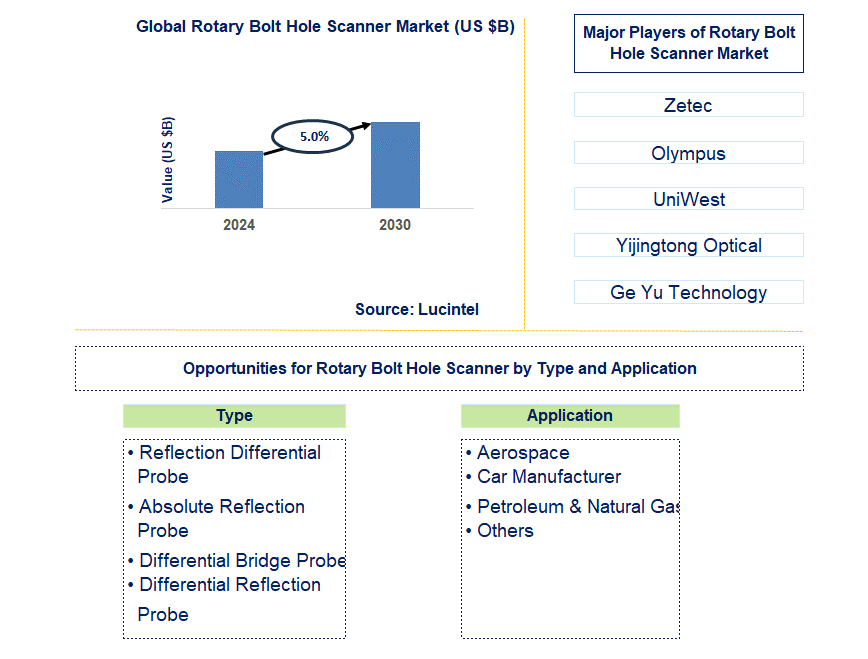
Key data points: The growth forecast = 5.0% annually for the next 6 years. Scroll below to get more insights. This market report covers trends, opportunities, and forecasts in the global rotary bolt hole scanner market to 2030 by type (reflection differential probe, absolute reflection probe, differential bridge probe, and differential reflection probe), application (aerospace, car manufacturer, petroleum & natural gas, and others), and region (North America, Europe, Asia Pacific, and the Rest of the World)
We'll send your sample report shortly.
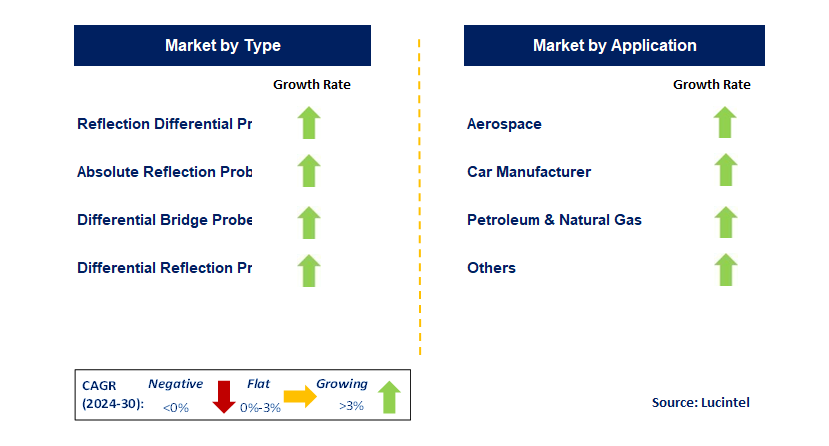
• Lucintel forecasts that,within the type category, reflection differential probe is expected to witness the highest growth over the forecast period due to its versatility and compact nature.
• Within the application category, aerospace will remain the largest segment due to growing demand for advanced inspection technology to ensure quality and reliability of product.
• In terms of regions, APAC is expected to witness the highest growth over the forecast period due to rapid industrial growth, growing number of infrastructure projects, and increasing demand for energy and power generation in the region. Gain valuable insights for your business decisions with our comprehensive 150+ page report.
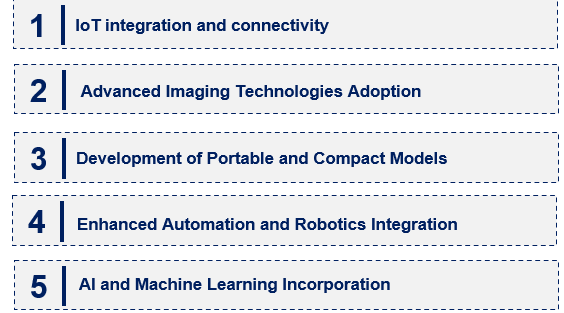
• IoT integration and connectivity: Rotary bolt hole scanning machines are increasingly incorporating IoT to enable real-time data communication and remote monitoring. Through seamless integration with quality control systems, this connectivity enhances data access and discernment. The efficiency of operations is increased through remote diagnosis and maintenance facilitated by IoT-enabled scanners that reduce downtime. This trend has resulted in the adoption of advanced inspection solutions, especially those that involve constant observation necessary for decision-making based on data.
• Advanced imaging technologies adoption: The use of sophisticated imaging technologies, including 3D scanning and high-resolution cameras, has enhanced accuracy and detail in inspections. These technologies facilitate more precise identification of defects or abnormalities in bolt holes, thereby enhancing overall quality management. This makes it possible to conduct comprehensive analyses using intricate imaging techniques, leading to better decision-making and making rotary bolt hole scanners more reliable and effective.
• Development of portable and compact models: The market is demanding portable and compact rotary bolt hole scanner models that can be deployed flexibly across different environments. Recently, there have been developments focused on lightweight, user-friendly models that can be used conveniently for onsite inspections in small areas. Portable models are usually preferred by industries requiring onsite inspections, thereby speeding up quality assurance processes.
• Enhanced automation and robotics integration: The industry's focus has turned toward automation and robotics integration, mainly concerned with increasing speed and consistency associated with rotary bolt hole scanners. Automated systems minimize human errors, improving throughput and reducing the need for manual labor intervention while simultaneously enhancing productivity levels through faster operations. This also allows for accurate repetitive scanning actions, thus applicable in high-volume production environments. This trend has enhanced the scale and efficiency of inspection processes across different industries.
• AI and machine learning incorporation: The rotary bolt hole scanner market is being transformed by AI and machine learning, with algorithms for data analysis and defect detection. Artificial intelligence-based systems can handle large datasets, uncover patterns, and forecast potential issues with greater accuracy. The diagnostic capacity of scanners is improved through this integration, leading to better decision-making and proactive maintenance. These elements are driving market innovation by enhancing the overall performance and reliability of inspection solutions. These new trends are redefining the rotary bolt hole scanner market due to technological advancements and increased applications. The integration of IoT, advanced imaging technologies, and AI has enabled improvements in scalability and efficiency in inspection solutions. Scanners are made more flexible through the development of portable models and higher levels of automation. All these developments, therefore, stretch the boundaries of inspection technology, boosting quality control procedures while widening industries’ scope for expansion in the process.
• Advanced sensor technology: The performance of rotary bolt hole scanners has significantly improved due to recent developments in sensor technology. With high-resolution sensors and improved imaging capabilities, more accurate defect detection and bolt hole dimension measurements can be performed. This makes it possible to implement better quality control measures, enhancing reliability in critical applications such as those found in aerospace and automotive industries. The use of advanced sensors is leading to the development and expansion of rotary bolt hole scanner capabilities.
• Integration of AI and machine learning: The integration of AI and machine learning technologies into rotary bolt hole scanners is transforming data analysis and defect detection. AI algorithms enhance the ability to analyze complex datasets, identify patterns, and predict potential issues. This integration leads to more accurate and efficient inspections, reducing the likelihood of missed defects and improving overall quality control. AI-powered scanners are setting new standards for performance and reliability in the market.
• Development of wireless and IoT-enabled scanners: The development of wireless and IoT-enabled rotary bolt hole scanners is revolutionizing data connectivity and accessibility. These scanners allow for real-time data transmission and remote monitoring, improving integration with broader quality control systems. Wireless connectivity facilitates easier data sharing and analysis, enhancing the efficiency of inspection processes. This development is driving the adoption of advanced scanning solutions in industries requiring constant monitoring and data-driven decision-making.
• Enhanced portability and user-friendliness: Recent advancements in design have led to the development of more portable and user-friendly rotary bolt hole scanners. These compact models are designed for ease of use in various environments, including field inspections and confined spaces. Improved ergonomics and lightweight construction make these scanners more accessible and practical for on-site applications. Enhanced portability is driving adoption in industries where flexibility and mobility are crucial.
• Automated and robotic systems: The integration of automated and robotic systems into rotary bolt hole scanners is enhancing inspection speed and consistency. Automated scanning solutions reduce the need for manual intervention, minimizing human error and increasing throughput. Robotic systems enable precise and repetitive scanning tasks, making them ideal for high-volume production environments. This development is improving the scalability and efficiency of inspection processes across various industries. Recent developments in technological advancements and applications within the rotary bolt hole scanner market have been significant. Improvements in sensor technology, integration of artificial intelligence, and wireless connectivity have resulted in enhanced performance and capabilities. Usability and efficiency of portable models, as well as automated systems, are also being developed. By doing so, these advancements increase the market's potential by setting new standards in inspection technology, reflecting its dynamic nature and fast growth.
• Aerospace industry: The aerospace industry offers substantial growth opportunities for rotary bolt hole scanners due to its stringent requirements for quality and safety. Advanced scanners can ensure the structural integrity of aircraft components by providing precise measurements and defect detection. The increasing focus on safety and reliability in aerospace applications drives demand for high-precision scanners that can handle complex inspections. Companies can tap into this market by developing specialized scanners that meet aerospace industry standards, offering enhanced performance and compliance.
• Automotive manufacturing: In automotive manufacturing, the need for precise quality control and efficient assembly processes presents a key growth opportunity for rotary bolt hole scanners. These scanners are crucial for inspecting bolt holes in various vehicle components, ensuring safety and functionality. As automotive manufacturers seek to improve production efficiency and adhere to strict quality standards, the demand for advanced, automated scanning solutions is growing. Developing scanners that integrate seamlessly with production lines and provide real-time data can address this market need and drive growth.
• Construction and infrastructure: Rotary bolt hole scanners have significant growth potential within the construction and infrastructure sectors, which require reliable inspection tools to ascertain structural component quality and safety. Scanners used in these sectors inspect bridge bolts and other critical structures such as buildings. Robust portable scanning solutions are increasingly demanded by constructors due to the emphasis on durability and safety in this area. Consequently, firms focusing on developing sector-specific scanning tools can gain a foothold in the expanding market.
• Oil and gas industry: Growth opportunities for rotary bolt hole scanners exist within the oil and gas industry, as equipment and infrastructure require regular maintenance and inspection. Scanners are used to inspect bolt holes in pipelines, drilling rigs, and other crucial components that ensure operational safety and efficiency. Reducing downtime and accidents is the objective of this industry, which accounts for its need for reliable and efficient checking methods. For example, it is possible to develop scanners with advanced features suitable for harsh environments.
• Manufacturing and heavy industry: By improving quality control systems and process optimization, rotary bolt hole scanners have potential for growth in manufacturing and heavy industries. These scanners help monitor bolt holes within machinery, equipment, or structural components, ensuring correct alignment and proper performance. The demand for advanced scanning technologies that minimize production errors while improving product reliability increases daily. By delivering scanning solutions offering high precision combined with automation integration, manufacturers will be able to cater to this wide market. In the rotary bolt hole scanner market, crucially important domains such as construction, heavy industry, oil and gas, aerospace, and automotive manufacturing are witnessing new strategic growth opportunities. This necessitates improved scanning techniques that can satisfy specific requirements in every industry segment concerning accuracy, speed, and dependability. If companies create tailor-made technologies that satisfy these particular demands, they can exploit the expanding market for their own benefit. As a result, the future of this market depends on these possibilities while encouraging technological advancement to spur its use in diverse applications across multiple sectors.
• Technological advancements: Recent technological developments have been a significant driving force behind the rotary bolt hole scanner market. Innovations such as high-resolution sensors, sophisticated imaging techniques, and integration with artificial intelligence (AI) technology enhance the precision and functional capability of scanners. With this technology, defects can be detected easily, leading to increased measurement accuracy and better data analysis, catering to rising demands in different industries. It also paves the way for efficient inspections, promoting market growth while expanding its applications.
• Increasing demand for quality control: The increasing emphasis on quality control in industries such as aerospace, automotive, and manufacturing underpins demand for rotary bolt hole scanners. These scanners ensure components are reliable through precise measurements, thereby detecting any defects present. Due to stricter quality standards imposed on companies by regulatory authorities aiming to maintain the integrity of their products, there is a need for advanced inspection solutions that can meet these new requirements. Thus, many firms are now seeking improvements within their quality control processes, spearheading growth across this sector.
• Expansion of industrial applications: Growth in the rotary bolt hole scanner market has been fueled by expansion into industrial applications beyond traditional aerospace and automotive markets, including construction and oil and gas companies' operations. In addition, the ability of rotary bolt hole scanners to examine various kinds of structures and components has led to an increased uptake in their usage. The result is a wide range of applications in the market, thus promoting new sectors and driving technological developments in scanner technology.
• Regulatory and safety standards: A major driver for the rotary bolt hole scanner market is the stringent regulatory environment and safety standards in sectors such as aerospace and automotive. These regulations necessitate advanced inspection techniques that guarantee the security and functionality of parts. With tightened rules, there is higher demand for high-precision scanners that meet these conditions, prompting firms to invest in these tools. Therefore, this factor forces firms to invest more in scanning technology to maintain compliance with industry regulations and avoid penalties.
• Focus on operational efficiency: Demand for rotary bolt hole scanners is rising due to an increasing focus on improving operational efficiency across different industries. This leads to faster inspections through the provision of real-time information, enhancing efficiency during production. As a result, companies can reduce downtime costs while simultaneously lowering their overall cost per unit produced within any given period, leading to enhanced product quality. Firms that invest in improved scanning will therefore enjoy higher productivity levels than their rivals, thus growing the entire industry through competition. Challenges in the rotary bolt hole scanner market include:
• Costly nature: The high costs associated with advanced rotary bolt hole scanners present a significant challenge. The initial costs of advanced machinery and ongoing expenses for maintenance and calibration can be exorbitant, especially for small businesses. Such expenses may eliminate an enterprise from the market or make it difficult to adopt this technology, limiting its growth potential. It is crucial for firms to develop affordable solutions and demonstrate that scanners offer sustained value so they can justify their spending and appeal to a larger customer base.
• Incorporation into existing systems: There can be difficulties when integrating existing manufacturing systems with rotary bolt hole scanners. Compatibility problems, data integration issues, and workflow changes pose challenges that can hinder the seamless adoption of new technologies. These integration challenges require careful planning by scanner companies in collaboration with industry users. Therefore, it is imperative that these concerns are addressed to ensure effective integration of new scanning solutions that provide maximum benefits.
• Emerging regulatory standards: The changing regulatory environment poses a threat to the market for rotary bolt hole scanning devices. As regulations continue to change, companies must constantly adjust their scanners to meet new requirements. This regulatory dimension remains uncertain, making it more difficult to maintain standards in enforcement. Adjusting strategies according to upcoming regulations and ensuring compliance will help manufacturers stay competitive. The rotary bolt hole scanner market is significantly influenced by technological advancements, increasing demand for quality control, expanded industrial applications, regulatory standards, and a focus on operational efficiency. Nonetheless, challenges such as high costs, compatibility issues, and shifting laws hinder this sector from growing at an accelerated pace. Therefore, balancing these forces is crucial for effective navigation through this marketplace. In summary, all these factors are interconnected, determining how technology evolves in response to developments within the market, as well as adoption levels and strategic investments made in rotary bolt hole scanning solutions. These aspects will dictate the market's direction and growth potential.
• Zetec
• Olympus
• UniWest
• Yijingtong Optical Technology
• Ge Yu Technology
• Reflection Differential Probe
• Absolute Reflection Probe
• Differential Bridge Probe
• Differential Reflection Probe
• Aerospace
• Car Manufacturer
• Petroleum & Natural Gas
• Others
• North America
• Europe
• Asia Pacific
• The Rest of the World
• United States: The United States has seen recent developments in rotary bolt hole scanners that incorporate advanced digital imaging and data analysis technologies. This innovation enhances the accuracy and speed needed for inspections, especially in industries such as aerospace and defense. Additionally, the trend toward the use of wireless and IoT-enabled scanners is improving data accessibility while allowing integration with broader quality control systems. There is also a drive toward producing portable models that are user-friendly to enable on-site inspections, thereby minimizing downtime.
• China: China’s market for rotary bolt hole scanners has been growing due to its focus on localized production capacity and competitive pricing. Enhancements in inspection efficiency and accuracy are achieved through automated scanning solutions. Chinese firms are also investing in research and development to create new scanning technologies that meet international standards. The emphasis on affordable solutions is driving adoption among various industries such as automotive and construction, leading to China’s increased presence in the global market.
• Germany: Germany is setting the standard for precision and reliability in the rotary bolt hole scanner market. Recent developments in Germany have focused on incorporating sophisticated sensor technology with automation. German manufacturers have developed high-resolution scanners equipped with advanced algorithms that enable them to detect defects more accurately for analysis. Furthermore, strict European quality standards necessitate robust and durable scanning solutions designed for harsh industrial environments.
• India: Growth in India is fueled by increasing industrial activity and an infrastructure development boom affecting the rotary bolt hole scanner sector. These advances entail affordable yet efficient scanners targeting emerging markets. Additionally, Indian firms are enhancing the mobility and simplicity of their scanning solutions to address diverse applications using single products or service offerings based on customer requirements. The expansion of the manufacturing sector, coupled with rising quality assurance demands, has increased the need for modern scanning technologies in India.
• Japan: Japan leads other countries in rotary bolt hole scanners, pursuing highly advanced robotics and automation systems. Notable developments include the use of high-speed precision scanners for intricate scanning in the automotive and aerospace sectors. Additionally, Japanese manufacturers are employing AI and machine learning to enhance data analysis and defect detection capabilities. The focus on high-tech solutions indicates Japan's intention to remain a world leader in innovative industrial technologies.


• Zetec
• Olympus
• UniWest
• Yijingtong Optical Technology
• Ge Yu Technology Q5. Which rotary bolt hole scanner market segment will be the largest in future? Answer: Lucintel forecasts that reflection differential probe is expected to witness the highest growth over the forecast period due to its versatility and compact nature. Q6. In rotary bolt hole scanner market, which region is expected to be the largest in next 5 years? Answer: APAC is expected to witness highest growth over the forecast period due to rapid industrial growth, growing number of infrastructure projects, and increasing demand for energy and power generation in the region. Q7. Do we receive customization in this report? Answer: Yes, Lucintel provides 10% customization without any additional cost.


Choose a license that fits your team. Instant PDF delivery.
Prices exclude taxes. Instant delivery. Custom licensing available on request.
Market Report · July 29, 2026
Market Report · July 20, 2026
Market Report · July 20, 2026
Trusted partner for strategic intelligence and business growth


Receive a complimentary market analysis tailored to your industry. Our analysts will identify key growth opportunities and competitive dynamics specific to your business.

Market size, growth rate, and key trend analysis for your specific sector.

Top competitor positioning and market share analysis.

Strategic recommendations backed by data-driven insights.
Get curated market intelligence and competitive moves straight to your inbox.
By subscribing, you agree to receive our monthly insights. Unsubscribe anytime.
Receive a complimentary market analysis tailored to your industry. Our analysts will identify key growth opportunities and competitive dynamics specific to your business.
Market size, growth rate, and key trend analysis for your specific sector.
Top competitor positioning and market share analysis.
Strategic recommendations backed by data-driven insights.
Get curated market intelligence, emerging trends, and competitive moves straight to your inbox each month.
By subscribing, you agree to receive our monthly insights. Unsubscribe anytime.
We'll send your sample report shortly.